
Medium Writing Tips
How Do You Write A Good Medium Article?
Lessons learned from studying Medium top writers

There is an art to writing on Medium. Previously successful writers can flounder, while relatively new and inexperienced writers can flourish. This leads many people to give up on their hopes of making it as a writer in the digital age.
However, with a little bit of patience and practice, virtually anyone can achieve some level of success on Medium. The following writing tips are based on my study of top authors on Medium over the past year.
While each writer possesses unique skills, there are several common traits that almost all top writers share (which I rarely see utilized by writers who are struggling on the platform). When implemented consistently, these traits lead to stellar Medium articles.
Note: If you are looking for articles covering specific Medium formatting techniques, writer tools, FAQs, or earnings data, check out Blogging Guide.
1. B R E V I T Y
Savvy writers realize that many readers zealously guard their time and prefer short but informative content. If you have a lot to say on a topic, focus on distilling the key takeaways from your draft and consider splitting these topics up into separate articles. Articles can be long, but increasing the length of an article typically increases the reader’s scrutiny of your content.
▹Remember to keep in mind the context in which your article is being read — half of your readers are viewing your article on a mobile device with a small screen and many are skimming content.
▹Medium’s own data has suggested that articles under 7 minutes are ideal.
▹Medium readers tend to expect shorter paragraphs and more white space than other publications.
2. P E R S O N A L I Z A T I O N
Readers want content that is personalized. If you are explaining something complex, expect to use diagrams or insert custom charts. If you are writing about coding, consider using inline or block coding. If you are writing for your own publication, make sure you use consistent images, logos and branding across all articles.
▹Personalization of content to better meet the needs of your readers is subtle, but an effective way to show your readers that you care.
▹If you write about more than one topic, publish your articles in distinct publications. If there are not publications that consistently take your articles of a specific theme —create you own Medium publications.
3. F O R M A T
Familiarize yourself with all of the formatting options Medium allows. It is also important to examine the rules relating to content formatting, which can affect eligibility for curation by Medium.
▹There is no single formatting style that will guarantee you claps. But there are details like using article headers/subheaders, bullet points, or numbered lists that readers are accustomed to on Medium.
▹Medium is generally pretty restrictive and only allows users to customize their articles to a small extent. That is why it is worth spending the extra time to make your content stand out, resonate, and ultimately persuade the reader to choose your content, the next time they are reading on Medium.
▹Small, yet unique features can go a long way. That is why the smallest formatting details are worth your time. Symbols and special characters, consistently scheduled article publication times, and even properly capitalized article titles are all examples of small formatting changes that many authors overlook.
4. V O I C E
Developing your voice as a writer is essential. Medium’s top writers spend time developing their unique writing voices, sharing their personal experiences, and connecting with readers. This authenticity is the secret behind many top articles.
▹You don’t need to share your innermost fears or past traumatic experiences to produce compelling writing. But you should aim for readers to come away from your writing with a sense they know you or your life better.
▹Include a personal bio in both your profile description and at the end of articles. This can be as simple as one or two lines about you. But for readers, it is nice to know what perspective you are writing from.
▹When I look at the writing of some of the best authors on Medium, I can almost always match their name to their content. For example, look at the three articles below:
Article 1 Excerpt:
The story of Zoom founder Eric S. Yuan is an entrepreneurial fable that proves even the most crowded markets are never truly full.
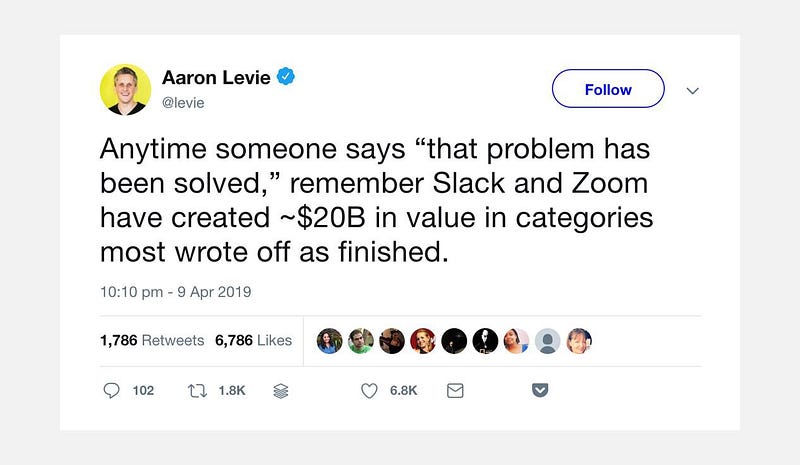
Before launching his online conferencing and collaboration product, Zoom’s Yuan ran engineering for Cisco’s WebEx. He expanded the WebEx team from 10 engineers to 800 and grew revenues from $0 to over $800 million annually.
Yuan was the heart of WebEx from 1997 to 2011, but he wasn’t happy. The product wasn’t good enough. Yuan (and many customers) thought it was slow, multimedia streams were often shaky, and it lacked modern features for mobile.
For years, Yuan campaigned Cisco execs to let him rework WebEx and build video conferencing on the cloud, but the existing product was still earning serious cash.
His bosses saw no reason to risk a reboot. So, Yuan left in 2011 to build Zoom.
“Cisco made a mistake,” he recently told Forbes magazine. “Three years after I left, they realized what I said was right.”
Was he ever.
Zoom’s annual revenues currently hover around $331 million.
The product has over 50,000 corporate customers, including Uber, Walmart, Slack, Ticketmaster, and Nasdaq, plus countless individuals and small businesses.
Article 2 Excerpt:
Douglas Adams (1952–2001) died at the early age of 49, but his work lives on for so many generations to come.
The Hitchhiker’s Guide to Galaxy is an iconic book, one that spawned a series that continues to be adored the world over.
Adams had such an incredible talent for writing, and thankfully he was able to share with us some of his many wise insights about the craft. Here are five of them!
1. I love deadlines. I like the whooshing sound they make as they fly by.
This is Douglas Adams’ most famous quote about writing, and it’s easy to see why. As writers we are often forced into deadlines. If we have signed with a publisher on a manuscript, there’s a deadline for when the manuscript is due, along with a follow up deadline if you’ve signed a two-book deal. I also believe in making up deadlines as a writer to keep you on track.
But sometimes you simply do have to let the deadline whoosh on by. Especially if you’re in the zone. Especially if the writing is coming along well, and you don’t want to yet break the spell.
And if you’re in a bind? Missing a deadline won’t be the end of your career either. Just make sure you tell someone!
2. I remember very little about writing the first series of ‘Hitchhiker’s.’ It’s almost as if someone else wrote it.
One thing that amazes me about pretty much all kinds of art and creativity is that the current project you’re working on becomes for awhile your entire world, your life, hundreds of thoughts throughout the day. You’re immersed in it.
But when you finish, you move onto the next project, and the previous one stays exactly there: in the past. You remember working on it fondly, of course. I have great memories of working on all of my novels.
But after a certain point, definitely years later, your projects often do begin to feel like someone else wrote them. You can barely remember the premise of the thing, let alone all the characters and the scenes. Enough time goes by, and you forget so much about the story.
This is a good thing. You shouldn’t necessarily remember every detail. You should have moved on to the next project.
Article 3 Excerpt:
“The first principle is that you must not fool yourself — and you are the easiest person to fool.” — Richard Feynman
You know what I love about books and blog posts?
They give me a rare opportunity.
What’s the opportunity, you ask?
The opportunity to be honest with yourself.
See, it’s hard, to be honest with yourself in most other situations. Hell, it’s hard, to be honest with yourself even when you’re alone. But social situations — where we have a face to save — make it difficult to impossible.
You’ve experienced this when a friend or family member calls you out on something you know is true. You get the most defensive in those situations because the truer something is the more it hurts.
When you’re alone you have a fighting chance at real self-reflection. The author doesn’t know you personally, so it feels less like an attack. Because it isn’t.
I’ll never tell you that you must do something. I’m here to provide insights, get you to have an internal dialogue, and let you take the reigns from there.
It’s a new year. You can be a new you.
But you have to stop bullshitting yourself. And, paraphrasing Feynman, you’re the easiest one to bullshit.
The authors of the 3 excerpts above are Ayodeji Awosika, Aytekin Tank, and Brian Rowe. If you’ve read anything from these three authors, I’ll bet you can guess which excerpt belongs to each author (answers at the bottom ¹).
5. O B J E C T I V E S
Take the time to understand why you are writing on Medium and focus on achieving clear objectives. Some writers come to Medium looking to make some extra money while exploring a creative endeavor. Others are looking to build a transferable fan base. There are even many writers who just share their work with no expectation of success. All of these reasons are fine! But it is important to remind yourself of what your goals are and to stick to the plan you set, and not be derailed by what other people are doing.
▹For example, I primarily write for fun, but I also enjoy creating free informational guides, helping people better access the internet and digital content, and conducting background checks. Writing any Medium related instructional material pretty much assures that my articles won’t get curated, but that’s fine because my goal is just to create free content in my spare time. If I were doing this for a living or relying on Medium for any portion of my income, I would probably reconsider this strategy!
▹Many writers become obsessed with stats relating to reads, views, fans, curation rate, or monthly earnings. However, it’s important to remember that while someone else may be obsessing over fans, if your goal is exposure to the broader audience of the internet or generating leads to your consulting business, fans may not be worth worrying over.
A N S W E R S
Excerpt ➊ ⇢ Aytekin Tank
Excerpt ➋ ⇢ Brian Rowe
Excerpt ➌ ⇢ Ayodeji Awosika

Thanks for reading this article! Leave a comment below if you have any questions. Be sure to sign up for the Blogging Guide newsletter, to get the latest tips, tricks, and news about writing on Medium and to join our Facebook group, Medium Writing, to share your latest Medium posts and connect with other writers.
If you liked this article, here are some other articles you may enjoy:

Casey Botticello is a partner at Black Edge Consulting. Black Edge Consulting is a strategic communications firm, specializing in online reputation management, digital marketing, and crisis management. Prior to founding Black Edge Consulting, he worked for BGR Group, a bipartisan lobbying and strategic communications firm.
Casey is the founder of the Cryptocurrency Alliance, an independent expenditure-only committee (Super PAC) dedicated to cryptocurrency and blockchain advocacy. He is also the editor of several Medium publications, including Medium Blogging Guide, Investigation, Strategic Communications, K Street, and Escaping the 9 to 5. He is a graduate of The University of Pennsylvania, where he received his B.A. in Urban Studies.