
How Civil Wars Start And Can They Be Stopped?
We are living in dangerous times.
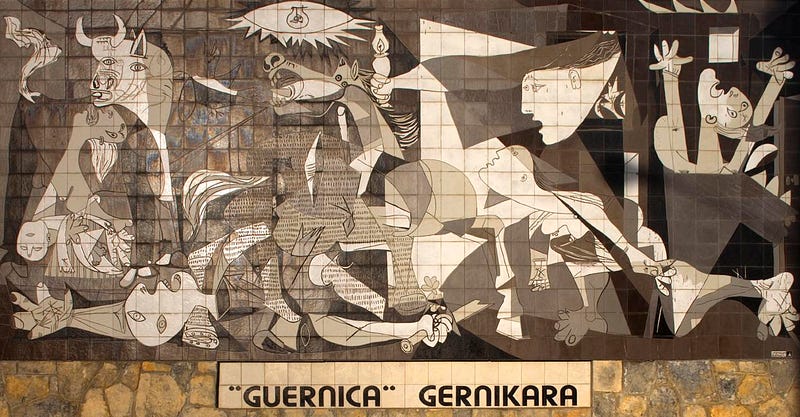
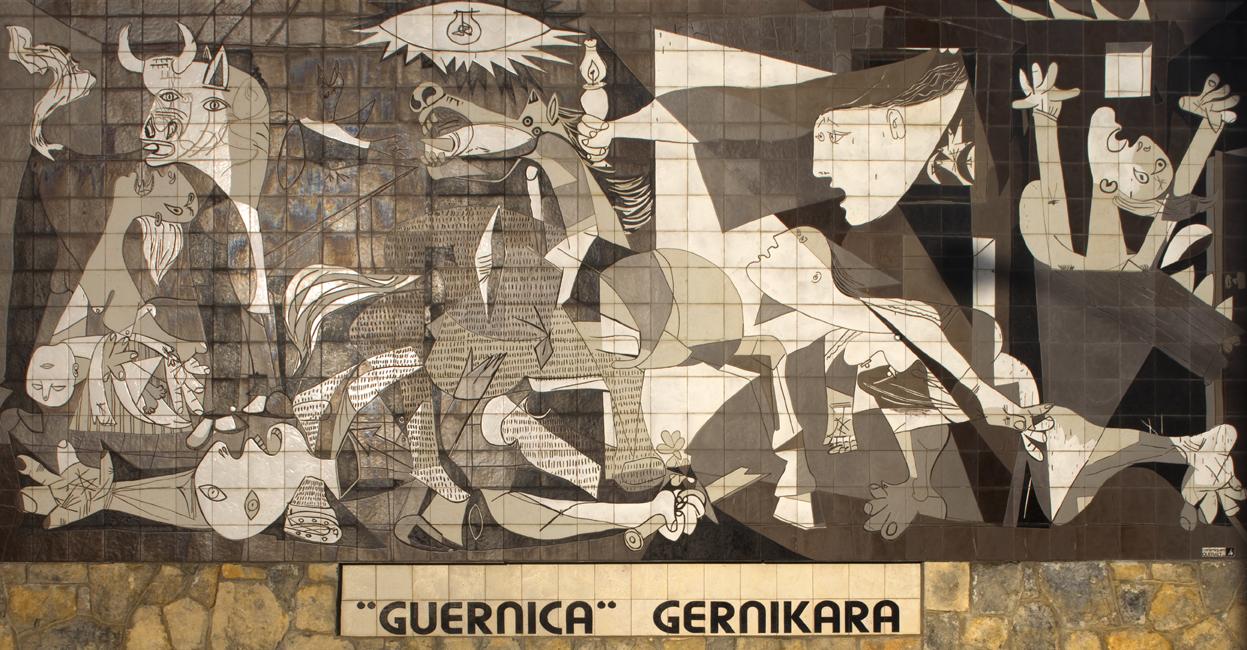
Pablo Picasso’s Guernica is one of the most powerful paintings of the 20th century. Looking at it, the tragic symbolism of war unfolds before you. As its bizarre shapes and forms play with the inner recesses of your mind, an eerie chill runs up your spine.
Picasso was inspired to create the picture in 1937 after he heard of the Nazi German bombing of Guernica, a town in the Basque Country of northern Spain. This aerial attack was carried out on behalf of the Spanish Nationalist forces fighting in that country’s civil war.
To depict the tragedy, the painter included a number of striking elements. A woman carrying a dead child. A woman putting her arms in the air. A chicken. A dead soldier, his body shattered to pieces. What jumps at you from this collage of images is pain and suffering, of humans and of animals.
Two large animals dominate the painting. A horse and a bull. There have been different interpretations of what these symbolize. Picasso himself never revealed his vision of these images. Instead, he stated that everyone looking at the picture should find their own meaning.
Painted in a cubist style, mixed in with notions of surrealism, Picasso’s artwork has been described as a masterpiece. Its juxtaposition of different elements evokes the chaos and cruelty of violence and war. The colors help strengthen the somber mood. Black. White. Grey. Those were the only colors the Spanish painter used for the painting.
How civil war creeps up on you
The 1930’s were a horrible decade for Spain. The country became embroiled in a devastating civil war. In 1936, a left-wing Republican-led government was elected to power in Madrid. Immediately, the right-wing Nationalists led by a group of generals started to plan a coup.
This state of affairs didn’t arise overnight. Rather, it was the culmination of a growing polarization between the two sides. Political violence, strikes, and armed riots brought about a state of chaos. With both sides growing more radicalized, the country was at the brink.
On the 17th of July, 1936 the generals set their coup into motion. First taking over Spanish Morocco, the Nationalists then tried conquering Spain proper. Fierce fighting ensued, launching one of the bloodiest civil wars of the 20th century. It would be marked by atrocities from both sides, with especially the Francisco Franco led Nationalists committing unspeakable horrors.
State failure happens among backsliding democracies
In 1994, then US Vice President Al Gore (D-Tennessee) tasked the Central Intelligence Agency (CIA) with studying the forces that lead to state instability.
The spy agency put together a group of scholars, and set up the State Failure Task Force. After examining hundreds of cases from around the world, the task force zeroed in on a number of factors that led to state failure.
One of the primary ones was the level of democracy. They divided countries into three groups: full democracies, partial democracies, and autocracies. Full democracies were stable, and had very low probabilities of succumbing to state failure. It was the partial democracies where the risk of chaos, political violence, and civil wars was the highest.
At the time, it was taken for granted that the US was a full democracy. The study was meant to look at the risks in other parts of the world. After all, the thinking was that this could never happen in a country that prided itself on two hundred years of democratic institutions.
Then boom! In 2016, The Economist’s Intelligence Unit rated the US a flawed democracy, one step below full democracy. While this coincided with the election of Donald Trump, it happened despite the orange-head’s rise to power. The US had been going downhill for years.
Other think tanks followed suit. In 2021, the International Institute for Democracy put the US in the category of backsliding democracies. Their argument was that the declines in civil liberties and checks on government were so severe as to warrant this status. They also noted the increasing polarization as concerning.
By then, it was very evident that things have gotten bad. Really bad.
Bring in the quants
In her book How Civil Wars Start And How To Stop Them, the author Barbara F. Walter mentions that experts on conflict studies call these types of backsliding regimes “anocracies.” Not full democracies, but also not full blown autocracies. Rather, something in between.
Researchers have gathered a lot of data on political regimes around the world. They quantify it, and then create different measurements. One of these is called the Polity Score. It’s the grade a country gets on a scale from -10 to 10, according to the quality of its democracy.
Countries with scores from 6 to 10 are full democracies. Countries with scores from -6 to -10 are classified as autocracies. The states with scores in between, — 5 to +5, are the anocracies. Among the anocracies, you find places like Turkey, Thailand, and Russia. Since 2020, the US has joined the list with a score of 5.
What leads to civil wars?
Being on the list of backsliding democracies or anocracies doesn’t mean that a country will descend into civil war. It does make it more likely though.
Many of these places end up experiencing increased polarization based on different cleavages and fault-lines. On their way down, anocracies often become ochlocracies. That’s another fancy Greek word, this time for mob-rule.
A very telling sign of this way down is the weakening of the institutions of power. As these are sidelined, alternative power centers arise. These are often centered around narcissistic, power-hungry individuals, and mobs of people supporting them. A defining characteristic is the loss of trust in the old system, leading to an outright denunciation of it by these mobs.
Political norms are chipped away little by little, until they are meaningless. That’s when the traditional institutions become toothless, replaced by populist leaders and mob-rule. It’s now either their way or the highway. In such a polarized environment, it doesn’t take much for clashes between opposing groups to erupt.
In their book How Democracies Die, Steven Levitsky and Daniel Ziblatt note how dangerous the breakdown of mutual toleration really is. When you view the opposing side as illegitimate, coupled with a distrust in the traditional institutions of government, you are on dangerous grounds.
No one expects a civil war to happen. Until it does. Many of the descriptions given by survivors from countries torn apart by violent strife have one thing in common. The memory of how normal life was at the beginning. Things were calm. People laughed. Went to work. Played with their kids, and hung around with their neighbors. Until one day, the guns started to go off, and those very same neighbors began killing them.
There is a darkness in the human soul. Numerous psychological studies have uncovered the mechanism that can drive an otherwise ordinary person to commit atrocities. Cognitive biases, such as the herd mentality, can unchain individuals, lowering their previous inhibitions. Then the inner beast takes over.
All these tendencies are quickly accelerated in an environment of “us” versus “them.” Primitive tribalism is not just a relic of humanity’s ancient past, it is deeply ingrained in all of us. This mechanism is at the root of civil war.
In her book, Walter states that the main cause of civil war is factionalization. This is when extremist groups are created due to three factors: ethnic, religious, and/or geographical distinction. These divisions are then preyed upon by predatory leaders who stoke up hatred.
While this is true, there are also other factors which she doesn’t mention. Walter in fact downplays ideology and purely political factors based on polarization. However, in my opinion this is wrong.
In the 20th century, some of the worst civil wars were fought based on ideology. The first one that springs to mind is the Russian Revolution. Different factions, the Whites and the Reds, were fighting each other out for the control of the empire. Class played a huge role there too, but the primary factor delimiting the two sides was their visions of society.
Another bloody internal conflict was the Spanish Civil War. The left-wing Republicans and their allies fought against the right-wing Nationalists and their conservative collaborators. This clash might have been the first one in history where the civilian casualties outnumbered the military ones.
Of course, this doesn’t negate identity as being one of the biggest factors for conflict. In the US, the racialization of the discourse is pushing divisions based on color. This identitarian turn in US politics is quite worrying.
However, identity is complex. It doesn’t run only skin deep. This wider context is often left out of the discussion. In fact, political stance can become a part of identity. It fuses with other parts of the person’s background to create an identity for that individual. People can even fuse their identity with that of political leaders, which is something that happened with many Trumpists.
Studies show that the US has entered a state of affective polarization. This is where people supporting one political party hate the people supporting the opposing one. A deep sense of dehumanization is entering into the equation. No longer is the other party just the opposition. They are the enemy.
The incipient conflict phase
The CIA identifies three stages of an insurgency: pre-insurgency, incipient conflict, and open insurgency. According to Barbara F. Walter, the US has already undergone the first two. Only one step left. The worst one. Open insurgency is civil war.
The last two years have been quite telling in this regard. The most prominent scar was the storming of the US Capitol on the 6th of January, 2021. A large crowd of Trump-supporters and conspiracy theorists pushed their way into one of the most sacred buildings for American democracy. Their wanton rampaging caused widespread damage, and deaths.
This was preceded by a similar event in the previous year, where groups of gun-toting militia members entered the Capitol building of the state of Michigan. However, violence and chaos-sowing don’t come just from the far right.
Looting and violent protests associated with the Black Lives Matter (BLM) movement have engulfed many cities around the country. In places like Seattle and Portland, the protesters even created “occupied free zones,” in defiance of the local authorities.
The narratives are sharpening. You can see it clearly across the different corners of the internet. Partisans of both sides predict a looming conflict coming. Yet the stories told to explain it are wildly different.
In this type of an atmosphere, it is important to watch out for partisan interpretations. It’s “them” who are the danger. Each side has its narrative, and is sticking to it. In fact, the accusations are growing more extreme.
As presidential historian Jon Meacham remarked, the situation in the US is similar to what it was in the 1850s.
“I hate to say it because of the way the decade turned out, but I think we’re in the 1850s in America.” — Jon Meacham
The next few years will be crucial. The 2024 presidential election is on the horizon. The stakes are high. The result, and how the losing side reacts to it, will likely determine where things are headed. There is a big danger of violence. In the worst case scenario, this could be the spark of a wider conflict. Maybe even civil war.
How to prevent civil wars
When looking at Picasso’s Guernica, French writer Michel Leiris wrote a poignant reflection:
“In a black-and-white rectangle that looks like an ancient tragedy, Picasso sends us our death notice. All that we love will die.” — Michel Leiris
This is what we need to keep in mind. No matter your vision for society. No matter how passionately you feel about it. It will not come about through war. While razing the system might seem attractive, it will not accomplish anything. Only death and destruction.
Most people don’t realize how small things can add up. The Roman Republic didn’t crumble from day to day. It took over a hundred years from when the first cracks started appearing until freedom was lost. That’s when the Empire of one-man rule began.
For the ancient Greeks, the solution to growing polarization was moderation. One way was to try packing each side with moderates, in order for cooler heads to prevail. Another one was trying to moderate the two sides from the sidelines. History teaches us that it is often common projects that can bring people together.
On the eve of the American Civil War, on the 4th of March 1861, President Abraham Lincoln (R-Illinois) gave his first inaugural address. He closed with these words:
“We are not enemies, but friends. We must not be enemies. Though passion may have strained it must not break our bonds of affection. The mystic chords of memory, stretching from every battlefield and patriot grave to every living heart and hearthstone all over this broad land, will yet swell the chorus of the Union, when again touched, as surely they will be, by the better angels of our nature.” — Abraham Lincoln
Each side has its grievances. The key is to see beyond that. Hate doesn’t lead anywhere. Neither does envy. As ancient philosopher Hierocles the Stoic used to say, “don’t keep your circle of concern just around you and your group. Instead, enlarge it to cover the whole world.”