
Machine Learning Art
How can I make a lion a virtual friend?
AI brings animals into VR for companionship
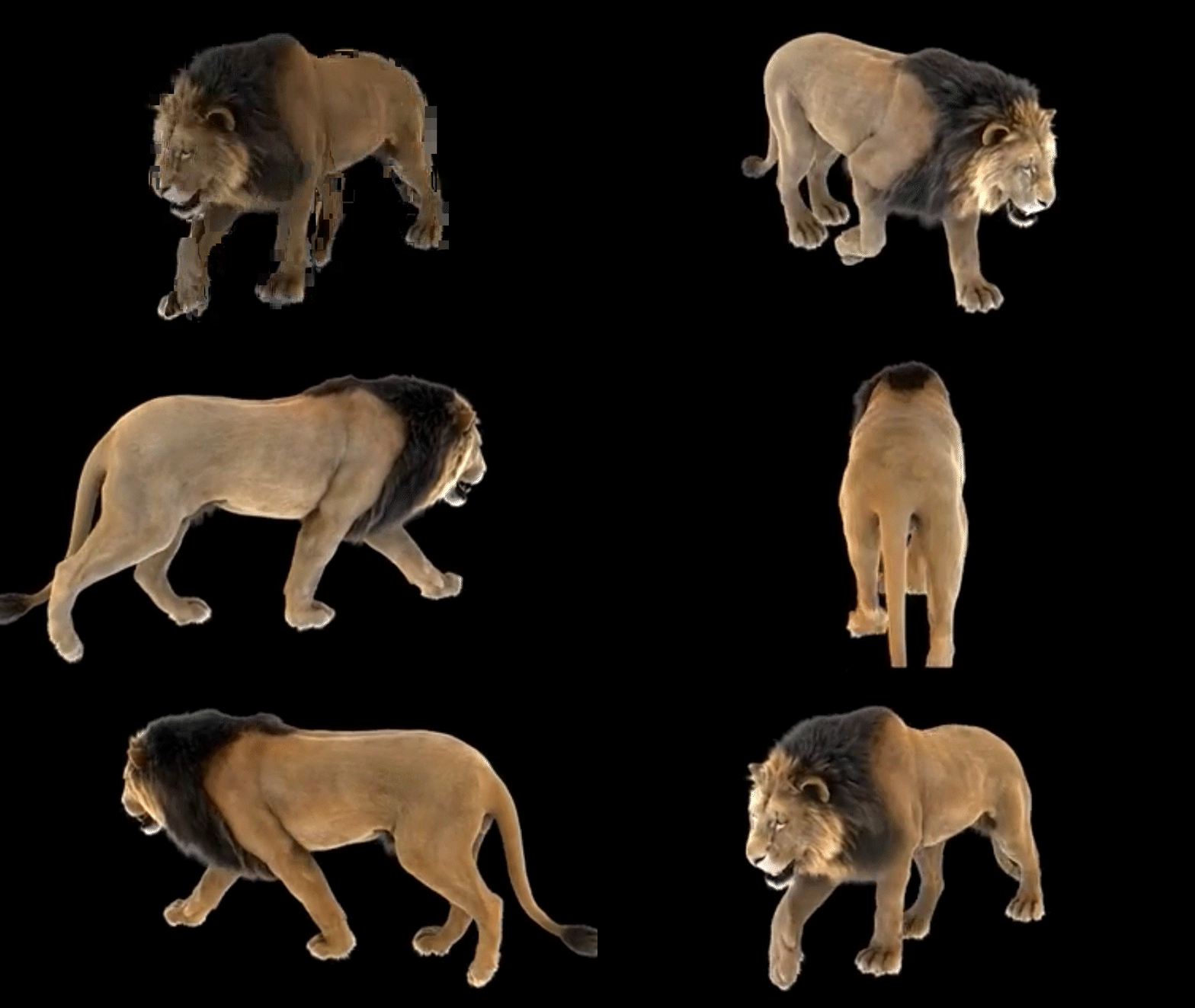
Some claim that we are going into a virtual era, including lions as pets. What would the world be like if we had virtual reality friends?
VR animal friends in our metaverse
The following article is a discussion of this very topic + DEMO code
- May 2022 — AI art tools update can be found ➡️ HERE ⬅️
Neural pets are demonstrated in a virtual reality setting. The process of creating photo-realistic and interactive virtual pets. Off-line rendering limits computer-generated (CGI) fuzzy creatures, let alone interactive motion control. The authors describe a new way for developing ARTiculated neural pets with appEarance and motion synthesIS and revolutionary neural modeling and rendering workflow. Interactive motion control, real-time animation, and photo-realistic representation of hairy creatures are all possible with this technology.
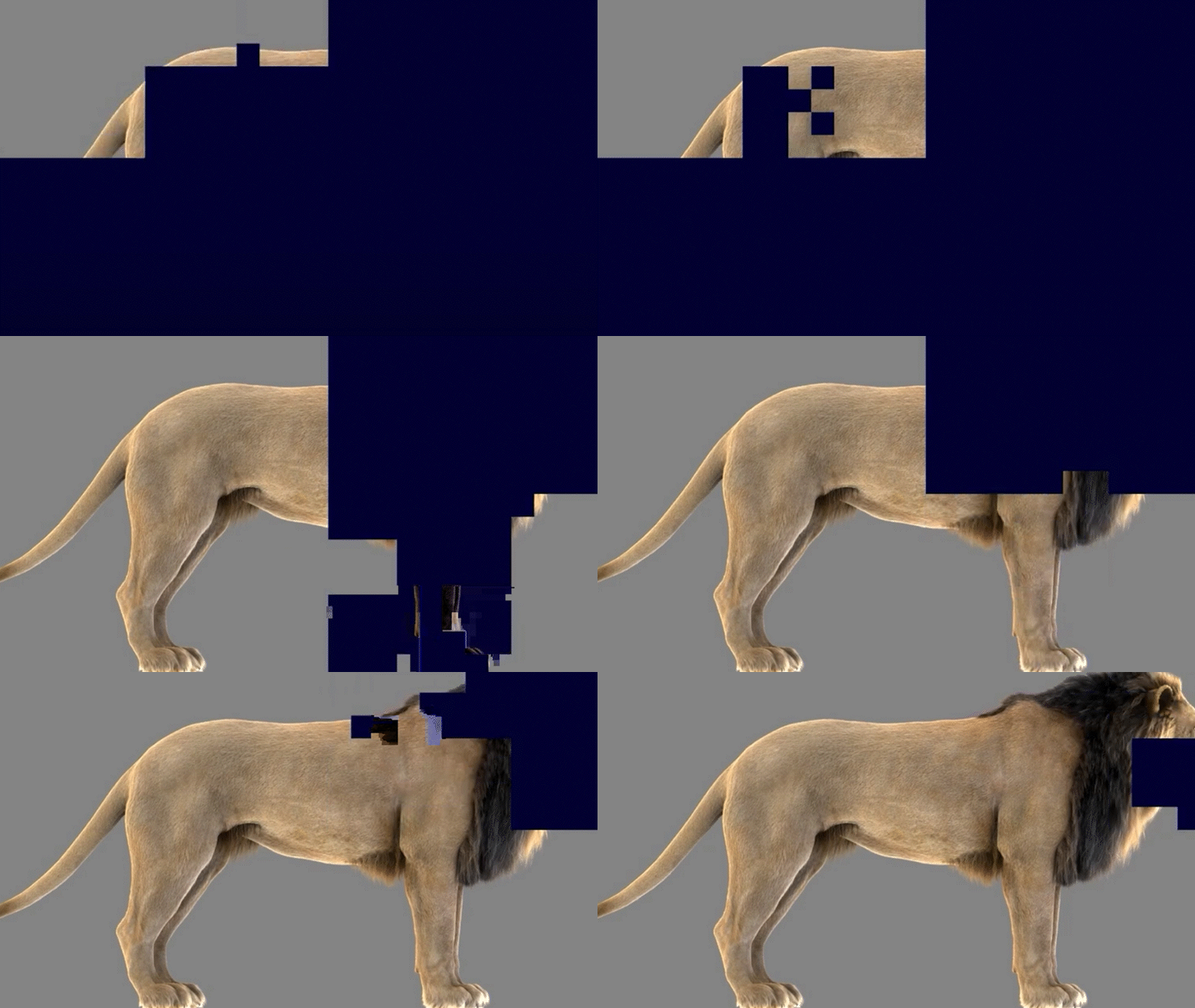
The new model and dynamic fuzzy animal dataset are accessible at project page (scroll down)
ARTEMIS is built around a neural-generated (NGI) animal engine that uses an efficient octree-based representation to depict animal animation and fur. The motion now resembles voxel-level distortion caused by explicit skeletal warping.
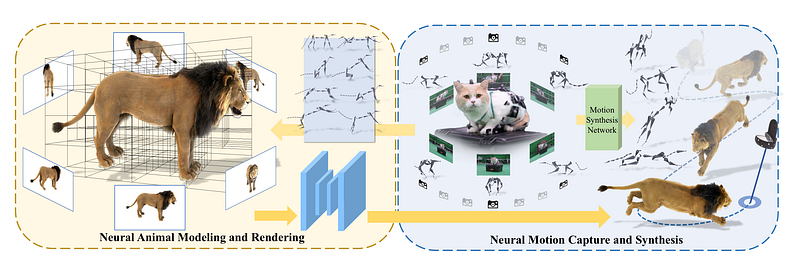
The authors employ a quick octree indexing and efficient volumetric rendering technique to build appearance and density characteristics maps. Finally, they present a new shading network that uses appearance and density feature maps to provide high-fidelity details of appearance and opacity under unique postures. The authors combined a state-of-the-art animal motion capture technology with a recent neural character control scheme in the ARTEMIS motion control module. An efficient optimization approach reconstructs the skeletal motion of actual animals filmed by a multi-view RGB and Vicon camera array.
motion styles
The authors input all of the collected motion into a neural character control method to produce abstract control signals with motion styles. ARTEMIS is incorporated into current engines that support VR headsets, allowing users to engage with a range of virtual animals with expressive motions and photo-realistic looks in an unmatched immersive experience. Extensive tests and displays illustrate how the ARTEMIS system can achieve a very realistic depiction of NGI animals in real-time, allowing for daily immersive and interactive encounters with digital creatures that have never been seen before.
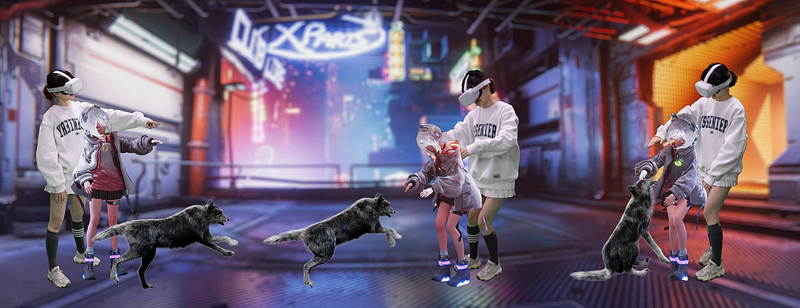
virtual animals
The ability to engage with our NGI animals with more realistic motions is provided by the strong motion capture technique for actual animals and the latest neural character control scheme. Furthermore, the hybrid rendering engine allows ARTEMIS to be integrated into existing consumer-level VR headset platforms, allowing users to interact with virtual animals in a surreal and realistic manner as if they were in the real world.
Animals in virtual reality is a new trend. For example, a person can create a virtual lion friend by using a new method that brings animals into VR.
How can VR pets benefit us?
VR friends into our META lives is a new and exciting trend. VR can help us feel our imagination or make us naturally feel real emotions. Virtual pets can help children/young people, and adults to understand the illusion of reality, which gives them crucial psychological support. VR pets can bring more happiness to our META lives and make them more exciting.
It will be a big step for those interested in VR animals.
@article{luo2022artemis, title={Artemis: Articulated Neural Pets with Appearance and Motion synthesis}, author={Luo, Haimin and Xu, Teng and Jiang, Yuheng and Zhou, Chenglin and Qiu, QIwei and Zhang, Yingliang and Yang, Wei and Xu, Lan and Yu, Jingyi}, journal={arXiv preprint arXiv:2202.05628}, year={2022} }v
Project Page:
https://arxiv.org/pdf/2202.05628.pdf
Code is coming soon:
https://github.com/HaiminLuo/Artemis
Keywords: computer vision, Artificial Intelligence, Machine Learning, AI art, art, digital art, pose estimation, 3d animals, Motion Synthesis, Motion capture; Volumetric models, neural volumetric animal, novel view syntheis, neural rendering, neural representation, dynamic scene modeling, motion synthesis
I invite you to explore the concept of “AI creativity” by reading and learning from the many articles found on 🔵 MLearning.ai 🟠
- Check out my instagram with new material every week
- If you enjoyed this, follow me on Medium for more
- Want to collaborate? Let’s connect on LinkedIn
- https://linktr.ee/evartology
Data Scientists must think like an artist when finding a solution when creating a piece of code. Artists enjoy working on interesting problems, even if there is no obvious answer.
All our writers (members) receive the opportunity to be promoted on our social media, which increases the popularity of articles published on MLearning.ai


