you to act as you would in a crisis. I want you to act as if the house is on fire, because it is.”</p></blockquote><p id="f81a">For many environmental advocates, the word hope has become an ‘<a href="https://read.dukeupress.edu/environmental-humanities/article/5/1/295/8203/Hope">empty political slogan</a>’; an overused cliché that values positive thinking over concrete action.</p><p id="6a61">Thunberg puts it succinctly: <i>“We’ve had 30 years of pep-talking and selling positive ideas and I’m sorry but it doesn’t work. Because if it would have, emissions would have gone down by now. They haven’t. And yes, we do need hope, of course, we do. But the one thing we need more than hope is action. Once we start to act, hope is everywhere.”</i></p><p id="25ac">In Greta’s framing of hope for addressing the climate crisis, hope follows action. In other words, hope is the fruits of action, not its roots.</p>
<figure id="1fb3">
<div>
<div>
<img class="ratio" src="http://placehold.it/16x9">
<iframe class="" src="https://cdn.embedly.com/widgets/media.html?src=https%3A%2F%2Fwww.youtube.com%2Fembed%2FRjsLm5PCdVQ%3Ffeature%3Doembed&display_name=YouTube&url=https%3A%2F%2Fwww.youtube.com%2Fwatch%3Fv%3DRjsLm5PCdVQ&image=https%3A%2F%2Fi.ytimg.com%2Fvi%2FRjsLm5PCdVQ%2Fhqdefault.jpg&key=a19fcc184b9711e1b4764040d3dc5c07&type=text%2Fhtml&schema=youtube" allowfullscreen="" frameborder="0" height="480" width="854">
</div>
</div>
</figure></iframe></div></div></figure><h1 id="ba88">What is Biocultural Hope?</h1><p id="84c6">In <a href="https://www.jstor.org/stable/10.2979/ethicsenviro.17.2.165?seq=1">his essay</a> about maintaining ‘radical hope’ in a time of climate crisis, the philosopher Byron Williston asks,</p><blockquote id="5f24"><p>“given the state of the climate crisis, and the fact that many of us are, as we have seen, genuinely hopeful that we can avert total disaster, what shape should this hope take?”</p></blockquote><p id="333c">If we’re looking for a shape of hope that is deeply human ––hope as an effect of action, not its precondition––one shape of hope we might draw inspiration from is <b>biocultural hope.</b></p><p id="64cd">In his essay, <a href="https://read.dukeupress.edu/environmental-humanities/article/5/1/295/8203/Hope"><b>‘Hope’, </b></a>the anthropologist <a href="https://eben-kirksey.space/">Eben Kirksey</a> writes about ‘biocultural hope,’ a type of hope he observed in his experience working with environmental activists who came to the Gulf Coast to help clean up and care for wildlife after the BP Deepwater Horizon explosion in 2010.</p><figure id="d1ca"><img src="https://cdn-images-1.readmedium.com/v2/resize:fit:800/1*2gQGjHMn6TWm2lMvn0fB2Q.jpeg"><figcaption>Fire boat response crews battle the blazing remnants of the off shore oil rig Deepwater Horizon April 21, 2010. Photo by US Coast Guard, on <a href="https://commons.wikimedia.org/wiki/File:Deepwater_Horizon_fire_2010-04-21.jpg">Wikimedia Commons</a> (Public Domain)</figcaption></figure><p id="6973">In New Orleans, Kirksey met with a collective of local artists to share conversation and artwork on the theme ‘<a href="https://www.multispecies-salon.org/hope-blasted-landscapes/"><i>Hope in Blasted Landscapes.</i></a>’ The aim of their gathering was to explore the question through prose and art: “In the aftermath of disasters — in blasted landscapes that have been transformed by multiple catastrophes — what are the possibilities of biocultural hope?”</p><p id="c504">Volunteers came in the thousands to help clean up beaches and save wildlife after the oil spill. But BP harnessed state and local enforcement agencies to prevent people from engaging in clean up ‘for their safety’ (but these rules conveniently allowed BP to operate in secrecy too). Kirksey writes,</p><blockquote id="4f5a"><p>“Official rules blocked people from trying to help charismatic animals, like birds. Volunteers instead began caring for smaller animals, like hermit crabs, that fell through the regulatory cracks.”</p></blockquote><p id="0093">Amidst the mess of oil and regulations around clean up, the Hermit Crab Survival Project emerged as a space for people to simply do something about the disaster, even if it meant simply getting the oil off of a few hermit crabs.</p><p id="653e">
Options
Observe volunteers’ ‘tiny actions’ to save these little creatures inspired Kirksey to develop the concept of biocultural hope:</p><blockquote id="7666"><p>“I argue for the importance of grounding hopes in communities of actual living animals, plants, and microbes. Grounding hopes in living figures illuminates the possibilities that are emerging in an era of extinction and widespread ecological change…” — Eben Kirksey</p></blockquote><p id="d2ef">‘Living figures’, for Kirksey, are the nonhuman protagonists in a story around which people can repair and rebuild hopeful identities, and eventually hopeful ‘multispecies communities.’ He writes:</p><blockquote id="9e74"><p>“‘To figure’ also means to have a role in a story.” By collaborating with living figures, in this case, the hermit crabs, “tinkers and thinkers are learning how to care for emergent ecological assemblages by seeding them, nurturing them, protecting them, and ultimately letting them go”</p></blockquote><p id="40a6">Partnering with ‘living figures,’ like hermit crabs, Kirksey argues, allows people to ground their collective hopes, joys, disappointments, and anger, in tiny actions. And like compound interest, the collective of tiny actions eventually enable people to “produce hopeful events and concrete victories.”</p><div id="18b1" class="link-block">
<a href="https://readmedium.com/nourishing-multispecies-communities-on-a-planet-in-crisis-b65d90f35bab">
<div>
<div>
<h2>Multispecies Communities: Living Together On A Planet In Crisis</h2>
<div><h3>Environmental Philosopher Deborah Bird Rose On ‘More-than-Human’ Storytelling In A Time Of Crisis</h3></div>
<div><p>medium.com</p></div>
</div>
<div>
<div style="background-image: url(https://miro.readmedium.com/v2/resize:fit:320/1*6ofgXtVQDtXyoqijfbU6cA.jpeg)"></div>
</div>
</div>
</a>
</div><h1 id="627d">Taking ‘tiny actions’ to make the world a more livable place</h1><p id="be14">Biocultural hope is a messy, contradictory, more-than-human type of hope built on our collective <i>tiny actions</i>. It's a kind of hope that attaches itself to concrete living beings and places that we strive to protect. And because there is always the possibility of danger and disappointment in caring for others we may not be able to save, biocultural hope also inevitably means to “care for that which is beyond or outside your control.”</p><p id="2c80">But caring for a world beyond our control is a kind of hope, to quote Heglar again, where “We can just be human. We can be messy, imperfect, contradictory, broken. We can recognize that “hopelessness” does not mean “helplessness.”</p><p id="fefd">I like this idea of hope because it ejects us from the two dominant stories about hope and hopelessness in our time of climate crisis.</p><p id="4f8f">On the one hand, there is an apocalyptic narrative of hopelessness: human stupidity has doomed us. On the other hand, there is a messianic narrative of hope: human ingenuity will save us. Both of these anthropocentric stories paint a narrow and certain vision of the future, without much room for other stories of messy, imperfect, and more-than-human hope to take shape.</p><p id="c7bc">Biocultural hope points to other messy stories of worldly repair we might tell at “the intersection of dread and hope,” Kirsky suggests. A type of hope where there is <i>“the potential for <b>tiny actions</b> — like Jacqueline Bishop’s gestures of care towards hermit crabs — to make the world a more livable place…ripe with open-ended biocultural possibilities.”</i></p>
<figure id="3f9e">
<div>
<div>
<img class="ratio" src="http://placehold.it/16x9">
<iframe class="" src="https://cdn.embedly.com/widgets/media.html?src=https%3A%2F%2Fwww.youtube.com%2Fembed%2Fq9-IpZ8IeMg%3Ffeature%3Doembed&display_name=YouTube&url=https%3A%2F%2Fwww.youtube.com%2Fwatch%3Fv%3Dq9-IpZ8IeMg&image=https%3A%2F%2Fi.ytimg.com%2Fvi%2Fq9-IpZ8IeMg%2Fhqdefault.jpg&key=a19fcc184b9711e1b4764040d3dc5c07&type=text%2Fhtml&schema=youtube" allowfullscreen="" frameborder="0" height="480" width="854">
</div>
</div>
</figure></iframe></div></div></figure></article></body>
How To Talk About Climate Hope: Energizing Tiny Actions To Save The Planet
‘In the aftermath of disasters, what are the possibilities of biocultural hope?’

Some say that expressing hope in the face of our global climate crisis is a kind of rosy optimism. For many, expressing optimism that the climate movement will succeed, even as we witness the cascading monumental loss of species and places, can feel a bit maddening.
If we imagine our attitudes towards the possibility of successfully addressing the climate crisis, confident optimism sits at one end, with exhausted despair at the other.
Regular old hope seems to sit somewhere in the middle of that spectrum: at the point where evidence for finding solutions begins to dwindle, but optimism still holds despite the mounting counter-evidence.
One of my favorite writers on climate, Mary Annaïse Heglar, writes on hope: “In our context now, rosy hopefulness feels downright sociopathic…As these tragedies fade and blend into a continuum, the climate community’s insistence on hope everlasting begins to sound anything but realistic. It becomes emotionally immature. A hurdle unto itself.”
People who hold this emotionally immature type of ‘mistaken hope’ are sometimes referred to as ‘Pollyannas.’
In his book, Radical Hope: Ethics in the Face of Cultural Devastation, the philosopher Jonathan Lear writes:
“We use the term ‘Pollyanna’ pejoratively to designate someone whose hopefulness depends on averting her gaze from devastating reality. Indeed, we sometimes suspect that a person’s hopefulness is a strategy for averting her gaze. This may be a psychologically effective strategy for coping with awful circumstances — and we may thus sympathize — but we don’t think of it as fine or admirable.”
‘Focus on the positive and avoid the negative’ is a common refrain in climate messaging: ‘Don’t dwell on the problems, amplify the solutions.’ There is truth to this for sure, but at the same time, I also agree with Heglar when she writes that the opposite of being hopeful isn’t being alarmist, it’s being human. There is a messier version of hope, built from a contradictory combination of resolute courage and existential dread. As Heglar puts it,
We don’t have to be pollyannish, or fatalistic. We can just be human. We can be messy, imperfect, contradictory, broken. We can recognize that “hopelessness” does not mean “helplessness.”
In a statement at the Davos World Economic Forum in 2019, Greta Thunberg said this about hope:
“Adults keep saying we owe it to the young people, to give them hope, but I don’t want your hope. I don’t want you to be hopeful. I want you to panic. I want you to feel the fear I feel every day. I want you to act. I want you to act as you would in a crisis. I want you to act as if the house is on fire, because it is.”
For many environmental advocates, the word hope has become an ‘empty political slogan’; an overused cliché that values positive thinking over concrete action.
Thunberg puts it succinctly: “We’ve had 30 years of pep-talking and selling positive ideas and I’m sorry but it doesn’t work. Because if it would have, emissions would have gone down by now. They haven’t. And yes, we do need hope, of course, we do. But the one thing we need more than hope is action. Once we start to act, hope is everywhere.”
In Greta’s framing of hope for addressing the climate crisis, hope follows action. In other words, hope is the fruits of action, not its roots.
What is Biocultural Hope?
In his essay about maintaining ‘radical hope’ in a time of climate crisis, the philosopher Byron Williston asks,
“given the state of the climate crisis, and the fact that many of us are, as we have seen, genuinely hopeful that we can avert total disaster, what shape should this hope take?”
If we’re looking for a shape of hope that is deeply human ––hope as an effect of action, not its precondition––one shape of hope we might draw inspiration from is biocultural hope.
In his essay, ‘Hope’, the anthropologist Eben Kirksey writes about ‘biocultural hope,’ a type of hope he observed in his experience working with environmental activists who came to the Gulf Coast to help clean up and care for wildlife after the BP Deepwater Horizon explosion in 2010.
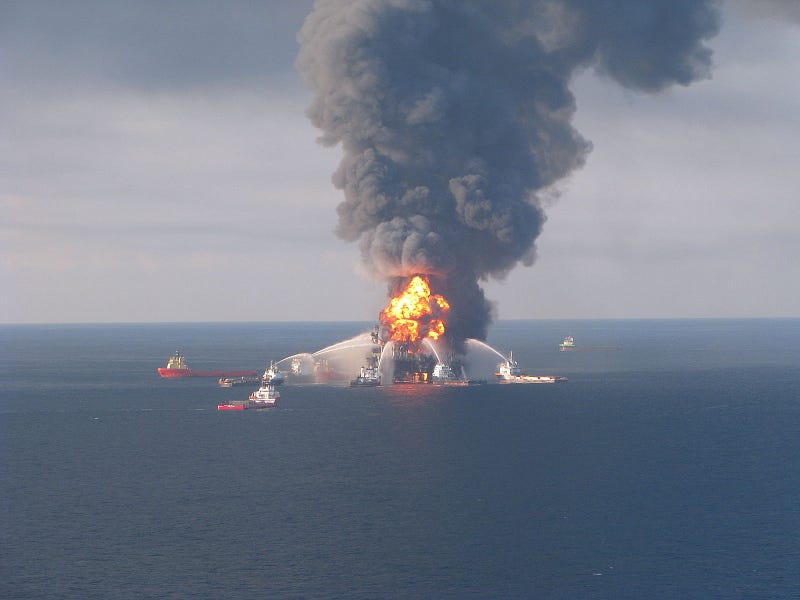
Fire boat response crews battle the blazing remnants of the off shore oil rig Deepwater Horizon April 21, 2010. Photo by US Coast Guard, on Wikimedia Commons (Public Domain)
In New Orleans, Kirksey met with a collective of local artists to share conversation and artwork on the theme ‘Hope in Blasted Landscapes.’ The aim of their gathering was to explore the question through prose and art: “In the aftermath of disasters — in blasted landscapes that have been transformed by multiple catastrophes — what are the possibilities of biocultural hope?”
Volunteers came in the thousands to help clean up beaches and save wildlife after the oil spill. But BP harnessed state and local enforcement agencies to prevent people from engaging in clean up ‘for their safety’ (but these rules conveniently allowed BP to operate in secrecy too). Kirksey writes,
“Official rules blocked people from trying to help charismatic animals, like birds. Volunteers instead began caring for smaller animals, like hermit crabs, that fell through the regulatory cracks.”
Amidst the mess of oil and regulations around clean up, the Hermit Crab Survival Project emerged as a space for people to simply do something about the disaster, even if it meant simply getting the oil off of a few hermit crabs.
Observe volunteers’ ‘tiny actions’ to save these little creatures inspired Kirksey to develop the concept of biocultural hope:
“I argue for the importance of grounding hopes in communities of actual living animals, plants, and microbes. Grounding hopes in living figures illuminates the possibilities that are emerging in an era of extinction and widespread ecological change…” — Eben Kirksey
‘Living figures’, for Kirksey, are the nonhuman protagonists in a story around which people can repair and rebuild hopeful identities, and eventually hopeful ‘multispecies communities.’ He writes:
“‘To figure’ also means to have a role in a story.” By collaborating with living figures, in this case, the hermit crabs, “tinkers and thinkers are learning how to care for emergent ecological assemblages by seeding them, nurturing them, protecting them, and ultimately letting them go”
Partnering with ‘living figures,’ like hermit crabs, Kirksey argues, allows people to ground their collective hopes, joys, disappointments, and anger, in tiny actions. And like compound interest, the collective of tiny actions eventually enable people to “produce hopeful events and concrete victories.”
Taking ‘tiny actions’ to make the world a more livable place
Biocultural hope is a messy, contradictory, more-than-human type of hope built on our collective tiny actions. It's a kind of hope that attaches itself to concrete living beings and places that we strive to protect. And because there is always the possibility of danger and disappointment in caring for others we may not be able to save, biocultural hope also inevitably means to “care for that which is beyond or outside your control.”
But caring for a world beyond our control is a kind of hope, to quote Heglar again, where “We can just be human. We can be messy, imperfect, contradictory, broken. We can recognize that “hopelessness” does not mean “helplessness.”
I like this idea of hope because it ejects us from the two dominant stories about hope and hopelessness in our time of climate crisis.
On the one hand, there is an apocalyptic narrative of hopelessness: human stupidity has doomed us. On the other hand, there is a messianic narrative of hope: human ingenuity will save us. Both of these anthropocentric stories paint a narrow and certain vision of the future, without much room for other stories of messy, imperfect, and more-than-human hope to take shape.
Biocultural hope points to other messy stories of worldly repair we might tell at “the intersection of dread and hope,” Kirsky suggests. A type of hope where there is “the potential for tiny actions — like Jacqueline Bishop’s gestures of care towards hermit crabs — to make the world a more livable place…ripe with open-ended biocultural possibilities.”