How Addictive Tech Exploits Our Evolutionary Needs
We evolved the need to be aware of anything important going on in our social circle

Living in a digitally enforced attention economy means being subjected to a constant assault of automated manipulation. Persuasive technology, as it’s now called, is a design philosophy taught and developed at some of America’s leading universities and then implemented on platforms from e-commerce sites and social networks to smartphones and fitness wristbands. The goal is to generate “behavioral change” and “habit formation,” most often without the user’s knowledge or consent.
Behavioral design theory holds that people don’t change their behaviors because of shifts in their attitudes and opinions. On the contrary, people change their attitudes to match their behaviors. In this model, we are more like machines than thinking, autonomous beings. Or at least we can be made to work that way.
That’s why persuasive technologies are not designed to influence us through logic or even emotional appeals. This isn’t advertising or sales, in the traditional sense, but more like war-time psy-ops, or the sort of psychological manipulation exercised in prisons, casinos, and shopping malls. Just as the architects of those environments use particular colors, soundtracks, or lighting cycles to stimulate desired behavior, the designers of web platforms and phone apps use carefully tested animations and sounds to provoke optimal emotional responses from users. Every component of a digital environment is tested for its ability to generate a particular reaction, be it more views, more purchases, or just more addiction. New mail is a happy sound; no mail is a sad one. The physical gesture of swiping to update a social media feed anchors and reinforces the compulsive urge to check in — just in case.
Most persuasive technology tactics depend on users trusting that a platform accurately represents the world it claims to depict. The more we accept the screen as a window on reality, the more likely we are to accept the choices it offers. But what of the choices that it doesn’t offer? Do they really not exist?
A simple search for “a pizzeria near me” may list all the restaurants that have paid to be found, but not those that haven’t. Persuasive designs offer users options at every juncture, in order to simulate the experience of choice without the risk of the user exercising true autonomy and wandering off the reservation. It’s the same way game designers lead all players through the same game story, even though we feel like we’re making independent choices from beginning to end. None of these choices are real, because every one leads inevitably to the outcome that the designers have predetermined for us. Because the interfaces look neutral, we accept the options they offer at face value. The choices are not choices at all, but a new way of getting us to accept limitations. Whoever controls the menu controls the choices.
Designers seeking to trigger addictive loops utilize what behavioral economists call “variable rewards.” Marketing psychologists in the 1950s discovered that human beings are desperate to figure out the pattern behind getting rewarded. It makes sense from a survival perspective: Sudden wind gusts mean rain is coming, and predicting the motions of a fish in the water makes it easier to spear.
In the hands of slot machine designers, this survival trait becomes an exploit. By doling out rewards at random intervals, the slot machine confounds the human being attempting to figure out the pattern. Consciously, we know the machine is randomized or perhaps even programmed unfairly to take our money. But subconsciously, those random intervals of quarters clinking into the metal tray induce a compulsive need to keep going. Are the quarters coming down every 10 tries? Every five tries? Or is it five, seven, 10, and then back to five? Let me try again and see…
Compulsions are futile efforts at gaining control of random systems. Once triggered, they are really hard to shake. That’s why academic studies of slot machine patterning became required reading in the euphemistically named “user experience” departments of technology companies. It’s how we’ve become addicted to checking our email — looking to see if there’s just one rewarding email for every 10 useless ones. Or is it every 11?
Persuasive design also exploits our social conditioning. We evolved the need to be aware of anything important going on in our social circle. Not having the knowledge that a fellow group member is sick or angry could prove disastrous. In the compliance professional’s hands, this “fear of missing out” provides direct access to our behavioral triggers. All we need are a few indications that people are talking about something to stimulate our curiosity and send us online and away from whatever we were really doing. So designers put a red dot with a number in it over an app’s icon to make sure we know that something’s happening, comments are accumulating, or a topic is trending. If you refuse to heed the call, you may be the last person to find out.
User experiences are also designed to trigger our social need to gain approval and meet obligations — ancient adaptations for group cohesion now turned against us. We seek high numbers of “likes” and “follows” on social platforms because these metrics are the only way we have of gauging our social acceptance. There’s no difference in intensity between them. We can’t know if we are truly loved by a few; we can only know if we got liked by many. Similarly, when someone likes something of ours or asks to be our “friend” on a social network, we feel socially obligated to return the favor.
Some platforms leverage our urge to compete, even playfully, with our peers. Websites employ leaderboards to honor those who have made the most posts, trades, or whatever metric a company wants to promote. Users also compete for “streaks” of daily participation, badges of accomplishment, and other ways of demonstrating their achievements and status — even if just to themselves. Gamification is used to motivate employees, students, consumers, and even online stock traders. But in the process, the play is often surrendered to some pretty unplayful outcomes, and people’s judgment is clouded by the unrelated urge to win.
Many familiar interfaces go even deeper, building addictive behaviors by leveraging our feeding instincts. Designers have discovered that “bottomless feeds” tend to keep users swiping down for additional articles, posts, or messages, consuming more than they intend to because of that unsatiated feeling of never reaching the end.
On the other hand, designers want to keep us in a state of constant disorientation — always scrolling and paying attention to something, but never so much attention that we become engrossed and regain our bearings. So they use interruption to keep us constantly moving from one feed to another, checking email and then social media, videos, the news and then a dating app. Each moment of transition is another opportunity to offer up another advertisement, steer the user toward something yet more manipulative, or extract more data that can be used to profile and persuade more completely.
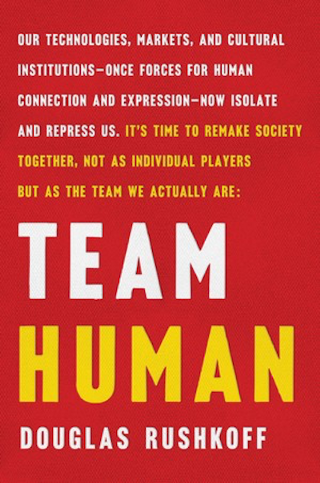
This is section 33 of the new book Team Human by Douglas Rushkoff, which is being serialized weekly on Medium. Read the previous section here and the following section here.