Our Lives Are Now Run by Persuasion Engineers
We know beyond doubt that we are dumber when we are using smartphones and social media

Instead of designing technologies that promote autonomy and help us make informed decisions, the persuasion engineers in charge of our biggest digital companies are hard at work creating interfaces that thwart our cognition and push us into an impulsive state where thoughtful choices — or thought itself — are nearly impossible.
We now know, beyond any doubt, that we are dumber when we are using smartphones and social media. We understand and retain less information, comprehend with less depth, and make decisions more impulsively than we do otherwise. This untethered mental state, in turn, makes us less capable of distinguishing the real from the fake, the compassionate from the cruel, and even the human from the nonhuman. Team Human’s real enemies, if we can call them that, are not just the people who are trying to program us into submission but the algorithms they’ve unleashed to help them do it.
Algorithms don’t engage with us humans directly. They engage with the data we leave in our wake to make assumptions about who we are and how we will behave. Then they push us to behave more consistently with what they have determined to be our statistically most probable selves. They want us to be true to our profiles.
Everything we do in our highly connected reality is translated into data and stored for comparison and analysis. This includes not only which websites we visit, purchases we make, and photos we click on but also real-world behaviors such as our driving styles and physical movements as tracked by mapping apps and GPS. Our smart thermostats and refrigerators all feed data into our profiles.
Most people worry about what specific information companies may record about us: We don’t want anyone to know the content of our emails, what we look at for kicks, or what sorts of drugs we take. That’s the province of crude web retailers who follow us with ads for things we’ve already bought. Algorithms don’t care about any of that. The way they make their assessments of who we are and how to manipulate us has more to do with all the meaningless metadata they collect, compile, and compare.
For instance, Joe may travel 12 miles to work, look at his text messages approximately every 16 minutes, purchase fat-free cookies, and watch a particular TV program two days after it airs. The algorithm doesn’t care about any of the specifics nor does it attempt to make any logical conclusions about what kind of person Joe may be. All the algorithm cares about is whether this data allows it to put Joe in a statistical bucket along with other people like him and if people in that bucket are likely to exhibit any similar behaviors in the future.
By crunching all these numbers and making constant comparisons between what we’ve done and what we do next, big-data algorithms can predict our behaviors with startling accuracy. Social media sites use the data they’ve collected about us to determine, with about 80% accuracy, who is about to get divorced, who is coming down with the flu, who is pregnant, and who may consider a change in sexual orientation — before we know ourselves.
Once algorithms have determined that Mary is, say, 80% likely to go on a diet in the next three weeks, they will fill her feeds with messages and news content about dieting: “Feeling fat?” Some of these messages are targeted marketing, paid for by the site’s various advertisers. But the purpose of the messaging isn’t just to sell any particular advertiser’s products. The deeper objective is to get users to behave more consistently with their profiles and the consumer segment to which they’ve been assigned.
The social media platform wants to increase the probability Mary will go on a diet from 80% to 90%. That’s why Mary’s feeds fill up with all those targeted messages. The better it does at making Mary conform to her algorithmically determined destiny, the more the platform can boast both its predictive accuracy and its ability to induce behavior change.
Algorithms use our past behavior to lump us into statistical groups and then limit the range of choices we make moving forward. If 80% of people in a particular big-data segment are already planning to go on a diet or get divorced, that’s fine. But what of the other 20%? What were they going to do instead? What sorts of anomalous behavior, new ideas, or novel solutions were they going to come up with before they were persuaded to fall in line?
In many human enterprises, there’s a tendency toward the Pareto principle, or what’s become known as the 80/20 rule: 80% of people will behave rather passively, like consumers, but 20% of people will behave more actively or creatively. For example, 80% of people watching videos online do only that; 20% of them make comments or post their own.
While 80% of kids play games as they were intended to be played, 20% of kids modify them or create their own levels. The people in the 20% open up new possibilities. We are using algorithms to eliminate that 20%: the anomalous behaviors that keep people unpredictable, weird, and diverse. And the less variation among us — the less variety of strategies and tactics — the less resilient and sustainable we are as a species. Survivability aside, we’re also less interesting, less colorful, and less human. Our irregular edges are being filed off. In a stark reversal of figure and ground, we develop computer algorithms that constantly advance in order to make human beings more predictable and machinelike.
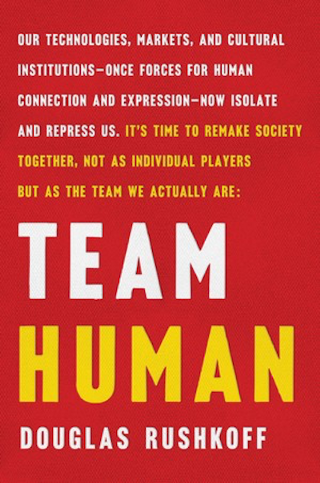
This is section 34 of the new book Team Human by Douglas Rushkoff, which is being serialized weekly on Medium. Read the previous section here and the following section here.