The Internet Used to Make Us Smarter. Now, Not So Much.
Going online went from an active choice to a constant state of being

The problem with media revolutions is that we too easily lose sight of what it is that’s truly revolutionary. By focusing on the shiny new toys and ignoring the human empowerment potentiated by these new media — the political and social capabilities they are retrieving — we end up surrendering them to the powers that be. Then we and our new inventions become mere instruments for some other agenda.
Social phenomena of all sorts undergo this process of hollowing. When punk rockers reduce their understanding of their movement to the right to wear Mohawks or pierce their faces, it’s easy for them to lose touch with the more significant anti-authoritarian ideology of DIY, direct action, and never selling out. Instead, punk becomes just another fashion trend to be sold at the mall. When ravers understand their movement as the right to take drugs and dance all night, they lose sight of the deeper political potentials unleashed by reclaiming public space or separating recreation from profit. Rave becomes just another genre for industry to sell. The styles of these movements were co-opted, and the essential shifts in power on which they were based were left behind.
With digital technology, we too quickly let go of the social and intellectual empowerment offered by these new tools, leaving them to become additional profit centers for the already powerful. For example, the early internet enabled new conversations between people who might never have connected in real life. The networks compressed distance between physicists in California, hackers in Holland, philosophers in Eastern Europe, animators in Japan — and this writer in New York.
These early discussion platforms also leveraged the fact that, unlike the TV or telephone, internet messaging didn’t happen in real time. Users would download net discussions, read them in their own time, off-line, and compose a response after an evening of thought and editing. Then they would log back onto the net, upload the contribution, and wait to see what others thought.
As a result, the internet became a place where people sounded and acted smarter than they do in real life. Imagine that: a virtual space where people brought their best selves, and where the high quality of the conversation was so valued that communities governed these spaces the way a farmers’ cooperative protects a common water supply. To gain access to the early internet, users had to digitally sign an agreement not to engage in any commercial activity. Advertising was expressly forbidden. Even the corporate search and social platforms that later came to monopolize the net originally vowed never to allow advertising because it would taint the humanistic cultures they were creating.
Over time, enthusiasm for the intellectual purity of the net was overtaken by the need to appeal to investors. Business magazines announced that the internet could save the dying stock market by creating more room for the economy to grow — even if that additional real estate was virtual. A search engine designed to promote academic thought became the world’s biggest advertising agency, and a social media platform designed to help people connect became the world’s biggest data collector.
Enthusiasts still associated the net with education and political power. They pushed for technology in schools and laptops in Africa, even though the digital society’s essential values had been left behind in the era of 2400-baud modems. The primary purpose of the internet had changed from supporting a knowledge economy to growing an attention economy. Instead of helping us leverage time to our intellectual advantage, the internet was converted to an “always on” medium, configured to the advantage of those who wanted to market to us or track our activities.
Going online went from an active choice to a constant state of being. The net was strapped to our bodies in the form of smartphones and wearables that can ping or vibrate us to attention with notifications and updates, headlines and sports scores, social media messages and random comments. We have ended up living in a state of perpetual interruption that used to be endured only by 911 emergency operators or air traffic controllers, only we do it 24/7 and we pay for the privilege.
The resulting disorientation is self-reinforcing. The more we are interrupted, the more distracted we become, and the less we avail ourselves of the real-world markers we use to ground ourselves. We become more easily manipulated and directed by the many technologies whose very purpose is to disorient us and control our behavior.
We humans go from being the figure in a digital environment to being the ground.
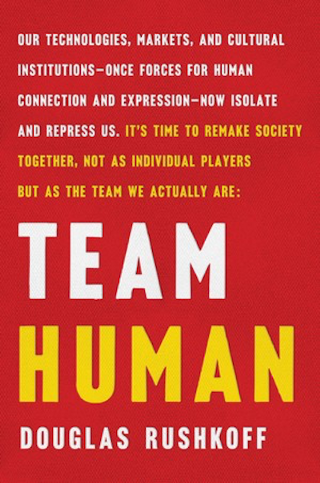
This is section 32 of the new book Team Human by Douglas Rushkoff, which is being serialized weekly on Medium. Read the previous section here and the following section here.