
Games are Political
How Activists Wargame
reviewing (and hacking) The Social Strike Game
The world is going straight to Hell in a hand basket. A former US attorney, who’s known for grokking the nuances of government, is now saying the Trump Show is as bad as it looks. Cops are beating protestors but politely asking militia dudes to go home. The Post Office is being gutted. McConnell is trying to starve people into going back to work during a pandemic. Plus, Belarus’ president stole an election and Orbán has transformed Hungary into an “illiberal democracy”.
There’s a lot of shit to protest. The prolific Lauren Martinchek has been calling for a general strike for a few months now (here, here, and here). Great idea, if you can plan it right.
A while back I wrote a piece on class wargaming. The practice was inspired by the inventor of A Game of War, Guy Debord. Debord believed that normally pacifist socialists could hone their strategic chops by playing historical tabletop wargames. I’m not sure if I buy his theory. RAND and CNA probably have the better method. And what’s good for the military-industrial complex is good for the gander.
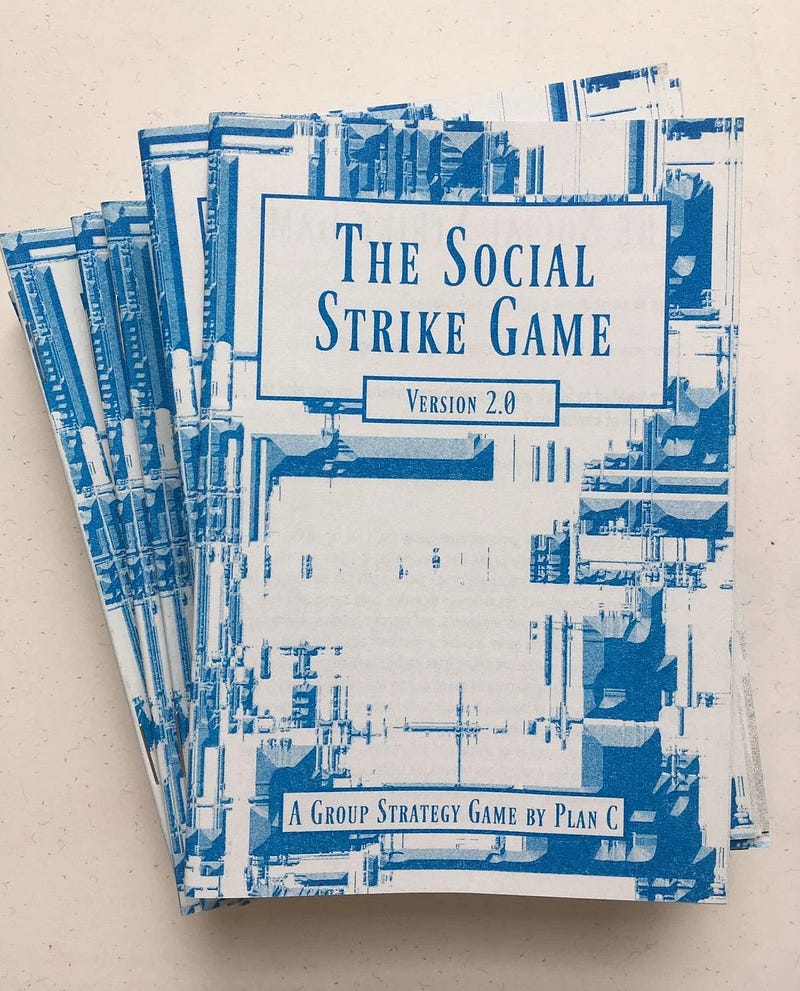
The Social Strike Game is a rules-lite “serious game” meant to build strategic capabilities in activist groups. The book opens by defining “social strike”. The designers try to differentiate it from a “general strike”, but I still don’t grok the difference. Doesn’t matter. For our purposes, they’re functionally the same. They’re big “meta” strikes. Rent strike, labor strike, debt strike, all rolled into one.
The verbiage in The Social Strike Game is incredibly leftist. The word “comrade” is in the very first sentence. These Commies need to give it up. English-speaking countries are never going to be OK with anything even remotely Marxist-sounding. “The Nordic Model” is as close to socialism as we’re going to get for at least a century.
Mechanically, The Social Strike Game is a matrix game with Powered by the Apocalypse-ish dice mechanics. Matrix games are free-form games, often used in professional wargaming. This is very different from crunchy miniature or abstract wargames. In a matrix game, players state what they want to do, and a facilitator determines how that translates to a playable action.
On the player’s turn, they dedicate two of their Resources to one or two different actions. Resources can include renter’s unions, art spaces, anti-fracking activists, etc, depending on the scenario.
The dice mechanics are similar to Apocalypse World’s. Players roll 2d6. 0–6 is a failure. 7–9 is a partial success. 10+ is an unqualified success. They’re not “moves” in the PbtA sense. The MC (which is also straight out of PbtA) determines the positive and negative consequences. Players aren’t meant to state what consequence they’re aiming for. This differs from matrix games, where the desired outcome is stated as part of the action.
On top of that, the MC is encouraged to pick consequences that further the scenario. Realistic outcomes take a backseat to the narrative flow of the game. It’s meant to be an educational and ideation tool, not a planning tool.
There’s one thing that bugs me about the game’s structure. If the players have access to other groups, like anti-fracking activists or renter’s unions, then who or what do the players represent? A central “command” organization, with no capabilities of their own? They just order other groups around? Or does each player group represent the leadership of the various Resource groups? Maybe I’m overthinking this.

Hacking The Social Strike Game
The game can be hacked in several ways by borrowing concepts from standard matrix gaming. None of the following ideas are mutually exclusive. But the more you use, the more it will BECOME a standard matrix game. As always, you do you.
- Umpire — An independent Umpire can better adjudicate results while the MC focuses on the overall scenario.
- Components — The game defaults to “Theater of the Mind” style play. Maps and counters can help speed things up and clarify events.
- Resource Power — a resource’s ability to affect things or people can be quantified, if you want to go that route. I use three vague levels of Power: A Little, Some, and A Lot.
- Event Power— same thing as above. Events can require A Little, Some, or A Lot of Power to change. Resources would need to have as much or more Power to deal with the Event effectively.
- A Red Team —another player or team can control the powers that be. They would have their own turn, and could react to the Players’ actions. Most Red Team resources would be the antithesis of Blue Team resources (Nationalist protest groups, a Landlords’ organization, pro-fracking lobbyists, etc).

Last Thoughts
If you treat this as a creativity or team-building exercise, I’m sure the participants will enjoy it, but it won’t provide a reliable stress-test for an activist’s plans. But if the MC pushes back enough, it can be a legitimate tool for planning the kneecapping of oligarchs, postmasters general, and other shit stains.


