
Homophobia in Education Is a Toxic Disease With an Impact That Can Last For Decades
A response to a Prism & Pen prompt on the barriers and discrimination LGBTQ people face at work
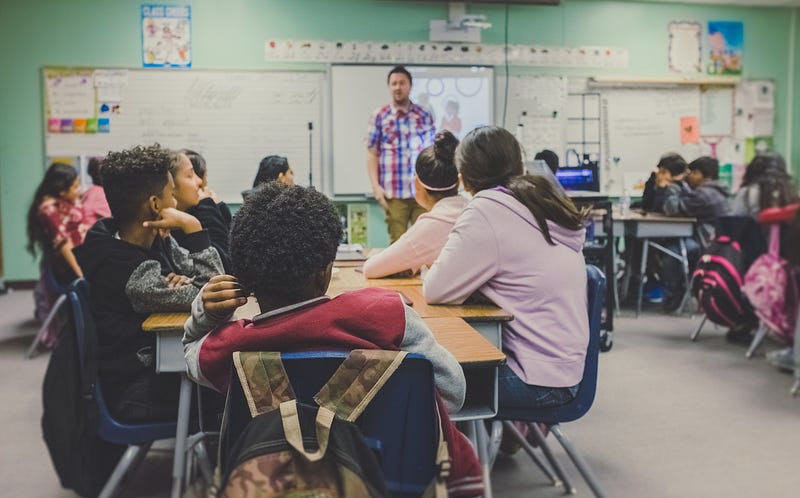
I was eighteen and in my first week of a Bachelor of Education degree with the intention of becoming a primary school teacher. I loved children, and I thought this would be a great career for me.
In the cohort of perhaps eighty prospective teachers, there were only four men (some of us barely out of our boyhood). On the second day, the four of us were “invited” to a special session where we were, in no uncertain terms, told what we wouldn’t be able to do as male teachers:
- Never be in a room alone with a child.
- If a child comes up to you for a hug, do not reciprocate.
- Don’t build personal relationships with children.
It was unclear who amongst us was gay. I was very closeted at the time, and although the directive was about gender more than sexuality, the effect of the sanction was abundantly clear.
Society’s fear or mistrust of men in relation to children was such that any emotional connection with children was viewed with suspicion.
I lasted a year before I shifted my studies from primary to secondary education. Although my decision was not consciously guided by my still deeply repressed sexuality, the impact of that conversation still echoed strongly in my mind.
High school wasn’t a positive experience for me. I went to an all-boys Catholic school where homophobic bullying went unchecked. Teachers either joined in or turned a blind eye.
I remember one boy being bullied and a group of us would stand around him to protect him. But at the same time, we also made ourselves small and presented — as best we could — as straight acting so as not to become a target ourselves.
Acting straight as self-protection is a form of internalized homophobia that has taken me years to unwind. It’s the kind of behavior that simultaneously says, both proudly and ashamedly, I’m not like “them” (read: I’m not like the effeminate ones).
Homophobia was not only directed towards other students. Our history teacher was also the target of homophobic abuse, with students chanting “Brian’s a faggot!” whenever he walked by.
The fact that students were not reprimanded or suspended for this behavior said a lot about the culture of the school. The message was clear: it is not okay to be gay here!
Of course, no one ever knew whether he was gay or not. He would never be able to out himself at school. It was an assumption based on how he presented. Again, further reinforcement to present as straight.
I did eventually become a high school teacher and went on to work with teenagers in a variety of settings over a six-year period.
I taught for two years in a co-educational Christian private school. Students would ask me if I was gay, to which I would always laugh it off as a “no.” I did this for two reasons:
- I was still deeply closeted and truthfully didn’t know who I was, and
- Even if I did, it would be a career-destructive move to do that.
I never once feared how the students would react. I was highly respected and emotionally and intellectually available to them in ways they didn’t get from other adults in their lives.
I look back on this period with both shame and forgiveness. I feel sad for those students who were aware of their sexuality or difference who could have been supported by a teacher who had the courage to be true to themselves. Yet I need to forgive myself if for no other reason than dwelling on it doesn’t change the past.
I also worked with young people in out-of-home care. I worked with dozens of boys who struggled with their sexuality and other aspects of their life. What they needed more than anything was someone who could authentically show up and let them know they could also show up as themselves.
It was, for this reason, I walked away from education and youth work. I knew that if I was to ever step into my own authenticity, I couldn’t do it within that profession. And sadly, education is the field that needs authenticity the most.
I was a great educator. I don’t usually speak about myself in such glowing terms. I share it because that is what I was always told. And I share it because I know other great educators who have left the profession for similar reasons.
Religious freedom allows for discrimination.
I wish I could say that these issues are of the past. The legalization of same-sex marriage gave society the false impression that we have made it to a homophobia-free destination; that we are now equal in rights and opportunities. Sadly, this is not true.
Australia is currently debating a religious freedom bill that will trump all other anti-discrimination legislation. It is unclear what the ramifications of this will be, but it essentially allows churches and schools to hire or fire people for reasons associated with their religious beliefs. If those beliefs are homophobic, that means schools can fire teachers. Indeed, this has already been happening.
I reject the idea that education is only about academics. A rounded education includes good citizenship and the ability to connect with, understand, and respect people of different backgrounds.
It is a sad indictment of our culture and society that we don’t allow children to be exposed to people of diverse orientations. It is my belief that my sexuality and the coming-out journey would ultimately make me a better and more compassionate educator.
Rather than excluding LGBTQ folk from educational settings, we should be actively recruiting and supporting them to fully express themselves in their work.
It’s not all bad news. After leaving education, I came out and found courage in naming my sexuality in workplaces. I share this story here, which includes a look at how we out ourselves as writers.

This story is a response to Prism & Pen’s writing prompt, I’m an LGBTQ Person Who’s Faced Work Barriers and Discrimination.


