Writing Tips
Hit More Home Runs as a Writer
A GREAT baseball player gets on base 30% of the time

Are you tired of striking out? Do you step up to the plate to hit a home run, only to whiff and walk away defeated? Would you love to be the hero of the game but instead feel like you lost the World Series?
In this article, I’m offering an analogy on writing, I’ll investigate two of my posts that failed, and I’ll promote and investigate three other writers’ posts. I’ll also talk about this new publication and a contest/project I’d like you to join.
I’m talking about writing using a baseball analogy, so let me talk about baseball a little (for anyone reading and not understanding the metaphor). Hopefully, afterward, you will be able to hit more writing home runs.
Batter’s Up — A Brief Overview of Baseball
For this analogy, it is good for you to know a few things about baseball. Mainly, when a player goes up to bat, they get three chances to hit the ball. (This is a very basic overview, so I’m not going into the detailed rules, such as foul balls, etc.) If they miss the ball three times, they are out. They lost their chance to get on base.
If they hit the ball, they can score for the team depending on how they hit it. Or, they set up a position for the team to score. If they hit the ball really well, called a home run, they can score up to four points.
I want you to realize a few things about baseball:
- Hitting a home run is rare.
- Fans consider a player “great” if they hit the ball over 30% of the time. Not a home run; just hitting the ball.
- There is a lot of strategy in professional baseball. Every time the player makes a swing, they have a plan (full swing, bunt, etc.)
Writing is Like Baseball
Yes, some players hit more home runs than other players. Hitting more home runs DOES NOT mean that player is better than another player. Some players are great at throwing, or pitching, or catching, or stealing bases. Some players are best at coaching. If you aren’t consistently hitting home runs, it doesn’t mean you are a terrible player.
A quality batter doesn’t have to hit home runs all the time. Even the BEST batters rarely hit home runs. For instance, Babe Ruth had 714 home runs out of 8,399 chances to hit.
In writing, if you step up to the bat enough times, you will get a hit. You may even get a home run. As long as you make contact 30% of the time, you are a GREAT writer in baseball terms.
Every Time You’re at Plate — Have a Plan
If you step up to the plate without a plan, you will strike out more often. And — NO! — it is not a wise plan to always try and get a home run. Sometimes you have to get out on purpose as part of the overall strategy.
I am NOT talking about making money. I’m talking about writing with a purpose. Some players will make a lot of money; even players who don’t hit home runs can make a lot of money. But you are here to play the game. Money is a side attribute that does not define your worth as a player.
Every time you write: know your plan. A few days ago, I published an article talking about not posting links on social media. I did not plan for that article to be a home run (and please notice, even if you plan to swing for a home run, you won’t always get a home run. Far from it.) I broke that article out into different versions: posting one version on Facebook, another on Twitter, etc. I tried to get the conversation started. And now, I’m bringing it all together.
What’s Your Plan?
Different writers want different things. The same writer can often want different things: validation, comments, follows, money, likes. I asked this on social media, and these are some of the responses I got:
I write to become a better thinker.
I write because it’s fun and I have things to say.
I write, I research and I speak about what I find interesting and educative from my point of view.
I write because I want to share my experience as a developer but also to inspire and teach about programming in general. I love creating stuff and would love to help others do the same.
I write because I just have the impetus to do so
To share my story and the stories of Black and brown women who can’t — and to be a better writer and storyteller.
It’s therapeutic for me.
Mostly to entertain myself and others. Sometimes to raise awareness about important issues.
I write because I have too many ideas and have to get them on paper. Writing is like breathing for me.
Thank you to all the people who corresponded with me on my article and social media: Veronica Haunani Fitzhugh, Jairam R Prabhu, Renato Francia, Atul Jha, Heather Jauquet, Nur Zafirah Zapri, and more!
Let’s continue the conversation. Do you have a purpose every time you write? Does each piece have a plan? Are you going for a home run, or do you have a different plan?
My theory: I think we often write with a plan (satire, a conversation starter, being artistic) but are regularly disappointed when we don’t get home runs.
- It’s okay to be artistic, but don’t expect a home run.
- If you want a home run, try for a home run.
- You won’t always get a home run. It’s rare.
- The more times you are at bat, the greater your chances.
Remember, even Top Writers with over 100,000 followers and make $30,000 a month have publications reject them and pieces that “strikeout.” It’s part of the game.
Two of My NOT Home Run Articles
I want you to realize a few mind-blowing statics about this platform:
- 100 Million readers a month.
- The 88th most popular website by traffic in the world.
- Has between 200,000 and 400,000 paying subscribers.
So when I get an email like the one below, it sounds exciting. “Recommended to readers across…homepage, app, and emails.” Here’s the email:
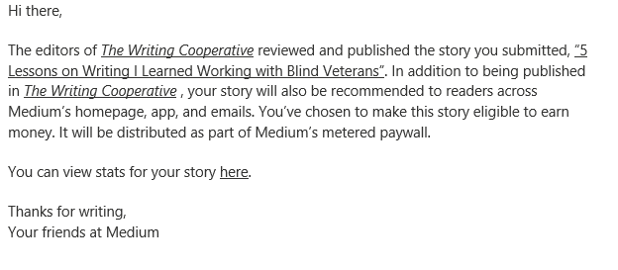
The publication hosting my article has 229,000 followers. So, let’s do some math to guess how many views it got. 100 million readers + 300,000 paying subscribers + 229,000 followers = how many views? 22.
Twenty-two views (with 11 reads) for an article recommended to readers across the homepage, app, and emails. Not bad, right? Why didn’t it get more views? Honestly, I have no idea. I’d love to hear your thoughts.
My other article, I understand. It is in no way sexy: What is Socially Responsible (SRI) or Sustainable Investing? This article was an experiment. I took advice from Christopher Kokoski on finding trending topics, wrote about them on my blog first, and then posted it using a canonical link.
My rationale for this experiment is as follows:
- This site is ranked 95 in Google search (see stats link above).
- We don’t get paid for external views.
- Canonical links send Google search to the original post (my blog).
- I can monetize my blog for external views.
- I use THIS site for its Google power to drive traffic to my blog.
How did my experiment work out? In 6 days, I got 4 views (1 read) — all internal — from here. On my blog, I got 10 views, 6 likes, and 2 comments. I have less than 50 followers on my blog; I have over 800 followers here.
For a boring article that uses trending topics, I’d say using canonical links to get external traffic works decently.
Three At-Bats From Other Writers
First up is major leaguer Joe Duncan. He’s a professional player, meaning he makes a living playing this game. He hits many home runs, most of which you will see on the “trending now” section. So I was surprised when I asked on Twitter for writers to send me their BEST articles that didn’t do well, and Joe responded.
Let’s be clear: this is a great article that has home run potential: great title, well written, lots of research, and — this platform’s favorite!! — presented in a list. So why wasn’t it a home run? No reason. Joe tried for a home run and didn’t get a home run. Is that disappointing? Fuck yeah.
Next at-bat is Emily Jennings. She, like me, has been playing ball here for a few months. She, unlike me, has mastered the art of Canva. Her article seeks to inform and relate, and sometimes hits like this can score big points. Sometimes, despite being hit well, don’t convert into scoring opportunities. Was it played well? Absolutely.
Finally, you have the master of satire, Reuben Salsa. He has 1,600 followers here and about the same on Twitter. His strategy doesn’t placate the crowd to get views; he hits them in the balls. He is effective at getting you to question and think.
Are You Ready to Swing Batter Batter?
No matter your reason to write, it is essential that you have a plan every time you step up to the plate. Remember, the best players in the world strike out 70% of the time. Be happy with yourself whenever you make contact and keep stepping up to the plate for more chances.
Here’s a 30-second video I put together to summarize this article:
Here’s Your Chance to Hit the Ball
I’m offering you two chances to swing for the fences (try to get a home run). First is this publication: Story Second Chances. Mary DeVries came up with the idea, and I’m helping along. Read about the opportunity here. The essence: take one of your stories that didn’t get the response you wanted and try again, but with help from the community.
Second, I’m trying out a project and making a contest of it. I want to get 100 writers to write their version of the same story. I’m giving away three books and publishing 100 stories in a book. Here are the details.
Here’s a 30-second promotional video of the challenge:
And finally
Thanks for following me on Twitter @LifeisPresence. Have you considered joining my mailing list? I promise not to sell you anything; I’ll send you my books for free. It’s all love, my friend!