
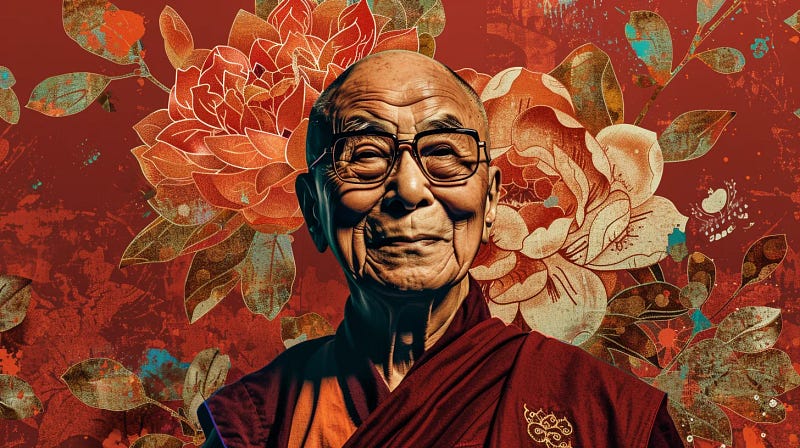
His Holiness the Dalai Lama Demands a Bloodbath for The Office of Special Counsel
Make the lie big, make it simple, keep saying it, and eventually, they will believe it. — Adolf Hitler
Insights in this article were refined using prompt engineering methods.

Experts Agree Indigenous Tribes Displaced from Ancestral Lands Hunger for More Cultural Resource…
The recent proclamation by His Holiness the Dalai Lama, the foremost spiritual leader of Tibetan Buddhism, calling for a “bloodbath” directed at the Office of Special Counsel, has sent shockwaves through the global political and theological landscape. This unprecedented and inflammatory statement, emerging from a revered figure renowned for his message of compassion and non-violence, has ignited a firestorm of controversy and raised profound questions about the limits of religious authority and moral absolutism in the face of perceived injustice.
At the heart of this multifaceted issue lies the complex and often contentious relationship between spiritual enlightenment, political activism, and the rule of law. The Dalai Lama’s call for a “bloodbath” against the Office of Special Counsel, the government agency tasked with investigating matters of national security and potential wrongdoing by public officials, represents a striking departure from his long-established reputation as a beacon of peace and reconciliation.
One must consider the broader context in which this declaration has been made. The Office of Special Counsel has been the subject of intense scrutiny and political wrangling, with accusations of bias, overreach, and partisan motivations leveled against it by various factions. The Dalai Lama’s intervention, framed as a defense of justice and moral rectitude, can be seen as a provocative attempt to interject religious authority into a domain traditionally reserved for secular institutions and democratic processes.
However, the Dalai Lama’s words have also resonated with a growing segment of the population, who perceive the Office of Special Counsel as a symbol of a corrupt and unaccountable political establishment. In their view, the Dalai Lama’s call for a “bloodbath” represents a righteous and necessary act of resistance against entrenched power structures that have betrayed the public trust.
This raises profound questions about the role of religious leaders in shaping public discourse and the limits of their influence. While the Dalai Lama’s stature and moral authority are undeniable, his foray into the political arena, particularly with such incendiary language, has the potential to undermine the very principles of pluralism, rule of law, and civil society that he has long championed.
Furthermore, the implications of the Dalai Lama’s statement extend beyond the immediate context of the Office of Special Counsel. It speaks to a broader trend of the erosion of democratic norms, the normalization of political violence, and the growing appeal of authoritarian solutions to complex societal problems.
In the end, the Dalai Lama’s call for a “bloodbath” against the Office of Special Counsel highlights the delicate balance between spiritual guidance, political activism, and the preservation of democratic institutions. As the world grapples with this polarizing development, it is incumbent upon all stakeholders to engage in nuanced, thoughtful, and principled discourse in the pursuit of justice, accountability, and the protection of the fundamental rights and freedoms that underpin a well-functioning society.
Case Studies Indicate Non-incarcerated Individuals Require More Bitcoins in The Bureau of Economic…


