
Hippocrates: 6 Powerful Insights on Life That Will Change You for the Better
Make a comfortable ‘bed’ for your mind to sleep.
“It’s not that. It’s Karma and will take its ‘hisaap’ soon.”
(Hisaap is an Arabic-Indian phrase for revenge).
My mother’s family comes from an Indian background. For hundreds of years, these clans lived in huts, surrounded by farms, prayed to the almighty, and signaled diseases on Karma.
- Like Karma was behind the curtains mimicking our every move.
Let me tell you, the word “Hisaap” is not limited to one culture. Here are a few more cultures associated with this word:
- Turkish
- Indians
- Arabic Bedouins
As a means of surviving harsh weather, these clans believed “hisaap” would make everything right.
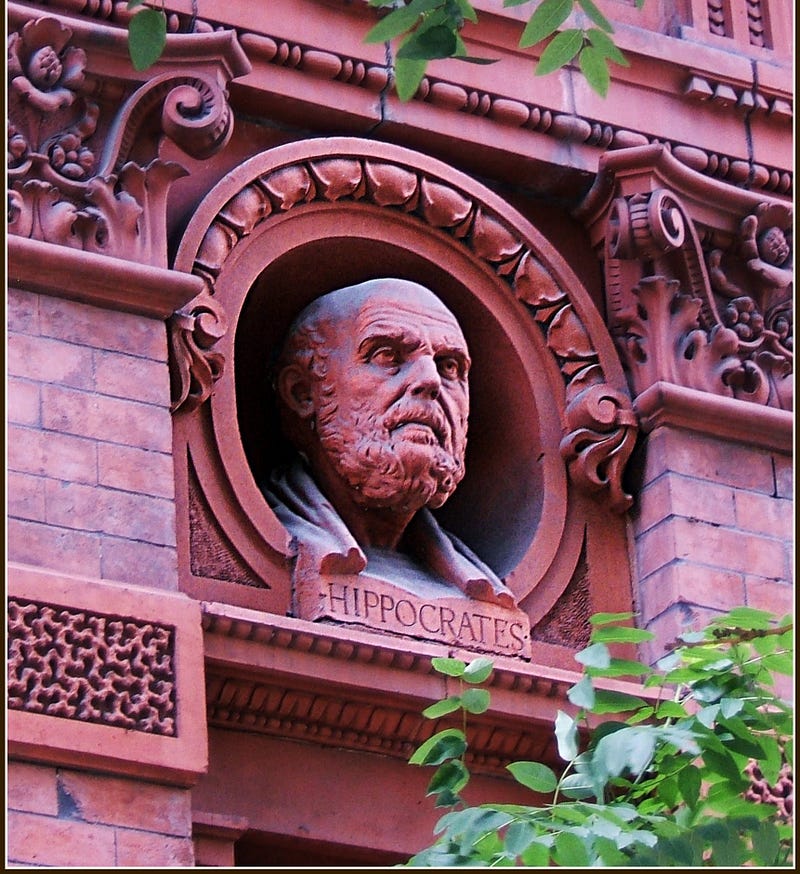
Hippocrates was born in 460 BCE in Greece.
Hippocrates taught that people could get sick for scientific reasons — an unhealthy diet, extreme stress, and worst living habits cause poor physical health.
On a lighter note, Hippocrates had a major effect on clans and civilizations that believed health issues resulted from Karma.
- Not to mention, it is.
The best way to deal with untreatable health problems like cancer is to consult a doctor. If the health issue is lighter and non-chronic, you can assume it’s “hisap.”
Other than this, Hippocrates had excellent advice that you can read below. Let’s get started.
1. Harvest creativity
After binge-watching 30 episodes of Vampire Diaries, a question arose in younger Noorain’s mind.
I asked my mom: “What happened to those who live long enough? Do they outgrow creativity?”
She reminds me of a Hippocrates quote:
“Life is short, art long, opportunity fleeting, experience treacherous, judgment difficult.”
In front of wonders and art, life is very short.
A single person can either:
- Travel the whole world to see the art, or
- Slide inside of their body to configure art
Both the physical and mental worlds are a piece of art. It’s unlikely a person can explore both in *one* single life.
Thousands of generations can’t even outgrow the creativity of this world. At some point, people end up getting mad.
Because the universe only makes you see things that you can understand. Does that mean the universe cannot hide its surprises?
It surely can.
2. Cut the cord
Most people, including me, try to open a lock with another key.
We try… try… try, and ultimately fail.
I am sure my Guardian angels sees me crying and release a statement: “I gave that fool the right signs, but she doesn’t wanna listen.”
We are arrogant. The same things that bring us misery can never solve it. That’s why Hippocrates said:
“Before you heal someone, ask him if he’s willing to give up the things that make him sick.”
If a relationship, work, or even a thing is giving you trouble, go ahead and cut the cord.
The world only experiences greatness when it cuts the cord. Some major examples:
- A cord with a telephone turned into a mobile
- The umbilical cord attached to a mother’s belly prepared us for this world.
3. We are under the illness spell
I often think:
Are we trapped inside our souls or souls trapped inside of us?
It’s hard to say either way.
But our personality is one part of the soul that [never] changes. It remains constant. Especially the older people hardly know anything about comfort zones.
For most of their life, they remain the same. Not being able to change brings immobility to the personality or nature — like the person is against the growth call.
“It is more important to know what sort of person has a disease than to know what sort of disease a person has.”
Here are a few examples associated with the above statement:
- A farmer will always be worried about his crops
- A writer will always be concerned about his ideas
- A mother bearing a child will always be worried about pain.
Sometimes the diseases and the pain comes with who you’re.
It’s unfaithful to believe a laboring man will never get his hands dirty or a chef would never have cuts and splashes of oils on their skin.
4. Fortune telling is easy
Most of us are quick fans of fortune telling.
But Hippocrates believes it is easy to do. He says:
“Declare the past, diagnose the present, foretell the future.”
1# Past: Your past is like gold, filled with lessons. You must declare it before going onboard to the present day’s flight.
2# Present: Your present is a present (gift). Diagnose your gifts, and struggle to win today’s blessings.
3# Past+ present: Include your lessons and gifts in a bucket. Use the bucket to guide you through the future.
Our problems are a direct effect of our thinking and mind. So when we don’t use our gifts and experience in the right mind, we end up unsolving the problems.
- Circumstances in life are like a maths problem.
Use the experience (past) and formula (gift) to solve your way out. It’s easy. Try it.
5. Launch your legs
I suffered countless fractures.
Coming from a person with a broken leg, let me tell you, walking is one of the greatest feelings.
- When I first got fractures, the doctor told me to stay uptight and not walk. I listened to him.
- The second happened a few months back when I refused to behave like a disabled person and walked my way out of the bone problem.
And why does this happen in the first place? My obsession with basketball and workout.
Recalling one of Hippocrates’ quotes where he said:
“If you are in a bad mood go for a walk. If you are still in a bad mood go for another walk.”
There is nothing in this world a walk cannot solve.
If you’re blessed enough to live in a neighborhood where you can walk to the nearest tram station, use walk to:
- Win friends
- Refresh yourself
- Clarify problems
- Stay connected with people
6. Soul trap
The bad and good thing about living creatures is that they have a soul.
The bad and good things about non-living things like:
- Rock
- Relationships
- History
… is that they do not have a soul.
That is why they hurt us more.
Hippocrates writes:
“The soul is the same in all living creatures, although the body of each is different.”
Sometimes I wonder if we’re an experiment shuffling in other bodies. All of us are unique. We have our defined footprint that doesn’t vanish anywhere for nearly 80 years.
The soul never has the ego. It’s always our bodies having the ego about our looks.
I wonder about a world with only souls. Would we be afraid of telepathy when we have nothing to hide?
Final thoughts:
Hippocrates was a greek doctor.
Yet he often encountered people who weren’t ill, but the only illness was in their brains.
The world doesn’t have time to bestow you with problems. Ahem… but on the other hand, you do.
So, don’t blame the world for the problems that are even there.
Join 1,100+ writers and get your next writing inspiration right now.
Or, join Medium with my referral link.


