
Bee Geometry — Why Are Bees Crazy About Hexagons?
And what math lessons have we learned from bees?
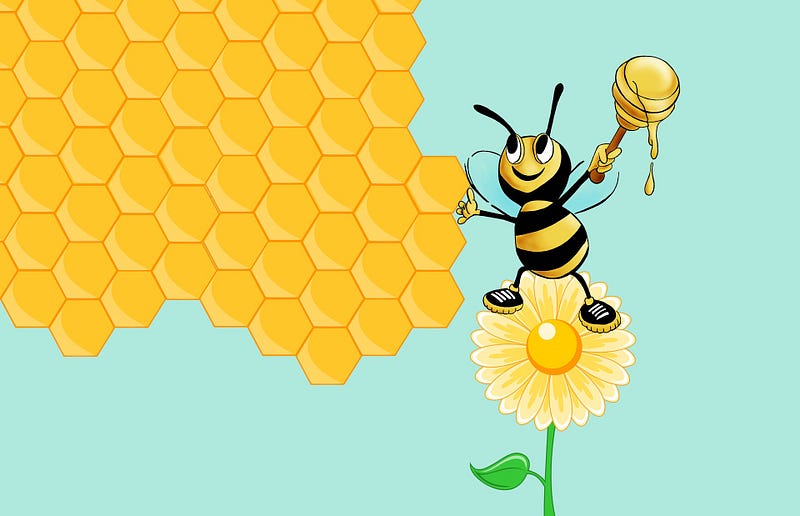
Charles Darwin said of the honeycomb that it was, “absolutely perfect in economizing labor and wax.”
During one of my nature rambles, I looked up into a tree and saw a beehive — with its hexagonal honeycomb — hanging from one of its branches. I thought: How do bees make such perfect hexagons?
I asked myself the question as I walked along, and a sciku — a science-based haiku — was born:
Bee geometry
Hexagonal honeycombs
Function marries form.
When I got home, I googled “hexagonal honeycombs,” and here’s what I found —
A honeycomb is built from wax that worker bees extrude as flakes from glands in their abdomens. The bees then chew this wax with minute amounts of honey and pollen to produce beeswax.
Some scientists believe that bees actually build circular cells. But their body heat melts and fuses the wax where these circles intersect — leading to the formation of hexagons.
A hexagon is the ideal shape for honeycombs because the cells fit together perfectly. Circles would leave gaps between the units — a waste of space and wax.
Wax wasted is labor wasted. Some studies estimate that bees need to consume eight ounces of honey to produce a single ounce of wax.
The walls of the hexagonal cells are fragile membranes measuring approximately 1/80th of an inch. But the honeycomb structure allows each cell to hold honey up to 30 times its weight.
The beehive is designed to utilize the least quantity of material in supporting the greatest amount of weight.
Humans use honeycomb structures to construct bridges, airplanes, prosthetics — and telescopes that orbit the earth.
The James Webb Space Telescope was launched on Dec 24, 2021, to replace the aging Hubble telescope.
Scientists designing the telescope’s mirrors looked for an overall circle comprising segments that fit together without gaps. The geometric shape they arrived at was the hexagonal honeycomb.
‘Nuff said.
Thanks for reading!
Some writers whose stories I enjoyed — Jane Frost (Jane Grows Garden Rooms)’s piece about a variety of garlic; Nazım Özer’s Nike story: B.R. Shenoy’s Four-day week story.
A couple of my stories:
Winterberry: The Day after Christmas
And another curious fact about the Winterberry Holly
medium.com
Thank you Jane Frost (Jane Grows Garden Rooms) for publishing my story!


