avatarGauri Sirur

Summary

The article "Winterberry: The Day after Christmas" discusses the author's encounter with Winterberry Holly trees the day after Christmas, highlighting their festive appearance and the curious fact that only female plants produce berries, requiring a nearby male plant for pollination.

Abstract

The narrative describes a family's return home from a Christmas gathering, where they are captivated by the vibrant Winterberry Holly trees at a takeout spot. The trees, with their green leaves and red berries, evoke the Christmas spirit anew. The author shares a botanical tidbit: Winterberry Hollies are dioecious, meaning they have separate male and female plants, with only the females bearing the characteristic red berries. Proximity to a male plant is necessary for pollination, with one male capable of pollinating several females. This biological trait is uncommon among flowering plants. The article concludes with a thank you to the readers and a suggestion of related stories.

Opinions

  • The author finds the Winterberry Holly's colors to be particularly festive and reminiscent of Christmas.
  • The author seems to appreciate the natural beauty of the Winterberry Holly, as evidenced by their stopping to appreciate the trees and the accompanying photograph.
  • There is an educational intent in sharing the fact about the dioecious nature of Winterberry Hollies, suggesting the author values knowledge and wishes to inform the readers.
  • The author expresses gratitude towards Dennett and Tracy Aston for publishing the story, indicating a sense of community and collaboration in the writing and publishing process.

Winterberry: The Day after Christmas

And another curious fact about the Winterberry Holly
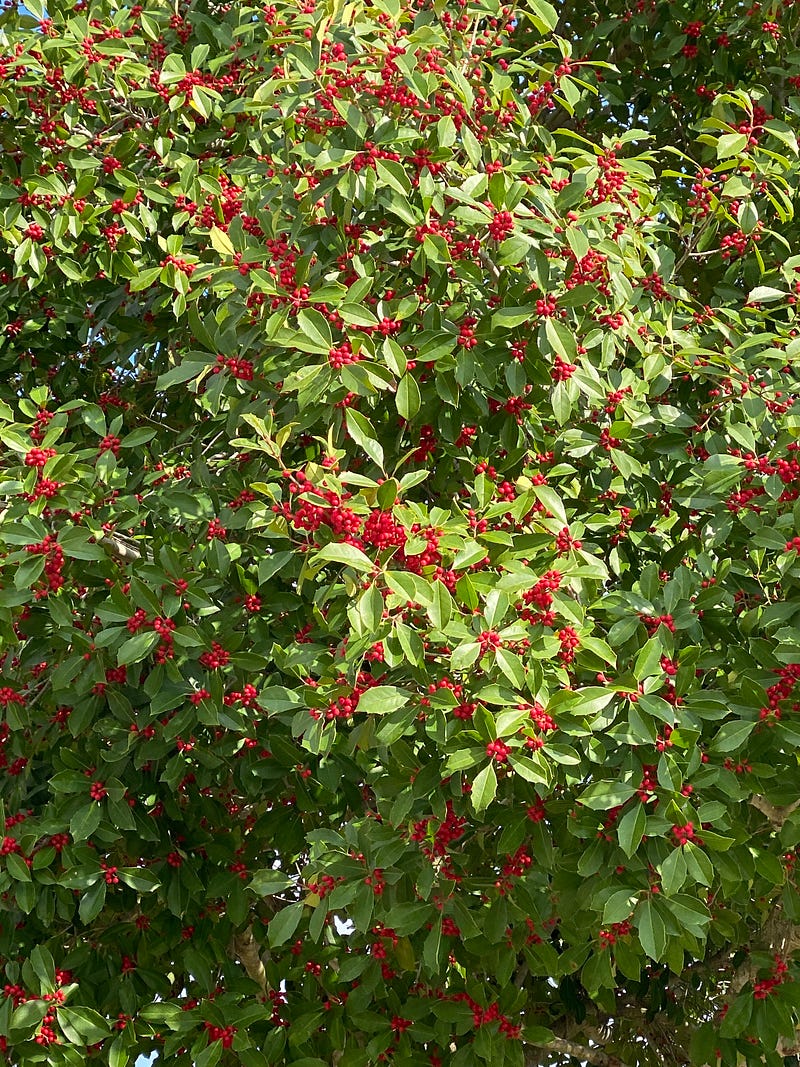
Photo by Author

Berry red, Leaf green

Winterberry Christmassy

Day after Christmas.

We spent Christmas with our extended family and drove back the next day. Just before we got home, we stopped for takeout.

There, in front of our vehicle, was a row of Winterberry Holly trees.

Vibrant green leaves. Masses of scarlet berries.

The colors were so festive — it was Christmas all over again!

Guys n’ Girls…

A curious fact about winterberry hollies is that they are dioecious — meaning that the species has both male and female plants. Only the females produce berries.

A male winterberry must be planted within 40 to 50 feet of a female to ensure pollination. It must be in bloom at the same time as the female. It is estimated that one male plant is needed to pollinate between three to six females.

Dioecy, the existence of both male and female individuals, is rare in flowering plants.

Thank you for reading!

You might like these stories:

Thanks to Dennett and Tracy Aston for publishing my story.

Haiku
Christmas
Plants
Nature
Poem
Recommended from ReadMedium