
Here’s What I Learned After Publishing 100K Words On The Internet
And what I focus on while writing my next

Last November, I decided to take things into my own hands.
Fed up by a year of declining business, many struggles, and even more uncertainty, I decided to stop being the victim. I started writing under my flag, using Typeshare.
There, I can see how long I’ve been writing and how many words I’ve published.

It’s an incredible way to keep going.
And it helps to learn more about yourself. That’s why, after writing online for 3 months and publishing more than 100K words, I want to share what I learned.
A writing habit is everything
When you want to be a writer, then write.
Treat it like W. Somerset Maugham:
“I write only when inspiration strikes. Fortunately it strikes every morning at nine o’clock sharp.”
Nicolas Cole and Dickie Bush are huge advocates of their so-called “sacred hours.” Just like Maugham, they advise you to create hours to write without distractions.
When? That’s up to you.
I write every morning at 06:30 am.
It’s when I’m the freshest, most creative, and most motivated. Because, let’s be honest: sometimes, even writing sucks.
But when you get your habit in place, you don’t care because you write anyway.
That’s what you need to publish 100K words on the internet and aim for a million.
The bigger the sample size, the better your research
Or: quantity first, quality second, then vice versa.
In the beginning, you have no idea what sticks and what doesn’t. But this isn’t a problem when you treat it like an experiment.
Write something, hit publish, and while you see how it develops, you already write the next thing. Hit publish again and repeat the entire process.
You need to get your foot in the door.
Since starting last November, I’ve published over 90 stories here on Medium, hundreds of Tweets, and dozens of LinkedIn posts.
One of the most important things I’d tell myself from November 2023:
“Dude, don’t worry. Nope, just don’t. Write more. Yes, even more.”
Dicke Bush said if he had to start again, he’d tweet 10 times daily. Yes, it seems outrageous.
But it’s great to figure out what works and what doesn’t.
Write and publish more, refine, then repeat.
Don’t be the rare after-war marmalade
Meaning: don’t spread yourself too thin.
If you don’t have a mountain of money to use to live comfortably and try growing as a writer, don’t publish on any platform.
Yes, that’s the opposite of what most established writers say.
But you have to think about it.
Even if you “only” repurpose your content, you must format it, rewrite certain parts, and schedule it. If you haven’t done this before, it’s more than exhausting. I can tell.
You can do more by doing less.
That’s one of the reasons why I stopped using X.
Focus on the type of content you enjoy first. Then, think about repurposing (or not).
Take your time on the platform you like to improve.
Compounding is the real deal
Yes, I was skeptical, too.
But it all adds up. When I started writing here, I struggled to exceed $15 an entire month.
The following month was $32. That’s already an increase of 200%. This month, I’m earning more than $140. That’s another increase of 400%.
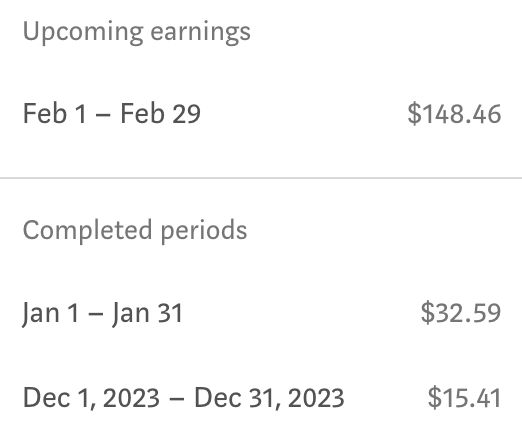
Of course, this won’t go on forever.
BUT you need to let your writing flourish to create an impact.
I once read something ingenious from Derek Hughes:
As a writer, don’t think like a factory worker; think like a farmer.
You don’t put X hours in and get Y output right away.
You put X hours in and get ? output.
However, this output will add over time.
Give it time to compound.
Publishing more than 100k words on the internet has taught me:
- writing needs a proper habit
- first quantity, then quality
- don’t do things you don’t like
- appreciate the effect of compounding
Thanks for reading.
You like what you read? Let me know!
Like, comment, leave a message, and if you want to read more:
The Happiest People In The World Have Realized These 3 Simple Truths


