
Healthy Boundaries Were His Infraction
To the man who quit when told to use personal time for work

I respect you. I admire you. I relate to you. You set healthy boundaries for yourself. When I did, I was told I had a bad attitude and was incapable of following rules or “recognizing authority.” I am one generation older than you, and a woman. I live under the stigma of the “lazy worker,” because I refused to get called into work. “I am not an E.R. doctor” was my mantra - no one was going to die if I stayed home on my day off.
I still remember a brutal job I had in the Florida keys when I was single. All-day driving a stupid beverage cart around, preparing drinks for golf players who would not tip. I worked since early morning, prepared sandwiches, and drove without shields or air conditioning under the burning sun all day. I wore a polo shirt and a mini skirt — the uniform of every blonde they hired to smile while being measured up and down by the old creeps golfing. My shift ended at 5 p.m. but I always had to stay until the last golfer would be gone, which sometimes meant 8 p.m.

The day I returned the car to the garage at 5, disregarding the douche trio who kept asking me to catch them “in the next round” for more drinks, I was written up by my manager the next shift. They were angry. They had complained. From what I heard, they might as well have thrown a tantrum, like little babies. How dare little me, leave them hanging after only five rounds of beers when they still wanted a few more rounds?
As my manager lectured me, I got up and walked away. “I quit,” I said. She yelled, “you can’t quit. This is a visa job.” I replied with laughter. Then, I turned around and challenged her: “Is that why no one quits? Well, go ahead. Call immigration.” Of course, she didn’t call. She wouldn’t even know how to mean her threats.
Years later, having to balance jobs with being a mother, I was interviewing for a recruiter position. The final interview was going great. In the room were my own recruiter, the Human Resources manager, and the two men who own the company. All was well until someone asked me why I had left my previous job. I answered with the truth. “I am looking for work-life balance. I dedicate myself completely to my job and I want to dedicate myself to my family outside of the work hours.”
Silence. The smiles turned into somber faces. Then, one by one they started shaming me for saying what I said. One of them even laughed and advised me, “if you are interviewing for a job, you better not mention you have a family.” The other said, “work-life balance is not something you should expect from a job with the opportunity to grow.”
“Opportunity to grow.” What a scam. I had fallen for it before and I was not going to do it again. It was finally the Human Resources manager’s turn to speak. Ignoring the red flags she had just witnessed, she went ahead with her script: “Why should I hire you?” Silence again. I was staring at her, with a half-smile. In my head, I was saying, “I don’t want the job anymore, in case you haven’t noticed. Why would it take this company three meetings with me to finally wonder what the reason would be to hire me? Have you done no homework? Do I have to answer your test questions for you? What a bunch of bozos.”
Instead, I let my good manners speak. I started slowly, with a sight and a “well, as you probably know by now…” and proceeded to re-list my amazing qualities and tell them how I would be a great asset, all the while feeling like the fraudster myself, wasting their time because there was no way in hell I was ever again going to take a job from a company whose H.R. manager still asks their favorite candidate why they should be hired. That is not only condescending. It is stupid. “I know why I am here and so should you.” That should be the answer.
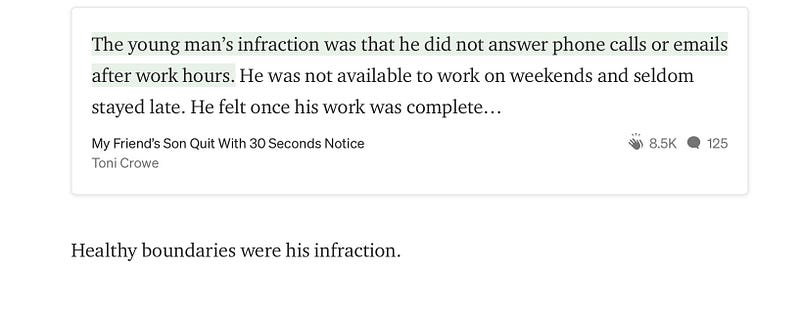
Healthy boundaries. The millennial who was about to get a poor performance review because he would not answer emails outside of working hours is my hero. He walked away without giving a two-week notice.
“The workers today have decided there is more to life than work. They are following a different path to happiness. There is some balance in their lives. The need for this balance is making companies wake up to the fact they had a real good thing going with earlier generations. They could not maintain that loyalty when they broke the social contract by laying people off at their whims as they sought more profit for shareholders.” (from Toni Crowe’s story)
Normalize healthy boundaries. Life is too short to grind for the wealthy. Watch more TV. Go camping. Cook your own meals. Spend time with the people you love. Work on a personal project. Let them figure out how to make things happen when you are not around. You are not their E.R. doctor.
More from This Woman: