
Hacking the Three-Day Effect — How to Maximize Your Nature Fix
Tips for getting the full benefit of time outdoors, even if you don’t have time for a three-day trip
It was early spring and we were paddling down the river and through the snowy marsh with cross-country skis strapped to the decks of our kayaks. While the ice had come out of the river, several feet of snow covered the marsh and the glades beyond. In the summer, the glades are inaccessible due to the boggy ground, but today we would ski from the shore of the river and explore the sunlit glades.
It was a sunny day in February and there I was, riding my bike (outfitted with studded tires) up the snow-covered river, towing a sled that held skis, ice skates, and a picnic lunch. My partner Leslie, who had been cross-country skiing nearby, joined me, and together we traversed several beaver dams and made our way up a long straightaway toward the southwest. The river ahead was glassy black ice bisected by a 10-foot centerline strip of fresh snow. We flipped the sled over as a bench and ate our lunch. Then we took turns skating on the smooth ice and skiing on the powdery center strip, all the while delighted by the warmth and the sunlight.
It was early May and there I was, kneeling on the sun-spattered hillside amidst the new spring growth. I had gone off-trail and was alone. Where exactly my students were, I was for a rare moment unconcerned. Bells, schedules, and lesson plans seemed far off. What captivated my attention was the wintergreen flower in front of me. “If you go where you always go, you’ll see what you always see,” I had said to my students just a few minutes before. “Take a few steps off the path. Seek edges and transition zones — streamside, hillside, shaded areas, sunlit areas, wet areas, dry areas — if you want to find something new.”
What time in nature can do for us
What these moments had in common was a sense of immersion. In each instance, I was focused on my surroundings, free of my usual cyclical patterns of thought. I was entranced by simply being where I was. Time expanded. I felt adventure and novelty. As if seeing the world for the first time. As if in the act of being there, I was getting away with something; I was breaking the rules — but in a good way.
The 20–5–3 Rule and the three-day effect
Think of a time when you felt alert yet relaxed. A time when the anxieties and concerns that normally buzz through your brain were magically absent. A time when you felt creative and vividly awake, alive, grateful, and in tune with your surroundings. This is the brain state that nature can deliver us to.
A copious amount of recent research tells us time in nature is essential to human health — and has significant benefits to mood and mental well-being. Most people are aware of this — and our grandparents somehow knew it, even without the research.
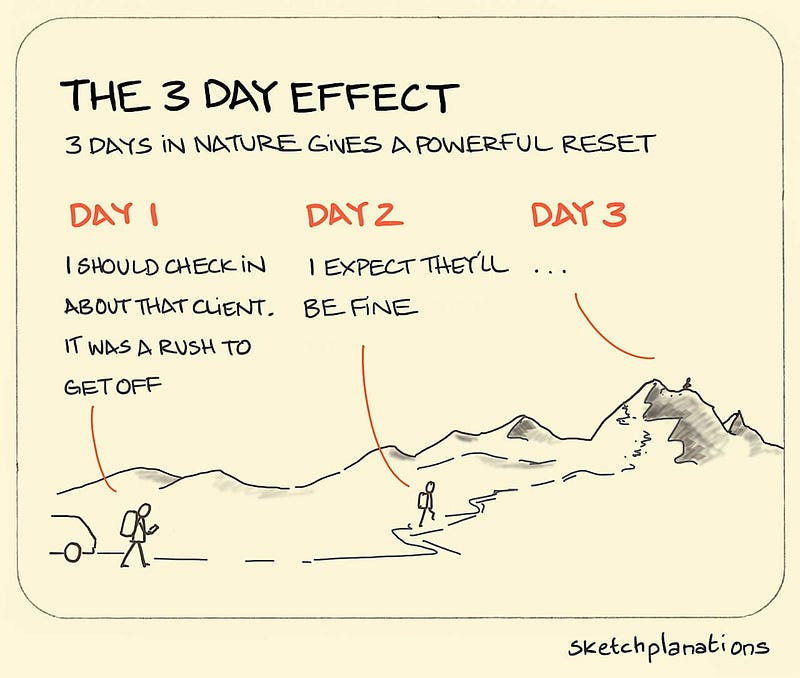
Many have heard of the nature pyramid, which recommends the minimum “nature dose” required for health. Some are familiar with the 20–5–3 rule, which prescribes 20 minutes a day in green spaces, 5 hours a month in natural landscapes, and 3 days a year in true wilderness.
In short, a short walk in a local greenway is good for you, a day hike in a state park is better, and a several-day stay in the wilderness is best.
The research shows that while even a small dose of nature reduces stress, lowers blood pressure, and benefits overall health, crossing the three-day threshold can amplify those benefits as well as exponentially boosting creativity, sense of connection, and feelings of well-being. In other words, extended time in nature brings additional benefits — and those benefits are the frosting on the cake.
The frosting on top of the nature pyramid is represented by 3-days in a true wilderness. Research suggests there is something magical and synergistic in the suggested 72-hour time span. In particular, studies reveal reduced stress and anxiety levels — and a significant boost in creativity. One way this shows up is in the form of increased alpha and theta wave activity in the brain.
Does it always take three days?
The paddle down the snowy marsh, the bike trip up the frozen river, and the quiet moment on the hillside show three days isn’t always needed to bring about the healthy brain shift that can occur when we’re out in nature.
To my thinking, three days is the middle of the bell curve — the average amount of time needed for people to make that brain shift, especially if they’re not being intentional about it. But who wants to hang out in the middle of the bell curve? If you go with intention and purpose, maybe the three-day “minimum” isn't an absolute.
I went to the woods because I wished to live deliberately, to front only the essential facts of life, and see if I could not learn what it had to teach. -Henry David Thoreau
Can the 3-day effect be hacked?
What brainwave research shows
As mentioned above, research shows that spending extended time in nature leads to beneficial changes in brain wave activity. Alpha waves (associated with decreased anxiety and increased clarity) and theta waves (associated with calmness, creativity, and a dreamlike state) are shown to increase. One study, for example, found that people who spent four days in nature had more alpha waves in their brains than those who stayed in urban environments. These changes in brainwave activity are associated with improved mood, reduced stress, and increased focus and concentration.
Brainwave research in other areas (nonspecific to the 3-day effect) finds the alpha/theta state can be attained in fewer than three days. For example, research shows that regular practice helps the brain attain the buzzy alpha/theta state more easily. Other studies find that for those who meditate regularly, the brainwave changes gained through meditation can be permanent. In other words, even when the person is no longer meditating, elevated levels of alpha and theta waves are likely to be present.
In addition to meditation, physical exertion, and biofeedback are other ways to increase alpha and theta waves. This implies that spending three days in nature is not the only way to reach the alpha/theta state and that reaching that state may not be as time-dependent as previously thought. If time in nature, exercise, and mindfulness are combined and done regularly, our brains can be primed to reach the alpha/theta state more readily.
According to research, the following are conducive to getting to the alpha/theta state more quickly: — Good overall health (sleep, meditation, exercise, diet). — Regular practice in reaching the alpha/theta state. — Pairing outdoor time with yoga, Tai Chi, and other forms of exercise. — Pairing outdoor time with music, aromatherapy, attention to nature sounds, and other practices that help open our senses.
What my experience shows
Based on decades of experience in as an outdoor trip leader and adventurer as well as my experience in completing the Basin Pond Challenge (an hour outside every day for a year, regardless of weather), I would say yes, it’s possible to hack the pyramid. Here are some tips that can help you reach the top of the pyramid. You can try them one at a time, or you can combine several of them together.
— Pay attention to gear. Practice with gear. This ensures you will feel secure and relaxed. It reduces the chance that gear will be a distraction while you’re out there. Make sure you’re dressed for comfort, and bring something to sit on if you plan to pause. Have everything you need and want with you. — Pause and celebrate moments. Bring something special — a drink or a snack — so that you’ll have occasion to pause and soak in your surroundings. This is similar to the tea-ceremony concept used in forest bathing. Pausing and breathing can open your senses and help you engage more fully in the present moment. — Bring poetry or other inspirational writing with you. Even better if you memorize a few stanzas beforehand. It can be a mantra or a phrase that’s meaningful. For example, a line from a Mary Oliver poem, “May and among the miles of leafing . . . ” Let the words resonate. Repeat the phrase especially when thoughts of the non-present start to intrude. This helps free the mind from rumination and usual patterns of thought. — Combine several activities. Mix it up. Bike and hike. Bike and paddle, ski and paddle, bike and ski, hike and orienteer. Multi-sport trips delight the body and mind. These trips trick your brain into believing you are on an expedition rather than an afternoon jaunt. In addition, this kind of trip has an enhanced spirit of novelty about it. See below. — Go off the beaten path. Go somewhere new. Go before dawn or after sunset. Go off-trail. Add an extra leg or bonus time. Avoid out-and-back trips and routes you are overly familiar with. — Choose your companion(s) carefully. It’s difficult to achieve those alpha/theta levels if your companion is talking non-stop about work or politics. A like-minded person and fellow awe-seeker who is likewise intentional about getting the full benefits of nature can support your own quest. And sharing this experience with another person magnifies it and makes it more real. — Gently dismiss thoughts that are not of the present. Focus on your surroundings. practice mental discipline, and put rumination to rest. When thoughts of work, family, money, politics, etc. surface, repeat your mantra (see above) or remind yourself “I can think about this later when I get back home.” — Physically push the pace at times. This helps maximize endorphin levels which in turn can help your brain produce more alpha waves. — Seek liminal places. Liminal places are edges and transition zones. The edge of the sea, the bank of a river, the top of a hill, the edge of a field. These places have particular power in the human imagination and inspire awe. Try it and see. — Pay attention to timing and natural “signposts.” Go at high tide or low tide, new moon or full moon. Time your trip to coincide with bird migrations, sunrise, sunset, rainbows, thunderstorms, or rainstorms. Go on the coldest day or the warmest day. Celebrate ice out or new ice, a solar eclipse, a lunar eclipse, planetary alignment, meteor showers, or the Northern Lights. You get the idea! — Go frequently — make it a practice. Even if it’s just to a local park. Even if some visits are just for ten minutes. The frequency of your exposure may help rewire your brain to more readily reach the alpha/theta state. — Pre-plan to optimize the above. Having the right gear and being able to watch the moon rise doesn’t happen by accident. It takes planning. You’ll be glad you did. — Write or talk about the experience afterward. This helps you re-live the experience and makes it more real in your memory. It also inspires you and others to return for more.
Our species evolved in the outdoors. Our brains evolved in nature and function best when they’re immersed in nature. Unfortunately, modern life limits our time in nature, so that’s why it’s important to be able to maximize the benefits we get from even small doses of nature.
Taking an annual three-day trip into the wilderness is definitely a worthwhile goal. But in the weeks and months between those trips, it’s nice to think there are ways we can still get a full fix of nature. The top of the pyramid provides a great view — one that deserves to be enjoyed more than once a year.
To read more about the connections between nature and wellness, please see:


