avatarChristianlauer

Free AI web copilot to create summaries, insights and extended knowledge, download it at here

1068

Abstract

e-biglake-2836397a3001">this article</a> and provided a small tutorial — here also the official statement by Google:</p><p id="0e69"><i>Built on years of investment in BigQuery, BigLake is a storage engine that allows organizations to unify data warehouses and lakes, and enable them to perform uniform fine-grained access control, and accelerate query performance across multi-cloud storage and open formats. — Google [1]</i></p><p id="c6b3">Google Big Lake or BigLake to be correct is designed to allow companies to unify their Data Warehouses and Data Lakes without having to worry about the underlying storage format or system. You can easily access Google internal storage as well as cross-platform data such as Microsoft Azure or AWS within BigQuery using SQL, without having to cache it. It’s a big benefit that you don’t have to duplicate your data in two different environments and create data silos. You can also support your data governance because with BigLake you can also assign rights to the data.</p><figure id="2444"><img src="https://cdn-images-1.rea

Options

dmedium.com/v2/resize:fit:800/0*VGIKpG3hkg-w1_Ki.png"><figcaption>Google BigLake — Source: <a href="https://www.nextplatform.com/2022/04/06/google-biglake-stretches-bigquery-across-all-data/">THENEXTPLATFORM</a></figcaption></figure><p id="b9e6">With the new capabilities you and your organization will gain more power and benefits in your daily data integration and analytics processes — like <b>Better Security and Governance Controls, Performance and Scalability and Easy Data Control.</b></p><p id="e29a">All in all, great news, as it makes it even easier to create Data Lakehouses. Existing features such as the Google Analytics Hub and the ability to control access to the data also provide opportunities to successfully establish the Data Lakehouse as a <a href="https://readmedium.com/what-is-a-data-mesh-ef2b7b5e740e">Data Mesh approach</a> in the company and strengthen your data governance.</p><h2 id="574d">Sources and further Readings</h2><p id="d3f0">[1] Google, <a href="https://cloud.google.com/biglake#section-4">BigLake</a> (2022)</p></article></body>

Google launches new Data Lakehouse Engine — Big Lake

How it’s great News for all Google Cloud Platform Users

Photo by Redd on Unsplash

Google is bringing out new guns to support companies even better in the creation of data platforms. With BigQuery, customers already have a wonderful easy-to-use SaaS Data Warehouse and, with various cloud storage options, the possibility to build the matching Data Lake. The two interacting in a Data Lakehouse is not new — but with BigLake it is now gaining momentum.

I had already addressed the topic in this article and provided a small tutorial — here also the official statement by Google:

Built on years of investment in BigQuery, BigLake is a storage engine that allows organizations to unify data warehouses and lakes, and enable them to perform uniform fine-grained access control, and accelerate query performance across multi-cloud storage and open formats. — Google [1]

Google Big Lake or BigLake to be correct is designed to allow companies to unify their Data Warehouses and Data Lakes without having to worry about the underlying storage format or system. You can easily access Google internal storage as well as cross-platform data such as Microsoft Azure or AWS within BigQuery using SQL, without having to cache it. It’s a big benefit that you don’t have to duplicate your data in two different environments and create data silos. You can also support your data governance because with BigLake you can also assign rights to the data.
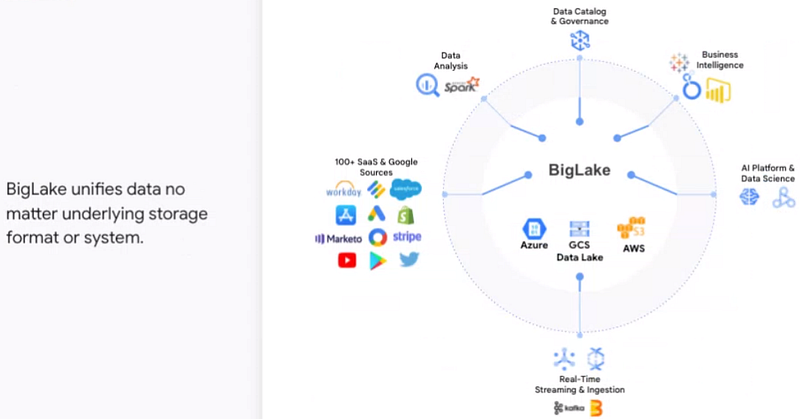
Google BigLake — Source: THENEXTPLATFORM

With the new capabilities you and your organization will gain more power and benefits in your daily data integration and analytics processes — like Better Security and Governance Controls, Performance and Scalability and Easy Data Control.

All in all, great news, as it makes it even easier to create Data Lakehouses. Existing features such as the Google Analytics Hub and the ability to control access to the data also provide opportunities to successfully establish the Data Lakehouse as a Data Mesh approach in the company and strengthen your data governance.

Sources and further Readings

[1] Google, BigLake (2022)

Google
Big Data
Data Science
Technology
Data
Recommended from ReadMedium