
Goodbye Bench Press
A better way to build a big chest?
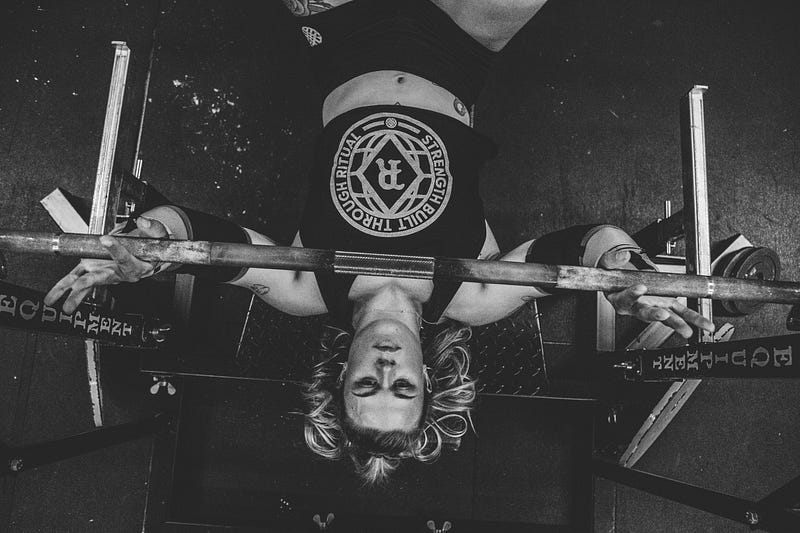
Everybody wants a bigger chest, and no exercise carries more bragging rights than bench press. Serious lifters might ask how much you squat or deadlift, but 99% of people just want to know how much you bench. It’s no surprise. Impressive numbers on bench press will almost inevitably belong to athletes with thick, well developed pecs. Being a compound exercise, bench press also builds your front delts and triceps. It’s a fundamental exercise and I have been a stalwart for as long as I’ve been lifting weights. Steadily building up your poundage and repetitions on the bench press is a tried and tested way of building your chest.
In my articles on building bigger arms and making my wife stronger than you, I mention that compound exercises are the most effective for building muscle. That’s because compound exercises allow you to move heavier weights. Your body’s appearance and condition are a direct reflection of your body’s ability. The more weight you can lift, the more muscular you will be.
That said, in my quest for a bigger chest, I’m going to be dropping bench press from my routine. That’s right, no more bench pressing to build a bigger, stronger chest.
The best chest exercise?
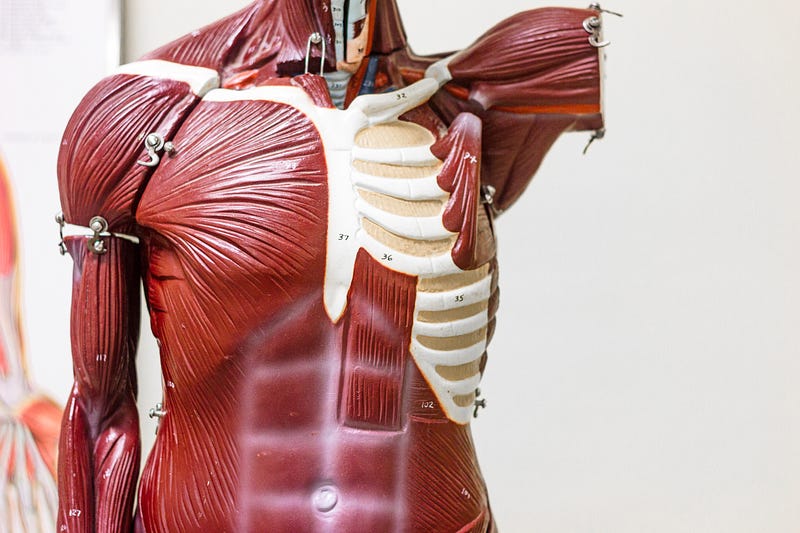
Bench press works, but is there an exercise that works even better? Even if there is, why not perform it in addition to bench press? To answer these questions, let me give you some background.
In 2019 I lost all of my muscularity and strength after hospitalisation for a life threatening illness. I had sepsis, which kills around 25% of people who contract it and does serious damage to a lot more. That was followed by two years of inability to exercise due to adhesive capsulitis.
When I got back in the gym last June, I was starting from scratch, building muscle in my forties. I was weaker than I’d been at any time since my teens. I had to find the best routine to build muscle and strength in the shortest amount of time. That meant there was no room in my training for ineffective exercises.
The three exercises I’ve used to rebuild my chest are bench press, dips and chest fly. I get stronger on every workout and my chest has grown, a lot. One might argue that I’ve simply benefitted from muscle memory. My training partner on the other hand is in his fifties and had never lifted weights before, he’s also had significant strength increases and growth.
With bigger muscles, and renewed confidence, in December 2021 I set the target of bench pressing 100kg again (I did that with ease in my twenties). As part of my strategy, I’m going to stop bench pressing altogether, for six months…
How can I improve my bench press without bench pressing?
You can improve your bench press by making your chest, shoulders and triceps as strong as possible. Bench press is not necessarily the best way to do that.
In bodybuilding, there are two distinct paradigms .One is the high volume approach practised by stars like Arnold Schwarzenegger in the 1970’s, and immortalised in the popular documentary Pumping Iron. The other is the low volume, high intensity approach, developed and spearheaded by Arthur Jones in the 1970’s, and Mike Mentzer in the 1980’s and 1990’s.
The high intensity approach dictates much briefer, much less frequent workouts than those favoured by the high volume trainees. Whilst Arnold and co. would spend several hours in the gym every day, Jones’ trainees, including Casey Viator who became the youngest ever Mr America, were training for less than an hour, every other day. Later, Mike Mentzer advocated even shorter, less frequent workouts.
High intensity training recognises the importance of rest and recuperation between workouts. It also acknowledges the body’s very limited capacity for hard work. To activate the greatest strength increases and muscle gains, you must push a muscle to the absolute limit of its capability because that is what triggers the biological adaptation leading to increased strength and muscle size.
When done properly, high intensity training is brutal. Let’s look at Arnold Schwarzenegger's impression of it. After Schwarzenegger spent time at Arthur Jones’ training facility with Casey Viator, he wrote an article in one of Weider’s magazines titled “Arnold Invades the Viator Torture Chamber.”
“Viator” he wrote “tortures himself to hysteria. Some day, he might have to be dragged from the gym in a straight jacket… He does forced reps until an observer could puke from the horror.”
Describing the intensity of Viator’s workouts, Schwarzenegger continued “(a) dedication and madness no bodybuilder has ever approached. If I had to do this every day, I’d opt for a hernia, go back to Austria, and be a ski instructor.”
Arnold could not train with anything approaching Viator’s intensity, but he could train for up to four hours a day. You can train long, or you can train hard. You can’t do both.
Training really hard and pushing your muscle to the point of failure involves techniques that are easier to apply with some exercises than they are with others. Bench press it turns out, is not the best exercise for really high intensity muscle stimulation.
What is the best way to train?
The guiding principles of volume training are that a muscle must be trained from every angle with a variety of exercises to fully develop it, and more exercise is better than less. The logical extension of these principles, representing the best of volume training, would be to train a body part, all day, every single day, with as many sets of as many exercises as possible. If that worked, typists, pianists and guitarists would have forearm muscles capable of humiliating any other athlete, and if they were on steroids, they’d make bodybuilders’ forearms look puny too. But that’s not the case. The volume of work is not what determines muscle growth. It is the intensity of the work that determines your results.
Intensity can be translated as hard work. You are training at maximum intensity, when your muscles couldn’t possibly be worked any harder. Pushing your muscles to an almost unbearable, almost fatal limit, alerts your body that it must adapt in order to survive a similar assault in the future. The adaptation occurs in the form of stronger, larger muscles. Repairing and building muscles takes energy. So you must use as little energy as possible in the gym to leave as much as possible for the repair and growth of your muscles. In the gym, you are destroying your muscles, you are not growing.
The logical conclusion of the high intensity approach is to trigger growth with the least amount of work possible, and to work as hard as possible, then rest for as long as is necessary to allow full recovery and growth.
Doing the least amount of work possible means only doing one set of one exercise. The three best chest exercises are bench press, dips and flys. Flys do not allow you to handle as much weight as bench press so the most effective movement must be dips or bench press. Bench press does not allow you to safely incorporate the most effective high intensity technique, which leaves dips. Done properly, dips can stimulate greater strength gains and growth in your chest, triceps and front deltoids than any other exercise.
Negatives, the secret sauce
In the 1960’s nobody in bodybuilding outside Arthur Jones’ circle had ever heard of a ‘negative.’ Nowadays, the term is freely used along with other bodybuilding parlance. But the technique itself is poorly understood.
Every person has three different levels of strength. By exhausting the strongest of the three, you will stimulate the greatest possible amount of growth. Your three levels of strength are your ability to lift a weight, your positive strength, the ability to halt the motion of a weight, your concentric strength, and the ability to lower a weight under control, your negative strength. Your positive strength is the weakest, and your negative strength is the strongest, with concentric strength being in the middle.
Performing negatives will take your training and your gains to the next level. In the 1963 Colorado Experiment, Casey Viator gained over 60 pounds of muscle in one month using a routine where half of the exercises were negatives, sometimes to the exclusion of positive and concentric work.
Dips allow you to safely perform negatives, whilst bench presses do not. Even if you have a training partner who can initially lift your bench press weight, strength gains using negative training tend to be rapid, and before long, your partner will not be able to safely assist you.
As negatives are your strongest level of strength, you can train them after you have exhausted your concentric and static strength, and this can all be done in one set.
How to perform negatives for rapid strength increases
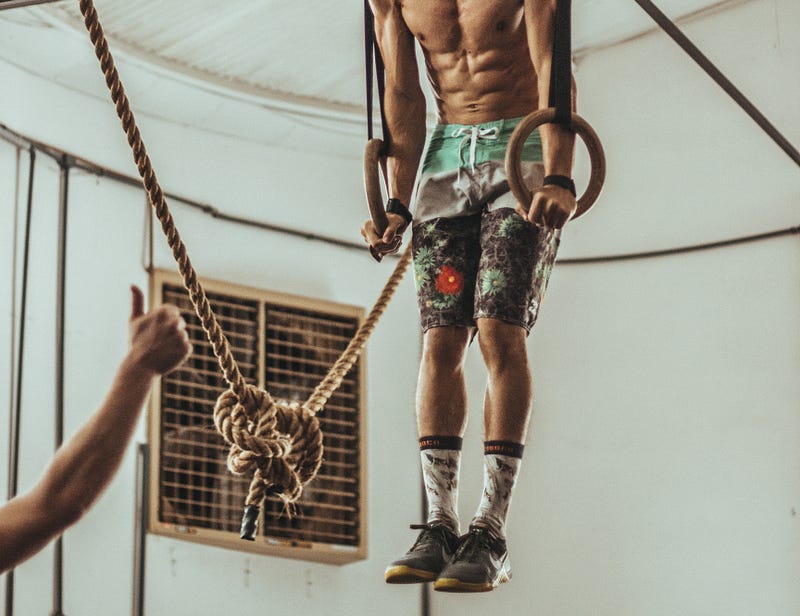
If you want to see some serious strength gains in your chest, triceps and front shoulders, do the following. Perform a set of dips and take it as far as you can. The last rep should be almost impossible, with the positive part of the movement taking at least 3 seconds. If you can do it faster than that, you can do another repetition. At the top of your final repetition, unlock your elbows so your weight is being supported by your muscles and not your skeleton. Then stay there as long as you can. At this stage you are exhausting your concentric strength. Eventually gravity will start winning and you will be forced downwards. Fight it, this is where the real battle begins. You are now using up your negative strength. When you have been forced down to the bottom of the movement, step back up into the top position immediately and repeat. Keep going until you are no longer able to lower yourself under control. Most trainees can perform 2 to 5 negatives at the end of a set.
Having a watch or clock in sight can be helpful when performing negatives. If you set yourself a target of a thirty second descent you are likely to last longer than if you just fight gravity with no idea how long it’s been. Negatives are painful and at the end of a set, you will feel tired, often out of breath, and occasionally dizzy. That’s what hard work can do.
You could perform bench press in a safety rack, with the pins set just at the right height to stop the bar from crushing your chest at the end of a negative. But you’d only be able to perform one negative, and wriggling out from underneath the bar can be difficult.
How much rest is needed for the best results?

You only need to perform one set in the above manner, then go home and rest. The speed at which your body will be able to recover, repair and then build more muscle varies from individual to individual, just like height, eye colour or intelligence. It is advisable not to exercise for two full days between each workout. If you are sore after a workout, you should wait for at least a day after the soreness is gone before returning to the gym. Some people don’t even get sore until forty eight hours after a workout. Recovery, repair and growth take time. Once you have triggered growth, rest is the most productive part of any muscle building regimen. The most effective way to trigger growth is by training as briefly and intensely as possible.
When you return to the gym you should be able to perform more repetitions. If you are not seeing stair step progress on every single workout, you need to rest longer between workouts. I have a friend in his mid fifties (not my training partner) who is seeing the best gains of his life working out once every nine days. Personally, I workout once every seven days. Tom Platz used to train his legendary legs once every fourteen days. Mike Mentzer had clients who made their best progress on a similar schedule.
Most people train too often or don’t train hard enough. Following the advice in this article, you will probably surprise yourself with the speed of your strength increases. Once you can perform 20 repetitions before your positive strength is spent, invest in a dipping belt that allows you to add weight around your waist. Start by adding 5kg, and once you can perform twenty dips with that weight, add another 5kg, and so on.
What if I’m too weak to dip?

Some people can’t perform a single push up, and dips are much harder. If you find that you’re too weak to perform a single dip, don’t fret. Once again, negatives can save the day.
Many gyms feature assisted dipping machines now but building up to a full dip using negatives will be more intense and lead to faster gains in size and strength. If you cannot perform the positive part of a dip, take advantage of your negative strength. Perform negative only dips.
Start at the top of the dip, unlock your elbows, and make the descent into the fully stretched bottom position as slow as possible. Fight gravity all the way. From the bottom position, step up to the top immediately and repeat. Keep going until you can no longer control the downward motion. When you can make the downward movement take 60 seconds on the first repetition, you will be strong enough to perform full dips on your next workout.
The next level
Exhausting all three levels of strength in a single set is extremely effective. Performing a negative only set can be even more effective. This may be because you are exhausting your greatest level of strength, but making less of a demand on your body’s limited energy reserves, leaving more for repair and growth.
Negative only dips are performed as described in the previous section. Rather than progress to normal repetitions once you can make the first descent take 60 seconds, you simply add weight. You don’t need to be as cautious as you do with positive repetitions. When I last used this technique I was adding 10kg each time. Eventually I was able to perform a 60 second negative with 40kg added to my bodyweight.
Massive triceps getting the way?

Everybody is different. Some people have disproportionately strong triceps and weak chests. Some people have disproportionately strong pectorals and weak triceps. If you find that your chest is never sore after an all out set of dips, it may be because your triceps are taking all of the load, or because your triceps are giving way and bringing an end to the set before your chest has been properly stimulated. If that is the case, or you notice that your triceps and shoulders have grown significantly whilst your chest is lagging behind, there’s simple fix. Before you do your dips, pre-exhaust your chest with an isolation exercise like dumbell flys, machine flys, pec deck, or cable crossovers. Go at least to positive failure on the pre-exhaustion exercise, then move immediately, with no rest to the dips.
If you are tempted to use a pre-exhaustion cycle without even trying dips only, don’t. Pre-exhaustion can lead to overtraining more easily than normal sets, and the best way to stimulate muscle growth is with the least amount of work required, at the greatest intensity possible.
Only use pre exhaustion if you are not seeing increases in chest size and strength on a regular basis. Before you incorporate pre-exhaustion, insert an extra rest day between workouts. If that does not improve your results, then start doing the isolation exercise before the compound exercise.
Perform one set of dips or one set of pre-exhaustion dips, going all the way to positive, concentric and negative failure, then get adequate rest, and you WILL grow and you WILL see significant strength increases.
Hello again…. Bench press
Bench presses are just a tool, so are dips, so is every other exercises. They are tools we use to build our body. For the best results, we must use the best tools in the best way.
I love bench pressing, and I will return to it. But what I am setting out to build is the biggest, strongest chest I can. To do that, I’m just going to do dips. One set, once every seven days, going all the way to negative failure. I’ll stick with this routine for 6 months, and at the end of it I know my chest, triceps and anterior deltoids will be significantly larger and stronger. That means I’ll be able to bench press a lot more than I can now, and I’ll stand a much better chance of hitting the 100kg target I set myself in December 2021.
If you’ve enjoyed reading this article and you’re not a Medium member, you might notice you can only read 3 articles per month. If you create an account, you can read 5 articles a month without charge. But if you become a member ( only $5/month or $50/year) you can read as many articles as you want, ad-free. You can become a paying member here and if you use my link I retain a small portion of your fee. Thanks for your support!