
My wife is going to be stronger than you
Stop being a wimp and lift some real weights
I make old men stronger than young men, and women stronger than some men
Do you lift weights or do bodyweight exercises like calisthenics? If you do, good for you, but why do you do it? Is it to be able to perform a certain move to impress your friends? Is it to look a certain way? Is it for health reasons? Is it to improve your confidence? Whatever the reasons, if you work out and you’re not getting stronger, you’re wasting your time. If you lift the same weights or do the same repetitions every time you go to the gym, you may as well not bother, because you’re not making any progress.
Whenever somebody trains with me for an extended period of time (a month or more) they make progress, it’s as simple as that. A lot of them tell me it’s the best progress they’ve ever made. Some of them have never trained before, so they don’t know any different. My current training partner is a 55-year-old who had never lifted weights before, and now on several exercises, he is lifting more than guys half his age who’ve been training for much longer than he has.
My new training partner is my wife. She hasn’t done any real exercise in over a decade. She is slender and built for a sport like long-distance running, she has long legs. She was a very good long-distance runner when she was younger. Despite her appearance, I know that in a few months, she’ll be lifting more than a lot of guys. I’m going to have a lot of fun showing them up in the gym when I’m training with her.
Why get stronger?
Because you can. Being stronger makes you fitter, less prone to cognitive degeneration in older age, less prone to injury at any age, more confident, and sexier. On top of that, it’s satisfying. Adding more weight or more repetitions to every exercise you do, every time you visit the gym feels absolutely fantastic. You can set new personal bests every week. And as you get stronger, you will notice changes in your body as well. The stronger you get, the better you’ll look.
But I don’t want to get too bulky?

Stronger muscles become bigger muscles, but they’re extremely unlikely to make you look ‘too bulky’. For every 10,000 people, you’ll probably have one with the genetics to build a huge muscular physique. And even the genetic freaks are going to need steroids to look like the hulking bodybuilders that some people use as an excuse not to lift weights in the first place.
Look up guys like Clarence Kennedy or ‘Squat Senpai’ on YouTube and you’ll see what guys without the genetics for bodybuilding (that’s the vast majority of us) and without steroids look like when they get really strong; they look fantastic.
If you’re looking unattractively bulky and you’re not a genetic powerhouse, you’re probably just carrying too much fat. You need to address your caloric intake.
For everybody else, getting stronger is going to seriously improve their health, and their appearance. And let’s be honest, everybody wants to look a little more athletic.
OK, so how do I get strong?
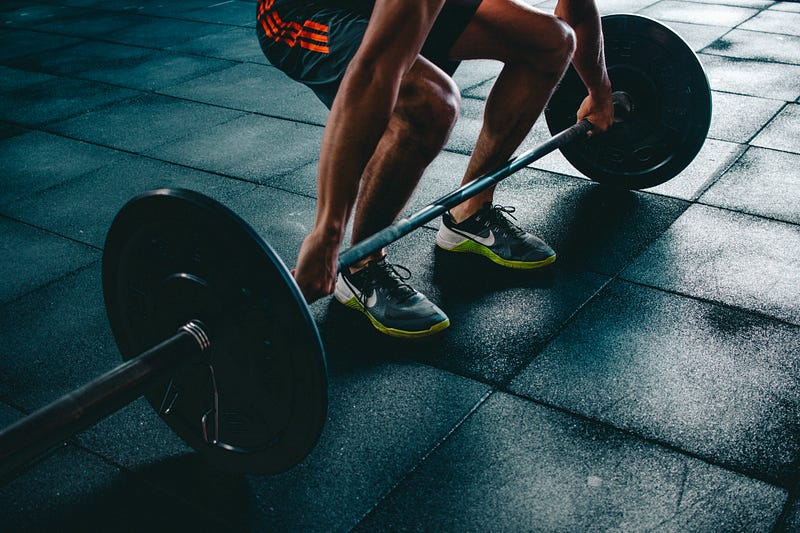
Getting stronger is very straightforward, but it’s not easy. There are only two things you have to do; work as hard as you can possibly work in the gym, without sacrificing exercise form, and then allow enough time for your muscles to recuperate, repair and overcompensate before going to the gym again. How long is that? It depends on your level of development. Most new trainees under the age of forty will do very well with two days of rest between each visit to the gym. I like to rest for a full six days between workouts. You read that right. I train my whole body in one session, then I do no more work for a full six days. And it works. I add reps or weight to every exercise I do, every time I visit the gym. And my wife will be able to do the same. That’s why she’s going to be stronger than you. Resting long enough between workouts means you can consistently make progress, and consistency wins every time. If you keep at it, it doesn’t matter where you start, in time you’ll be moving some impressive weights.
Shouldn’t I train everyday?
No. Not if you want to get as strong as you can in the shortest time possible.
In the nineteen seventies it was the trend for bodybuilders to train for up to six days a week, for several hours a day. That’s what Arnold Schwarzenegger did, and he was considered the greatest, so his style of training was considered the greatest as well. Schwarzenegger has always had an admirable work ethic, but it doesn’t make him right.
Even Arnold never trained the same body part two days in a row, realising that he had to allow some time for recuperation. Currently, the ‘Squat every day’ trend is clearly evident on social media. There are countless videos of people ‘squatting everyday’ on YouTube, sometimes for years on end. The craze seems to have been sparked by something called ‘The Bulgarian Method.’ The YouTuber Omarlsuf claims to have popularised the said method. In one of his videos he shouts “we don’t give a shit about science!” No kidding Sherlock.
There is a lot of psychology involved in lifting very heavy weights, and training everyday gives you an advantage in mastering that. But in my experience, and the experience of all the people I have trained with over the last 25 years, it is not the best way to get as strong as possible, as fast as possible. If you train to failure, the point at which another repetition is impossible, you have done all you can to trigger a muscular adaptation. The muscle has to recover, then be given time to grow. If you allow for that to happen, you will be stronger on your next workout.
What about muscle soreness?

If you experience muscle soreness after workouts (not everybody does), you can use it as a guide. Do not go back to the gym if you are still sore. In fact, if you were sore yesterday, don’t train today. Allow a day of no pain before lifting again. Muscle repair and growth are slow processes, so give them time. If you don’t experience regular muscle soreness, allow at least 48 hours before returning to the gym.
Recently I took two weeks off due to illness, and my arms grew visibly. Your muscles recover and grow whilst you’re resting, not whilst you’re training, so give your muscles time. You’ll be glad you did when you start lifting more than all the gym rats.
What’s the routine?
Getting stronger means improving the strength of all of your major muscle groups, not just maxing out on squats. The exercises that promote the biggest strength gains and most muscle growth are compound exercises. I wrote about this recently in Bigger arms in less time.
To make progress you need to stick with the basics. there are no magic exercises. ‘Magic exercises’ and ‘secrets to burning belly fat’ are all just different flavours of bullshit designed to make you watch videos and buy courses.
Dr Mike Israetel expands on this in the excellent video below.
Unsurprisingly then, the routine that I’m using to turn my wife into a paragon of physical strength and conditioning doesn’t involve any cables, or kettlebells, or medicine balls. All we use is bodyweight and barbells. The whole routine is below.
- Squats
- Deadlifts
- Chin ups
- Bent over barbell rows
- Bench Press
- Overhead press
- Parallel bar dips
- Standing calf raises
After warming up with a lighter weight, perform one working set of each exercise to failure. Write down the weight you lifted and the number of repetitions you performed. Next time you’re in the gym, lift more. When you can do more than 12 repetitions on any upper body exercise, increase the weight at your next workout. For lower body exercises, increase the weight when you can do more than 15 repetitions.
But I’m scared of barbells and too weak to lift my bodyweight.
All of the exercises above can be substituted for machine variations. Squats and deadlifts can be replaced by leg press, leg extensions and leg curls. Bench presses, overhead presses and rows can all be performed on machines. Chin ups can be performed on the pulldown machine, or on an assisted chinning bar. Some gyms have dipping machines. If your gym doesn’t have a dipping machine build up your strength using negatives.
Get on with it.
Unless you have a really compelling argument against getting stronger (there aren’t any), get in the gym and use the advice in this article. In six to twelve months my wife will probably be one of the strongest people I know. You can do the same, or you can stay wimpy. It’s up to you.
If you’ve enjoyed reading this article and you’re not a Medium member, you might notice you can only read 3 articles per month. If you create an account, you can read 5 articles a month without charge. But if you become a member ( only $5/month or $50/year) you can read as many articles as you want, ad free. You can become a paying member here and if you use my link I retain a small portion of your fee. Thanks for your support!


