
Bigger arms in less time
Stop wasting your time with bicep curls and start growing
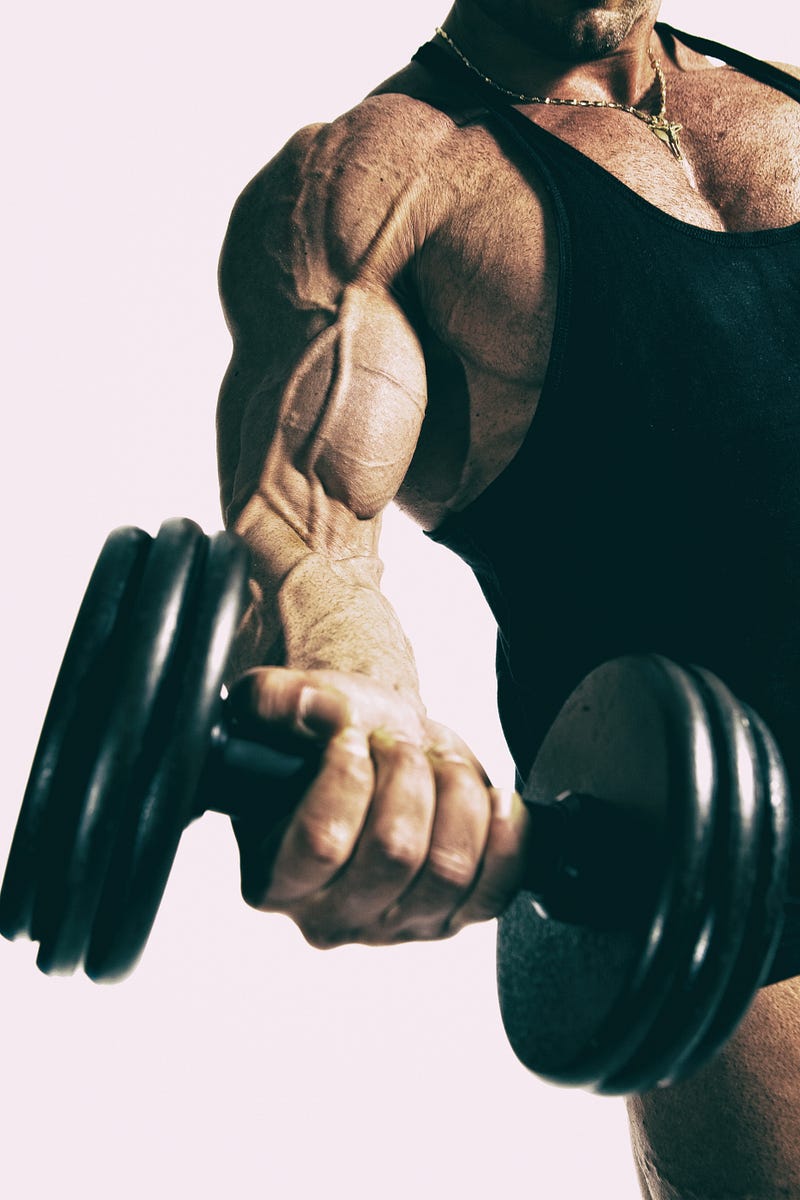
Everybody who works out wants an impressive set of biceps.
Whether you’re male or female, a good set of arms, toned or huge, makes a statement about your physical condition. Without wearing ridiculous clothing, your arms are usually the most visible part of your musculature.
This article is about the best exercises you can do to add size to your arms in the shortest time possible.
Vanity is the mother of invention
If you go to a gym you’ll see more variations on the biceps curl than just about any other exercise. Curls in the squat rack, concentration curls, curls with cables, curls with dumbells, curls lying down, curls standing up, curls on an incline bench, preacher curls, EZ bar curls, curls on the medicine ball, ad infinitum. It’s ridiculous and it’s misguided. Curls are not the most effective way to train the biceps, and the amount of training most people engage in is counterproductive.
Compound vs isolation
If you had to pick one exercise to grow your thigh muscles, would you pick an isolation exercise like leg extensions, or would you pick squats? How about your chest muscles, would you pick cable crossovers or a bench press? Most people will pick the compound exercises (squats and bench press) and that’s the right thing to do. But that line of thinking goes out of the window when it comes to training arms.
Compound exercises generate more growth than isolation exercises. Bicep curls and all of their variations are isolation exercises. The best compound exercise for your biceps is the chin up.
Good advice
To paraphrase Arthur Jones; ‘if you can do 20 chin ups and 20 dips, there’s not much more you can do for your arms’. Mr Jones may have been a thoroughly unlikeable character, but we shouldn’t let that blind us to his insights. A lot of people find chin ups hard, and they are, but that doesn’t mean they’re not superior to curls. As well as being the best single exercise for adding size to your biceps, chin ups help to stabilise and increase the range of motion in the shoulders, they are a good core exercise, and they’re a great back exercise.
As for curls, Mr Jones had something to say about them as well; I’ll paraphrase once again, ‘if you’ve never thrown up from performing a set of bicep curls, you’ve never performed them properly.’ His point was that any exercise performed in the most effective manner for inducing muscle growth is going to be unpleasant. If you want to get big and strong, you’re going to suffer in the gym whatever exercise you perform, so you may as well pick the most effective exercises. Squats over leg extensions, deadlifts over leg curls, bench press over cable cross overs and chin ups over bicep curls.
Work hard, work smart
Chins ups work the bicep around both joint insertions and they necessarily involve more weight (your bodyweight) than the vast majority of people will ever do bicep curls with. So, once again, they are the best way to train biceps. But once you know that, what do you do next? One hundred chin ups a day? (good luck with that!) One set of chin ups? Chins ups three times a day? 20 sets of chins ups? There’s a lot of conflicting advice out there and the majority of advice seems to go in the wrong direction. If you’re not on steroids, you will do your best by following the advice in the next paragraph.
Depending on your level of strength and the amount of intensity you can generate, perform one set of chin ups, to failure, once or twice a week. Intensity refers to how hard you can push without stopping. How close can you get to the point where the muscle is completely exhausted and simply cannot move anymore? When you have pushed to the point where no movement is possible despite your greatest effort, you have trained to failure. Intensity is something that takes practice. The better you get at it, and the stronger you get, the more damage you will be able to do to your muscles in one set. The more damage you do, the more growth you have potentially triggered.
Isn’t more better?
If you’re still reading this after the last paragraph, well done. A lot of people simply refuse to consider that one set once or twice a week is enough to trigger growth. One set works because you only need to trigger growth once, after that you need to let it occur. Growth occurs whilst you are resting, and you are not resting in the gym. So trigger growth, then stop exercising and let it occur.
A less trained athlete can afford to train more regularly because they're weaker and less able to cause massive damage in a workout. The stronger you become the less regularly you should train. If you are training hard and resting adequately between workouts, you will get stronger on every single workout for a considerable period of time. Eventually, however, you will stop getting stronger on every single workout, and at that point, it is time to insert an extra rest day between workouts. It’s that simple.
With resistance training, more is not better because your body needs to rest, recuperate, and then overcompensate (grow) between workouts. Also, why waste hours and hours in the gym when you can get better results in a lot less time?
The workout
After three years of not being able to train my arms (or do any form of resistance training) due to adhesive capsulitis (a frozen shoulder), I started doing chin ups in my local park, once a week, in June 2021. On my first attempt, I managed 3 repetitions with a very limited range of motion. I was not in good shape. By September 2021, my range of motion was improving, and I got all the way up to 17 repetitions.
Gyms had reopened by this time so I was not doing chin ups as a sole exercise in a park, but performing them after squats, deadlifts, calf press and seated cable rows. I decided to add 10kg to my bodyweight by holding a dumbbell between my feet. With the added weight, I got up to 13 repetitions, and my form was pretty good.
In October I stopped using the extra weight and concentrated on doing each repetition perfectly, making sure I went all the way down on each one and not swinging my legs to get me moving. On my last workout, I managed 15 repetitions. My arms currently look like this….
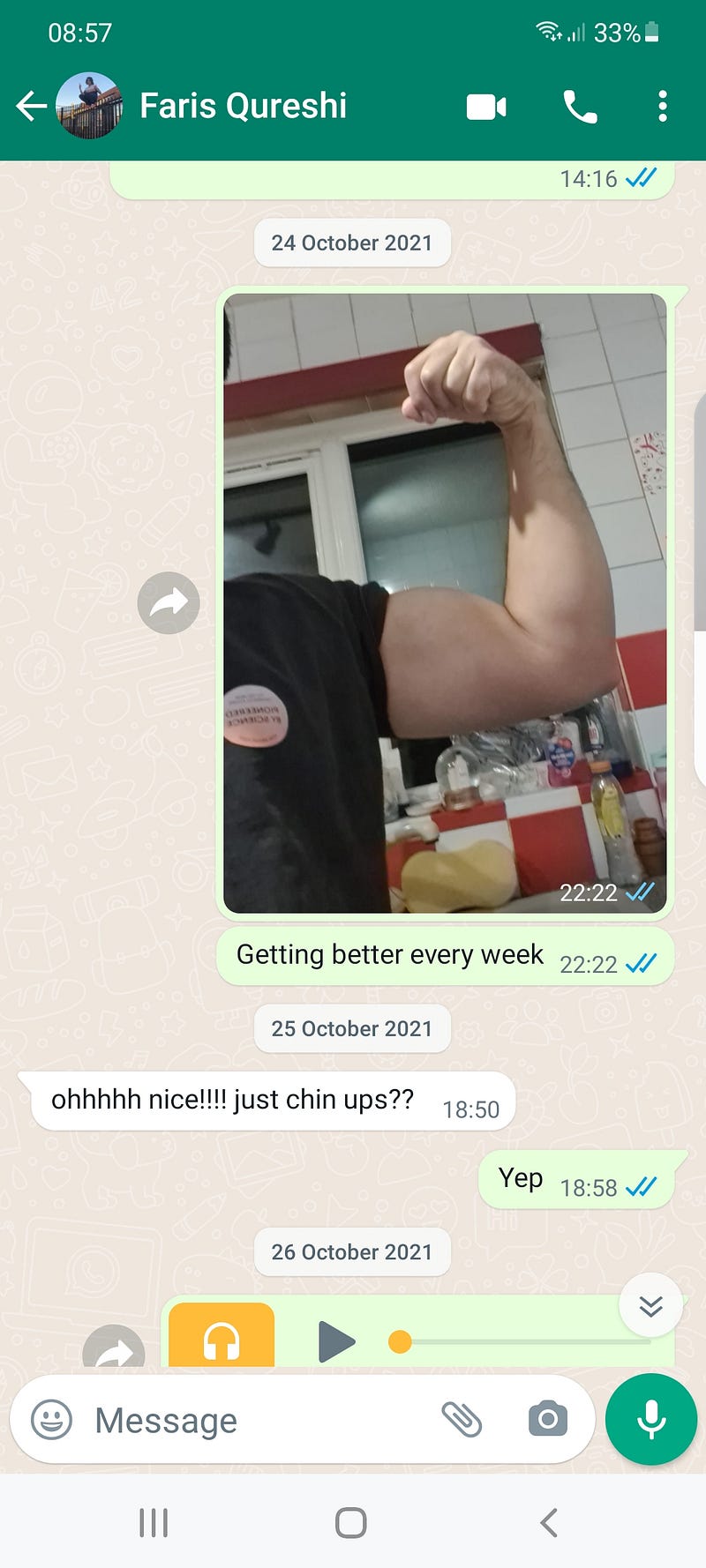
That’s from a WhatsApp chat with my nephew, who knows what I used to look like six months ago, my arms were like noodles.
What if you’re old, weak, or untrained, and you can’t perform a single chin up?
I’m nearly 43 and my training partner is 55. Before this summer, he’d never visited a gym, or done any type of resistance training. When we started working out, he couldn’t perform a single chin up. That’s nothing to be ashamed of, I know teenagers and people in their twenties who can’t perform a single chin up. It’s also nothing to be worried about.
If you can’t perform a single chin up, perform negatives. To do a negative, grab the bar and jump up to the top of the movement, where your arms are bent, your biceps are fully contracted, and your chin is above the bar. From the top position, start to lower yourself down to the bottom of the movement as slowly as you can. If you are not strong enough to make the descent last for 20 seconds, repeat the movement immediately until you are no longer able to control the descent and you’re essentially just dropping from the top to the bottom(that will usually be after about 5 repetitions). Only do one set. Then go home and rest.
My training partner has never worked out more than once every seven days and is making very good progress on all exercises. When you can make your negative repetition take 60 seconds from the top of the movement to the bottom, you will be strong enough to perform normal repetitions.
What about triceps?
Negative repetitions work because you can always lower more weight than you can lift, so it’s a good place to start building your strength. They can also be used on parallel bar dips, which is a great exercise for triceps. Parallel bar dips have been my main triceps movement since I went back to the gym. When I returned to the gym this year, I couldn’t perform a single one, so I began with negatives. I can now do 25 repetitions in one set. Dips are a fantastic triceps exercise that also build the chest and shoulders.
Chin ups and dips are the best exercises you can perform to quickly add size to your arms. You only need to do one set to failure, and you only need to do that once or twice a week.
If you’ve enjoyed reading this article and you’re not a Medium member, you might notice you can only read 3 articles per month. If you create an account, you can read 5 articles a month without charge. But if you become a member ( only $5/month or $50/year) you can read as many articles as you want, ad free. You can become a paying member here and if you use my link I retain a small portion of your fee. Thanks for your support!


