Part 2 of 3
Going Long With These Rock Tunes
Would you ever want these ten jam sessions to end?

“I was listening to my records — And I heard something real good — And it made me feel the way I should! I caught the rock and roll fever! I can’t let it go, baby! It’s in my blood to stay and will never go away!” — “Rock and Roll Fever” (1982) Composed by Walter Bowne, lead singer of Molehill Man and the Two Aces
11. “Highway Star” — Deep Purple, 1972 (6:08)
If you have an electric car with torque — or at least a hybrid, like my Kia Niro — you hit the gas fast and explode off the line, like with song.
0 to 100 in three seconds. Great riffs, this song, here, on Machine Head —1972 — and God, I wish they did more than this amazing album. It’s the opening track — and what a track to get the vinyl spinning.
Could they have competed with the likes of Zeppelin and The Who?
Yes — so many of us are in love with our machines. And if male, we call our machines a female name. Take these awesomely toxically male lyrics about “Highway Star” — which seems like a strip dancer’s name at The Castaway Club in Duncannon, PA, on 322 next to the Pilot Travel Center.
“Nobody gonna take my girl I’m gonna keep her to the end Nobody gonna have my girl She stays close on every bend Ooh she’s a killing machine She’s got everything Like a moving mouth body control And everything.”
You know, when I’m speeding across Iowa or Wyoming at 100 mph, this song is on full blast. I actually feel like this — “Ooh, I’m in heaven again. I’ve got everything. Like a moving ground an open road. And everything.”
Such a highway usually does not exist around the Beltway around Washington, DC. Or Route 81 through downtown Atlanta. There is no “moving road” or any road from Long Island through New York. It’s all “red” all of the time on Google Maps.
Such songs usually equate driving with sex. “She’s got everything, right? Like a moving mouth body control. And everything. It’s a mad hurricane — “
Unlike the happy-type of hurricane.
How did this song come about? According to bassist Roger Glover:
‘This was written specifically as an opener. Famously, we wrote it on a tour bus on the way to Portsmouth. We had some journalists with us who were coming down to cover the gig, and one of them asked us how we write songs. Ritchie said “Like this!” and started chugging out this riff on the guitar. Ian started singing any crap lyrics he could think of, and before long we just forgot about the journalists and the song came out. As the bootlegs will prove, we played it at the gig that night. The name was just a tribute to the fact that the song was written on the highway.’ (Steve Bradshaw — Highway Stars).
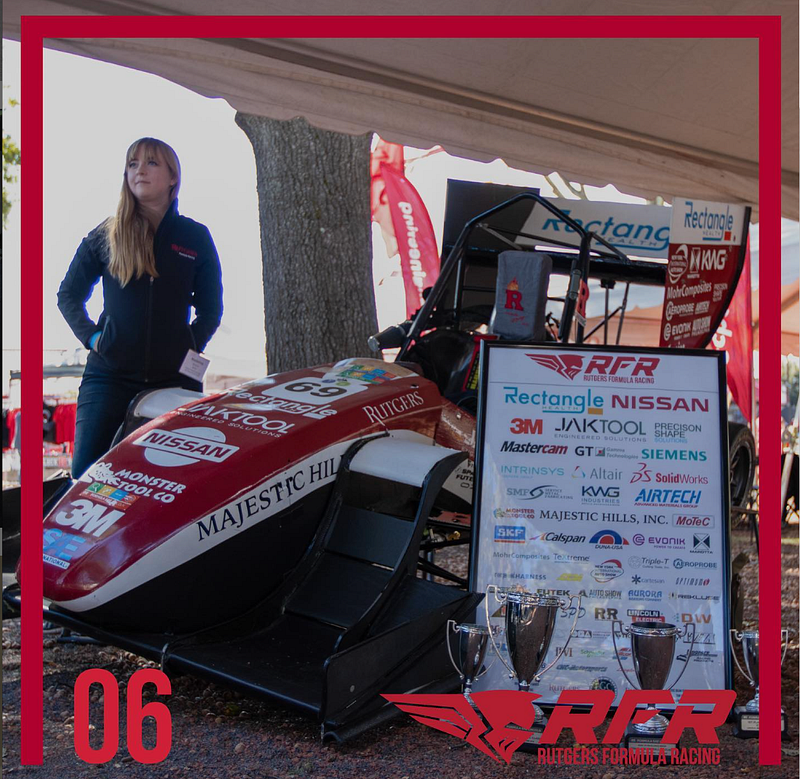
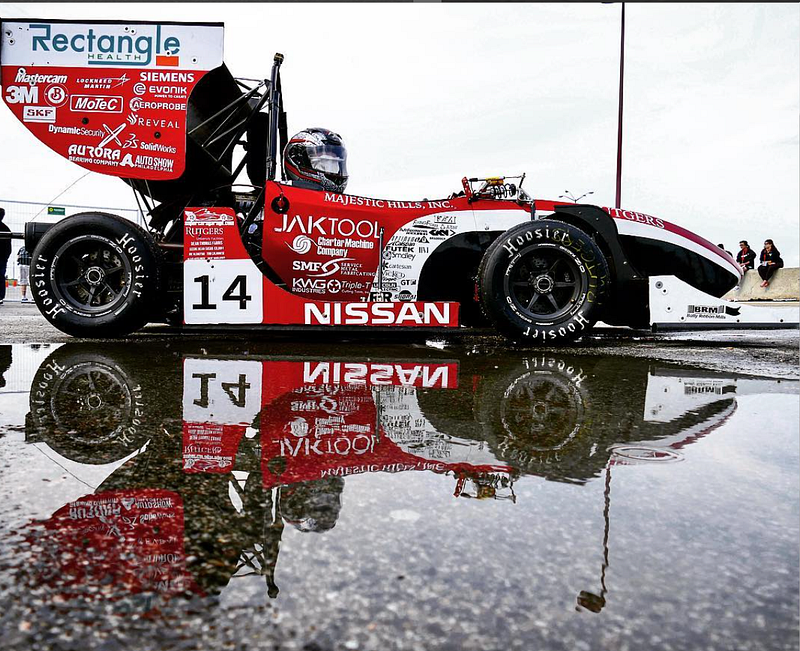
My daughter used this jam in her Rutgers Formula Racing promotional video. She’s moved on from cars to rockets — pursuing a Ph.D. in aerospace.
In her undergrad days at Rutgers, she loved designing and building race cars for SAE International. She’s one of my Highway Stars — along with Mary Jane, my wife, and daughter, Nancy. I don’t need to be in love with my black Kia Sorento.
Who does my daughter thank? Yeah — guitarist Ritchie Blackmore. Shooting for the stars! BTW, the lead singer also sang on the Broadway version of Jesus Christ Superstar by Sir Andrew Lloyd Weber — Ian Gillan as Jesus.
12. “Jessica” — The Allman Brothers Band, 1973 (7:31)
Dickey Betts — on vocals and guitar really makes this song. What a classic riff! For like the first two minutes. And then, at three minutes, Gregg Allman takes off, playing off Betts.
Rolling Stone ranked him #61 on the 100 Greatest Guitarists of All Time in 2015. “I’m the famous guitar player,” the late Duane Allman said, “but Dickey is the good one.” (link).
Quick quiz? Who are the Top Three? (see bottom).
This song is such a jam, and I don’t even miss the lyrics. The song was named for Jessica Betts, the daughter of Dickey Betts and Sandy Bluesky from the album Brothers and Sisters — 1973. (link).
It was composed by Dickey Betts and Les Dudek.
“In January 2006, a Wall Street Journal article referred to the piece as “a true national heirloom” (link).
Funny comments on YouTube mention that this is a great song for Karaoke. Just air guitar like crazy. Women were also named after the song. And make sure you make great and awkward facial expressions when air jamming.
Page, Clapton, Hendrix: 3, 2, 1. In Gomer Pyle's voice: Surprise, surprise, surprise.
13. Pink Floyd: “Pigs (Three Little Ones),” 1977 (11:25)
Who has pigs snorting at the beginning of the song? Yeah — Pink Floyd.
I was writing at King’s Road, a craft brew pub in Haddonfield, New Jersey, enjoying an IPA and the prose of James Joyce, and then this song came on the pub radio station. What a strange song to hear in a public place! How long had it been since I heard this song?
I listened to the hell out of Animals in the 1980s. At concerts, the Flying Pigs floated above me. Then someone behind me, a naked dude, pissed on the back of my leg. Talk about an animal! A pig!
We would listen to this album — which usually requires an entire deep listen — while camping. We’d chill on the playground, staring at the stars, and lounging on the sliding board — in love with the eerie mysticism of the album.
I was stoked when I saw the Power Station on the Thames in London in 1990! OMG! Animals!
But hearing this again got me into such a writing groove. I knew all the words. I stopped typing now and again to power chord, and the owner dug the Progressive song as well and laughed at my flashback singing.
“And when your hand is on your heart You’re nearly a good laugh Almost a joker With your head down in the pig bin Saying, “Keep on digging” Pig stain on your fat chin What do you hope to find? Down in the pig mine.”
So who are these pigs? Need you ask? Couldn’t we make a list of past pigs and current pigs? Pigs digging. Pigs with fat chins with faces in the public and private trowel? A bunch of jokers! Politicians, shysters, con-men, sycophants.
14. “How Many More Times” — Led Zeppelin, 1969 (8:28)
Zeppelin was always my favorite band. I was called Led Head in high school. I was the Zeppelin expert. This song I would play so loud on my Fender — the house would rattle, and my mom claimed she heard me from down the street when coming home.
I usually knew — or sensed — my mom and turned down the volume before she hit the Wall of Sound. This song, and many others from Zeppelin, like “Whole Lotta Love” and “The Lemon Song,” did not help me understand women, just me own ragging male sex hormones.
But what a bass line riff, right? Sometimes I think John Paul Jones gets overlooked as a bassist, especially with Bonham and Page in the mix. Entwistle, too, the “Hendrix of the Bass,” often gets overlooked, too. “Ramble On” from Zeppelin II also has a killer Jones bass intro.
If you watch the video or just listen, how does Bonzo not break the skins or the (synthetic aromatic polyamide polymer) of his kit? Does anyone get more bang from his wand than Bonham? Why don’t those sticks break? Especially on a song like “When the Levee Breaks” — one of the best drum introductions of all time.
Page offers some great improvised licks in the live version that we don’t get on the last song of their 1st album. I love how Jimmy Page plays off with every member — Plant — Bonham — and Jones — like a call and response thing.
Check out Page at 3:40–5:16 on the video, and you know why he’s one of the best of all time. Later, Page brings out his “cello” bow, and Plant emulates the sound. How did they do this stuff live — this good?
The few in the audience are transfixed. Just what is happening here? It’s still 1969. Is the direction of music changing? Is this like “Tomorrow Never Knows” from John Lennon on Revolver in 1966? Where did the fuck did this come from?
Of course, the song is about sex. Robert Anthony Plant wants to come and play? Let’s steal away, baby, steal away. He’s a hunter. He’s a player. That’s how he got his fame. Don’t run. Don’t hide. He’s got his gun out (get it), and it has you in its sights.
“Oh, Rosie, oh, girl, oh, Rosie, oh, yeah Steal away now, steal away Steal away, baby, steal away Little Robert Anthony wants to come and play Why don’t you come for me, baby, steal away, alright, alright
Well, they call me the hunter, that’s my name Call me the hunter, that’s how I got my fame Ain’t no need to hide, ain’t no need to run ’Cause I’ve got you in the sights of my gun.”
It’s a great thing that these songs sound so good musically. As poetry, well, not so much. But let’s just allow all that to youth. John Bonham and Robert Plant are only 20 years old. Page is 25 — the group's old man, journeyman, and session man.
What a jam! Triple loud that Smuckers on the toast!
15. “Get Up and Drive Your Funky Soul “— James Brown, 1973 (9:04)
This remix version here comes from Motherlode, released in 2003. It increases the funk to a Power of 3 — all the way to 9:04. There’s plenty of time to jump back and kiss yourself and also to get in and out of the hot tub after a cool down.
The original came out in 1973 on Slaughter’s Big Rip-Off.
Like Robert Plant, James Brown is a “sex machine.” We love these songs for the funk and not for the Shakespeare unless it’s Paul Simon or Bobby Dylan Or Neil Young lyrics.
Here are the lyrics:
“Fellas, I’m ready to get up and do my thing (yeah go ahead!) I wanta get into it, man, you know (go ahead!) Like a, like a sex machine, man, (yeah go ahead!) Movin’ and doin’ it, you know Can I count it off? (Go ahead).”
And like Plant, who was always looking for that “goddamn bridge,” James Brown is looking, too. Why? Maybe he has a date.
Bobby! Should I take ’em to the bridge? (Go Ahead!) Take ’em on to the bridge! (Take em to the bridge!) Should I take ’em to the bridge? (Yeah!) Take ’em to the bridge? (Go Ahead!) Hit me now!
16. “Midnight Rambler” — The Rolling Stones, 1969 (6:52)
There is something about Midnight and Rock and Roll. The witching hour? It’s when the freaks come out. “Midnight Special.” “After Midnight.” “Midnight Rider.” “Midnight Train to Georgia.” Midnight Oil. “Midnight in Paris.” “Midnight Cowboy.”
Wait — those are films!
This incredible song came out in 1969 from that incredible LP, Let It Bleed.
The video's great, previously unreleased live footage is a ten-minute jam. Guess which one I prefer? Yeah — three more minutes of Smuckers! The live footage is so intimate, raw, and in the moment — a flashback to 1971.
The band is flames in the video — complete with kicking back with a bottle of Jack. No big stadiums. Intimate and sweaty and fun.
“I’m talkin’ ‘bout the midnight gambler The one you never seen before Yeah, I’m talkin’ ‘bout the midnight gambler Did you see him jump the garden wall? Sighin’ down the wind so sadly Listen and you’ll hear him moan Well, I’m talkin’ about the midnight gambler Everybody got to go
Did you hear about the midnight rambler? Well, honey, it’s no rock ’n’ roll show Well, I’m talkin’ about the midnight gambler Yeah, the one you never seen before.”
So who is the Midnight Gambler? Is he symbolic of Lucifer? Whoever or whatever he or it is, he jumps garden walls, moves like the wind, and likes to moan —
So Jagger asks the rhetorical question: Did you hear? Why do we got to go? What shut the door? Why is it/he wrapped up in a black coat? Okay — it seems like “Satan” to me — but wait —
After a musical interlude jam and a million “Don’t do that” — whatever “that” is — like opening the kitchen door, we get less cryptic lyrics:
“Well, you heard about the Boston It’s not one of those Well, I’m talkin’ ‘bout the midnight The one that closed the bedroom door I’m called the hit-and-run raper in anger The knife-sharpened tippie-toe Or just the shoot ’em dead, brainbell jangler You know, the one you never seen before
So if you ever meet the midnight rambler I’m coming down your marble hall Well, he’s pouncing like a proud black panther Well, you can say I, I told you so Well, don’t listen for the midnight rambler Play it easy, as you go I’m gonna smash down all your plate glass windows Put a fist, put a fist through your steel-plated door.”
As a self-proclaimed “New Critic” — one who doesn’t believe you need to research and know the literary lingo to understand the secrets of language or worse, hearing what the writer says the lyrics mean (run away when an author speaks about their work) — I think we should be able to take the words as if found on the street and have a “response” to the experience.
Jagger and Richards change the game at the end. Guess who is the Midnight Rambler in the cloak and dagger game with all these questions and warnings? Jagger now changes to “I.”
“I’m called the hit-and-run raper in anger — The knife-sharpened tippie-toe — Or just the shoot ’em dead, brainbell jangler — Well, he’s pouncing like a proud black panther — I’m gonna smash down all your plate glass windows — Put a fist, put a fist through your steel-plated door.
And he tells us as he places a nice right down our throat that it’s gonna hurt. Well, no duh. Is it Chaos? The evil that lurks within all of us? Or is Jagger and Richards retelling a story from the news headlines — like a Jack the Ripper?
Does it matter? What is your feeling about the song and the lyrics? It’s one of warning and terror. Life is unsafe. After midnight, strange things happen on the streets and in your kitchen.
And you never know when that knife will come — or death. I have purposely not researched the “truth” of the song's meaning because I don’t believe in one truth.
If that was the case, there would be only one denomination — Christianity and no Shiites and Sunnis. But feel free in the comments to tell me, lol. Like “Free Bird” is actually about Duane Allman in 1971 from a motorcycle crash.
Ok. It makes so much sense. But the song means more than that. It’s out there for the world to use and love.
17. “Sweet Home Chicago” — The Blues Brothers (7:53)
Yes, this band was a serious Blues band that started as a Saturday Night Live skit. It is also in my Top 10 Most Hysterical Films of All Time. I was hooked from the first appearance on SNL. It’s one of those films, like Star Wars and The Holy Grail, I’ve seen more times than years I’ve been alive (53).
Robert Johnson originally composed the song in 1936. Here is a recording. Is Robert Johnson — the famous musician at the Crossroads — the inspiration for every Blues musician and fan out there? If you didn’t get the allusion in the Coen film, Brother Where Are Thou — yeah — that’s Robert Johnson who sold his soul for the guitar.
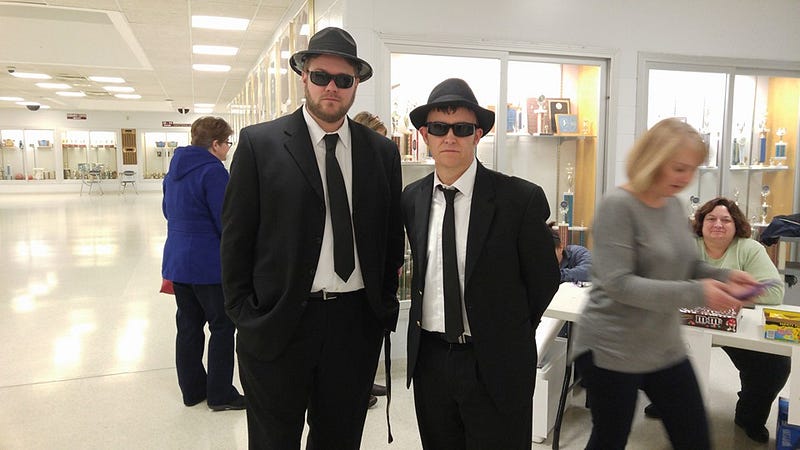
My buddy George and I played Jake and Elwood Blues for a benefit concert for a colleague. I was out of breath by the end of the act. We did some serious dancing and acting. Here is the Blues Brothers great cover.
While better comedians than singers, but still singing with soul and guts, and what else do you need except for your heart to bleed through your mouth, Belushi and Ackroyd gathered together some of the best blues session players in the world and toured — like Matt ‘Guitar’ Murphy.
A Briefcase Full of Blues is so worth repeated listens, as is the soundtrack to the film. My buddy Dan and I listened to that LP numerous times in high school. We’re both huge Blues Dudes (though white dudes from New Jersey suburbia) — but with working-class roots.
Is The Blues Brothers the best soundtrack of all time? Maybe. But I’d also put Pulp Fiction and Brother Where Art Thou up there. If you utter Titanic, stop reading. Lol. Romeo and Juliet wasn’t bad, though.
I first learned from Elwood Blues in talking to his “wild man archetype” Curtis — Cab Calloway — about famous Black musicians. (The Drink Scene). Like Elmore James. So that got me listening to Elmore James and going back to the Beginning of Jazz and Blues and Rock and Roll. Then I started spinning James Brown Live at the Apollo ’63 — one of the best live recordings ever.
And then I heard so many riffs ‘appropriated’ from so many rock legends — Elvis, Jerry Lee Lewis, Page, Clapton, Richards, Townsend, George Thorogood (or ThoroughBad if you don’t like his style), and Jack White and even Dan Auerbach. Now — I LOVE blues rock.
I actually dream in twelve-bar blues.
I just hate that it took white musicians to translate the Black experience of the Blues — the Southern Blues of Jim Crow — to a white audience to make it palatable and marketable. It’s the reason why the multitalented Josephine Baker had to leave the USA and find freedom in France as a singer and a dancer. Ironic, right?
Oh, I’m MONOLOGUING AGAIN. Sorry. But what a city — the Windy City — for the Blues and Motown.
“Come on, baby, don’t you wanna go? Oh, come on, baby, don’t you wanna go? Back to that same old place Sweet home Chicago
Six and three is nine Nine and nine is eighteen Look there, brother, baby and You’ll see what I seen
Hida-hey, baby, don’t you wanna go? Back to that same old place Sweet home Chicago.
“Elwood Blues: It’s a 106 miles to Chicago, we’ve got a full tank of gas, half a pack of cigarettes, it’s dark, and we’re wearing sunglasses.
Jake: Hit It.”
“In the 1980 cult classic film “The Blues Brothers,” Jake and Elwood are stuck in traffic as a Nazi rally blocks the bridge they need to cross. When they ask a nearby police officer about what’s going on, the officer shrugs, “Ah, those bums won their court case, so they’re marching today.” Jake replies, “What bums?” The officer shoots back, “The f**ckin’ Nazi party.”
“Illinois Nazis,” Elwood mutters, to which Jake groans, “I hate Illinois Nazis.” The duo then pushes the gas pedal to the floor, veering towards the Nazis, forcing them to jump off the bridge and into the river to avoid being hit” (link).
I hate Nazis, too, man. And fascists.
18. Have You Ever Loved a Woman — Derek and the Dominoes, 1970 (6:53)
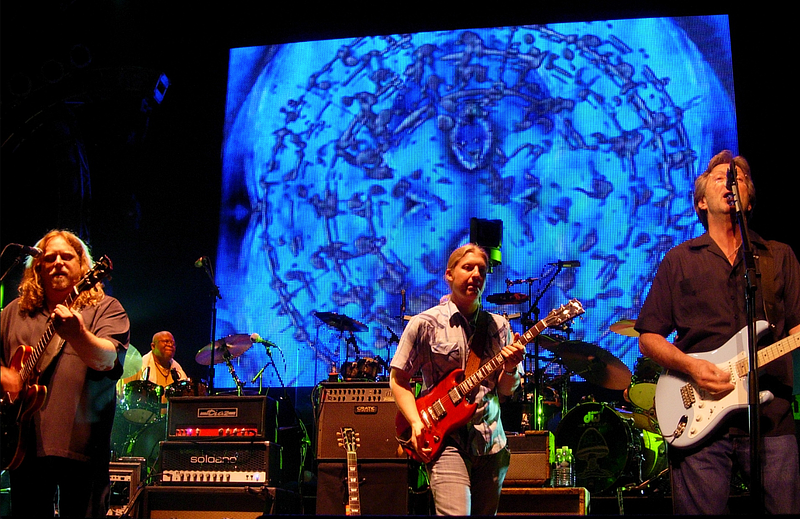
Yes — Eric Clapton is the only rock and roller to have been inducted into the Rock and Roll Hall of Fame three times — once as a solo artist (2000) and The Yardbirds (1992) and Cream (1993) (Hall of Fame).
But Derek and the Dominoes is an okay band, too, of course. This is 1970.
“Layla “— obvious. “Bell Bottom Blues” will make you cry. And this one — along with others. This one is BluesFest. I can feel the deep blues with Clapton here.
For some reason, this song took me a while to “discover.” I guess with a consistent hitmaker like Clapton over the decades, it’s so hard to catch up and then go deep on your old vinyl for that “oh — yeah — that song — gem!”
Have you ever loved a woman So much you tremble in pain? Have you ever loved a woman So much you tremble in pain? And all the time you know, yeah She bears another man’s name.
Yes — Eric — I have thought to have loved such women in the past, but never with another man’s name that goes by Harrison, like George. You know, your good buddy and general, all-around great dude.
19. “Won’t Get Fooled Again” — The Who, 1971 (8:31)
If you haven’t seen the video, which seems restored to 4K or 10K quality, watch it. It’s amazing. It’s also the last time Keith Moon would be seen playing live before his death.
Notice Townsend’s shirt getting progressively ripped. How many pounds did he lose during this song?
What can I possibly say about this classic Rock Anthem? It’s also on One of The Greatest Rock Albums of All Time — Who’s Next — and the last track. There is no mediocre song on the entire album — and this song — like the next one — is the perfect capstone to a perfect album.
Is it the first stadium rock anthem of many that would come later? Like “We Will Rock You/ We Are the Champions” from Queen? Perhaps. I have to think. 1971 was a turning point in rock and roll and full of major albums.
Sticky Fingers from The Stones. Zeppelin IV. LA Woman from The Doors. Low Spark of High Heeled Boys from Traffic. Madman Across the Water by Elton John. Every Picture Tells a Story by Rod Stewart. Tapestry by Carole King — Ram from McCartney — Honky Dory from Bowie (that early, yes), The Yes Album — Floyd’s Meddle —
So many. If you’re still reading, you know these lyrics. When you meet your new boss, you immediately sing to yourself, “same as the old boss,” right?
And political parties — the left and the right — the slogans. Does any politician or boss really care about you? Won’t we all get fooled again — even though Townsend says we won’t? Governments come and go, like French Republics, and we bow to the revolution to make things better, but will they?
What will actually change? The length of our beards.
There’s nothing in the street Looks any different to me And the slogans are effaced, by-the-bye And the parting on the left Is now parting on the right And the beards have all grown longer overnight
I’ll tip my hat to the new Constitution Take a bow for the new revolution Smile and grin at the change all around Pick up my guitar and play Just like yesterday Then I’ll get on my knees and pray We don’t get fooled again Don’t get fooled again, no, no
Yeah Meet the new boss Same as the old boss
By the way, as a Who Fanatic, I just finished reading the following three books. Worth checking out if you’re even the casual crazy Who fan.
Who I Am: A Memoir by Pete Townshend
Thanks a Lot Mr Kibblewhite: My Story by Roger Daltrey
The Ox: The Last of the Great Rock Stars: The Authorised Biography of The Who’s John Entwistle by Paul Rees
20. “Jungleland” — Bruce Springsteen, 1975 (9:36)
The perfect last song on a perfect album about romance, rebellion, teen angst, hope, and escape. As someone from New Jersey, I know Bruce is a blue-collar idol and sings of places I know — and themes I know (we all know) too well — seeking identity (and unity with one other) in a conformist society that wishes to dehumanize us.
The video is Bruce back in the day. 1975. I read somewhere, probably on Medium, that there are actually 7 Different Bruce Springsteens. Makes sense.
I can’t keep this LP of mine downstairs for my player. My daughter, Nancy, often has it. She may even have the cover framed in her room. I could write for hours on Bruce — and I have one essay about “Thunder Road” and my new lass — Mary Jane — taking a ride to the Jersey Shore — and then after drinking warm beer in the soft summer rain, I sang her Moondance on the beach at midnight. It was then I knew I wanted to marry this woman who seemed summoned from Bruce.
But she’s her own person. Not a persona. But she loved Bruce. For the car trip on one of the early dates, she brought cassette tapes of Bruce — even one I didn’t have — Greetings from Asbury Park.
Was it love, then? I definitely surrendered then — or was it even earlier —? Was this flash or flesh or fantasy? I’m a poet — but I wasn’t letting Mary Jane be. If I was wounded, it was Cupid. In New Jersey — a state that Mary Jane would soon call her home, but I could never call her my Jersey Girl.
She’s from Pennsylvania.
“Beneath the city, two hearts beat Soul engines running through a night so tender In a bedroom locked in whispers Of soft refusal and then surrender In the tunnels uptown, the Rat’s own dream guns him down As shots echo down them hallways in the night No one watches when the ambulance pulls away Or as the girl shuts out the bedroom light
Outside the street’s on fire in a real death waltz Between what’s flesh and what’s fantasy And the poets down here don’t write nothing at all They just stand back and let it all be And in the quick of a knife, they reach for their moment And try to make an honest stand But they wind up wounded, not even dead Tonight in Jungleland.”
Perfection, my friends. Perfection. The intersection of lyricism, musicality, tonality, theme, execution, and longing. Perfection.
Long Jams 1–10 Here: