
Ten More Songs from The Clash to Know (and Counting)
1–2–1–2–3–4 — picking 10 more is harder than you realize, mates
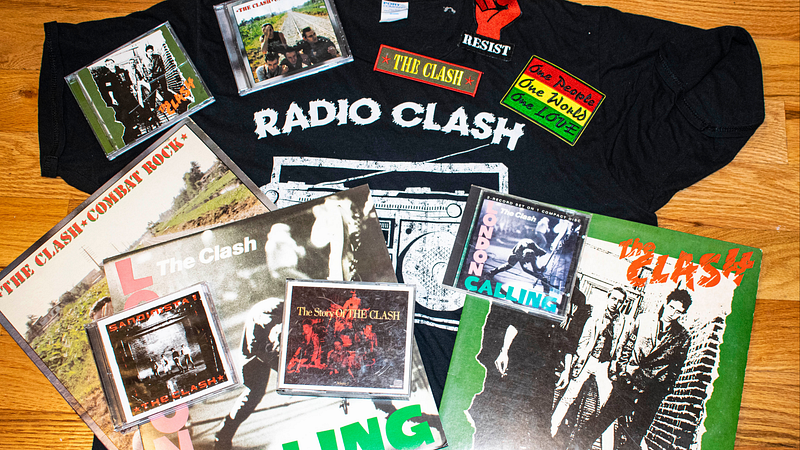
This article picks up from the first 1–10 songs from my “Clash” article from August in The Riff.
1. “Junco Partner” (1980)
Just how many times have I listened to this song? In fact, after dinner, I played the song to my family. My daughter’s boyfriend, Brian, 25, loved the complex sound of the song — including the subtle percussion. College radio program director, daughter Nancy, loved it, too. “Wow — listen to that fiddle! Fiddle with a combo of ska and reggae!”
It’s a helluva song — and it is what separates The Clash from not only other “punk bands” — but other bands too. They incorporate so many styles during such a short time period (1977–1983). What other band did this? The Beatles?
Born in “Angola/ Serving fourteen to ninety-nine, “Junco Partner” is a narrative about a poor man who has dreams of “a million dollars” but needs to pawn his worldly goods for a simple “headstone” —
Down the road came a Junco Partner For he was loaded as can be He was knocked out, knocked out loaded He was a’wobblin’ all over the street
The song is a gem from the wild and crazy LP Sandinista.
Released in 1980, a year after London Calling, the three albums that create Sandinista is The Clash equivalent to The White Album from The Beatles — just as a strange and eclectic and full of hidden gems — like grandma’s attic with just another level of oddities and curiosities.
For example, there is a “children’s version” of the punk anthem “Career Opportunities” from their first album. Having children complain about the lack of good jobs in a slowed-down tempo only increases the sad pathos of the song’s theme. Children are filled with dreams — but what has happened?
Whether in Angola, Jamaica or in the UK — we find the same pain.
2. “White Riot” (1977)
With the classic punk countdown — Mick Jones shouting 1, 2, 3, 4, — something so Ramone-like it makes me smile — “White Riot” is classic punk in all its two-minute intensity. Actually, it’s 1:54 minutes. How many chords? Does one need to ask?
Q Magazine placed the song number 34 in its 100 Greatest Guitar Tracks.
In the single version, there’s a police siren at the beginning. Ok — both are awesome, right?
On the UK release, it’s the fourth song on Side 1. On the 1979 USA version, it’s the fifth song. I actually like its position on the UK LP after “I’m So Bored with the U.S.A.”
Of course, The Clash has its finger on intense social inequities in both white and Black communities. They use antithesis and anaphora quite well:
Even though they want to “White riot, I wanna riot White riot, a riot of my own”
And —
“And everybody’s doing Just what they’re told to And nobody wants To go to jail” —
The Clash also recognizes the race tensions, too.
“Black man gotta lot a problems But they don’t mind throwing a brick White people go to school Where they teach you how to be thick”
The education system teaches obedience and compliance. So we have a huge segment of the underserved population trying to keep out of jail while thinking “thick” — as another “brick in the wall.”
And so often, the individual rage is private — not a “real riot.” It’s “a riot of my own.”
Freelance rock critic Bryan Wawzenek writes in Diffuser —
The song came about when Strummer, Simonon and Rhodes were attending a festival hosted by Jamaican immigrants in August 1976. The relationship between police and that community had become frayed, which led to a riot between upset Jamaicans and the bobbies on that day.
As a side note, the song was used as the title for 2019 The Grierson Award for Best Documentary that was directed by Rubika Shah.
3. “Rudie Can’t Fail” (Dec 14, 1979)
Like many Clash songs, “Rudie Can’t Fail” combines pop, rock, reggae, and rocksteady — a precursor to ska and reggae — that originated in Jamaica in the mid-1960s.
In 1962, Jamaica gained its independence from Great Britain. There was celebration, optimism, economic growth and opportunity (BBC — Rocksteady: The Roots of Reggae.
“Rudie Can’t Fail” appears as the last song on Side 1 on the double LP release of London Calling.
The song is a call and response duet between Mick Jones and Joe Strummer. Of course, there’s irony implied in the title because “success” in the UK meant wearing a “chicken thing suit” and wearing a “pretty hot in a pork pie hat” or a “doctor born with a purpose” while appeasing the “Boss man.”
And Rudie — if you’ll need “someone for a savior” and maybe you can find a “job with a paper.”
But Rudie needs a higher purpose — something for his “soul.” But we know that perhaps Rudie has failed because “he’s drinking brew for breakfast.”
Ok — the only time I saw this was in Munich, Germany as I watched an 80-year-old woman drink a liter of Pilsner at 10 am. Classic, right?
We can also see the song as just a kid who is fun-loving who doesn’t want what society expects of him. So, maybe, Rudie can’t fail as long as he stays true to his own bliss.
Like the songwriting duo superstars, Lennon/McCartney and Richards/Jagger, Strummer and Jones write:
I know that my life make you nervous But I tell you I can’t live in service Like the doctor who was born for a purpose Rudie can’t fail (ok)
I went to the market to realize my soul What I need I just don’t have (oh no) First they curse, then they press me ’til I hurt They say, Rudie can’t fail
First you must cure your temper Then find a job in a paper You need someone for a savior Rudie can’t fail
In the 2004 book, The Clash: The Last Gang in Town, rock critic Marcus Gray says the song is an “homage to Ray Gange, who had portrayed a roadie who quits his job to follow the Clash around in the 1980 film Rude Boy.”
4. “Clampdown” (Dec 1979)
Another amazing song from London Calling, “Clampdown” feels eerily prescient about the recent rise of fascism and nationalism in the world.
Like the song “London Calling,” the song is full of angst, anxiety, and apocalyptic warnings about the high grade, slippery slope toward nationalism and treating “others” who are not “blue-eyed men” to be the “true believers” — an obvious allusion to Hitler’s Aryan aspirations.
The driving beat is composed in the key of A with a change in the bridge to E major. But this only comes after an opening of mumbles over an instrumental track about “kingdom is ransacked, the jewels all taken back and the chopper descends — “ in what may be a not so subtle criticism of European colonialism in the Mideast and Africa — Strummer finally belts as a rhetorical call to action:
“What are we going to do now?”
Reading through the lyrics, I wonder if this is 1979 or 2022? The song reminds me of what I have read about the rise of the Nazi Party in the 1930s.
is this man a Jew? ’Cause working for the clampdown They put up a poster saying we earn more than you When we’re working for the clampdown
And you’re working for the clampdown You start wearing the blue and brown And you’re working for the clampdown
Blue and brown? The brownshirts of the Nazis and the blue shirts could be the modern-day police.
The authorities will will “teach our twisted speech To the young believers” — as a sort of conspiracy theory, alternative-facts, rebelling against logic and reason and the “lying press” — what Hitler attacked as the “lügenpresse” at his “rallies.”
Sound eerily familiar, my friends?
This “Clampdown” could happen in Russia, of course, or even in Harrisburg, PA — in the good old US of A —
Yeah, I’m working hard in Harrisburg Working hard in Petersburg
In these days of evil presidentes Working for the clampdown
Strummer and Jones warn about not becoming part of the problem:
You don’t owe nothing, so boy, get running It’s the best years of your life they want to steal
And even though the “voices in your heard” are calling — the voices to join the mob or “Pink” from “The Wall” in his rise as a fascist leader, we need to understand:
Stop wasting your time, there’s nothing coming Only a fool would think someone could save you
That’s such a great message. Don’t look for a savior who will only use you, grind you up, take away your soul, all for their profit and power.
In other words, don’t be a Stormtrooper for Darth Vader, stupid! But please recognize that evil is not as obvious as a man in black with a mask. Evil can come in many colors — even brown and blue and red and white (ah, the KKK).
5. “Kingston Advice” (1980)
Fellow Medium writer and music writer Jim Mowat suggested this song. “If I had to plum for a deeper cut,” he wrote in my first Clash piece, “it would be Kingston Advice on Sandinista.” And I’ve been doing that — looking through that crazy attic of an album, and he’s right.
Musically, I’d call it even antithetical Clash — subtle, low-profile, almost a nursery-rhyme sing-song that’s nothing “child-like” about it.
Here we are in Kingston, Jamaica, looking for “advice.”
Think about the power of this line: “In these days, I don’t know what to sing. The more I know, the less my tune can swing.”
How can one dance with the weight of the world? It’s a great extended metaphor, too, with the words — sing, tune, and swing. And the antithesis is simple but effective, too — opposing opposites — the more/the less.
Sorry for the rhetorical analysis (but hey, it’s my actual day job) — Strummer and Jones use anaphora — the repetition of beginning words, phrases, or clauses for dramatic effect. “These Days — right?”
In these days the beat is militant Must be a clash, there’s no alternative In these days, nations are militant We have slavery under government In these days in the firmament I look for signs that are permanent In these days with no love to give The world will turn with no one left to live.
And I love how they insert their own name — The Clash — a verb and a noun. Music should be liberating, but the “beat” is now “militant.” With no country or music for protection, even in the “firmament” — the heavens — is there a sign of liberty that is “permanent?” Is “these days,” is there not only is there “no love to give” but the militant nations will eventually leave the world with “no one left to live.”
Cue: Dr. Strangelove. And nuclear annihilation.
In such a world of poverty and Post-colonialism racism and neglect, what is there to do without food? “In these days, see the people run. They have no food, but the boy have gun.”
To view the plight of the West Indians in the United Kingdom, view the Amazon series “Small Axe” — a collection of five short films. Sometimes, as a narrow-minded Yank, I forget that racial tensions just didn’t exist in the United States.
6. “Police on My Back” (1980)
Another song from Sandinista is much more in line with “old school” Clash. This song, by Eddy Grant — you know “Electric Avenue” — in Brixton, London sounds like it could have appeared on their first album.
After the hit, “Magnificent Seven,” it has the most “plays” on Spotify at 12,990,614. It even has more plays than “Someone Got Murdered” which I think is a better song, by the way.
The opening imitates a police siren. It’s brilliant, actually, mates.
But I love the retro Clash sound here. We have the typical theme — the police are bugging us — even day of the week — and then a litany of the days of the week with the rhetorical question, “What have I done?”
And like so many — especially those in Brixton — “they’re running on a one-way track.”
7. “Know Your Rights” (1982)
Combat Rock from 1982 should get more respect than it gets. Of course, it propelled The Clash into the mainstream and MTV with super Mega Hits — “Should I Stay or Should I Go” and “Rock the Casbah,” but the first song is one of the many reasons I love this band.
Know your bloody rights, man.
I teach journalism. So many young people self-censor themselves. “They’ll never let us publish this!”
“Where do you think you live? North Korea? Russia?” I reply.
So I start class with a Public Service Announcement:
Number one You have the right not to be killed Murder Is a crime! Unless it was done By a policeman or an aristocrat Know your rights
In the age of George Floyd, etc, etc, etc, the students can respond to this. But it just not be untrained or stressed out policemen (most of which are trying to do their job) but really the “aristocrats” — the millionaires who simply do not care about the poor of any race.
And number two You have the right to food money Providing of course You don’t mind a little Investigation, humiliation And if you cross your fingers Rehabilitation
When we have studied Steinbeck’s The Grapes of Wrath, this makes so much sense. Starving people during the Depression had to smell burning oranges to keep the prices high. And then we had the Reagan “Welfare Queen” years of needing to “prove” you were worthy of living.
And then the last right:
You have the right to free speech As long as you’re not Dumb enough to actually try it
So that’s my 1st Amendment mantra to my award-winning student journalists. You are all smart enough to know your rights. And in the United States, it’s one First Amendment; therefore, the most essential.
8. “Safe European Home” (1978)
The opening track from the second 1978 UK release on Give ’Em Enough Rope, the song recounts the misadventures of the band in Jamaica — minus the bassist — Paul Simonon, the most “reggae” of the members, btw.
Strummer said during their two weeks there to compose songs for the album, they —
“ . . . must’ve looked like a strange pair to the locals… I’m surprised we weren’t filleted and served on a plate of chips” noted Jones. “We went down to the docks and I think we only survived because they mistook us for sailors.”
This feeling of alienation and struggling to stay alive in a very hostile environment far from home is evident in the lyrics, most obviously in the chorus.” (Song Facts).
The song stays true to punk roots — forceful and vivacious. It’s the “take no prisoners” theme that still resonates with me. It’s confident and rebellious and ironic.
It’s all very good “sitting in our safe European homes” while so many are poor and hungry. Being a “white face” is “an invitation to robbery.” And Strummer and Jones wonder — “Don’t want to go back there again.”
There’s this line too that harks back to, all of the things, “My Fair Lady” — about a rich guy trying to make a street urchin into a “lady” with the line: “Wasn’t I lucky, wouldn’t it be loverly? (where’d ya go?)”
Wouldn’t it be loverly?
And like many “white faces” who have the money to be tourists in “safe areas” — they still concede:
I’d stay and be a tourist but I can’t take the gunplay (where’d ya go?) They even feel like “dat Martian” arriving “at the airport.” And just how much will it cost for us to self-medicate knowing the insanity of the situation:
How many local dollars for a local anesthetic?
9. “(White Man) In Hammersmith Palais” (1978)
Another classic rock opening of 1–2-1–2–3–4 — but it’s still the second most sophisticated song from their debut album — after the masterful “Police and Thieves.”
I was shocked to learn that the song I always associated with the debut album was not on the original UK release in 1977. It was recorded during Give ’Em Enough Rope, which makes sense, stylistically and thematically, but it was featured on the American LP between “White Riot” and “London’s Burning.”
When my UK CD came via Amazon this year, I was shocked that this song was missing.
Both songs give us an idea that this is not your everyday basic punk band. This song is a huge wink and a nod to what is coming with London Calling in late 1979. It peaked at 32 on the UK singles chart in 1978. Yeah — but who cares about charts, right?
Even this early, The Clash was playing with ska (even at a slower tempo) and themes of Black and white troubles and Tory politics. I even use this line when people were surprised with the recent rise in nationalism and fascism:
All over people changing their votes Along with their overcoats If Adolf Hitler flew in today They’d send a limousine anyway.
The song starts as a basic narrative about a reggae group playing at the Hammersmith (a great venue, btw), but things don’t go so well. After all, it was the late 1970s. It’s al; about punk, disco, and New Wave. It’s the first time out of Jamaica — but
Ken Boothe for UK pop reggae With backin’ bands sound systems If they got anything to say There’s many black ears here to listen
But is there enough of an audience? Can’t they recognize a great new sound? And then The Clash uses an allusion to Robin Hood
And ask him for some wealth distribution
I love how The Clash throws “shade” on the pseudo punks. Such groups do not care about politics or racism or diversity in music —
Punk rockers in the UK They won’t notice anyway They’re all too busy fighting For a good place under the lighting
Ok, that’s just funny and sad, right, mates? And what’s worse? They are not concerned about the social and political and economic issues of the day. After all, they got “burton suits” and they try to turn “rebellion into money.”
Oh, boy. That’s cutting. How many artists are actual sell-outs, right? What a great song!
10. “Hateful” (1979)
Tom Carson of Rolling Stone wrote that this song is “jittery” and “hypnotic.” It’s about a drug dealer who is the sole friend of the singer.
Hateful, indeed, right?
Carson writes, “The Clash can only offer their sense of historic purpose and the faith, innocence, humor, and camaraderie embodied in the band itself.”
When it comes to most Clash albums, it’s so bloody difficult to pick 10 songs that should get more recognition other than the “hits.” The two-LP London Calling is one such album. So many incredible songs, man. In the end, I flipped some coins about the last song on the list.
And it’s great. Here’s the opening verse:
Well, I got a friend who’s a man (who’s a man) What man? The man who keeps me from the lonely The only He gives me what I need (what you need?) What you got? I need it all so badly
And the chorus is so sad and ironic:
Oh, anything I want he gives it to me Anything I want, he gives it, but not for free It’s hateful And it’s paid for And I’m so grateful to be nowhere.
He’s so grateful to be nowhere? His dealer can get him anything, but it’s not for free. He’s lost his nerves, his swerve, and his memory. But he’s not so lost as to recognize what he has lost, right?
Strummer and Jones write:
Behind, I can’t see so clearly. Indeed, perhaps, but the insight is pretty clear here.
“Hateful” was “only ever performed live three times: at their July 1979 shows in London at the Notre Dame Hall and the Rainbow.” (Songfacts)
When Strummer sings he’s lost some friends — yeah, mates, — that Sid Vicious of The Sex Pistols who died of an overdose on February 2, 1979.
Thanks for reading, mates!
Here is how The Guardian ranked 40 Clash songs. Not too, bad.
And here is Rolling Stone’s list of 12.
And why not The Independent? Here is their list.
And Far Out Magazine? Yeah, why not? “20 Greatest Songs of All Time”
The Clash
- Joe Strummer — lead and backing vocals, rhythm guitar
- Mick Jones — lead guitar, backing vocals, lead vocals on “Stay Free”
- Paul Simonon — bass guitar, backing vocals
- Topper Headon — drums