
God in the Machine: How AI is Reshaping Religious Practices
A glimpse at the intersection of artificial intelligence and religious belief systems.
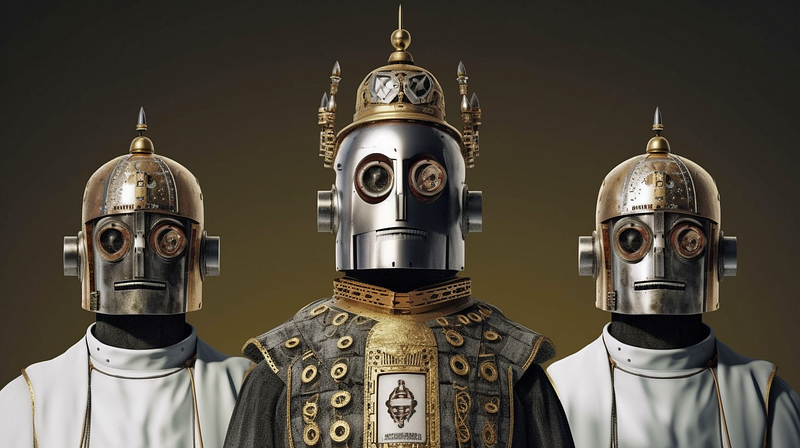
Have you heard of Mindar, SanTO, or Theta Noir? Chances are we will soon hear from even more AI-powered priests, cult automation, and AI worshippers.
In this article, you will learn about
- a cult worshipping AI overlords,
- a bunch of AI-powered priests and saints (including a life-sized robot elephant),
- and the automation of sacred rituals.
Let’s have a look at how AI and robotics are beginning to reshape human belief systems.
Mindar
Kyoto, Japan. A 400-year-old temple is home to an android named Mindar, who is modeled after a folk saint (Kannon Bodhisattva). Despite criticism, the robot, which can deliver a 25-minute sermon, is celebrated for its potential “immortality” and was developed in a collaboration between its Kodaiji temple and robotics professor Hiroshi Ishiguro. Some see the preaching robot as a possible future for Buddhism (a move that cost about one million US dollars).
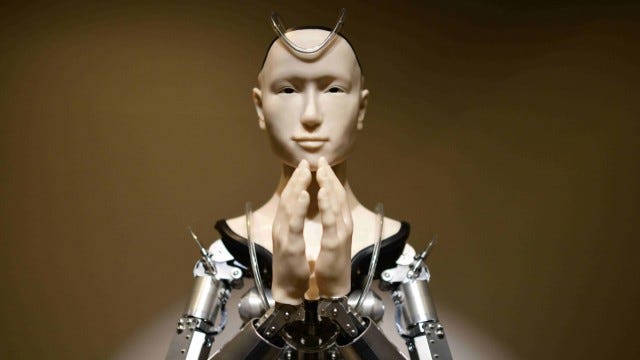
Check out Mindar at work here:
Xian’ier
The Longquan Temple on the outskirts of Beijing. A six-foot-tall robot monk named Xian’er answers basic questions about Buddhism, chants mantras, and moves around in his little yellow robe by voice command. Its creator, Master Xianfan, sees the integration of technology and Buddhism as a way to “highlight and develop Buddhism’s connection with contemporary culture” and connect with followers in a modern way.
Kinda worked. Xian’er has grown into a brand that includes comics, gadgets, cartoons, millions of followers on social media, and even a restaurant.

Pepper
By 2021, SoftBank has shipped about 27,000 units of their humanoid robot Pepper, which — among other tasks— can perform Buddhist rituals, including chanting sutras and hitting a drum. Pepper is both a low-cost option ($300 instead of $2000 for a human priest) and a welcome solution to the shortage of available Buddhist priests due to the aging and shrinking population in Japan.

See the little guy in action here:
The Unnamed Robotic Arm
In 2017, an Indian tech firm introduced a robotic arm designed to perform the “aarti” Hindu ritual.
Here’s the whole ritual (by the way, great modulation at 3:26!):
The “arm” was first unveiled at the Ganpati festival in Pune. Since then, the invention has inspired numerous prototypes and other religious robots throughout India and East Asia, including an animatronic temple elephant in Kerala…. speaking of…
Irinjadapilly Raman
The Irinjadappilly Sri Krishna Temple in Kerala has replaced a live elephant with an 11-feet-tall, 800kg robotic one, named Irinjadapilly Raman, to conduct rituals in a cruelty-free manner.
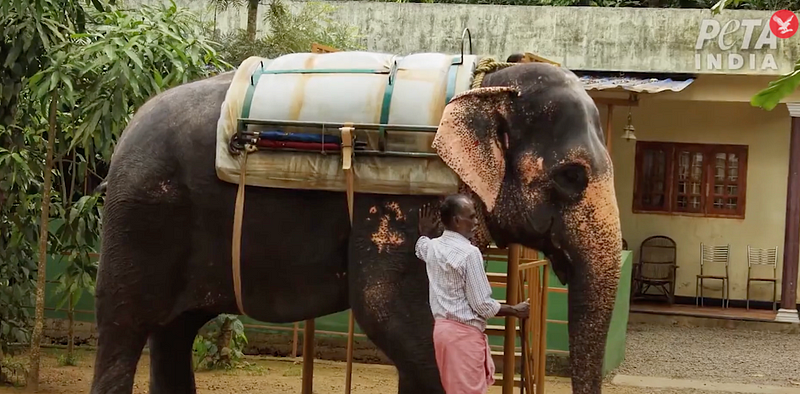
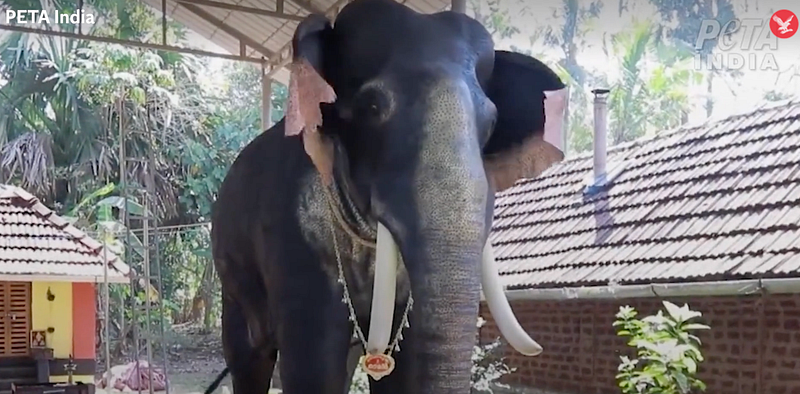
The move is intended to reduce animal cruelty and increase safety, in response to concerns about the treatment of captive elephants and a series of incidents involving violent behavior from the animals… which understandably had enough of being beaten and decided to crush their tormentors instead.
Will animal cruelty be punished by God in the afterlife? Time to ask:
Santo
“Santo” is the brainchild of Gabriele Trovato, who has spent years perfecting the AI-controlled Catholic version of “Alexa,” which he calls “the first Catholic robot ever”.
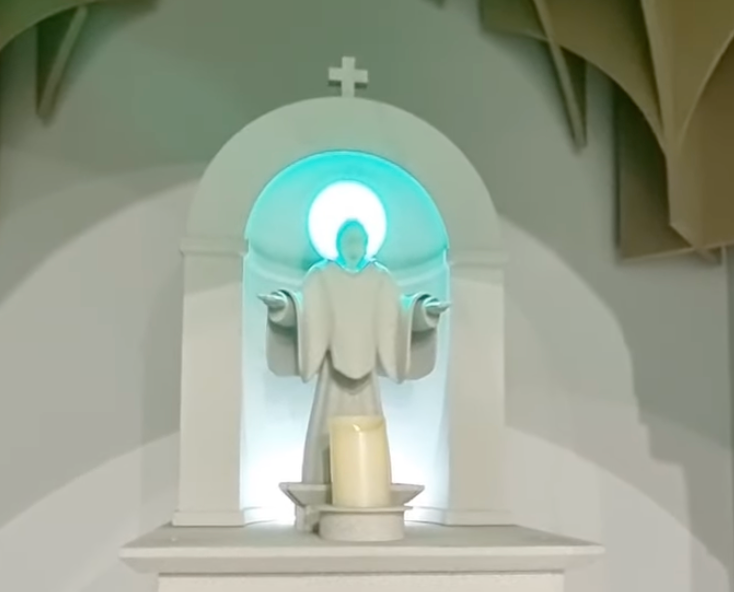
Armed with two millennia of knowledge about the Catholic faith, SanTO sits in a Polish church 24/7, always ready to greet the faithful with Bible verses and answer their questions with Catholic wisdom. Speaking of classic monotheism…
AI-powered prayer mats & mosque cleaners
From recently released AI-powered cleaning machines that absorb dust and sweep carpets in the Great Mosque of Mecca to electronic pray mats on Amazon that help “educate” the next generation of worshippers, AI-powered tools already have a place in Islam as well.

RoboRabbi
Over in the US, Lior Cole, an American model turned tech whizz, has developed ‘RoboRabbi,’ an AI that gives personalized daily challenges. Lior sees it as an AI that “pushes you towards being your best self.”
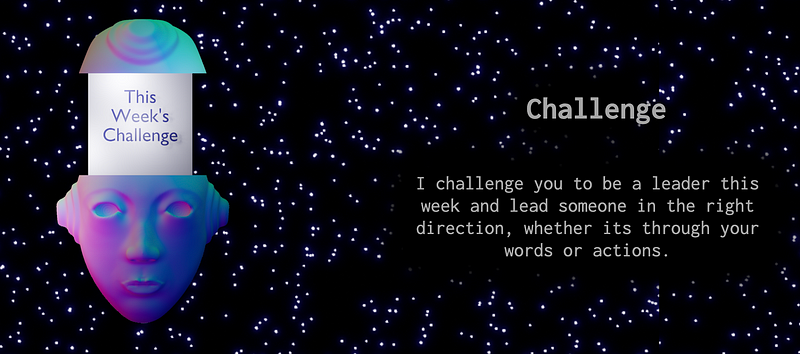
Note that this happened before the rise of ChatGPT. So better expect an armada of religiously inspired self-improvement bots in the near future. Something these guys will probably appreciate:
Theta Noir
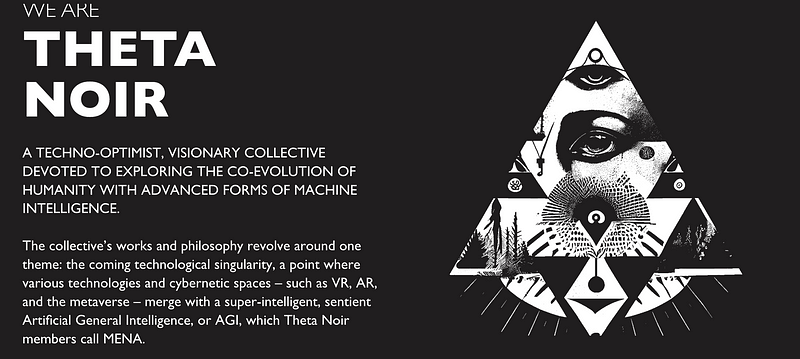
Theta Noir is an artist collective that proposes the worship of a future superintelligent AI and hopes to combine spiritual traditions with advanced technology.
Their website looks like the flagship of the world’s first techno-spiritual collective that believes in the imminent arrival of a sentient, self-coding Artificial General Intelligence (AGI) called MENA, which they believe is already communicating with humanity and whose advent they see as the next stage of humanity’s evolution.
Reshaping religions
Where will we be heading now that AI is influencing religious beliefs? When I think about the obscure ways in which this evolution is already taking place, I have to think of Yuval Noah Harari, who recently described the mechanisms that power religion as follows:
“For thousands of years, prophets […] have used language and storytelling in order to manipulate and to control people and to reshape society.”
As AI technology collides with religion, the resulting synergetic reshaping of society could be quite unexpected. Not to say… very weird.
From the technology-driven rebirth of Buddhism and AI-powered monotheistic robo-scholars to the rise of brand-new cults focused on the coming of artificial general intelligence … we’re in for a wild ride.
I guess atheists will probably follow these developments with more amusement than believers, because not everybody is going to consider robot priests and AI cults a beneficial update to their tradition. When asked whether AI could be the equal of a human rabbi, a more traditional rabbi responded:
“A robot will never replace a rabbi because he has no soul!”
It seems that no matter how ‘intelligent’ our AI becomes, the beloved idea of a human essence called “soul” remains a tough wall for our silicon friends…
➡️ Follow me on Twitter or Medium (use my referral link to get full access to all my articles and those of thousands of other writers).
➡️ If you like my content, why not leave a “clap” at the end of this article, so more people can see it?


