
Gnomon
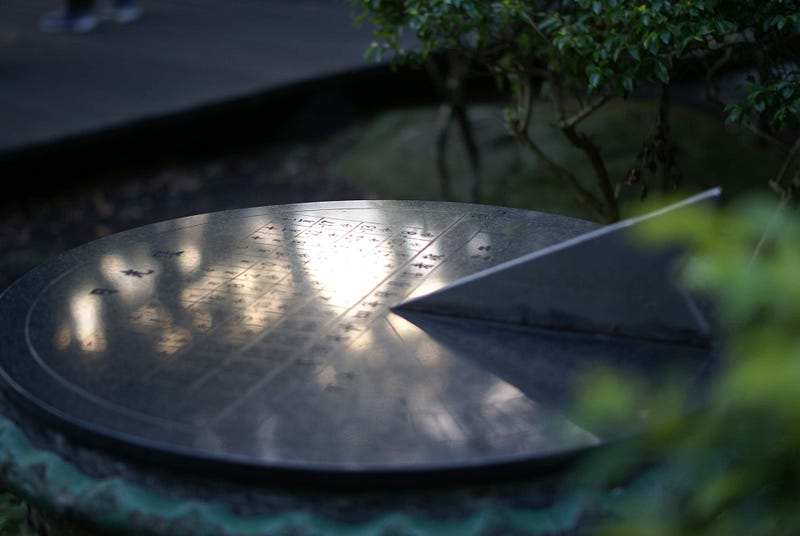
No, this is not a huge garden ornament
Today’s New York Times Spelling Bee letters:
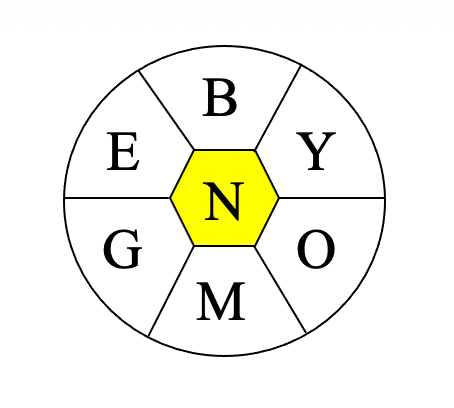
B, E, G, M, O, Y, and center N (all words must include N)
Merriam-Webster says…
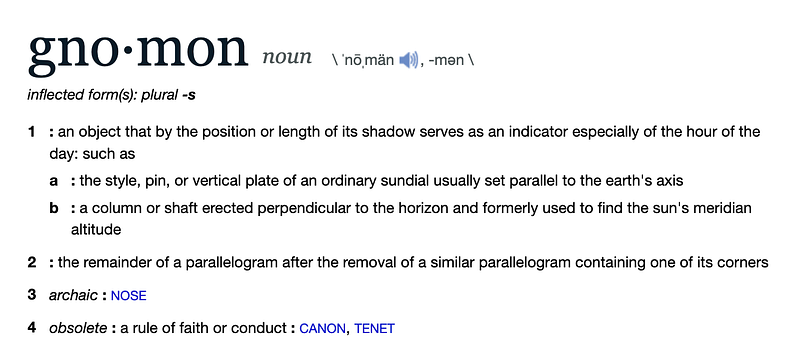
Silly little dictionary! Don’t you know that gnomon can’t possibly be a word if the New York Times says it ain’t?
For further fascinating facts, check out the Spelling Bee Master.
What’s your favorite dord* from today’s puzzle?
My Two Cents
Because the word gnomon has a few unrelated — and not archaic — definitions, one of which has to do with keeping time and the other with math… I would have thought it would be on the accepted word list for today’s game. Don’t get me wrong: I’ll freely admit I was not aware of the existence of this word until today. However, I’ll also confess I tried the word randomly after finding gnome. And if I did, perhaps others who play the game did, too. So what’s the harm of including it and giving people a nice surprise when they accidentally “discover” a word.
Dial up that sun
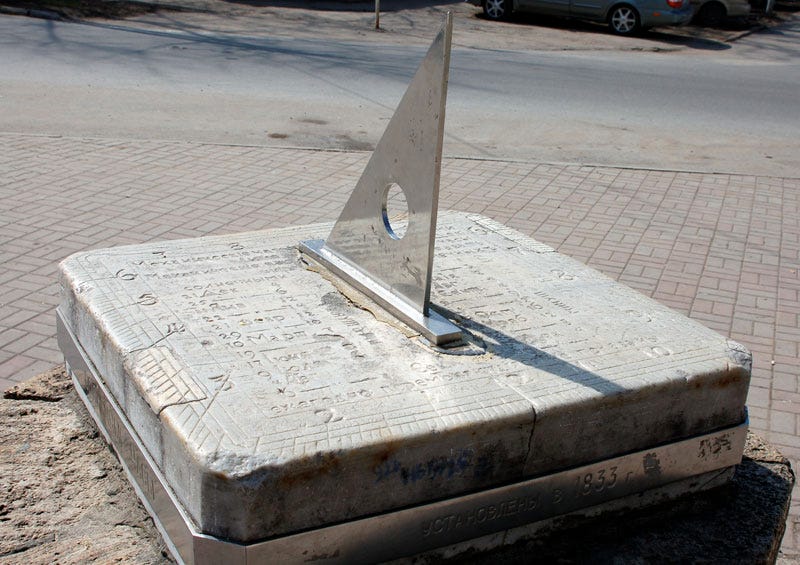
Merriam-Webster tells us that gnomon was borrowed from the Latin gnōmōn, meaning “pointer of a sundial,” itself borrowed from the Greek gnṓmōn , which had other meanings aside from that one: “examiner”, “interpreter”, and… “carpenter’s square”.
As you can see, the gnomon on this sundial indeed looks very much like a carpenter’s square.
The oldest known gnomon was part of the oldest known sundial discovered to date. Estimates are that this painted stick found in an ancient astronomical site in China may be more than 4,000 years old.
Italian astronomer and mathematician Paolo Toscanelli is known for a few things. Among them is his description of a comet as having a head “as large as the eye of an ox” and a tail “fan-shaped like that of a peacock”. That comet would eventually be named for Edmond Halley, who calculated the periodicity of this celestial object and correctly predicted its return.
Toscanelli was one of the “cool” guys of the early Renaissance in Florence; as such, he palled around with other intellectuals of that time. This is why he was probably given permission to install a gnomon consisting of a bronze plate with a round hole in the dome of the Cathedral of Santa Maria del Fiore. I mean, they don’t just let anyone do that… I tried once and spent the night in cathedral jail. Trust me, it’s not worth the effort.
According to the cathedral’s website:
The gnomon is an indicator of the position of the sun consisting of a hole through which a well-defined ray of light seeps through. In fact, it projects a scaled image of the sun as it happens in a camera through the lens shutter, or the lens of a modern video projector. The cathedral gnome hole, called ‘bronzina’, is made of bronze and has a diameter of about 1/1000 of its height from the ground. This allows a clear projection of the solar disk on the floor. The ‘bronzina’ is located 90 meters high in a southern window of the Lantern… At exactly midday on the solstice day, the solar image projected coincides precisely with the largest of these two superimposed marble discs, which has a diameter of 90 cm.
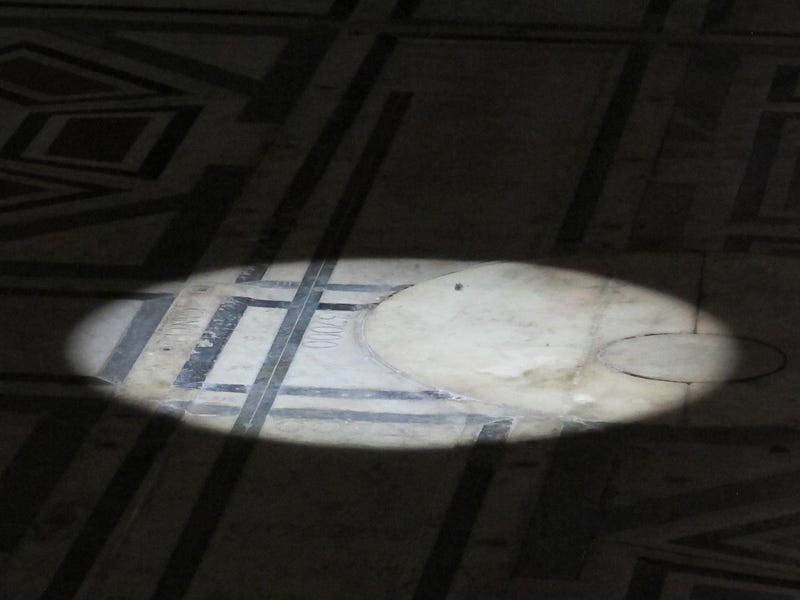
Now you have something to look forward to seeing when you visit Florence. It’s not like there’s anything else to see in that city… Right?
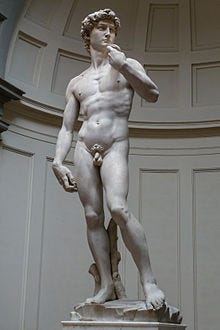
Right?
Parts of a whole
The ancient Greek mathematician and engineer Hero of Alexandria — so named not for his bravery, but rather for his love of foot-long sandwiches — defined a gnomon as something which, when added or subtracted to something else, could make a new something similar to that second something.
Something tells me this Hero guy was not very good at definitions.
Since a picture is worth a thousand words, an animation must be worth millions, or perhaps billions. So here is one showing a gnomon repeatedly and endlessly falling off a snail shell.
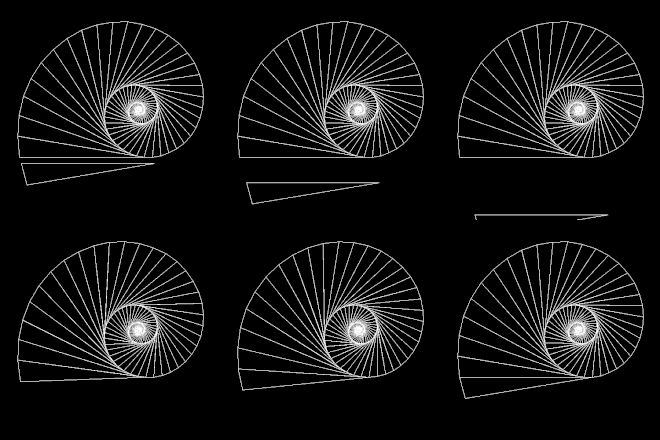
Notice how the shell shape basically remains the same.
This brings us to the second definition in the dictionary, the mathematical one: “the remainder of a parallelogram after the removal of a similar parallelogram containing one of its corners”.
This definition can be generalized to any figure, however. In the example, below, there is one obtuse triangle (it has one angle greater than 90 degrees, the same angle on which it is rotating) that “lets” go of an acute isosceles triangle once per spin. But every time that isosceles triangle flies off, you will still see an obtuse triangle, which spins and “lets” go of another isosceles triangle again, and so on.
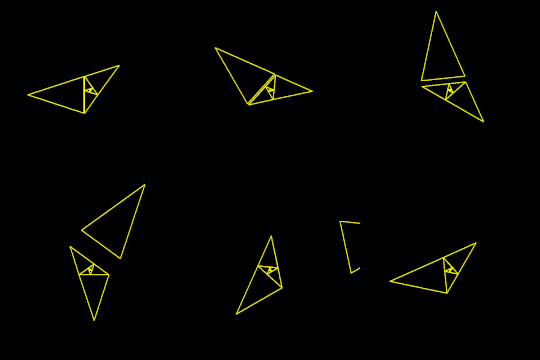
That triangle being thrown off is the gnomon of the obtuse triangle that remains.
Another mathematical application of gnomons is in building figurate numbers, typically represented as dots arranged as a regular polygon. Something you surely may remember from math classes:
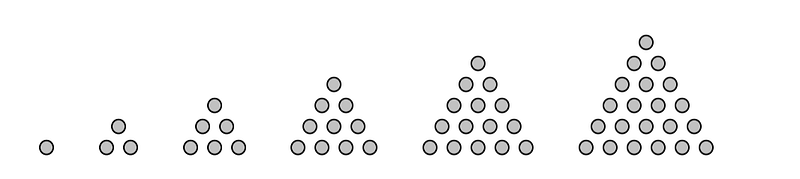
This is another example, using numbers instead of dots.
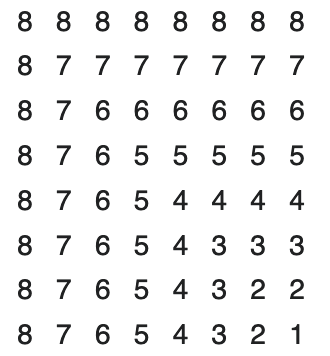
What’s interesting is that this arrangement helps prove the postulate that the sum of n odd numbers is always n². For example, the sum of 1 + 3 + 5 is 9. Nine is 3². And the 3 is the quantity (n) of odd numbers we added.
The rule for constructing this arrangement is using the formula 2n + 1. You start with one digit, which also happens to be odd: 1. When you plug that as n in 2n + 1, you get 3, which is the quantity of 2s next to the 1. So far, we’ve added 1 + 3 (1 one and 3 twos). The result is 4, which is the square of 2, the quantity of digits we added.
(It’s important to remember that, except for 1, the other digits in the above square do not represent the number being added, but rather its sequence in the sum. So, the twos represent the number 3: there are three of them, and they are second in the sequence of addition: 1 + 3 +…)
Now plug in 2 as n in the formula, and you get 2 x 2 + 1, or 5. Now count how many 3s you have around the 2s. That’s right. Five 3s. 1 + 3 + 5 +….
Each of these “upside down” Ls, or corners, of numbers is a gnomon. And each gnomon represents an odd number. 1 represents 1, 2 represents 3 (because there are 3 twos), 3 represents 5 (because there are 5 threes), etc. Now add the total of odd numbers: 1 + 3 + 5 + 7 + 9 + 11 + 13 + 15 = 64 = 8².
We added a quantity of 8 odd numbers (1, 3, 5, 7, 9, 11, 13, 15) and got the square of that quantity (8) as a result. And you can easily see the square, being that each side length is 8 numbers, or digits, long. When you add the next gnomon, consisting of 9s, you will still get a square. And when you add 17 (the seventeen 9s used to create that gnomon) to 64, you will get 81, which is the square of… 9 (the quantity of numbers you are adding: 1).
Am I the only one who finds this fascinating? Yes? Oh, okay. Sorry. Well, then, here’s a picture of a cute baby pudu being bottle fed:
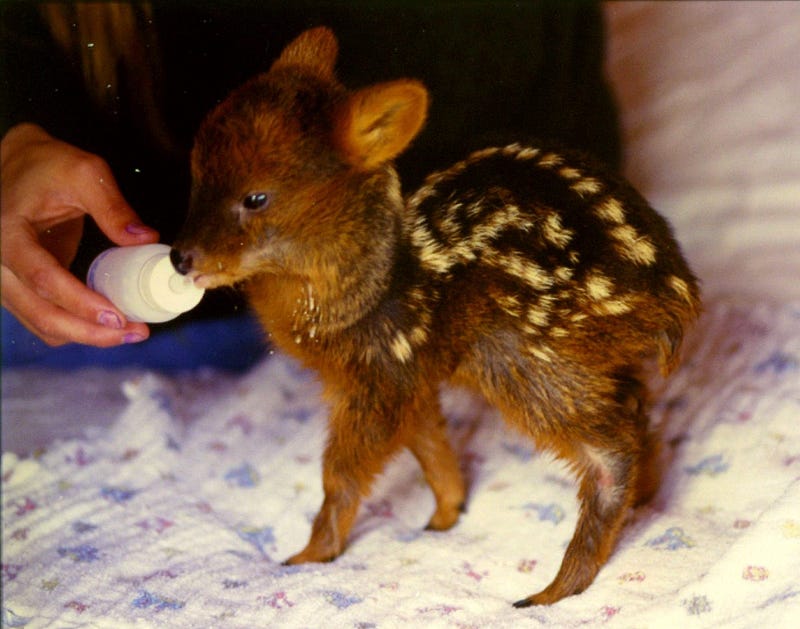
I hope that made up for torturing you with math on a Friday evening.
Perhaps the editors of the Spelling Bee found gnomons very boring, too, which is why they decided that the word gnomon is a dord.*
You can check out my previous entry on another dord* here:
*What the heck is a dord, you ask? Here’s the answer: