
Global Crisis will hit us all
Best time to launch a new startup!
Crises always present new opportunities for entrepreneurs. They are generally viewed as dangerous, and expensive, with destructive agendas and priorities. A Global Crisis that will hit us all soon is now a certain fact. However, a look back at history illustrates that crises and threats can be good for directing the world to better solutions. During a global crisis, the motivations burst, potentially leading to new global cooperation attempts to create new systems, structures, or companies. The dot-com bubble destroyed small companies and strengthened Amazon and eBay. Someone said that even “World War II paved the way for the birth of the United Nations and Bretton Woods institutions, and the 2008 global financial crisis led the major economies to come together to form the G-20 group.”
In the last few years, we’ve seen fast adoption of digital services and a shift in online spending. It’s improbable that many of these trends will be changed after the pandemic and war. In the case of remote work, we saw that more businesses are willing to shift 5% or more of their workforce to home or remote working. As a result, tools that facilitate remote work and communication are shifting for a good future. Zoom saw its daily active users grow to 200 million, up from 10 million three months prior to 2021, and Clubhouse's 10 million weekly active users, up from 600.000 in December 2020. Also, online education platforms almost doubled their user base.
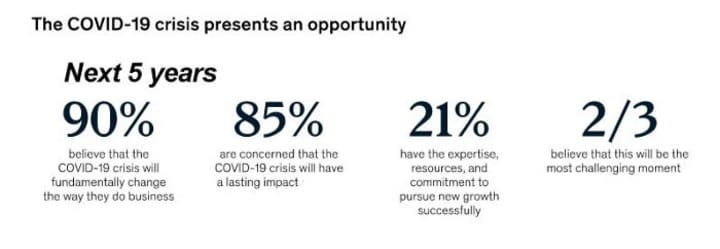
“McKinsey&Company survey on 200 top executives reveals that the pandemic crisis presents an opportunity.”
So once a global crisis is in motion, turning it into an opportunity can be tough but not impossible. Now is the best time to launch startups and to test new and crazy ideas because if it fails we can always blame the crisis. There are no easy, or difficult solutions; thus, the time has come to approach them in new ways, creating occasions for building new companies. Looking at the issues through a different lens is the best approach. Underestimating the severity often is insufficient. Understanding its nature and process probably will require many trials and errors but provides more latitude to explore opportunities and innovate. A global crisis has a manner of getting the better ones to rise from the ashes. Therefore, those with the right skill sets have a way of advancing to meet the big challenge, creating a dynamic for the group to grow and work better together. Rapid changes and sales models are the wheels in any crisis. So companies or startups should understand that investing now in innovation will give them a boost in growth. The SARS epidemic ravaged Asia in 2002 and led to the growth and widespread adoption of e-commerce in that region, making China the epicenter of innovation around social commerce.
Sometimes fear enables people to act. To make bold and often heavy moves and disrupt some aged habits. Stopping to protect the old, the entrenched, the irrelevant way from the past. Catalyzing a range of new discoveries, structures, and behaviors from astonishing technological “thingy” to unseen levels of global cooperation. Furthermore, crises tend to reshape spending patterns, which in turn change how attractive an end market may be. From this perspective, every customer touchpoint will become a new opportunity to learn. This ability to rapidly synthesize the many signals, recognize new patterns of customer behavior, and take action quickly can give companies or startups a head starts in the innovation race. Organizing this information to be rapidly converted into new products, services, customer experiences, and business models is critical. Leaders can then leverage rapid formats such as pitch panels to further prioritize new concepts or ideas. Those are always outstanding people in even the most broken systems that will recognize this is the time to act. They will be the ones who win eventually. But the immediate challenge is to motivate people/teams to bring intense focus, speed, and agility to delivering those new sources of value.
Crises are like adrenaline for innovation, causing barriers that once took years to overcome to disappear in a matter of days. Removing constraints and questioning previous assumptions about what will generate the most value are means and powerful ways to conceive new economic models. Ex: Chinese consumer consumption offline dropped almost 70% with restrictions and only half of that volume returned after the lockdown was lifted. That has implications for some organizations’ assets, tools, and capabilities. As market dynamics evolve customers will rethink their needs and associated spending so a reconstructing model should be in place for those companies affected by the crisis. A trend was seen in the greater ecosystem as well; many top companies have opted to provide their services and products for free or at discounted prices, making it the prime moment to test or build something at a minimal cost.
Without such bubbles and crises to existing systems and practices, leaders and populations are generally resistant to major changes and give up some of their sovereignty to new organizations, rules, or companies. Nearly 3 from 4 executives agree that changes brought about by this pandemic will be a great opportunity for growth across different industries. So Build now and Build it fast!
This work here is entirely reader supported so If you enjoyed reading it please consider sharing it around and SIGN up here to get all my future articles directly to your inbox. Also if you feel like you can throw some money into the tip jar gladly will be accepted. Thank you for the support!