
WEEKLY BUSINESS ROUNDUP
Global Business Week: What does it cost to run a big business?
The state of Financial markets & Economies, Weekly Charts, Business Trends & Statistics
In anticipation of the Jackson Hole summit, the U.S markets continued to creep up all week and took heart from Federal Reserve Chair Jerome Powell’s comments that the central bank is in no hurry to raise interest rates or taper off the bond purchases. On Friday, The S&P 500 closed above 4,500 points for the first time, while the Nasdaq jumped more than 1%, also finishing at an all-time high. The Dow was up more than 200 points, just 170 points from its best close ever.
For the week, the Nasdaq added 2.8%, while S&P increased 1.5%, and the Dow went up 1.0%. Apart from all three major U.S indices, Crude oil also had a strong week, gaining 10% to $68.72 per barrel. Energy turned in the best performance, rising 4.9%, Financials followed with a 2.8% increase, and Consumer Discretionary drove up 2.7% — Utilities, Consumer staples & Real estate lagged. The 10-year Treasury yield ended the week at 1.31%, up almost 5 basis points from a week ago.
With the mention of earlier tapering in the most recently released FOMC minutes, the dollar index had been well supported above support around the 92.80–92.90 zone. But dovish comments by Fed Chair during Jackson Hole pushed the risky equities higher and the Greenback lower — DXY closed the week @ 92.68. This decline follows the firming up of DXY to a fresh 2021 high earlier. Even if the tapering is delayed, FOMC remains ahead of the curve among other major central banks to raise interest banks. The sentiment alone may keep the dollar index bullish in the medium term.
Cryptos have seen an equally bullish sentiment — albeit a waning one. Although Bitcoin & Ethereum are relatively flat for the week, short-term bearish consolidation seems well supported at current levels. Cardano has continued to outpace the other top Alt. coins recently, gaining almost 15% for the week. At the time of writing, Bitcoin was trading close to $48.7k, while ETH is trending near $3,240. With higher lows in place and supportive fundamentals in place, cryptos remain set to gain further ground.
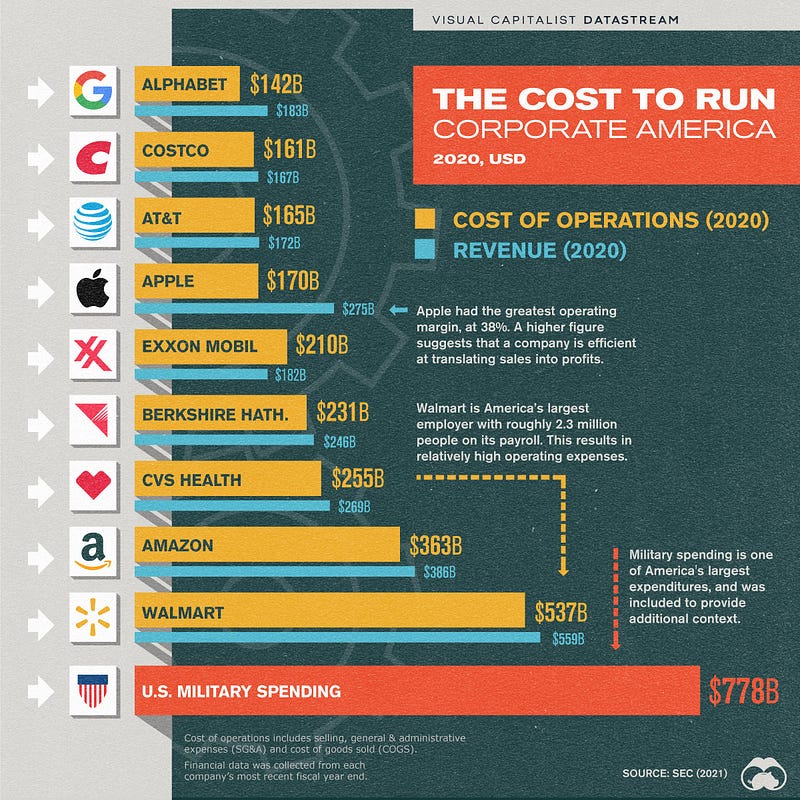
Today’s featured infographic (above) looks at how much it costs to run one of America’s largest corporations? For household names like Apple, Costco & Walmart, well over $100 billion each year. To get a better sense of their massive scale, this chart compiles financial data from some of the largest Fortune 500 companies and includes U.S. military spending as an additional point of comparison.
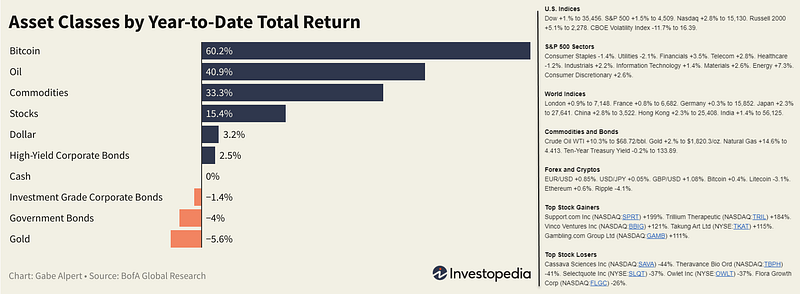
And finally, before moving on to some other statistics, here are the weekly & YTD numbers from various markets and different assets (Figure 1).
Most Efficient Unicorn Investors
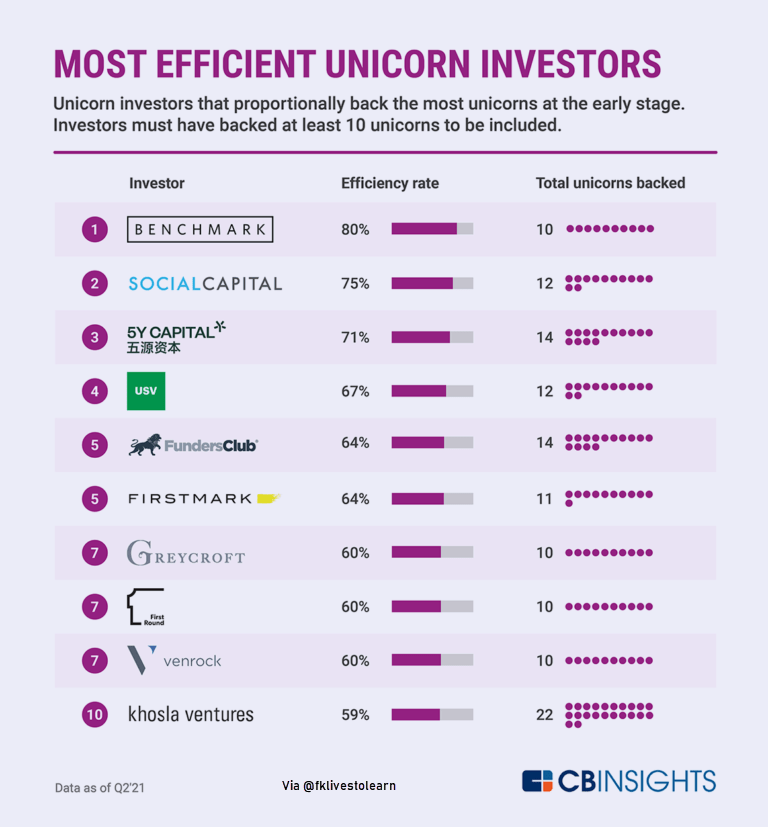
Venture capital investing is a game of home runs. VCs are always looking for the investment that can “return the fund” and make up for all their losses — and then some. Using CB Insights data and their real-time unicorn tracker, they dug into investors’ portfolios to see which have backed the most current unicorns when they were just taking off (as of Q2’21). They rank the top 10 investors based on their early-stage bets on today’s billion-dollar companies (Figure 2).
Market Share of Stablecoin Supply
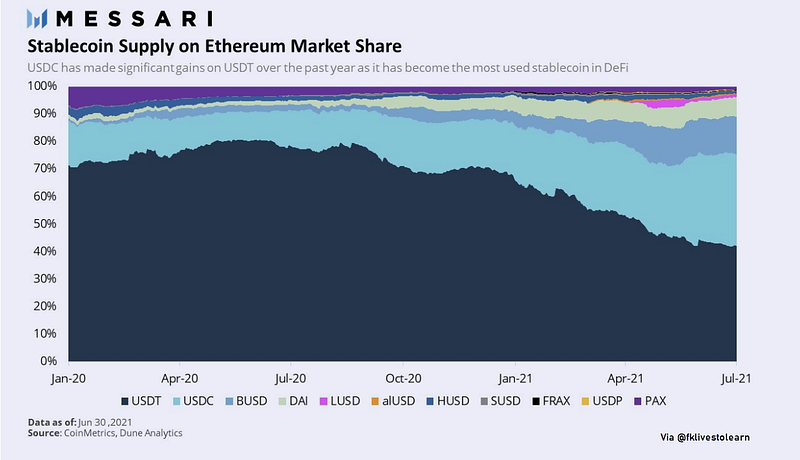
Circle and Coinbase recently announced their stable coin USDC will now be 100% backed by cash and short-term U.S. Treasuries by September. With the strong likelihood that the U.S. utilizes privatized stablecoins to usher in the next era of dollarization, Circle and Coinbase are strategically positioning USDC as the prime option (Figure 3). Thus far, Coinbase and Circle have executed brilliantly, and the changes in USDC reserves are yet another indication of where the stablecoin/Fedcoin conversation is heading. Long USDC, Short USD. The gain by USDC in the share of the total stablecoin supply is a reflection of the fact.
Apple’s Decade of Growth under Tim Cook
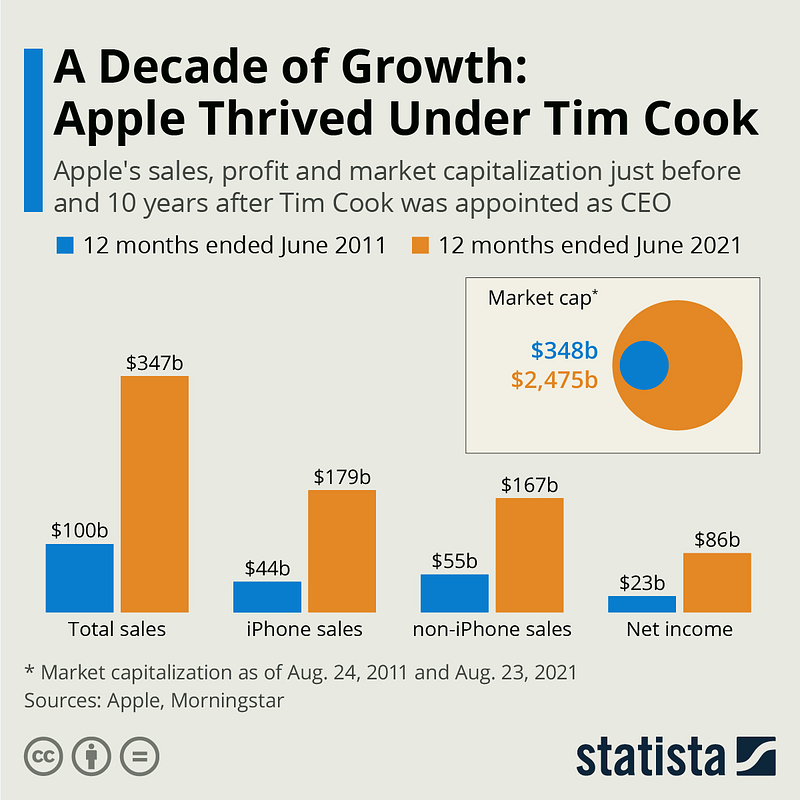
While Tim Cook was respected as an efficient COO, many in the industry believed he lacked the vision and charisma to follow in the footsteps of his larger-than-life predecessor. Looking back at Cook’s tenure at the helm of Apple, it must be concluded that he has done a commendable job. While the jury is still out on whether the past decade was the most innovative in Apple’s history, it certainly was the brightest in terms of growth and execution. As the following chart shows (Figure 4), Apple’s revenue and profit more than tripled between 2011 and 2021, as the company constantly expanded the ecosystem of devices and services around its flagship product, the iPhone. As a consequence, Apple’s market capitalization grew from roughly $350 billion on the day of Steve Jobs’ resignation to almost $2.5 trillion, 10 years later.
Chinese IPOs in H1 2021
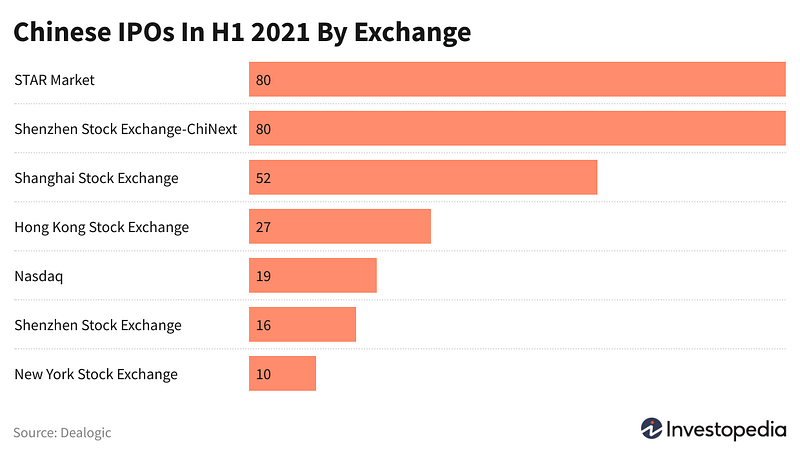
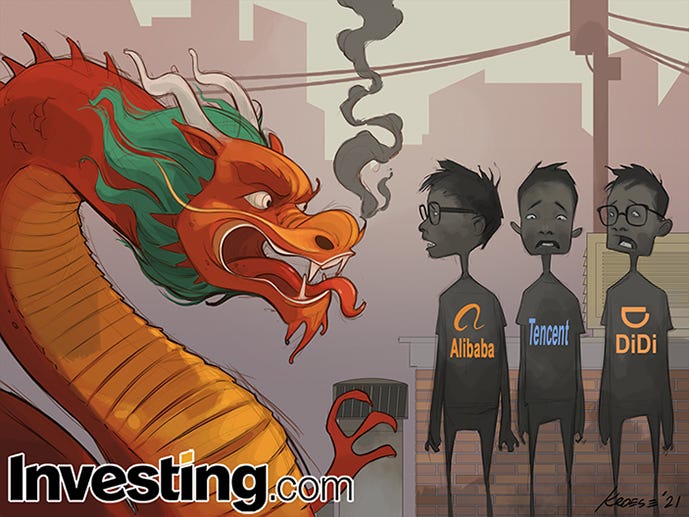
China will propose new rules banning companies with large amounts of sensitive consumer data from going public in the U.S., The Wall Street Journal reported last Friday. Officials said the new rules, which have not yet been finalized, would only affect firms holding certain kinds of personally identifiable information, and that firms with less sensitive data, like pharmaceutical firms, are still likely to receive Chinese regulatory approval for foreign listings. Chinese regulators are rolling out a series of new rules for data-intensive firms in addition to the IPO (Figure 5) restrictions. The new rules would also bar companies from using algorithms to price-gouge consumers based on their buying preferences, and from forcing employees to work 72 hours a week.
FDI Flows retreat to 1995 Levels
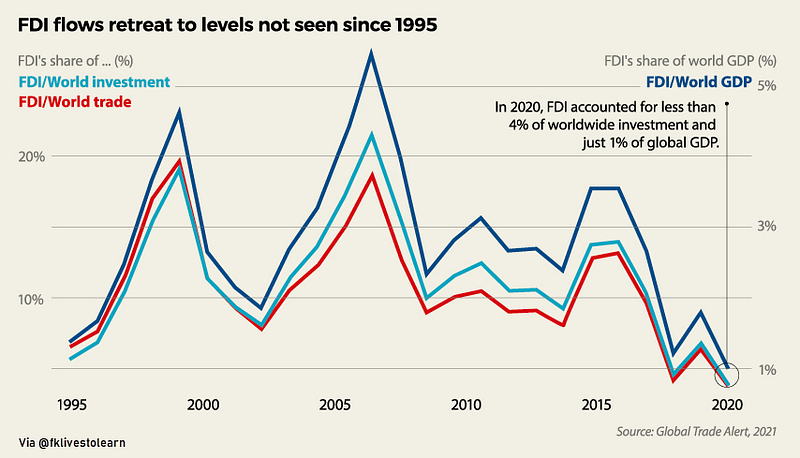
Foreign direct investment (FDI) has long been a hallmark of globalization, helping to transform entire firms, cities, sectors, and economies. For evidence of this, we look no further than China. Attracting cumulative net inflows of $3.5 trillion since 1979 has enabled the country to grow its GDP by almost 8,000%. Over a similar time frame, China has also lifted 700 million citizens out of poverty. Despite all of the benefits that FDI can deliver, global investment flows have been in a downward trend since the Global Financial Crisis of 2009. The Hinrich Foundation puts this collapse into perspective (Figure 6).
NFT Marketplace Volume Skyrockets
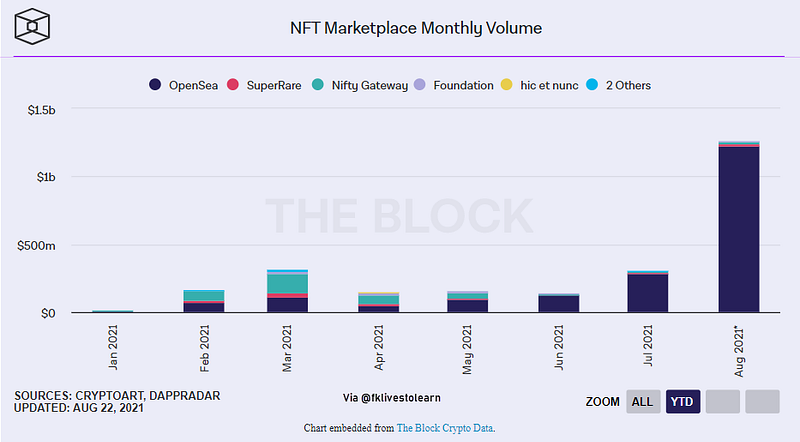
The leading NFT marketplace OpenSea has seen $1.2 billion of sales in August alone or $1.5 billion of sales in the last 30 days. Visa has purchased a CryptoPunks NFT for 49.5 ETH — the equivalent of approximately $165,000 (Figure 7). Even the legacy players are joining in as said by VISA in a recent tweet, “Over the last 60 years, Visa has built a collection of historic commerce artifacts — from early paper credit cards to the zip-zap machine. Today, as we enter a new era of NFT-commerce, Visa welcomes CryptoPunk #7610 to our collection.”
The United States of Tech Startups
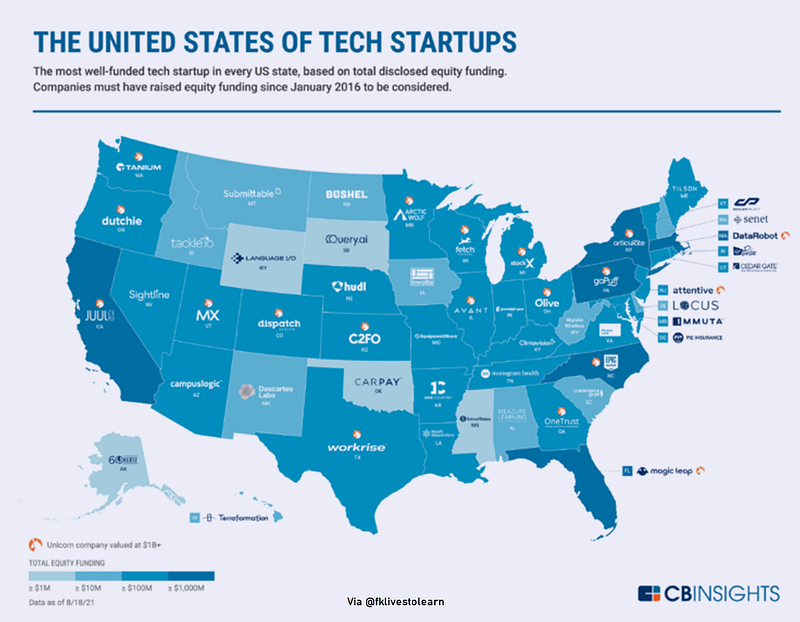
From DataRobot and Olive to Epic Games and Magic Leap, the infographic from CB Insights shows the top private tech company in every U.S state, based on funding totals. The tech boom has diffused beyond the traditional hotbeds of California, New York, and Massachusetts, spreading across the entire US. In their latest map of the most well-funded tech startup in each state (Figure 8), some companies with the deepest pockets were found in North Carolina (Epic Games, $4.4B), Florida (Magic Leap, $3B), and Georgia (OneTrust, $930M). Altogether, the companies on this map have raised more than $40B.
Millions in U.S Set to Lose Jobless Benefits
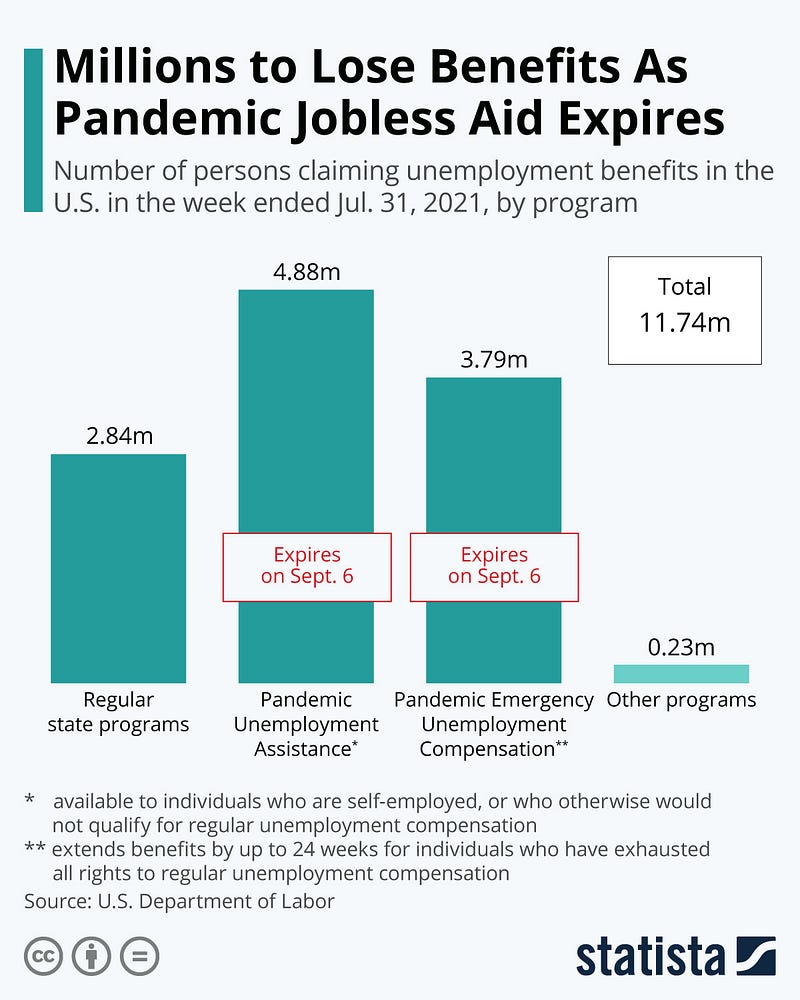
Both the Pandemic Unemployment Assistance program, which is available to individuals who are self-employed or who otherwise would not qualify for regular unemployment compensation, and the Pandemic Emergency Unemployment Compensation program, which extends benefits by up to 24 weeks for those who have exhausted regular unemployment aid, are due to expire on September 6 (Figure 9). According to data published by the U.S. Department of Labor this week, 11.7 million Americans still received unemployment benefits in the week ended July 31.
The Trillion Dollar Club
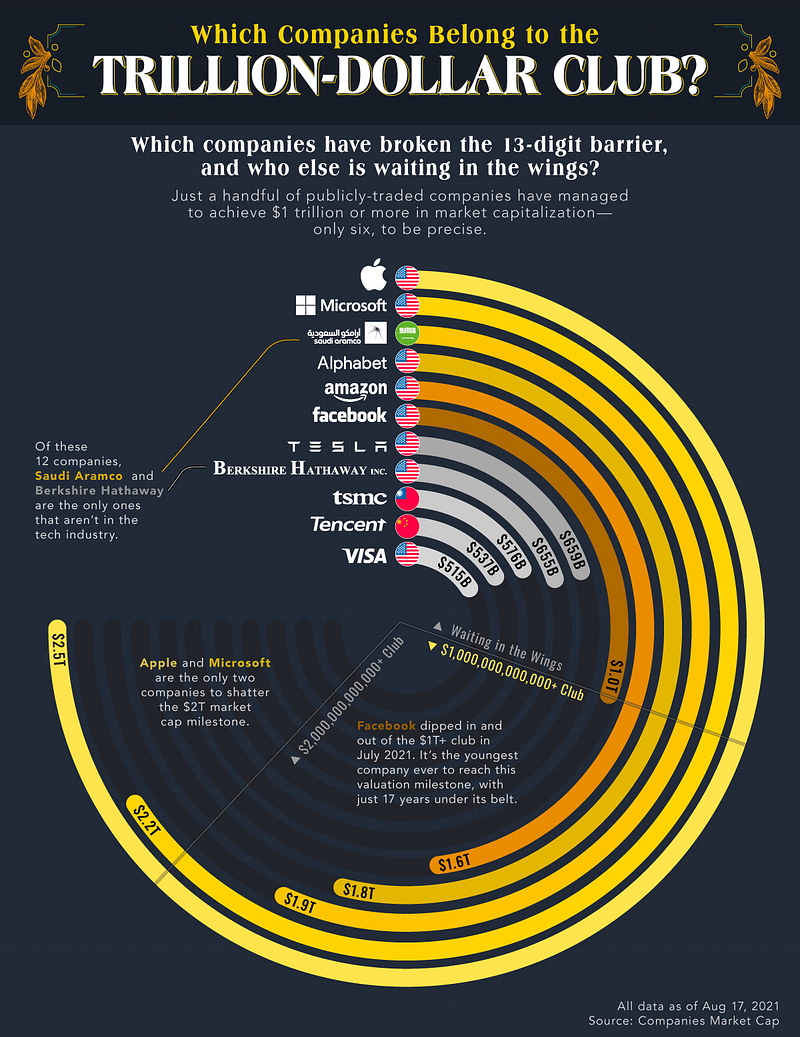
This Elite group of public companies now has six members with a prospect of a few more additions in the coming years (Figure 10). Of the six members of the group, all but Saudi Armaco is from the tech sector. Also, the five tech companies in the club also feature at the top of the list when it comes to naming the Most Innovative Companies of the World. The social media giant, which has been hopping in and out of the $1T+ club in July 2021 is the newest addition to the group.
Market Humor: China’s Tech Regulatory Dragon
Previous Edition of GBW
