
WEEKLY BUSINESS ROUNDUP
Global Business Week: Visualizing social risk in global investment hubs
The state of Financial markets & Economies, Weekly Charts, Business Trends & Statistics
U.S. stock market racked up another round of record highs on Friday, after recovering from earlier losses. Investors looked past disappointing quarterly results from Apple and Amazon to finish the strongest month of the year — where the S&P 500 rose 6.9%, the Dow was up 5.8%, and the Nasdaq gained 7.3%. On the economic front, the U.S. economy was reported to have grown at a 2% annualized GDP pace in the third quarter to mark the slowest rate of increase in more than a year. Despite mixed economic data & supply chain problems, stocks have been buoyed by 80% of companies on the S&P 500 reporting earnings so far beating estimates from Wall Street analysts.
Talking about earning, Bigtech was in front and center of the news. Microsoft shares rose more than 2%, hitting an all-time high and helping the market overcome losses from Apple and Amazon following their disappointing earnings reports. With today’s gains Microsoft surpassed Apple as the world’s biggest company by market capitalization. Shares of Tesla were higher for the eighth straight session, hitting another all-time high — Shares surged 13% to $1,025, marking its biggest one-day advance since March 9, making it the newest entrant to the trillion-dollar club. The catalyst to this massive move was the order of car rental company Hertz for 100K Model 3 sedans to rent in major U.S. markets and parts of Europe.
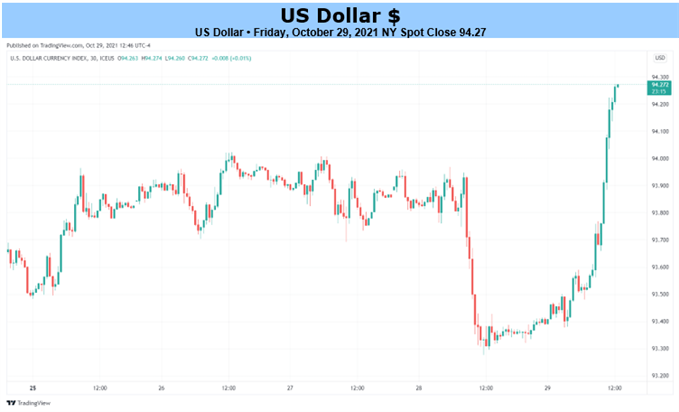
After a few weeks of consolidation, the dollar index (DXY) rebounded strongly on Friday as the yield curve flattened, which reflects the rising hawkish Federal Reserve monetary policy expectations. Strong inflationary data out of the U.S also propelled the benchmark index higher — closing @ 94.13. All eyes now turn to the November FOMC monetary policy announcement due on Wednesday. Following a shift in the central bank’s tone on inflation, the monthly asset purchase tapering is expected to begin. In countries like Australia, New Zealand & Canada central banks have all either finished tapering QE or have started it. It is no surprise to see AUD, NZD & CAD as some of the best performing major currencies against USD over the past month. With that in mind, a hawkish Fed could allow for US long-term rates to outperform, opening the door for Greenback strength.
Meet Shiba Inu, a different puppy-inspired meme coin that has been making waves in recent weeks. A record rally has led the token to become the ninth-most valuable crypto in the world, with a market cap of around $38.8B, at the time of writing. While Shiba Inu may be a meme coin, it’s been increasingly looked upon as having more advantages over Doge. First of all, SHIB is built on Ethereum, meaning it has the potential for more smart-contracting capabilities (think Shibaswap, a Uniswap-like decentralized exchange, as well as NFTs).
SHIB is also a whole lot cheaper than Doge, making it more attractive to crypto traders that want to buy a million of something. The broader crypto market remains steady with Bitcoin hovering around $60k. While BTC consolidates below its new all-time high (ATH) charted recently, Ethereum has posted a new ATH in the $4460 region. Overall, the total market cap of cryptos is just above the $2.60 trillion mark.
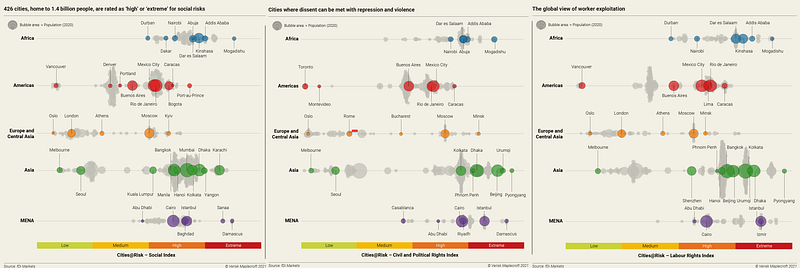
Today’s featured infographic looks at the world’s top cities for foreign direct investment (FDI) and assesses their relative levels of social risk — using data from a report by Verisk Maplecroft. The report outlines how risk was assessed in the report and touches on some key markets that placed high on the ranking.
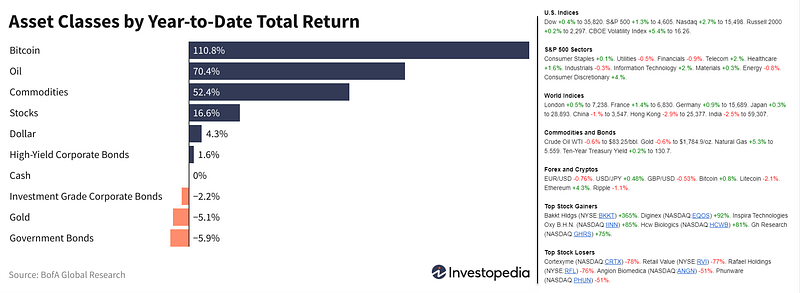
And finally, before moving on to some other statistics, here are the weekly & YTD numbers from various markets and different assets (Figure 1).
Rebranding Companies
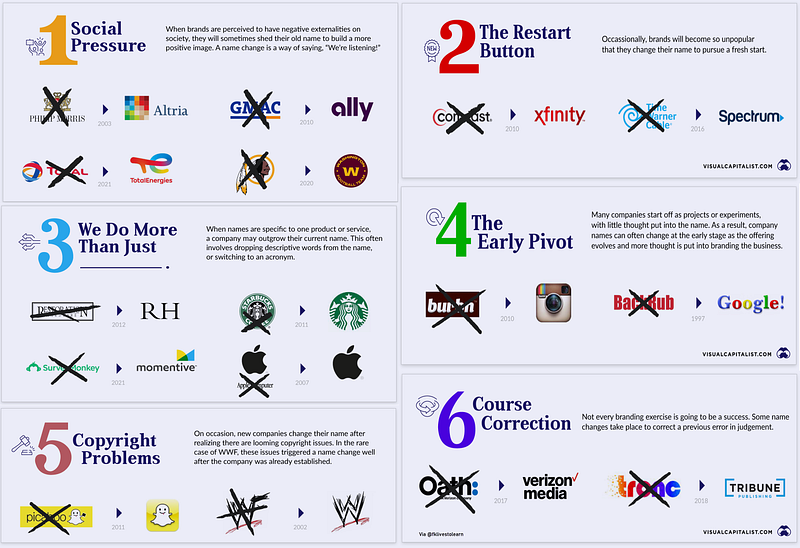
Facebook (the parent company, not the social network) has changed its name to Meta, The infographic below (Figure 2) looks at historical corporate name changes in recent history, exploring the various motivations behind why a company might change its name. Below are some of the categories of rebranding that stand out the most.
Cryptos AUM Reach an ATH
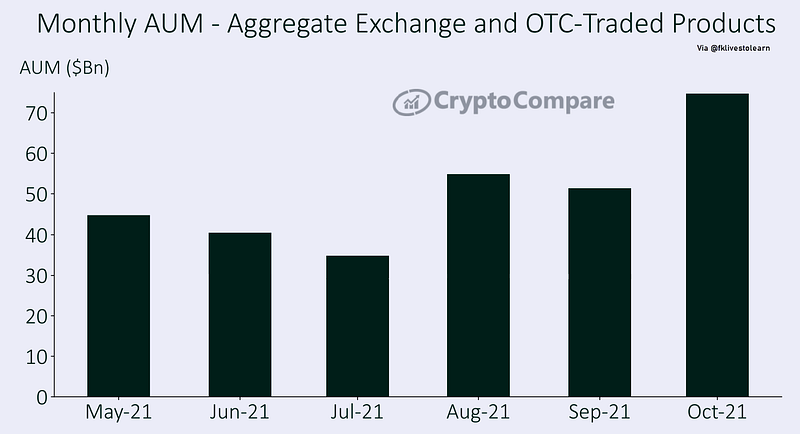
Since September, total assets under management (AUM) across all digital asset investment products has increased 45.5% — reaching a new all-time high (ATH) of $74.7 billion (as of October 21-Figure 3) The previous all-time high of $58.7 billion was reached in March 2021.
Tesla is a Trillion Dollar Company
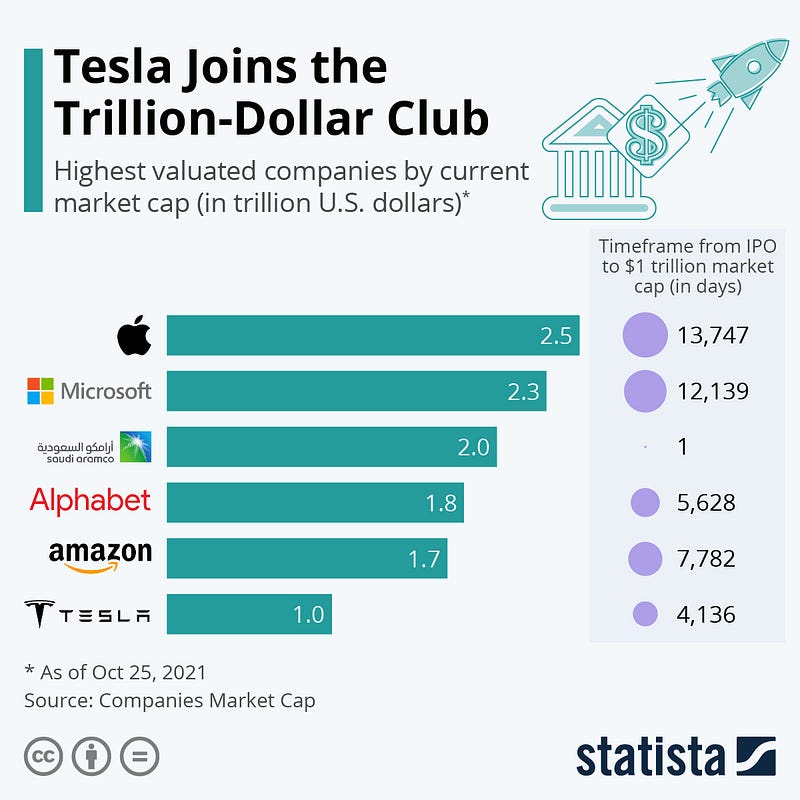
While the car manufacturer’s market capitalization has been edging closer towards the $1 trillion mark for some time, it took an unprecedented order of 100,000 Tesla cars by car rental company Hertz to finally push the corporation over the hump. This not only makes it the latest but also one of the fastest additions to the trillion-dollar club. As the chart shows below (Figure 4), only one company currently is valued at more than $1 trillion was quicker to reach that number — Saudi Aramco, the owner of the second-largest crude oil reserves and producer of the largest amount of oil per day, went public on December 11, 2019, and reached a valuation of $1.9 after only one day of trading.
The second-fastest company, Facebook, dropped out of the elusive club after being a member between June and September 2021, possibly caused by the controversy surrounding whistleblower Frances Haugen and her exposure of the social media giant’s dubious engagement mechanics throughout September and October. Apple and Microsoft, the two tech giants leading the pack in terms of market cap, also took the longest to reach the trillion-dollar mark. Both companies went public in the 80s but didn’t cross the coveted line until the 2010s.
Record Year for M&A
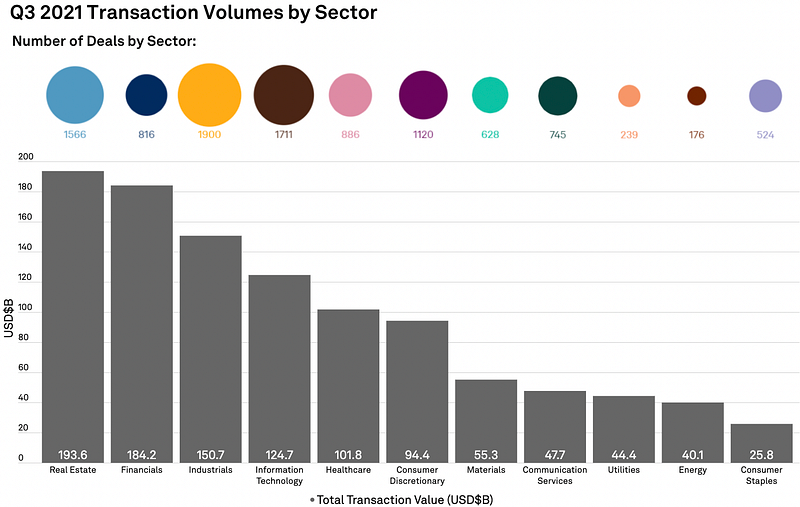
Despite the pandemic and global economic turmoil, 2021 looks to be heading for a record year for mergers and acquisitions (M&A) activity. M&A deals passed $1.07 trillion in the 3rd quarter of this year (Figure 5), overtaking the previous high of $1.06 trillion in the fourth quarter of last year, according to an analysis by S&P Global Market Intelligence. 2021 deals will likely surpass 2018 and 2019 totals as well, possibly breaking the $4 trillion mark. So far, total deals are 29% above previous years’ average transactions. Among the hottest sectors for M&A in the third quarter of this year were real estate and financials, followed by industrials, information technology, and healthcare, which mirrored activity a year ago. Third-quarter real estate deals totaled $193 billion compared to $184 billion in the financial sector.
‘Whales’ Entering the DeFi Market
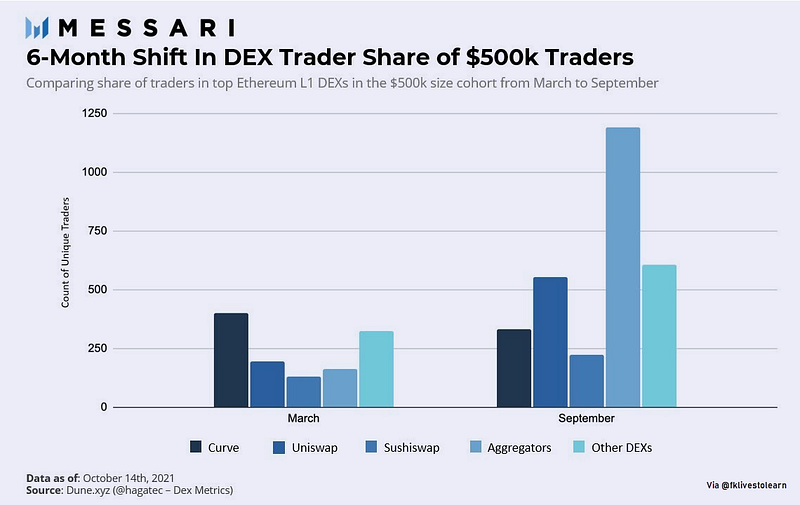
Decentralized exchanges (DEXs) have grown significantly as crypto has bloomed. Uniswap is the most valuable DeFi protocol by market cap. The entire DEX volume has exceeded $78 billion per month for the last two full months and topped out at $163 billion in the month of May. DEXs now average 7–10% of aggregate CEX spot volumes on a monthly basis. DEXs created this success from the now-famous yet simple x*y=k price curve which is responsible for balancing pool liquidity across all price ranges. Uniswap was the pioneer. DEX protocols themselves have begun to change to more efficiently accommodate larger transactions. Uniswap’s V3 and Sushi’s Trident have implemented concentrated liquidity models to improve upon the x*y = k model. DEX routers have grown to attract significant volume — especially in the large-order market (Figure 6) where large trades are efficiently broken up among various DEXs.
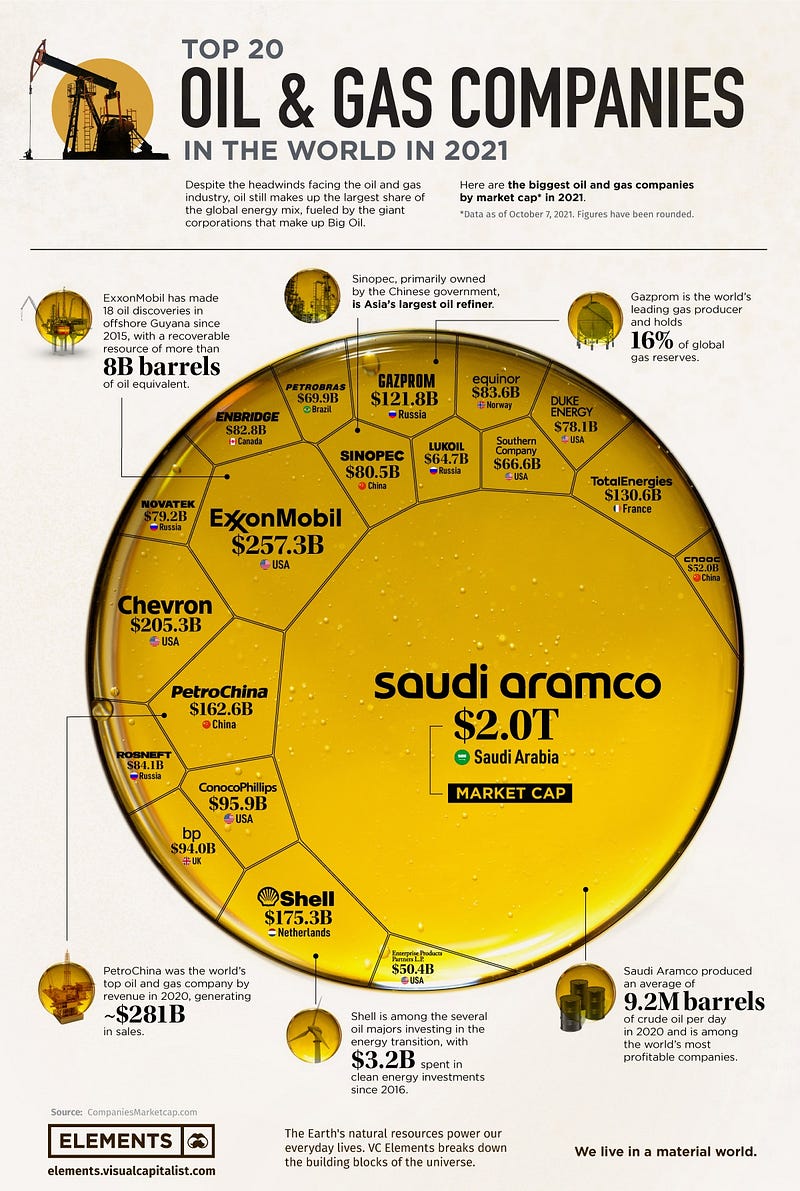
Top 20 Global Oil & Gas Companies
The pandemic brought strong headwinds for the oil and gas industry, and oil majors felt the blow. Global primary energy consumption fell by 4.5% relative to 2019 and oil demand declined by 9%. For a brief period in April 2020, the price of West Texas Intermediate (WTI) crude futures went subzero, marking the largest one-day price plunge since 1983. Some expected the demand crash to have a lasting impact on the industry, but it’s safe to say that 2021 has proved otherwise. With that in mind, here is an infographic (Figure 7) showing the 20 biggest global companies in the Oil & Gas sector.
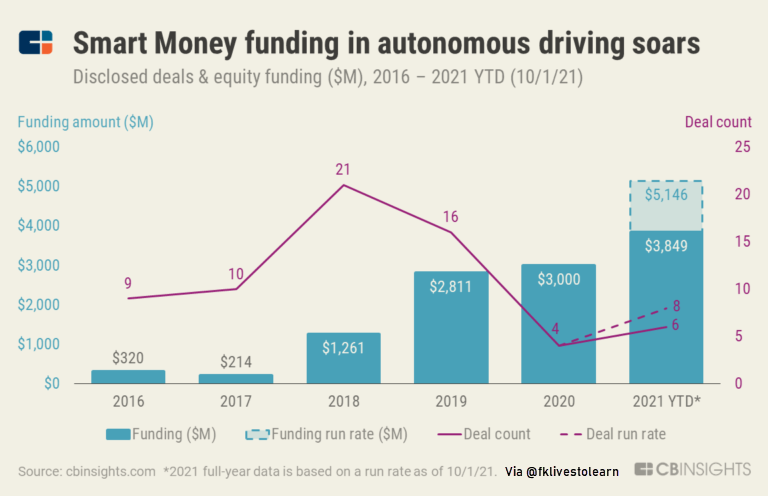
Funding in Autonomous Driving Soars
Smart Money investors are backing autonomous driving companies working on simulation & training, developing the full self-driving stack, enhancing mapping & localization, and more. Autonomous vehicle tech is gaining momentum as startups and major automakers roll out solutions from lidar to computer vision to machine learning systems for perception and decision making. Total equity funding (Figure 8) to the space has already eclipsed $12 billion in 2021, up more than 50% from all of 2020.
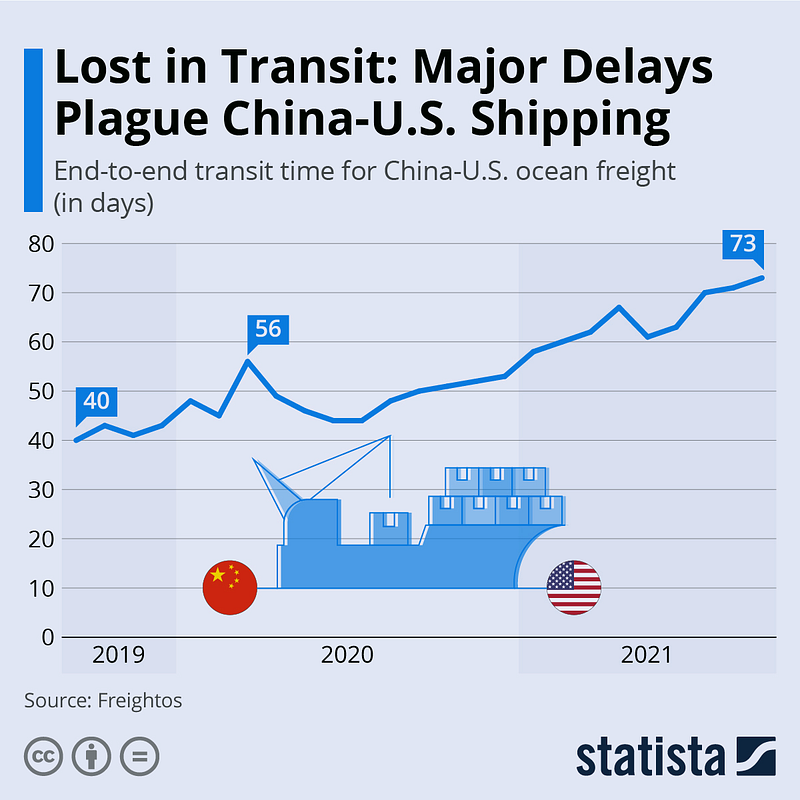
Supply Chain Problems
Before the coronavirus pandemic, goods shipped between China and the U.S. via container ship took just over 40 days, hold-ups and delays have extended that time to upwards of 70 days in July, August & September of 2021 (Figure 9). The delays are much longer than those at the beginning of the global coronavirus pandemic in the spring of 2020 when transit time briefly spiked at 56 days. According to freight booking platform Freightos, container ship pileups at ports on both ends of the journey are significantly increasing the transit time and are adding to the global container shortage that has seen shipping boxes pile up in the U.S. and Europe as the stream of wares coming out of Asia intensified again in 2021.
Power shortages, recent holidays taking place in China and finally Typhoon Kompasu pummeling the Southern Chinese coast have also not aided a streamlined shipping process either. In early October, Freightos said that shipping containers from Asia to the U.S. West Coast was now 330% pricier than it had been a year earlier. The cost of shipping goods from Asia to Northern Europe had even increased by 570%, but rates still remained slightly lower in absolute terms than for Asia to California routes.
Market Humor:
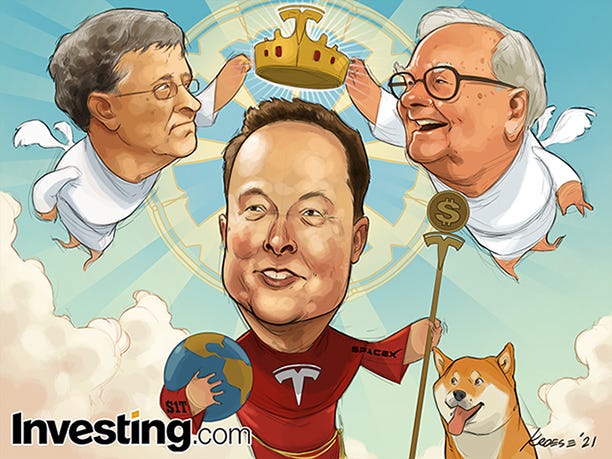
Tesla Rally Makes Elon Musk The Richest Person In The World, Now Worth More Than Bill Gates & Warren Buffett Combined
Previous Edition of GBW
