
WEEKLY BUSINESS ROUNDUP
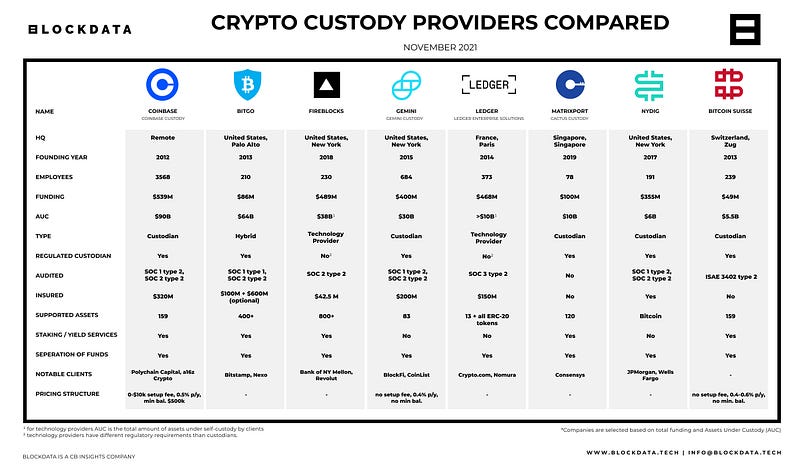
Global Business Week: Crypto Custody Providers Compared
The state of Financial markets & Economies, Weekly Charts, Business Trends & Statistics
Global stock markets plunged alongside oil prices and U.S. Treasury yields Friday after South Africa raised the alarm over a fast-spreading strain (Omicron) of the coronavirus. Holiday-shortened week in the U.S saw a major sell-off as investors feared the discovery of Omicron could derail the fragile economic recovery. The Dow fell more than 1,000 points during the day before ending down 905 points, its biggest one-day loss this year. The S&P 500 and Nasdaq declined more than 2%. The so-called fear index, the VIX, jumped to an eight-month high.
Investors pulled money out of stocks into the relative safety of bonds. The yield on the 10-year Treasury note fell 16 basis points to 1.48%. The best performers included some of the stay-at-home plays that performed so well in the earlier months of the pandemic, such as Zoom, Peloton, and Moderna. Travel-related company stocks plummeted, with shares of airlines, cruise lines, and hotels all taking significant losses. Energy company stocks tumbled as oil futures plunged 12% on worries the potential slowdown from new virus outbreaks could reduce demand.
Although the benchmark dollar index (DXY) fell on extreme risk aversion in financial markets, coupled with falling treasury yields — this impulsive reaction might be short-lived as markets run to the safe haven reserve currency of the world. Technically speaking too, DXY was due for a correction as traders looked for some profit-taking after a relentless bull run since early November. Having said that, Friday losses alone were enough to wipe out the gains for the week.
Cryptos were not spared from the brunt of bears either, as the digital assets got steamrolled — Bitcoin, acting like a typical risk asset almost shaved off 10% from its most recent high. For now, it is trading just shy of $55,000 rebounding from $53.6k. Similar moves were replicated in other Alt. coins as well — Ethereum charted a new low, just above $3,900, and is currently trading just above $4,120. Next week will be pivotal for cryptos and other financial assets and the World makes sense of the new Covid variant.
Besides exchanges, typical clients of crypto custody providers include hedge funds, corporates, institutional investors, and high net worth individuals — the reason being that it is safer to store their digital assets at a crypto custody provider than to do it themselves, and therefore choose to store their assets there. Today’s featured infographic (above) highlights some of the top crypto custody providers in order to get a better understanding of their differences.
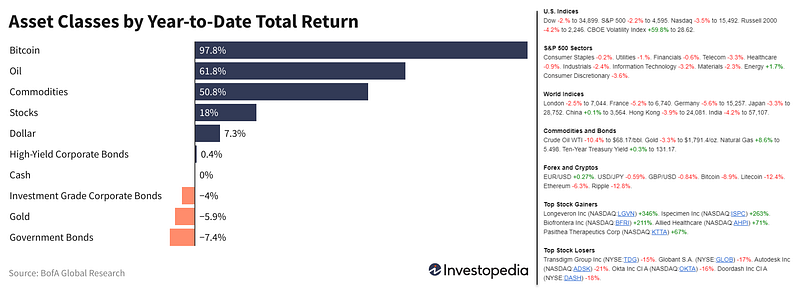
And finally, before moving on to some other statistics, here are the weekly & YTD numbers from various markets and different assets (Figure 1).
U.S Big Tech VS. European Companies
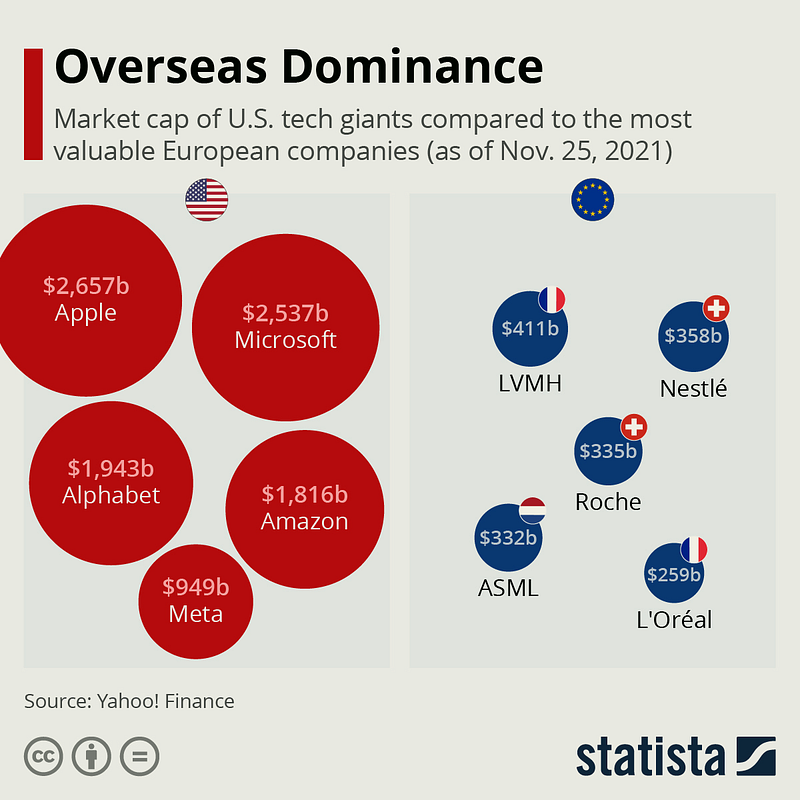
The European Union on Thursday took another step in its continuous efforts to rein in American tech giants. The Council of the European Union, one of three institutions involved in the bloc’s legislative process, agreed on a common position with respect to two legislative initiatives proposed by the European Commission in December 2020: the Digital Services Act and the Digital Markets Act. It’s pretty clear which companies are targeted by the Digital Markets Act, namely Amazon, Alphabet, Apple, Meta, and Microsoft. The European Union has made a name for itself in recent years for going head to head with big tech, slapping the likes of Alphabet and Apple with billion-dollar fines on more than one occasion.
As the following chart shows (Figure 2), the power and financial clout wielded by the five companies often summed up as Big Tech is unmatched in Europe. While these five tech giants have market capitalizations above or close to $2 trillion, the most valuable public company from Europe is luxury conglomerate LVMH with a market cap of $411 billion. In fact, the five most valuable companies from Europe combined, including two from Switzerland which is not an EU member but part of the European Single Market, do not match the market value of either of the four companies mentioned above.
NFT Financial Protocols
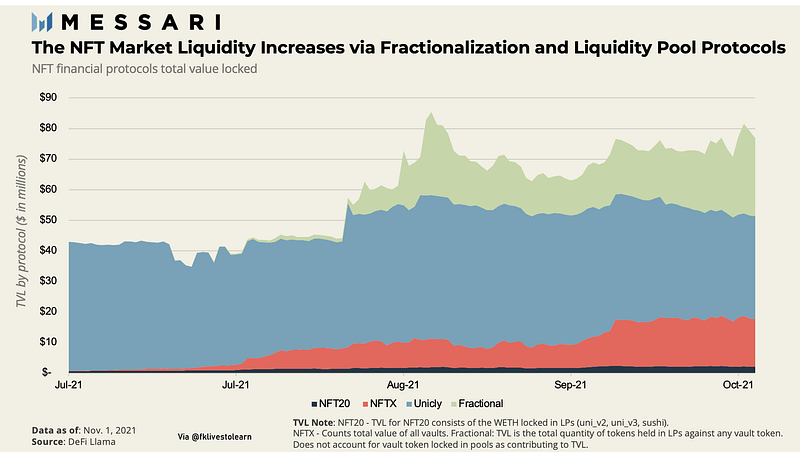
Most NFT liquidity protocols have taken one of two approaches. The first approach is creating liquidity by facilitating the creation of liquidity pools where individuals can deposit similar Non-Fungible Tokens (NFTs) into the pool and redeem them at any given time. The benefit of protocols like NFTX and NFT20 that effectively become marketplaces, built on top of liquidity pools for a group of assets. The second approach, taken by Unicly and Fractional, is to create fractions/pieces of an individual NFT that trade as fungible fractional tokens (e.g. 1 NFT becomes 10,000 fungible tokens).
The second approach facilitates greater liquidity by lowering the purchase price to acquire a part of a whole NFT, similar to how Robinhood fractionalized stock shares so that an individual doesn’t have to buy 1, $1000 Tesla stock and instead can purchase 2 fractional Tesla shares at $100. The top four NFT liquidity protocols — NFTX, NFT20, Unicly & Fractional — hold nearly $80 million in combined total value locked (TVL, Figure 3).
Richest Women in America
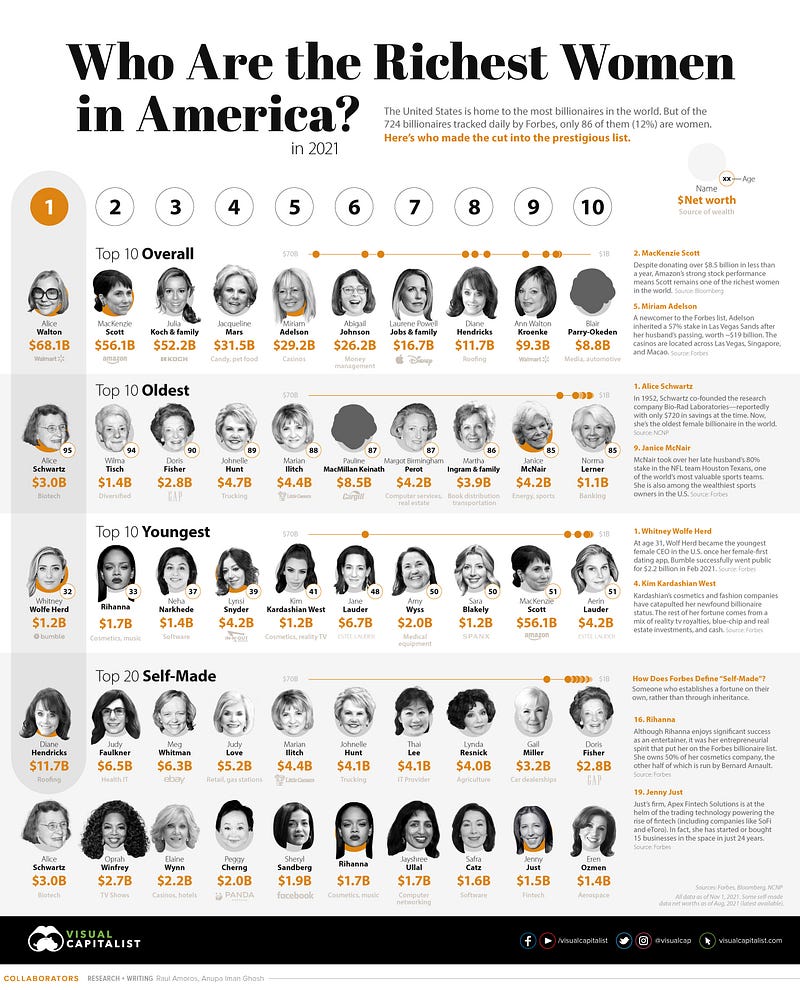
The majority of the world’s billionaires hail from the United States. But of the 724 American billionaires whose net worths are tracked daily by Forbes, only 86 are women. That’s just 12% of the country’s billionaires. The visualization below (Figure 4) shows the select few who have made the cut into this prestigious list, using data compiled from Forbes’ real-time billionaires' list. Since 2020, MacKenzie Scott has donated over $8.5 billion and counting of her wealth. Yet, she still remains one of the richest women in the world. This is largely due to the Amazon shares that she received in her divorce settlement. Several of the women in this top 10 list also share membership with some of the richest families in America — from the Walmart Waltons to the Johnsons at the helm of Fidelity Investments and Fidelity International.
Top Staking L1 Blockchains
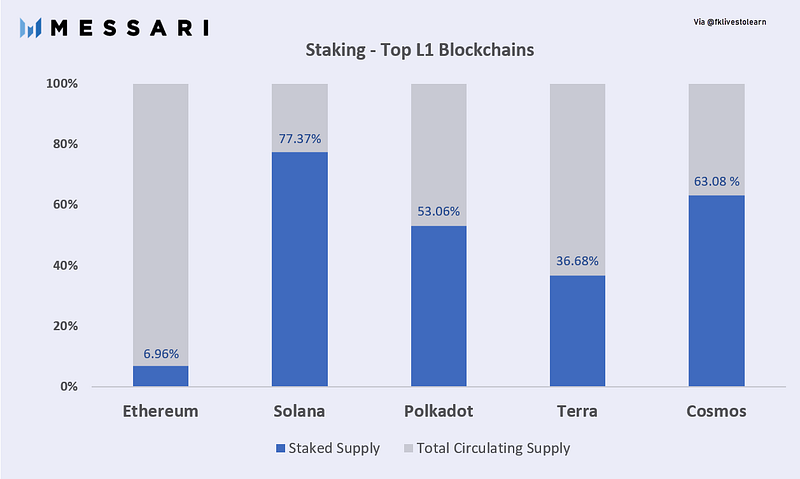
In the run-up to Ethereum’s much-anticipated Beacon Chain merge, there has been increased discussion around the apparent merits or pitfalls of liquid ETH staking. With roughly 20% of all staked Ether sitting in liquid pools and an even larger percentage staked via centralized crypto exchanges, the debate is warranted. Especially considering exchanges or pools could potentially enforce a strong, quasi delegated influence on the future of the network. By separating staking from block production via liquid staking options, another argument goes, staking pool and node operators could at some point lack adequate incentive to ensure the orderly operation of the Ethereum network. Despite the relevance of such a governance debate, the percentage of ETH staked to the circulating supply stands around 7% currently (Figure 5), a far cry from the 50%+ seen on first-mover PoS L1 chains like Polkadot, Solana, and Cosmos.
Visualizing the Longest Vehicle Production Runs
Over the automotive industry’s 100+ year history, companies such as Ford, Chevrolet, and Mercedes-Benz have produced some truly iconic cars. Whether they are designed for excitement, luxury, or just simple transportation, these vehicles offer a set of features that make them highly desirable to consumers. The most successful models will undergo numerous revisions over time, sometimes sticking around for many decades. To learn more, this graphic from Alan’s Factory Outlet lists the 35 vehicles with the longest production runs of all time. Here are the top 10 below (Figure 6).

Hardest Hit Categories by U.S Inflation
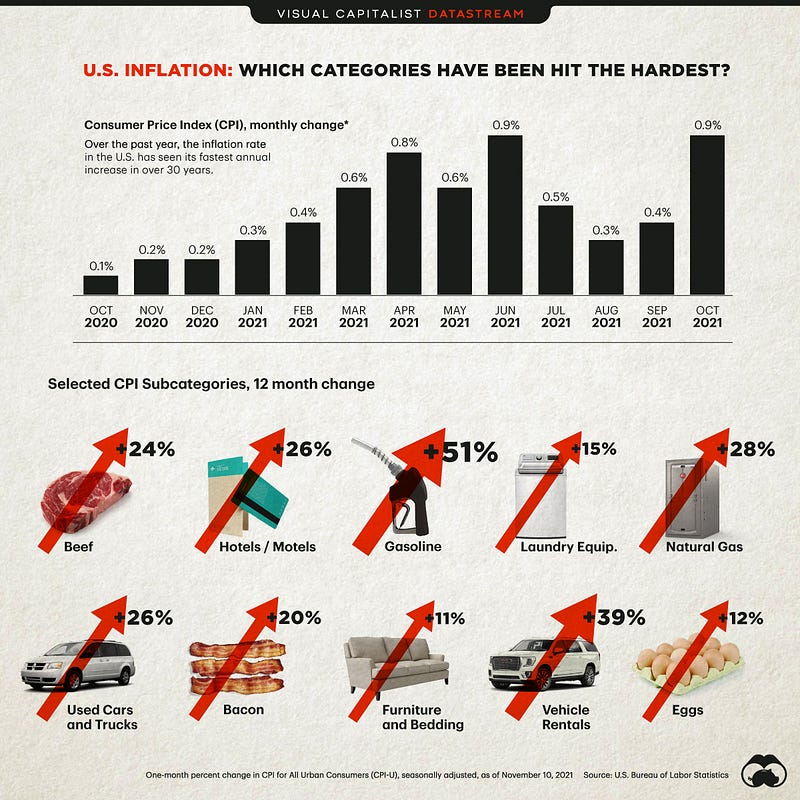
Since 1996, the Federal Reserve has oriented its monetary policy around maintaining 2% inflation annually. For the most part, U.S. inflation over the past couple of decades has typically hovered within a percentage point or two of that target. Right now, most price categories are exceeding that, some quite dramatically. Here’s how various categories of consumer spending have fared over the past 12 months (Figure 7). Prices have been going up in a number of segments of the economy in recent months, and the public is taking notice. One indicator of this is that search interest for the term “inflation” is higher than at any point in the past decade. Recent data from the Bureau of Labor Statistics highlights rising costs across the board and shows that specific sectors are experiencing rapid price increases this year.
Impact of CBDCs
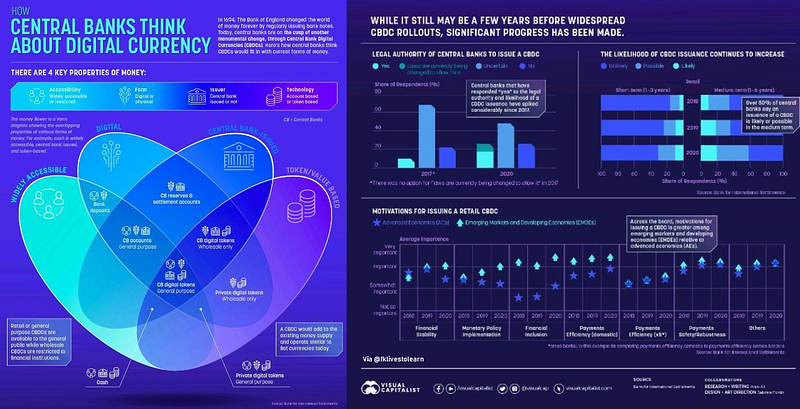
A Central Bank Digital Currency CBDC adopts certain characteristics of everyday paper or coin currencies and cryptocurrency. It is expected to provide central banks and the monetary systems they govern a step towards modernizing. Digital currencies are issued by a central bank, and therefore, are backed by the full power of a government. According to the Bank for International Settlements, over 20% of central banks surveyed say they have legal authority in issuing a CBDC (Figure 8). Almost 10% more said laws are currently being changed to allow for it. As more central banks issue digital currencies, there’s likely to be favorability between them. This is similar to how a few currencies like the U.S. dollar and Euro dominate the currency landscape.
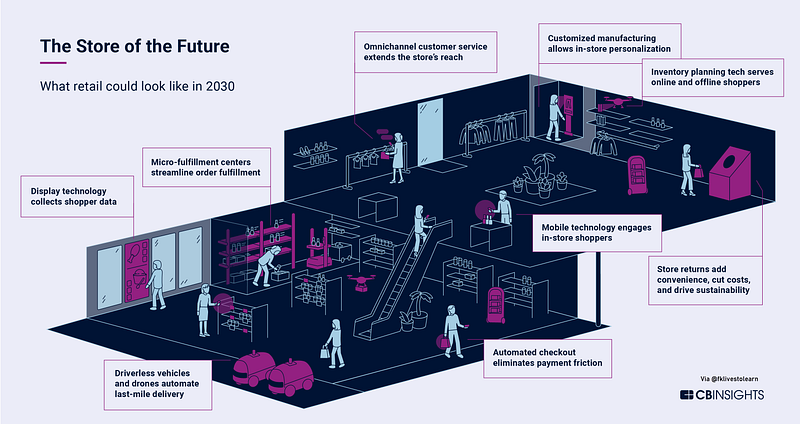
Store of the Future
The “store of the future” — a mass merchandise store set in roughly 2030, combines emerging trends across retail, including in-store robotic fulfillment, contactless checkout, live personalized pricing, and more. Products on shelves have a smaller footprint, as retailers shift more space and resources to online fulfillment, digital engagement, and even recycling. Meanwhile, real-time customer analytics and automation will become essential to store operations. Following is the depiction of this phenomenon and how might it transform the retail industry (Figure 9).
Market Humor: Will Covid steal Christmas?


Previous Edition of GBW
Read more stories like this and others by Faisal Khan on Medium.
Stay informed with the content that matters — Join my weekly Newsletter