
WEEKLY BUSINESS ROUNDUP
Global Business Week: World’s Largest Sovereign Wealth Funds
The state of Financial markets & Economies, Weekly Charts, Business Trends & Statistics
Retail sales and earnings in the U.S came in strong this week, raising concerns that consumers are spending despite rising prices, risking even higher inflation. Stocks finished mixed Friday, as energy shares dragged down the S&P 500 index to a slight loss while strength in tech shares lifted the Nasdaq Composite to a record high — Tech stocks helped boost the index to a second straight record high as it closed above 16,000 for the first time. For the week, the Dow Jones average fell 1.3% while the S&P edged 0.3% higher and the Nasdaq rose 1.2%,
Pandemic restrictions just announced in Austria and Germany, as well as rising hospitalizations in the U.S. Midwest, weighed on the markets. Oil plunged nearly 4% to its lowest level in six weeks, dragging down energy company stocks. Shares of airlines and cruise lines tumbled. Shares of financial firms dropped as investors put money into bonds, sending interest rates lower. The yield on the 10-year Treasury note was down to 1.53%.
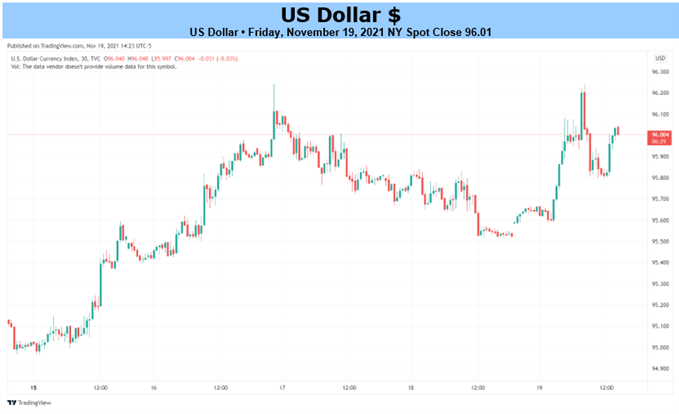
The U.S dollar index (DXY) remained on the offensive & may continue to do so next week as markets turn to important economic event risk from the U.S. Inflation has been a hot topic globally — most aggressive in decades in many countries. The US Dollar’s advance since June has been associated with increasingly hawkish Federal Reserve monetary policy expectations. Two rate hikes by the end of 2022 are fully priced in. Meanwhile, the 2-year Treasury yield sits at around March 2020 levels. Further rosy economic surprises may reinforce these estimates, lifting the US Dollar.
Renewed buying interest in Cryptos is lifting the digital assets market. Sustained bearish pressure seems to be subsiding. Although this is more evident in Ethereum than Bitcoin — where the former has almost recovered half of the losses from the most recent high, while the latter is still hovering around the $60k handle. At the time of writing, ETH was trading close to $4,400 with the BTC market dominance slipping to 42.4% with a total market cap of $2.65 trillion.
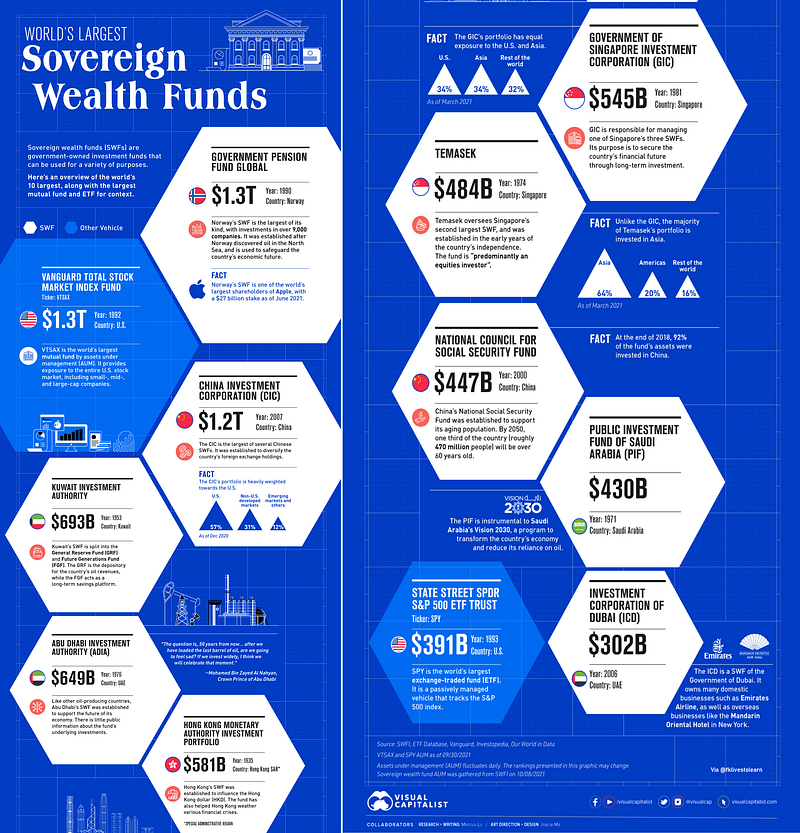
Did you know that some of the world’s largest investment funds are owned by national governments? Known as sovereign wealth funds (SWF), these vehicles are often established with seed money that is generated by government-owned industries. Today’s featured infographic, details the world’s 10 largest SWFs, along with the largest mutual fund and ETF for context.
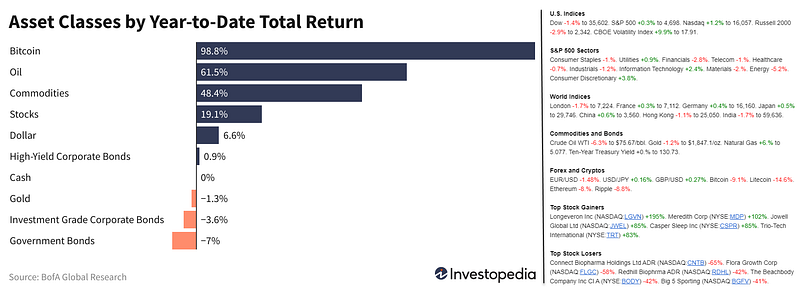
And finally, before moving on to some other statistics, here are the weekly & YTD numbers from various markets and different assets (Figure 1).
The Big Bet on Electric Mobility
In its first earnings report as a public company, Lucid, a Newark, California-based EV maker had reported a surge in reservations to 17,000 vehicles, while also announcing that its first production car, the Lucid Air had been named the 2022 MotorTrend Car of the Year, beating big-name competition including the Mercedes-Benz S-Class, Mercedes-Benz EQS and Porsche Taycan to win the coveted award. Following in the footsteps of Tesla and Rivian, Lucid is the third pure electric vehicle maker among the world’s most valuable car companies, and it’s only a matter of time before it also surpasses GM to leave all of the (former) “Big Three” behind it. The fact that neither Lucid nor Rivian has delivered a relevant number of cars to customers so far doesn’t stop investors from rating them highly.
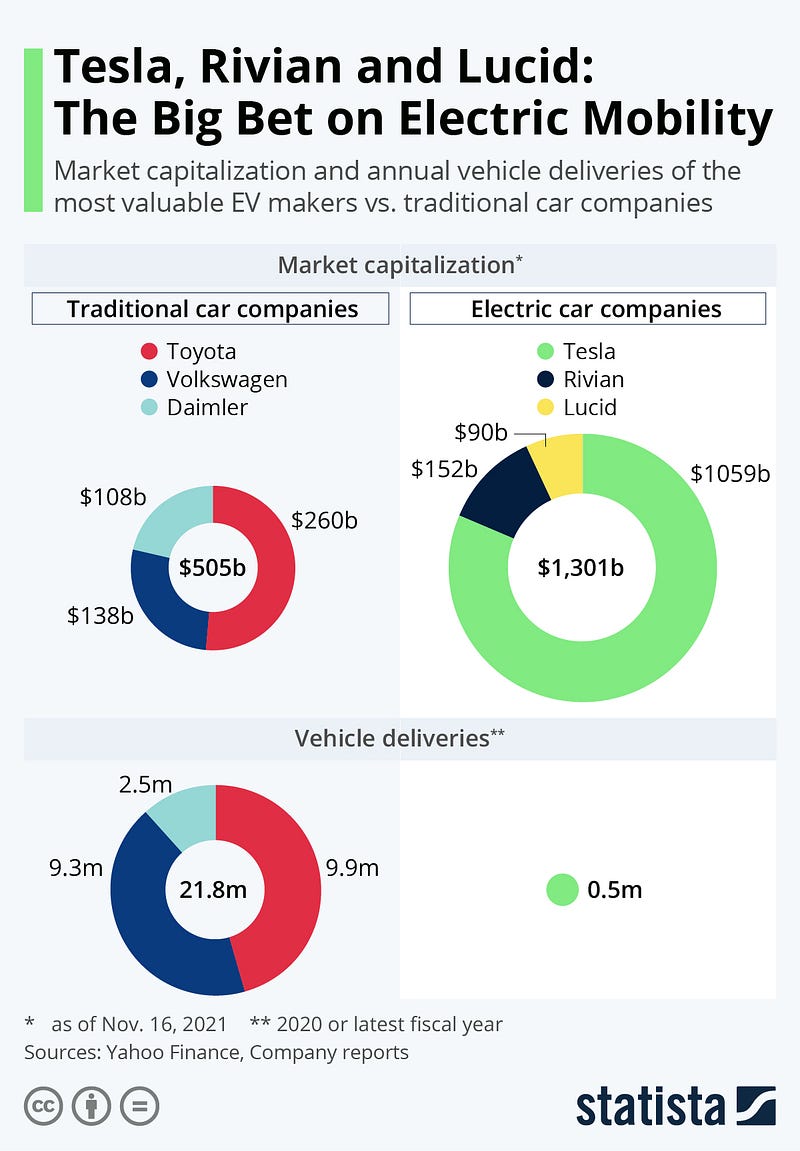
As the following chart (Figure 2), Tesla, Rivian & Lucid are valued at a completely different scale to traditional automakers. Toyota, Volkswagen & Daimler, the three most valuable industry veterans, have a combined market capitalization of $505 billion. Tesla alone is worth more than twice that, combined with Rivian and Lucid, the top 3 EV companies are worth $1.3 trillion. Taking annual deliveries into account makes the difference in valuation even more striking. Last year, Toyota, Volkswagen, and Daimler delivered 21.8 million cars to Tesla’s 500,000. That results in a combined valuation per delivered vehicle of $23,208 for the three traditional car makers vs. a whopping $2.6 million for the three EV upstarts.
Removing obstacles for Economic Progress
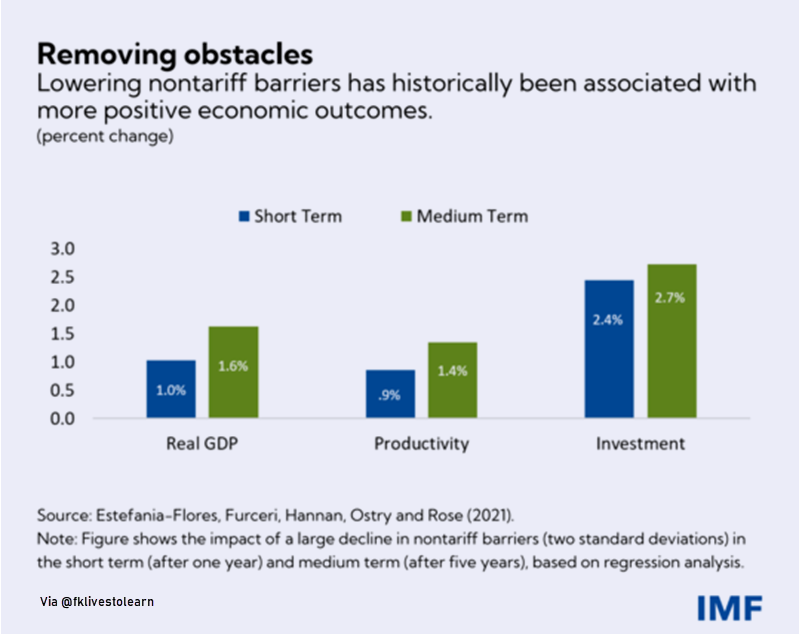
Empirical analysis suggests lowering nontariff barriers offers potentially large economic gains (Figure 3). A significant reduction in our measure, along the lines of Sri Lanka’s removal of export licensing, financing, and documentation requirements in the early 1990s can help boost GDP by about 1% in the short term. Those gains increase to about 1.6% after five years. Notably, improvements come from greater investment and productivity, not directly through higher net exports. This highlights how advances from trade liberalization occur via multiple channels that include benefits from specialization, technology transfer, and the reallocation of resources to more productive firms.
Blockchain Startups having a Wild Year
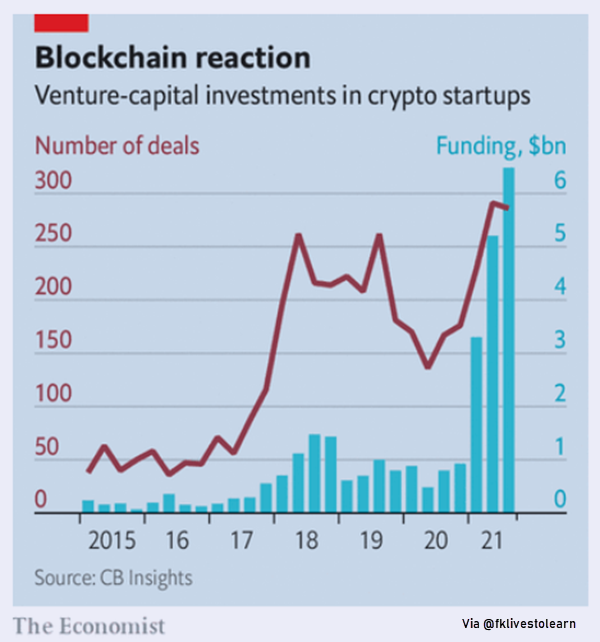
Blockchain startups are having a wild year. They’ve raised $15B in venture funding in the first 9 months of this year, which is nearly 5x 2020’s total investment (Figure 4). Early-stage rounds (seed/Series A) dominate the dealmaking, capturing almost 80% of deals in 2021, Year to date. Investors like Coinbase Ventures are also bursting onto the scene — the VC arm was by far the most active blockchain/crypto investor with 24 deals in the quarter.
Ending World Hunger
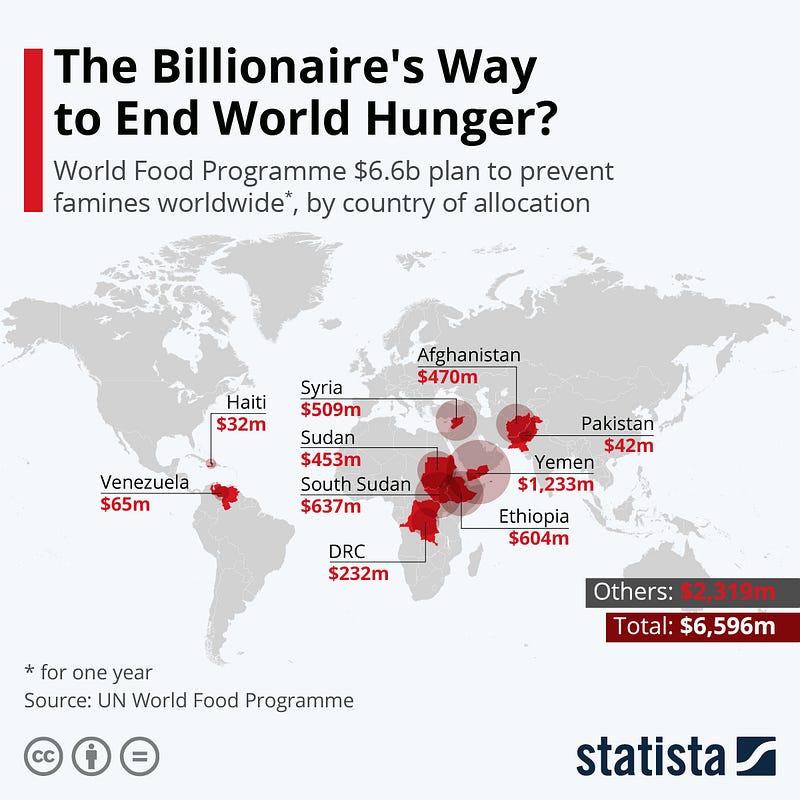
As so often with Elon Musk, it all started with a tweet. David Beasley, director of the U.N.’s World Food Program (WFP), tagged the newly minted world’s richest person on the social network in October, asking for $6.6 billion to alleviate a brewing worldwide hunger crisis. The Tesla CEO eventually piped into the conversation online, saying that if the program could explain in detail how his donation would solve world hunger, he would give it. Now the WFP has done just that. As already detailed in Beasley’s original tweet, the $6.6 billion are meant to help 42 million people worldwide who are currently experiencing a food emergency or a food catastrophe, defined as situations where people have exhausted alternative means to alleviate their lack of money or food and situations where severe malnutrition and death are already happening, respectively.
The country most affected by these dire situations is Yemen, where the WFP would be planning to spend around $1.2 billion of the donated money during one year (Figure 5). This is followed by South Sudan and Ethiopia, where the conflict in the Tigray regions is depriving inhabitants of food. Out of the 42 million people that would benefit, almost 12 million are located in East Africa, followed by around 9.5 million in Southern Africa and around 6 million each in the Middle East/Northern Africa as well as in South-East and Central Asia.
Blockchain Consortium 2021
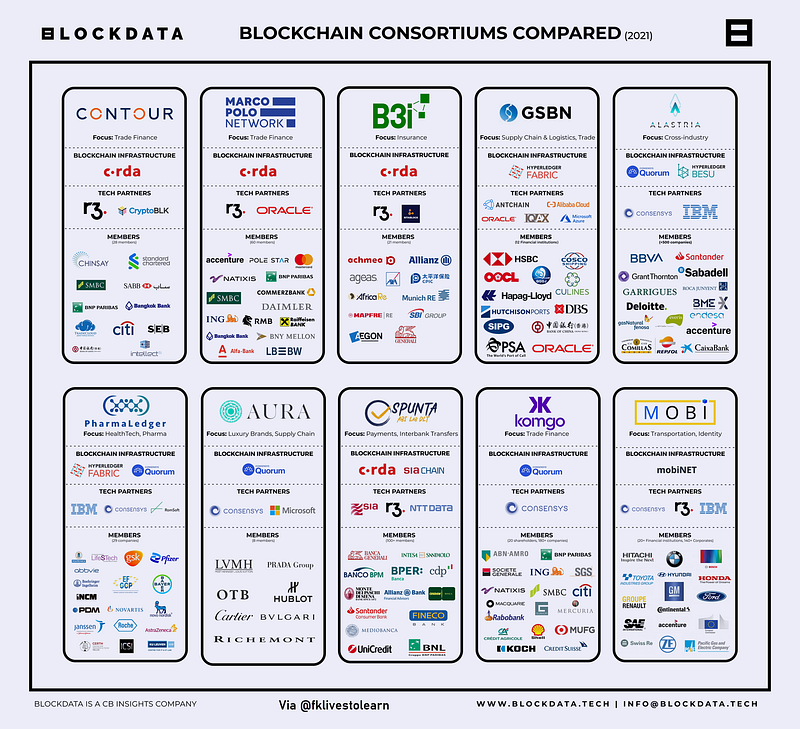
There has been a rising demand for enterprise blockchain. Part of the reason is the desire for corporations to join forces with others to work on similar solutions. Consortiums are nothing new to the blockchain space and have been around for almost a decade. A number of them are far beyond their R&D phases, with in-production services providing efficiencies in processing times, and moving millions of transactions and billions of dollars to date. Blockdata research found 53 active consortiums that are currently in operation in 2021 (Figure 6). Most are well known, such as R3 and Hyperledger, but major announcements from consortiums such as Hong Kong’s Global Shipping Business Network (GSBN), and insurance-based B3i have all begun to expand and develop numerous pilots and projects within their respective industries. The same goes for trade finance networks such as Contour, Marco Polo, we.trade, Spunta, RiskStream Collaborative, and others.
Job Starters in the EU
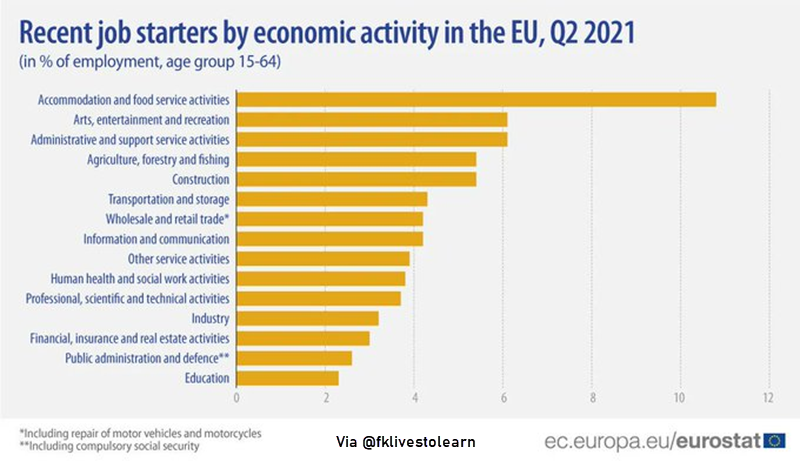
The EU economy as a whole contracted by 6% last year. It has bounced back, with expected growth of nearly 5% in 2021. Output is seen returning to pre-COVID levels in the past three months of this year, earlier than previously forecast, according to the European Commission (Figure 7). The European hospitality and entertainment industries are leading the return to work, as countries across the region continue their recovery from the COVID-19 economic slump. New hires in accommodation and food services accounted for 11% of recent job starters in the European Union in the three months through June 2021, according to the latest data from Eurostat. Services jobs overall saw the highest share of new employment during the quarter.
Best & Worst Pension Plans 2021
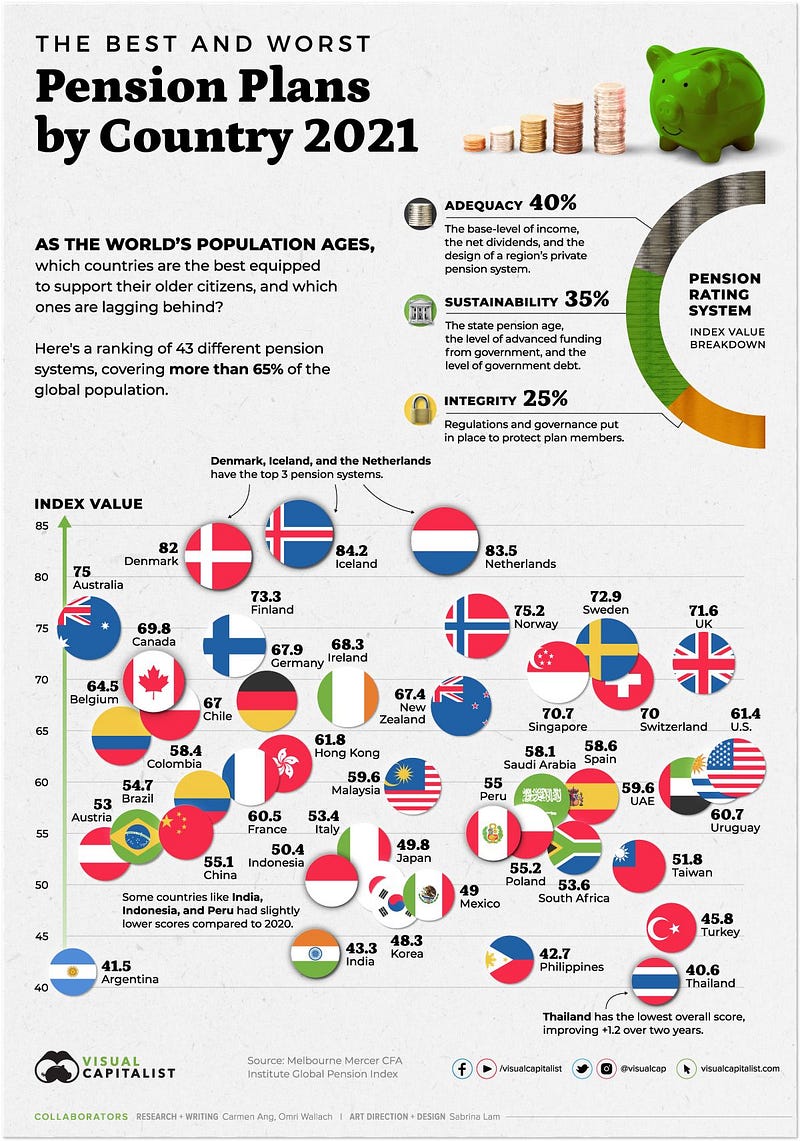
Each year, millions of people around the world leave the workforce to retire. But as the global population grows older, and the COVID-19 pandemic accelerates the already rising number of retirees, there is still a large degree of variance in the quality of public pension plans around the world. Which countries have invested in robust public pension programs, and which lag behind? The following infographic (Figure 8), using 2021 data from Melbourne Mercer CFA Institute Global Pension Index, compares retirement income systems worldwide.
Global Wealth Creation
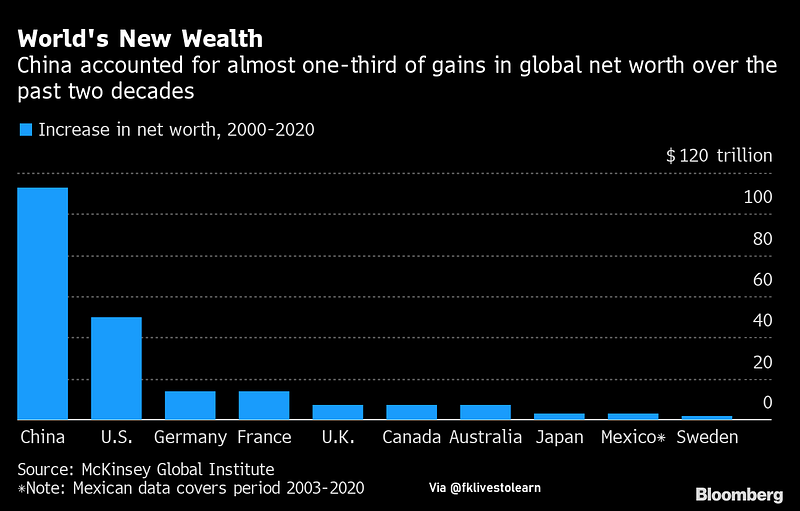
Global wealth tripled in the last two decades, with the U.S. falling behind as China takes over the top spot (Figure 9). Net worth worldwide rose to $514 trillion in 2020 from $156 trillion in 2000. China accounted for almost one-third of the increase.
The Great Resignation
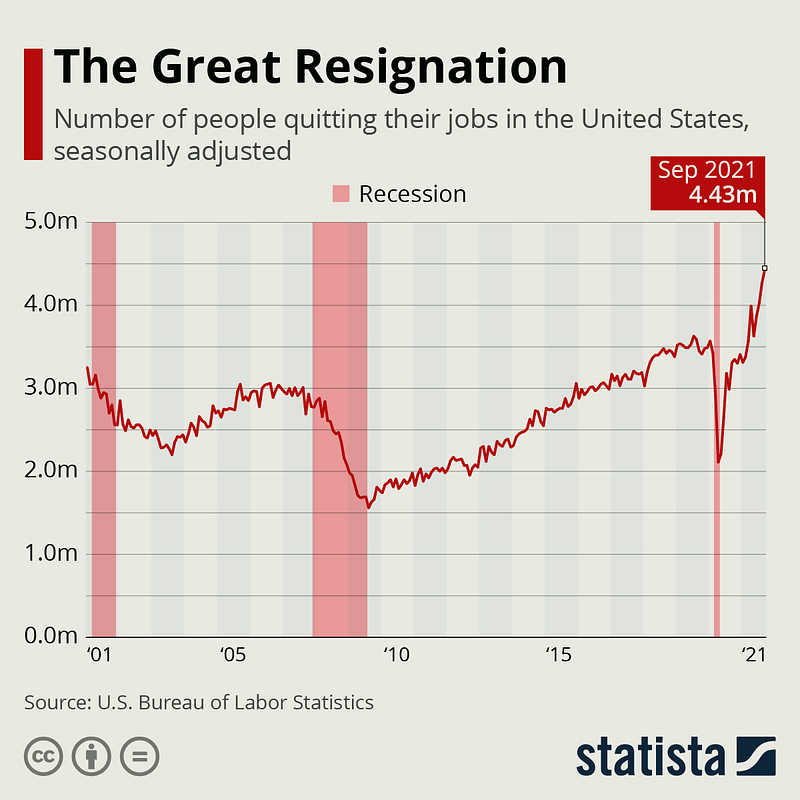
In the wake of the unprecedented jobs crisis brought about by the COVID-19 pandemic, a new trend has emerged in the U.S. labor market, as more and more Americans are quitting their jobs. According to the latest JOLTS report, a record number of 4.4 million Americans left their jobs in September, accelerating a trend that has become known as the Great Resignation (Figure 10). The number of Americans quitting has now exceeded pre-pandemic highs for six straight months, as employers, especially in low-wage sectors, are struggling to fill open positions.
The reasons for this trend are of course manifold, but one major driver appears to be that many workers are no longer willing to put up with the pay and/or working conditions they (perhaps grudgingly) accepted prior to the pandemic. The fact that the quit rate is particularly high in sectors with a large number of frontline workers, e.g. hospitality, health care & retail, suggests that safety concerns also play a role in the worker exodus, especially in face of the highly infectious Delta variant.
Most Popular Crypto Investments
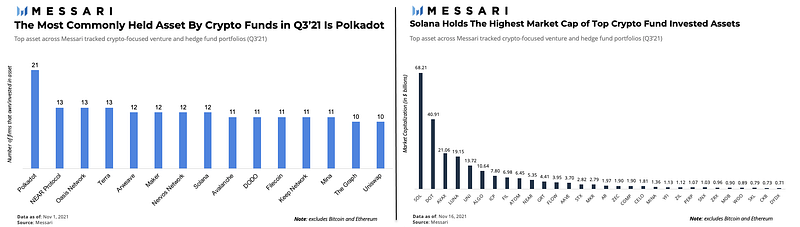
After analyzing all the portfolios, we found the top asset invested across the fifty-three funds we have tracked remains to be Polkadot (DOT). In fact, 21 of the 53 funds own DOT, meaning 39% of our tracked funds have a vested interest in Polkadot’s success (Figure 11). One important consequence of this is that large DOT holding funds will likely be the ultimate determining factor for which projects secure the first several parachains. Of the top invested assets, Solana possesses the highest-circulating market capitalization (with BTC and ETH omitted). DODO possesses the lower circulating market capitalization of the top fifteen fund-owned assets while Arweave possesses the lower circulating market cap of the top five.
Market Humor: Can Anything Stop This Market Rally?


Previous Edition of GBW
Read more stories like this and others by Faisal Khan on Medium.
Stay informed with the content that matters — Join my weekly Newsletter