
NFTs
What are NFTs & Why are they gaining such massive popularity?
Non-Fungible Tokens have become wildly popular among investors as the latest crypto craze takes the digital art world by storm
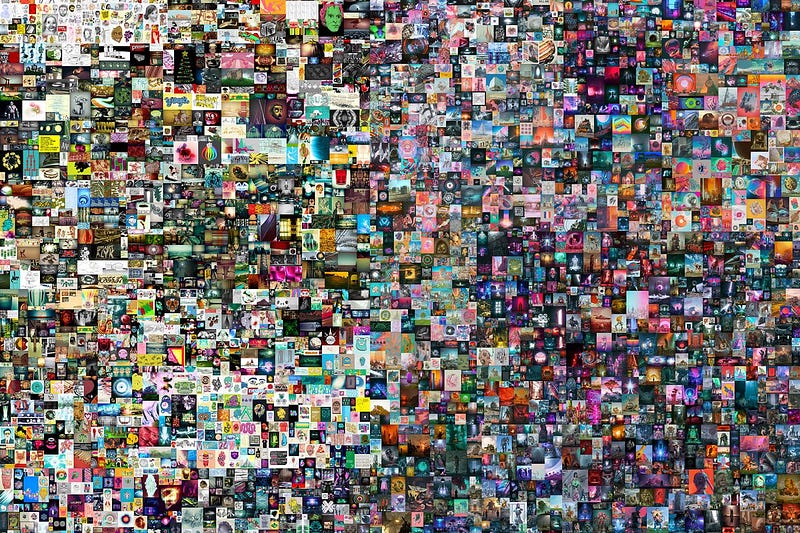
Headlines in the digital media have been dominated with the news of a non-fungible token (NFT) by the digital artist Beeple sold at an astonishingly high price at renowned auction house Christie’s. The JPEG is a mosaic of every image that artist Mike Winkelmann, who goes by the name Beeple, has made since 2013. Dubbed as ‘Everydays — The First 5000 Days’ (pictured above), it fetched $69.3 million, far eclipsing anything that has been bought in the industry.
Another example of an NFT that is being talked about recently is by Twitter’s CEO, Jack Dorsey, who is selling the NFT of his first tweet published on the platform 15 years ago. Dorsey posted a link to the auction, hosted by a platform called Valuables — the topmost offer stands at $2.5 million. He has promised to convert whatever funds he received into Bitcoin.
Let’s get back to some basics for people who have little knowledge about the new phenomenon. The easiest way to understand NFT is to consider it as a file format, just like jpeg, png, or gif. NFTs are a file format that transfers data and value on blockchain networks like Ethereum via smart contracts. Their existence on blockchains gives them the same properties as the other mainstream cryptos like Bitcoin — digital ownership with transparency.
To understand the concept of a non-fungible token, we first need to know what fungibility means? A good is said to be fungible if it is identical and interchangeable — the simplest example is paper money, where we would happily swap dollars with each other since we agree they all have the same value. A non-fungible item, being unique in nature, is exactly the opposite.
Real-world examples of non-fungible items include diamonds, houses, and baseball cards — no two are alike. Similarly, a digital trading card or piece of digital art is an NFT that is unique. The crypto art movement can be traced back to Canadian company Dapper Labs’ CryptoKitties blockchain game created in 2017. NFTs were first created back in June of 2017 by software developers at Larva Labs, busting out their CryptoPunks collectibles, sometimes described as nostalgic pixilation.
NFT Features
➤ Unique in nature →This is a specialized feature of an NFT which can be verified on a blockchain.
➤ Permanent information → Stored permanently on the token and can range from text, image, music, signature, or anything else.
➤ Programming capability → Since the NFT is a piece of code on a blockchain, other useful features like built-in royalties system can be incorporated — enabling artists to collect revenue for secondary sales of their artwork.
➤ Permissionless → Being built on permissionless networks like Ethereum (not exclusive though), NFTs can be programmed to have various qualities.
➤ Individual digital ownership → NFTs reside in the digital wallets of individuals, therefore, one has complete ownership —unlike some of the other digital assets where middlemen are involved (e.g domain names).
How to make an NFT?
These are some of the basic steps that one can follow to make an NFT.
➯ Compile your media files to decide what you want to make an NFT. Currently, NFTs support wide-ranging file extensions like JPG, PNG, GIF, MP3 & GLB etc.
➯ Unless you already have one, you will then need to set up an Ethereum wallet that is used to store the cryptocurrency used in buying, selling, and creating NFTs. The same wallet would also enable you to make accounts on various NFT marketplaces.
➯ Initially, you will need to have some Ethereum in your wallet to cover the costs of creating your first NFT — this is basically the fee that most marketplaces charge for converting your content into an NFT.
➯ Next step involves connecting your wallet to an NFT Marketplace. For example, an easy-to-use NFT marketplace is called Rarible. After your wallet is connected to the platform, it instantly generates an NFT account for you. Once done, you are all good to create, mint, and sell your first NFT.
➯ The final step involves uploading your file to the platform and fill out the asset’s description. At this point, you can decide on the various parameter of your NFT — standalone or multiple NFTs of the same piece, royalty percentage, unlockable content & others. Whatever you mint from your NFT becomes part of the public ledger that is unchangeable and tamper-proof. Your NFT can now be digitally tracked as it is purchased and traded.
NFT Landscape
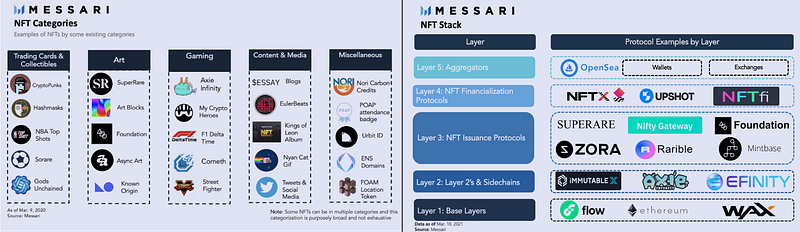
According to Messari Research, NFT issuance platforms and marketplaces currently make up one of the largest categories of NFT protocols (beyond NFT projects themselves). For an investor, it might be difficult to pinpoint which NFT may outperform so issuance platforms might be a better way to express a constructive point of view on the NFT sector. However, various NFT categories are beginning to emerge with the expanding ecosystem.
Explosive Growth
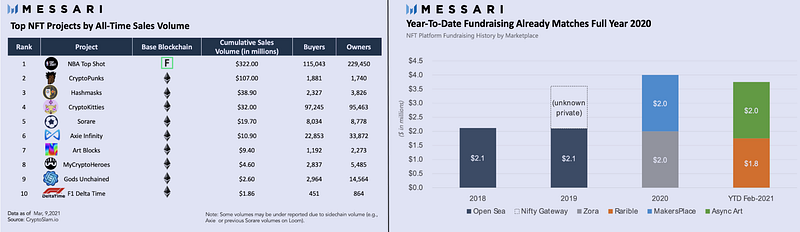
The total value of NFT transactions quadrupled to $250 million last year, according to a study from NonFungible and L’Atelier. The NFT market has been growing exponentially in 2020, up 299% from 2019. NFT issuance platforms have been among the most successful at fundraising this year, nearly matching the full year 2020’s fundraising within the first two months (right chart above).
The whole NFT movement has the potential to revolutionize art, investing, and the crypto economy. We could also see broader applications. For example, a startup called Blockchain Art Collective uses the technology to store information about a physical art piece’s authenticity and provenance. This could be an exciting opportunity for content creators globally.



