avatarShrish Tariq

Free AI web copilot to create summaries, insights and extended knowledge, download it at here

3462

Abstract

ith four known species: alfalfa leaf curl virus, Plantago lanceolata latent virus, french bean severe leaf curl virus, and Euphoria caput-medusae latent virus. These viruses are transmitted by their insect vectors that are aphids and their host range varies from monocots to dicot. Capulavirus genome has conserved nanonucleotide motif 5′-TAATATTAC-3′ at virion strand replication.</p><h2 id="25ea">Genus: Curtovirus</h2><p id="24c9">The genome of curtoviruses is monopartite with a wide host range mainly infecting dicots. They are transmitted by leafhoppers in a<a href="https://readmedium.com/top-ten-economically-important-plant-viruses-3ca7e9ce9b83"> circulative mode of transmission</a> and known species are beet curly top virus, horseradish curly top virus, and spinach curly top virus.</p><figure id="5371"><img src="https://cdn-images-1.readmedium.com/v2/resize:fit:800/1*rWdz4CiWst83zN1UNpW8qg.png"><figcaption>Image by <a href="https://talk.ictvonline.org/ictv-reports/ictv_online_report/ssdna-viruses/w/geminiviridae/393/genus-curtovirus">ICTV</a>/ Genome organization of curtovirus</figcaption></figure><h2 id="d6fc">Genus: Eragrovirus</h2><p id="817d">Like the genus becurtovirus, the eragroviruses have unique 5′-TAAGATTCC-3′ virion morphology and monopartite genome. They are vectored by leafhoppers on monocot host plants.</p><h2 id="1cd7">Genus: Grablovirus</h2><figure id="75c3"><img src="https://cdn-images-1.readmedium.com/v2/resize:fit:800/1*WmK6icI1hcNmM9rCRyUiew.png"><figcaption>Image by <a href="https://talk.ictvonline.org/ictv-reports/ictv_online_report/ssdna-viruses/w/geminiviridae/580/genus-grablovirus">ICTV</a></figcaption></figure><p id="5772">The genus grablovirus is monopartite with circular single-stranded DNA (ss DNA). The circular DNA consist of six open reading frames: three on virion sense strand as V1, V2, V3, and three on the complementary strand as C1, C2, C3 with conserved intergenic nanonucleotide 5′-TAATATTAC-3′ motif.</p><p id="3d2e">Grabloviruses are transmitted by tree leafhoppers. The genome size of these geminiviruses is 3200 bases that are comparatively more than other monopartite genome viruses. And their infections are severe on the grapevine.</p><h2 id="9baf">Genus: Mastrevirus</h2><p id="7efc">These are Eastern Hemisphere viruses with severe infections on cereal crops like maize and vegetables. Their genome is monopartite (ss–DNA) and size is 2.52–.8kb. They are vectored by brief leafhoppers and widely transmitted on Solanaceae, Poaceae, and Fabaceae crop species. Mastrevirus encodes four proteins as two encodes on virion sense strand that is coat protein (V1) and movement protein (MP). The coat protein encapsidates the ss DNA and acts as a nuclear shuttle protein for the translocation of ss DNA within the cell while the movement protein ensures the intercellular movement. The other two proteins are encoded on complementary sense strand as C1 and C2. These proteins are replication-associated. They ensure the viral DNA replication by interacting with host cell factors.</p><h2 id="f142">Genus: Begomovirus</h2><p id="acc0">Begomoviruses are the largest and well-studied members among all the other genera of the family <i>Geminiviridae. </i>The genome size of begomoviruses is 2.5–2.6 kb and they are vectored by whiteflies (<i>Bemisia tabaci). </i>Their genome varies among other species from monopartite to bipartite. The members of the genus begomovirus are of vital importanc

Options

e in agriculture because of their impacts on crop yield and production. They have a wide host range from grasses to vegetables, cereals. The members of the family geminiviridae replicate through a rolling circle mechanism and inside the host cell nucleus.</p><p id="b0bb">The reason for replication inside host cell nuclei is the dependence on the host factors. The begomoviruses have a complex relationship with their insect vector (<i>Bemisia tabaci</i>: whiteflies). Numerous <a href="https://readmedium.com/proteomic-tools-to-study-insect-vector-plant-virus-interactions-2b259caaa2">molecular techniques</a> have been invented to study these complex begomovirus–host plant–vector interactions so far.</p><figure id="fe3b"><img src="https://cdn-images-1.readmedium.com/v2/resize:fit:800/1*UsGKIXD5E8KyGLyvoFTARg.png"><figcaption>Image by <a href="https://talk.ictvonline.org/ictv-reports/ictv_online_report/ssdna-viruses/w/geminiviridae/392/genus-begomovirus">ICTV</a>/ Genome organization of the genus Begomovirus</figcaption></figure><p id="71d0">The genome of bipartite begomoviruses composed of DNA–A and DNA–B components. In the above image, the DNA–A components of both( monopartite & bipartite). The DNA–A component replicates autonomously and encodes proteins that help in replication on both virion sense and complementary sense strands. The virion sense encodes the coat protein (CP) that encapsidates the DNA and helps in intracellular movement while the movement protein functions for the cell to cell movement. The complementary sense strand encodes a replication-associated protein (Rep), transcriptional activator proteins (TrAP), replication enhancer protein (REn), and AC4 protein. Rep protein initiates the replication of DNA–A. Transcriptional activator protein regulates the expression of both components and also interferes with the host antiviral process. REn ensures efficient and secure replication.</p><p id="2c51">DNA–B component encodes nuclear shuttle protein (NSP)at virion strand and movement protein (MP) at a complementary strand. These two proteins help in intracellular and intercellular movement by facilitating symptom development and successful infection cycle completion.</p><p id="297d">The well-known species of begomoviruses are: African cassava mosaic virus, mungbean yellow mosaic virus</p><p id="3fac">Begomoviruses are the cruel foes of legumes and their damage includes plant growth retardation under severe conditions plant death and chlorotic leaves with less efficient photosynthesis. Other prominent symptoms of their infections are curly leaves, false growth, and poor seed production.</p><figure id="0a13"><img src="https://cdn-images-1.readmedium.com/v2/resize:fit:800/1*YRcgDXvjBmJfRlermKinMg.jpeg"><figcaption>Image by <a href="https://commons.wikimedia.org/wiki/File:Kuning_cabai.JPG">Kembangraps</a> on <a href="https://commons.wikimedia.org/wiki/Main_Page">Wikimedia Commons</a></figcaption></figure><h2 id="cbb5">Plant Foes: Geminiviridae</h2><p id="579b">Plants compete with millions of harsh factors in their lifetime. Among these, plant viruses are strategic and clever. They rely on entirely host cellular factors, encode multifunction proteins just to suppress the plant host’s amazing defense machinery. The complete eradication of plant enemies (viruses) is impossible but they can be managed with combined applications of agronomic practices and molecular techniques.</p></article></body>

AGRICULTURE | PLANT PATHOLOGY

Geminiviruses: Causal Agent of Devastating Plant Diseases

Geminiviruses replicate inside their host cell nucleus
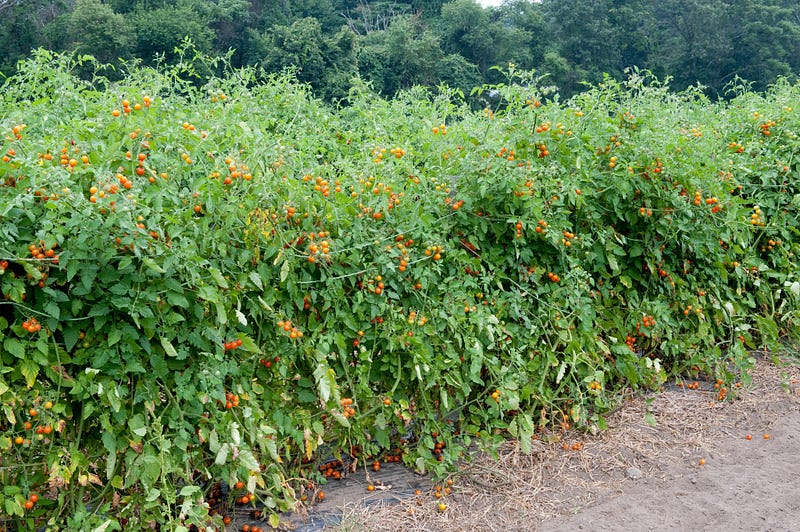
Image by Dwight Sipler on Wikimedia Commons

Geminiviruses are single-stranded deoxyribonucleic acid (ss-DNA) viruses with a genome size of 2.5–5.2 kilobases. They cause severe infections in many crops with heavy yield losses and are transmitted by various insects (whiteflies, leafhoppers, aphids, and treehoppers). The virion morphology of geminiviridae is comparatively uniques to other viral families. They consist of geminate particles with mono or bipartite genomes. The replication mode of geminiviruses is also distinctive to them because they replicate bi-directionally by rolling circle amplification (RCA) across the circular ss-DNA genome particles.

Drawing by Dr. Graham Beards on Wikimedia Commons

Despite being plant enemies, geminiviruses also serve as a model to understand plant cell cycle and growth.

Based on their host range, distinctive genome organizations, and insect vectors geminiviruses are classified into nine genera:

Becurtovirus

Begomovirus

Curtovirus

Capulavirus

Eragrovirus

Grablovirus

Mastervirus

Topocuvirus

Turncurtovirus

Genus: Becurtovirus

Becurtoviruses are monopartite with dicot host plants and their insect vectors are leafhoppers.
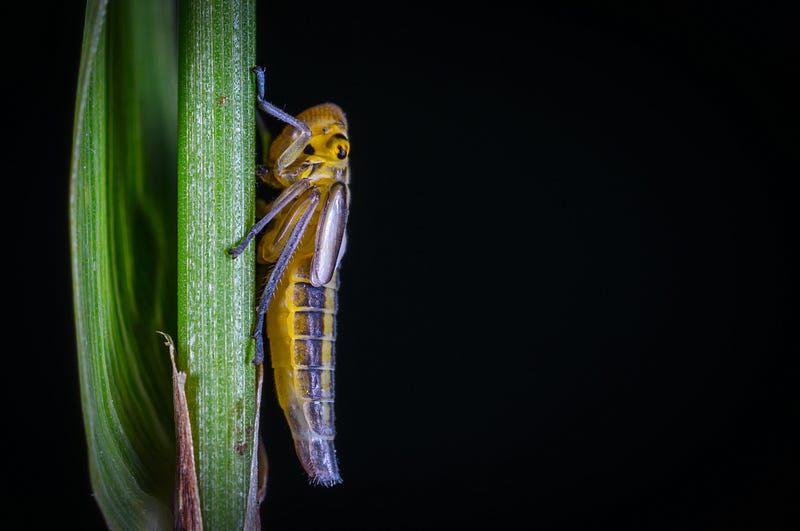
Photo by Егор Камелев on Unsplash

The above-mentioned image is of a leafhopper. These insect vectors transmit becurtoviruses during feeding on plants. These genera include three species: Beet curly top Iran virus, Exomis microphylla latent virus, Spinach curly top Arizona virus.

The members of the becurtovirus genera are different from all other geminivirus lineages in respect of nonanuceoltide. They have a unique nick of nonanucletodite 5′-TAAGATTCC-3′ at the origin of virion while the other geminiviruses have 5′-TAATATTAC-3′.

Genus: Capulavirus

The genus capulavirus is monopartite with four known species: alfalfa leaf curl virus, Plantago lanceolata latent virus, french bean severe leaf curl virus, and Euphoria caput-medusae latent virus. These viruses are transmitted by their insect vectors that are aphids and their host range varies from monocots to dicot. Capulavirus genome has conserved nanonucleotide motif 5′-TAATATTAC-3′ at virion strand replication.

Genus: Curtovirus

The genome of curtoviruses is monopartite with a wide host range mainly infecting dicots. They are transmitted by leafhoppers in a circulative mode of transmission and known species are beet curly top virus, horseradish curly top virus, and spinach curly top virus.
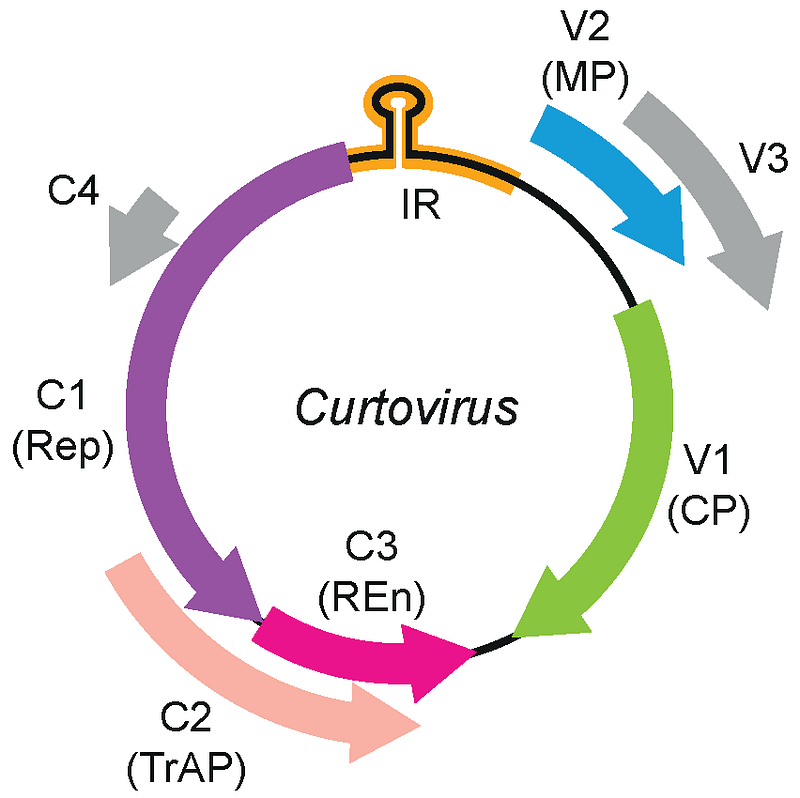
Image by ICTV/ Genome organization of curtovirus

Genus: Eragrovirus

Like the genus becurtovirus, the eragroviruses have unique 5′-TAAGATTCC-3′ virion morphology and monopartite genome. They are vectored by leafhoppers on monocot host plants.

Genus: Grablovirus
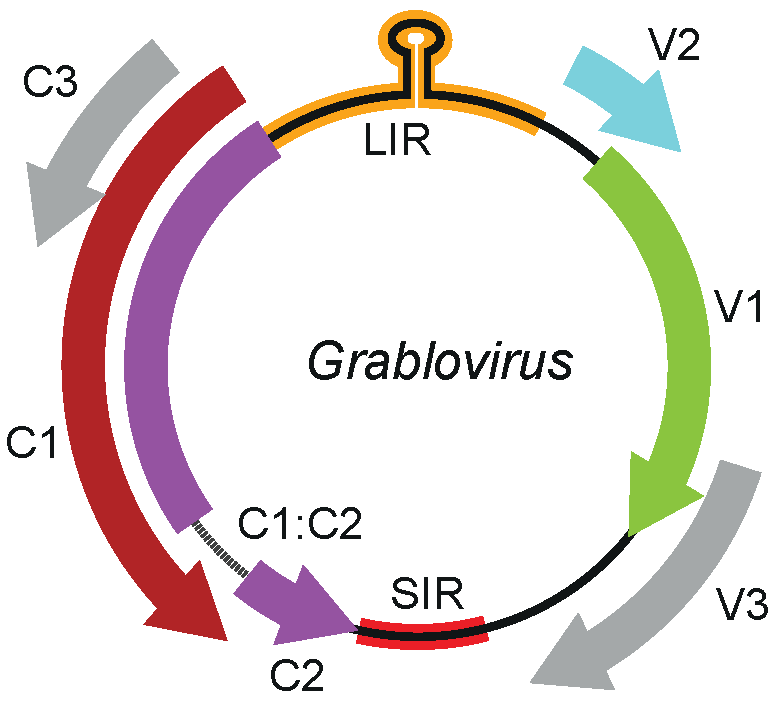
Image by ICTV

The genus grablovirus is monopartite with circular single-stranded DNA (ss DNA). The circular DNA consist of six open reading frames: three on virion sense strand as V1, V2, V3, and three on the complementary strand as C1, C2, C3 with conserved intergenic nanonucleotide 5′-TAATATTAC-3′ motif.

Grabloviruses are transmitted by tree leafhoppers. The genome size of these geminiviruses is 3200 bases that are comparatively more than other monopartite genome viruses. And their infections are severe on the grapevine.

Genus: Mastrevirus

These are Eastern Hemisphere viruses with severe infections on cereal crops like maize and vegetables. Their genome is monopartite (ss–DNA) and size is 2.52–.8kb. They are vectored by brief leafhoppers and widely transmitted on Solanaceae, Poaceae, and Fabaceae crop species. Mastrevirus encodes four proteins as two encodes on virion sense strand that is coat protein (V1) and movement protein (MP). The coat protein encapsidates the ss DNA and acts as a nuclear shuttle protein for the translocation of ss DNA within the cell while the movement protein ensures the intercellular movement. The other two proteins are encoded on complementary sense strand as C1 and C2. These proteins are replication-associated. They ensure the viral DNA replication by interacting with host cell factors.

Genus: Begomovirus

Begomoviruses are the largest and well-studied members among all the other genera of the family Geminiviridae. The genome size of begomoviruses is 2.5–2.6 kb and they are vectored by whiteflies (Bemisia tabaci). Their genome varies among other species from monopartite to bipartite. The members of the genus begomovirus are of vital importance in agriculture because of their impacts on crop yield and production. They have a wide host range from grasses to vegetables, cereals. The members of the family geminiviridae replicate through a rolling circle mechanism and inside the host cell nucleus.

The reason for replication inside host cell nuclei is the dependence on the host factors. The begomoviruses have a complex relationship with their insect vector (Bemisia tabaci: whiteflies). Numerous molecular techniques have been invented to study these complex begomovirus–host plant–vector interactions so far.
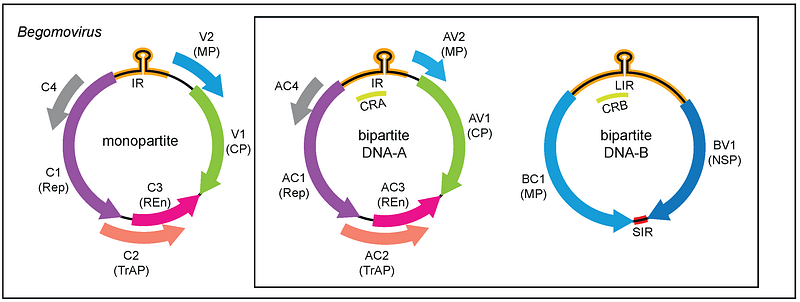
Image by ICTV/ Genome organization of the genus Begomovirus

The genome of bipartite begomoviruses composed of DNA–A and DNA–B components. In the above image, the DNA–A components of both( monopartite & bipartite). The DNA–A component replicates autonomously and encodes proteins that help in replication on both virion sense and complementary sense strands. The virion sense encodes the coat protein (CP) that encapsidates the DNA and helps in intracellular movement while the movement protein functions for the cell to cell movement. The complementary sense strand encodes a replication-associated protein (Rep), transcriptional activator proteins (TrAP), replication enhancer protein (REn), and AC4 protein. Rep protein initiates the replication of DNA–A. Transcriptional activator protein regulates the expression of both components and also interferes with the host antiviral process. REn ensures efficient and secure replication.

DNA–B component encodes nuclear shuttle protein (NSP)at virion strand and movement protein (MP) at a complementary strand. These two proteins help in intracellular and intercellular movement by facilitating symptom development and successful infection cycle completion.

The well-known species of begomoviruses are: African cassava mosaic virus, mungbean yellow mosaic virus

Begomoviruses are the cruel foes of legumes and their damage includes plant growth retardation under severe conditions plant death and chlorotic leaves with less efficient photosynthesis. Other prominent symptoms of their infections are curly leaves, false growth, and poor seed production.
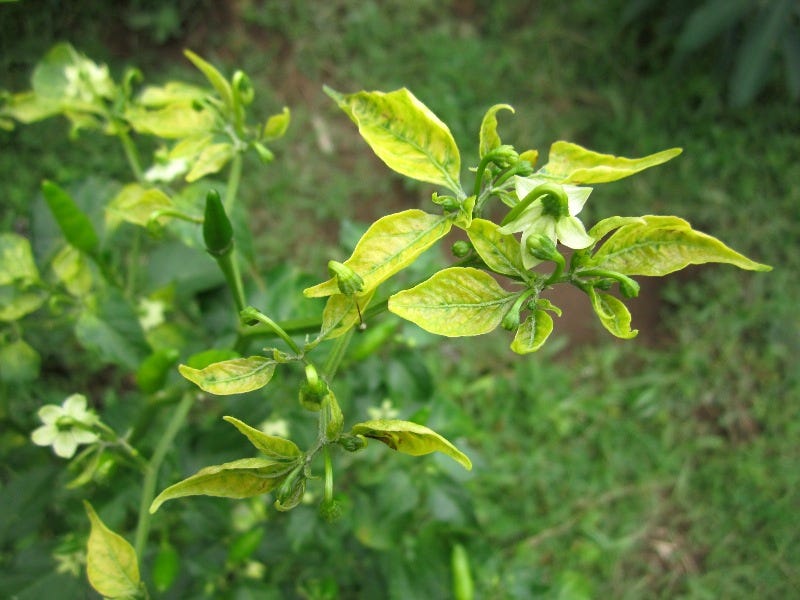
Image by Kembangraps on Wikimedia Commons

Plant Foes: Geminiviridae

Plants compete with millions of harsh factors in their lifetime. Among these, plant viruses are strategic and clever. They rely on entirely host cellular factors, encode multifunction proteins just to suppress the plant host’s amazing defense machinery. The complete eradication of plant enemies (viruses) is impossible but they can be managed with combined applications of agronomic practices and molecular techniques.

Agriculture
Plant Pathology
Geminiviruses
Begomoviruses
Science
Recommended from ReadMedium