
Top Ten Economically Important Plant Viruses
Being obligate parasites, viruses cause most important plant diseases globally. These diseases cause significant yield losses worldwide. Annually, the plant virus infection is responsible for a $30 billion economic yield loss in crops due to severe ailments.
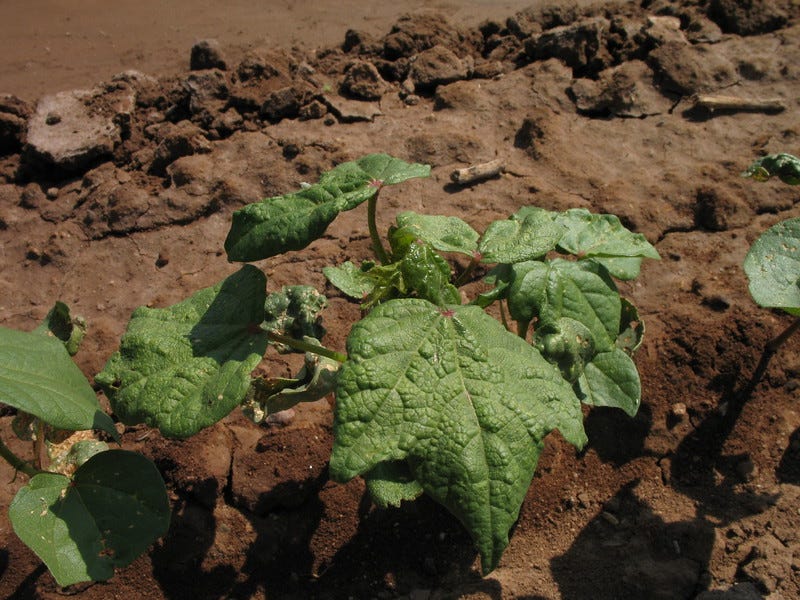
In 2011, the Journal of Molecular Plant Pathology published a list of ten economically important plant viruses. Economically important plant viruses cause severe disease infection and to compete for their ailments plant sacrifice their yield that ultimately causes food security risks. All over the world, 250 plant virologists voted for the following viruses:
- Tobacco mosaic virus (TMV)
- Tomato spotted wilt virus (TSWV)
- Tomato yellow leaf curl virus (TYLCuV)
- Cucumber mosaic virus (CMV)
- Potato virus Y (PVY)
- Potato virus X (PVX)
- Cauliflower mosaic virus (CaMV)
- African cassava mosaic virus (ACMV)
- Plum pox potyvirus (PPV)
- Brome mosaic virus (BMV)
Above mentioned viruses pose a serious threat to food security and safety.
Viruses are biotrophs and do not kill their host plants. Plant viruses rely on insect vectors for their transmission and survival into host plants. Not only insects act as the largest plant virus transmitting vectors but also mites, fungi, and nematodes are also transmitted viruses. Insects play a key role in the infection cycle of plant viruses. Viruses use their hosts for the multiplication and encapsidation.
The question is “How Plants Are Infected with Pathogens?”
The primary objective of viruses is to get access to the plant’s vasculature and infection, whereby they can complete the long-distance movement by using the plant’s vascular bundles. The infection process consists of three phases: pre-entry, entry, and multiplication.
The entry and colonization phase causes vital changes in the plant cell structure, its metabolism, and gene expression. It degrades the cell walls, intervenes with cellular proteins, and endoplasmic reticulum.
These interactions appear as symptoms (physical alterations in host plants due to pathogen infection). Symptoms include stunted growth, chlorosis, mosaic, deformed leaves, with no flowering.
Insect vectors transmit viruses into their respective hosts. Aphids, leafhoppers, whiteflies, thrips, and planthoppers are the best-characterized carriers of viruses.
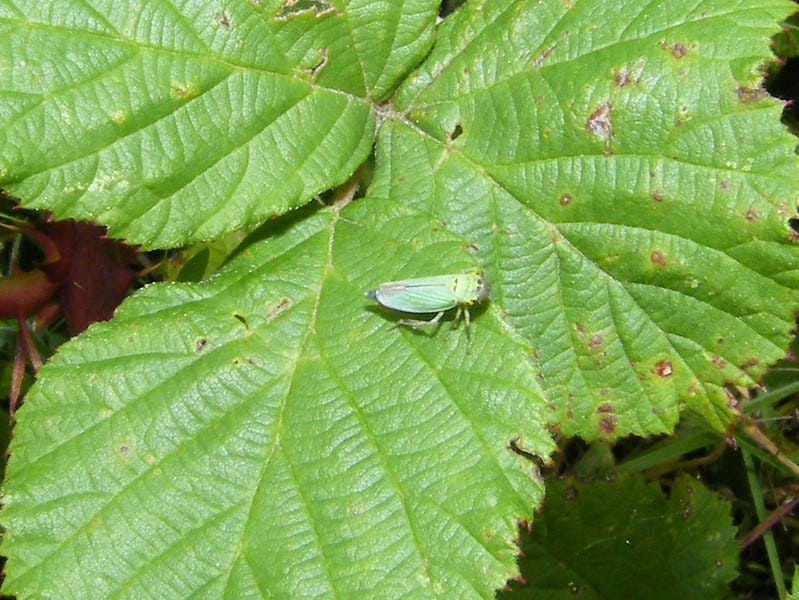
Insects transmit plant viruses by different modes. These modes of transmission depend on the insect vector's lifestyle and the time period for which they harbor viruses.
Mode of transmission by Insects
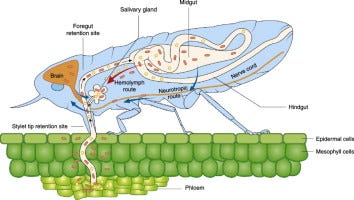
The transmission of viruses through insects occurred by the following modes:
Persistent Mode of Transmission
In persistent transmission, the viruses live in insect hemocoel and become part of its metabolic process and also transmit from insects to its offspring. This mode of transmission allows the virus to be a lifetime buddy of insects.
Semi-persistent
In this mode of transmission, a virus remains from hours to days in an insect body and does not enter into the insect’s tissues. This transmission mode is favorable for plants when insect metamorphoses, the viruses may lose. For example cauliflower mosaic virus.
Non-circulative Semi-persistent Transmission
Non Persistent semi-persistent viruses remain into the foregut and only dependent on the coat protein (CP) for transmission while the circulative semi-persistent viruses also require many organs of insects (from insects gut to hemolymph, and salivary tissues membranes) to reach to salivary glands for transmission. They do not replicate in vector tissues. For example cucumber mosaic virus.
Non-persistent Mode of Transmission
In non-persistent transmission, viruses retain into the insect stylet e.g; potyvirus. A stylet borne virus sticks to the mouthparts and activates the interactions of the virus, vector, and plant for their transmission.
Circulative, Propagating Transmission
These viruses are distinguished by replication and systemic spread in their host before transmission to the host plant. Insect vectors play a key role in host determination for viruses. Host selection for virus transmission is decided by plant virus vector interactions.
Plant viruses can alter insect behavior directly or indirectly by manipulating plant hosts. These interactions enhance transmission efficacy and spread.
Keynotes:
Insect vectors play a key role in the infection process of plant viruses.
Insects belong to the phylum Arthropoda and act as a carrier for viruses.
Insects mode of transmission based on the insect's lifestyle, morphology, and time period for which they retain viruses (persistent, non-persistent, semi-persistent transmission mode).
This is the initial study steps of insect virus transmission. I’ll complete the above mentioned ten viruses in my story series. I’ll write about virus etiology, symptoms, infection cycle, mode of transmission, insect vectors, and disease management.
References:
- Dietzgen, R. G., Mann, K. S., & Johnson, K. N. (2016). Plant virus–insect vector interactions: current and potential future research directions. Viruses, 8(11), 303.
- Rybicki, E. P. (2015). A Top Ten list for economically important plant viruses. Archives of virology, 160(1), 17–20.
- Dáder, B., Then, C., Berthelot, E., Ducousso, M., Ng, J. C., & Drucker, M. (2017). Insect transmission of plant viruses: Multilayered interactions optimize viral propagation. Insect Science, 24(6), 929–946.


