
PROTEOMICS
Proteomic Tools: To Study Insect Vector-Plant Virus Interactions
Proteomic tools have identified a plethora of important viral proteins inside their plant hosts and insect vectors.
Plant viruses are responsible for major yield and production losses in agronomically important crops. Being biotroph parasites viruses completely rely on their host plants for the completion of their life cycle. Therefore, viruses hijack their host’s cellular machinery particularly proteins for their own replication and intercellular movement.
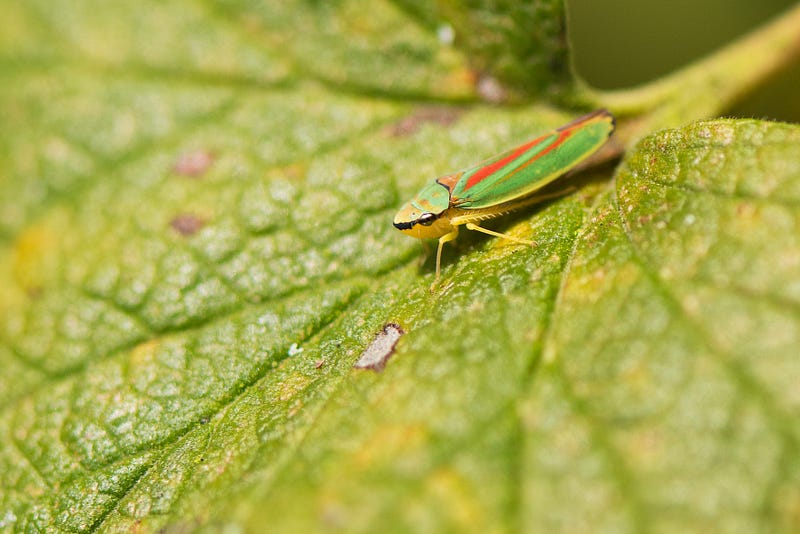
Plant viruses need insect vectors for their transmission. Insect vectors transmit viruses while feeding on plants through their mouthparts. In short, insects play a crucial role in the viral life cycle. When insects feed on diseased plants they acquire the virus (acquisition period), retain it in its tissues (retention period), and transmit it on disease-free plants (transmission period) during feeding.
However, proteomic tools have made it easier to study insect vector plant-virus interactions.
Proteins are key players in the physiological mechanisms of a cell or an organism and proteomics is the study of overall proteins of the cell while proteome analysis is the application of various tools and techniques used for qualitative and quantitative protein studies. The term proteome was first coined by an Australian scientist Marc Wilkins in 1996 to complement the term “Genome.”
Proteomic tools have enabled scientists to look into the environment of a cell when they encountered a foreign agent. The qualitative and quantitative protein analysis of cell helps in the diagnosis of various fungal, bacterial, and viral diseases.
Here are the following tools that are used to study insect virus-plant interactions:
- Enzyme-linked immunosorbent assay (ELISA)
- Two-dimensional gel electrophoresis
- Two-dimensional difference gel electrophoresis
- Western blot
- Yeast two-hybrid assay (Y2H)
- Bioluminescence resonance energy transfer (BRET)
Enzyme-linked Immunosorbent Assay
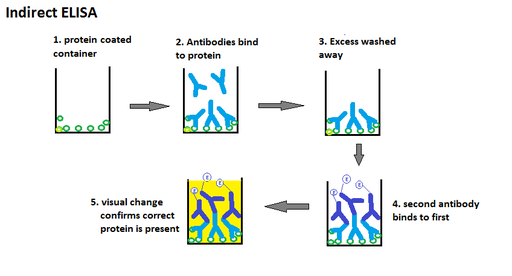
It is an easy, efficient, and widely used antibody-based assay for bacterial and viral disease diagnosis. ELISA is an antigen-antibody reaction-based assay that captures the target antigens from samples through epitope binding. The antibodies are cross-linked with an enzyme that changes the color of the substrate upon recognition of the targeted antigen from the sample.
The color concentration indicates the number of infection entities present in the sample.

The benefit of this method is it can be used for a large number of plant samples for diagnosis. This technique is also helpful to insect vectors for various viruses.
Two Dimensional Gel Electrophoresis (2DGE)
Gel-based proteomics analysis quantifies differential protein expressions for comparative studies of cells during infection. It helps in the study of protein structure, expression, and function.
Gel electrophoresis separates macromolecules under the effect of an electric filed termed as electrophoresis. Sodium dodecyl sulfate-polyacrylamide gel electrophoresis (SDS-PAGE) is an abundantly used gel-based method for protein quantification. It is widely used in molecular biology for protein expression analysis in cells under various conditions. These conditions could be related to cells infected or healthy state.
Sodium dodecyl sulfate-polyacrylamide gel electrophoresis (SDS-PAGE) is composed of a discontinuous gel system with different concentrations. The basic principle is based on the separation of proteins by a charge to mass (molecular weight) ration in an electric field. The smaller proteins migrate faster in the gel than larger protein molecules.
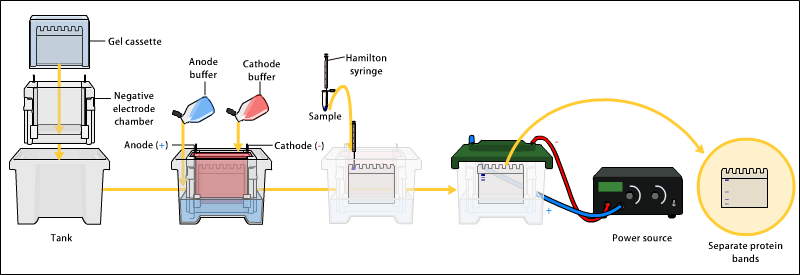
SDS-PAGE consists of two gel layers. The upper layer of gel is macroporous and called stacking gel and the lower layer is separating gel. The purpose of stacking gel is to stack up the loaded sample and to ensure that all proteins are transferred to running gel at the same time. So, the similar molecular weight proteins will move as tight band at running gel. The stacking gel ensures the precision of protein quantification.
The running gel separates the lined up sample based on their size. Once the proteins are in the running gel, their mobility is restricted due to the microporous nature of the gel.
Western Blot
Western blotting is another efficient proteomic tool that can be used for the detection of viruses in plants or insect bodies. Western blot separates proteins based on their size and type by gel electrophoresis.
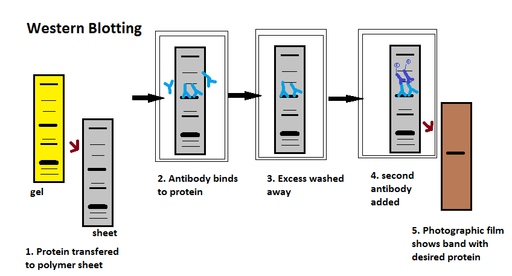

During the experiment, proteins are separated on the of their size then resultant proteins are transferred to a membrane. The membrane is incubated with protein-specific antibodies. As the antibodies bound with the target protein they are detected by film and the thickness of the band showed the amount of protein in the sample.
Yeast Two-Hybrid Assay (Y2HA)
Yeast two-hybrid system studies protein-protein interactions. “The assay is based on the observation that eukaryotic transcription factors are organized into functionally separable domains such as the DNA-binding domain (BD), which mediates the recruitment of the transcription factor on to specific genome DNA sequences, and the activation domain (AD), which recruits the transcriptional machinery promoting transcription.
These domains are physically separable, as it has been established that BD and AD domains. Thus the modular nature of eukaryotic transcription factors allows the detection of protein-protein interactions.”
What Can We Learn from Insect Vector Plant-Virus Interactions?
Proteomic techniques have provided insights into an insect, virus, and plant interface. These tools revealed the secrets of protein-protein interactions that occurred when plants get in touch with the virus and insect. Proteome analysis showed the whole protein inventory of a cell and such studies can be used in disease management studies:
Detection of the expression of unique proteins at insect, virus plant interface can be manipulated for disease resistance breeding.
Proteomic tools help in the study of the mode of infection and virus-insect vector interactions.
Proteome analysis lists out the key proteins that are involved in resistance mechanisms.
Comparative studies of the expression of proteins can be performed to target the susceptible and resistant proteins in the infection process.
Conclusively, many research studies are needed to unravel the complex protein-protein interaction involved in pathogenesis and suppression of host immunity.