Future Concepts: Artificial Intelligence (AI)

In How to invest in AI — Part I, the author Tristan Post begins this series with a simple way to think about AI investing:
The percentage of investments that are AI first has gone up. It almost seems like nowadays every startup that does software has a component of AI to it.
With the author’s background in AI startups and education, this three-part series about investing in AI is a great place to start on the topic of AI investing. All of the right data and findings are summarized and clearly reported, along with original diagram content to explain complex AI models.
Enjoy reading this methodical series on how to invest in AI. My question is: How are the AI applications for mining and electrification industries going to affect publicly-traded stocks in the future?
In We are Angry at The Wrong People I totally agree with all of the points Xiao Faria da Cunha made in this narrative about AI and artworks. I just would like to add that, instead of accepting the fact that people have lost their senses/abilities to appreciate art, that artists the world over should strive to localize their artworks for a target audience. I still believe that many artists are seeking that one big work of art that spans universally, and that is also a key problem of art’s future (whether AI-generated or traditionally crafted).
In response to the comments I made, here’s what the author said:
I might have slightly different opinion as far as the audience-artist relationship goes, which I plan on elaborating in a separate article. But I do get what you’re trying to say, and I agree that many artists are trying to go too big when having a focus/niche would definitely be far more beneficial both to the artist’s career and artistic advancement in general. I personally think it should more be audience finding their artists instead of artists tailoring to an audience, unless it’s commercial artists or genre artists (wildlife, plein air, etc.). But I 100% agree with finding our niche and narrowing things down.
The writer Marcelo Rinesi delivers a narrative about the effects of technology that are driving concepts about AI in society. Just read this excerpt from AI as societal zero-day exploits:
I’ve said this before, and it’s getting clearer by the week: you will know a competitor is qualitatively out-thinking you not when you can’t replicate their products but when, even with the benefit of hindsight, you can’t replicate the thought process that led to them.
The author really zones-in on the aspects of AI and society in this brief sketch. I’ll leave the rest of the ideals for you to ascertain on your own.
The story about A world without internet thanks to generative AIw as the content that inspired me to compile the best content about AI on medium. In the publication Data-Driven Fiction (DDF) on Medium, Eva Rtology envisions a world where content delivery networks (CDN) reign supreme in the context of art and media.
A content delivery network (CDN) is a distributed network of servers used to deliver content, such as web pages, images, and videos, to users based on their geographical location.

Amanda Claypool begins her discussion about AI with this question: “Worried your job is going to disappear?” Her writing about AI focuses on the potential effects AI will have on the labor market, and thus people’s worries about jobs. She uses data and reasoning to explain how AI is not going to make jobs disappear, but eliminate certain tasks, such as e-mail.
Eva Rtology brings readers back to the 19th century when female Impressionist painters were popular attractions in the world art and society. The Impressionist painters were famous for breaking social barriers through expressions in their artwork; and now AI has the ability to do the same thing in today’s era. The writing explains how AI-Assisted Artistry allows creators to re-discover the Impressionist era with the use of AI-powered tools.
In this edition of Geopolitics and Markets Review one of the issues on the agenda of world politics is the rush to develop AI. One of the key agenda items is how to stop AI from getting out of control. Regulations should be put in place to slow down its progress to ensure the safety of AI systems for humanity. The writer Geopolitics Explained opines that “true art will not be replaced by AI.”
I’ve been following Frank Diana ever since I joined Medium. A TCS Executive focused on the rapid evolution of society and business, his latest content about The Age Of AI explores ideals on the future of transporation, which has been filling up the talks about ChatGPT, but also ow Bill Gates formulated ideals on the role AI can play in advancing human development. Read all about this in his story on The Age Of AI.
Lastly, I wanted to share my own content about AI. Taking a mutual inspiration from a Medium story and March Madness 2023, I decided to write an AI risk assessment by applying an analogy from a basketball game scenario. This basketball game scenario serves as an analogy to explain AI risk assessments. It also serves as an explanation to how much impact AI is having on society’s standards for entertainment and time. Time becomes irrelevant, as all motion of the games comes to a hard stop during the play review. What will this mean for competition in the race for AI in the future?
March Madness 2023 was filled with excitement as 2023 seemed to be the year of the underdogs in college basketball. The Men’s NCCA national championship was held on April 3, in Houston Texas, between San Diego State (SDS) and University of Connecticut (UCONN), where UCONN won decisively.
During March Madness, I came across 4 Signs Your Industry Is Being Disrupted while looking at stories from my mobile phone on Medium by Greg Satell. Greg’s Medium story covers the topic of business systems and how they avoid scenarios of declining industries.
“Businesses also have two systems, which can sometimes conflict. One is immediate and operational. It seeks to optimize processes, gain market share and maximize profitability. The second builds capacity for the long term, by investing in employees, building trustful partnerships and creating new markets to compete for the future.”
Taking a mutual inspiration from Greg’s story and March Madness 2023, I decided to write an Artificial Intelligence (AI) risk assessment by applying an analogy from a basketball game scenario. Here it goes…

During a basketball game, the players and the coaches are constantly assessing risks.
Each dribble, pass and step are part of the calculated thoughts that are visible from the player’s motions on the court. While this constant risk assessment is being carried out — and ideally through a coach’s strategy — the outcomes from every dribble, pass and step determine the momentum of the game: every motion has a consequence, for better or worse.
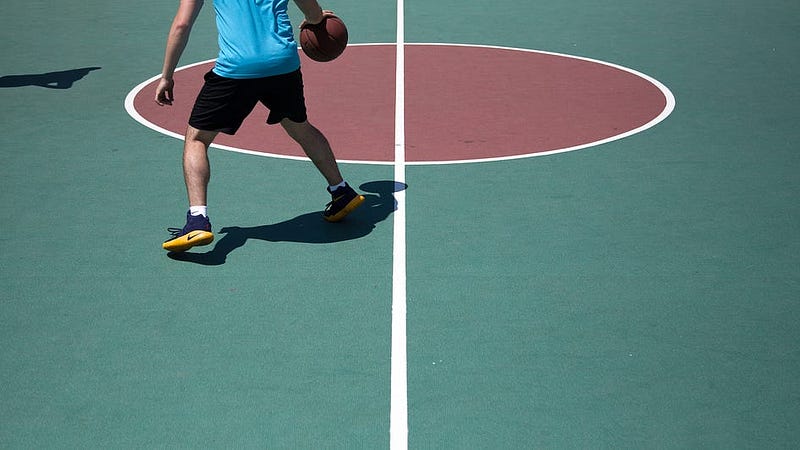
For example, player A dribbles the ball down the court, looking for player B to make a pass, but little did player A realize that player C sought to take the ball away from player A (aka: a steal). When player C made a move to steal the ball, it caused a response from an irrelevant actor — the referee.
During this moment of the game, when player C tried to steal the ball from player A, the referee called into question player C’s action, and enforced order in the game by consulting a network of watchers. This network of watchers form part of an exterior network of watchers who have the authority to leave the game (aka: the audience).
At this juncture, the referee had been irrelevant in reference to motion between the players, but after the referee’s action to stop the game — by calling into question the steal — the referee at once became relevant in reference to time. In other words, there was a paradigm shift in the game, in which AI becomes a focal point in determining the outcome of the referee’s action, thus rendering the referee a relevant actor to the final score.
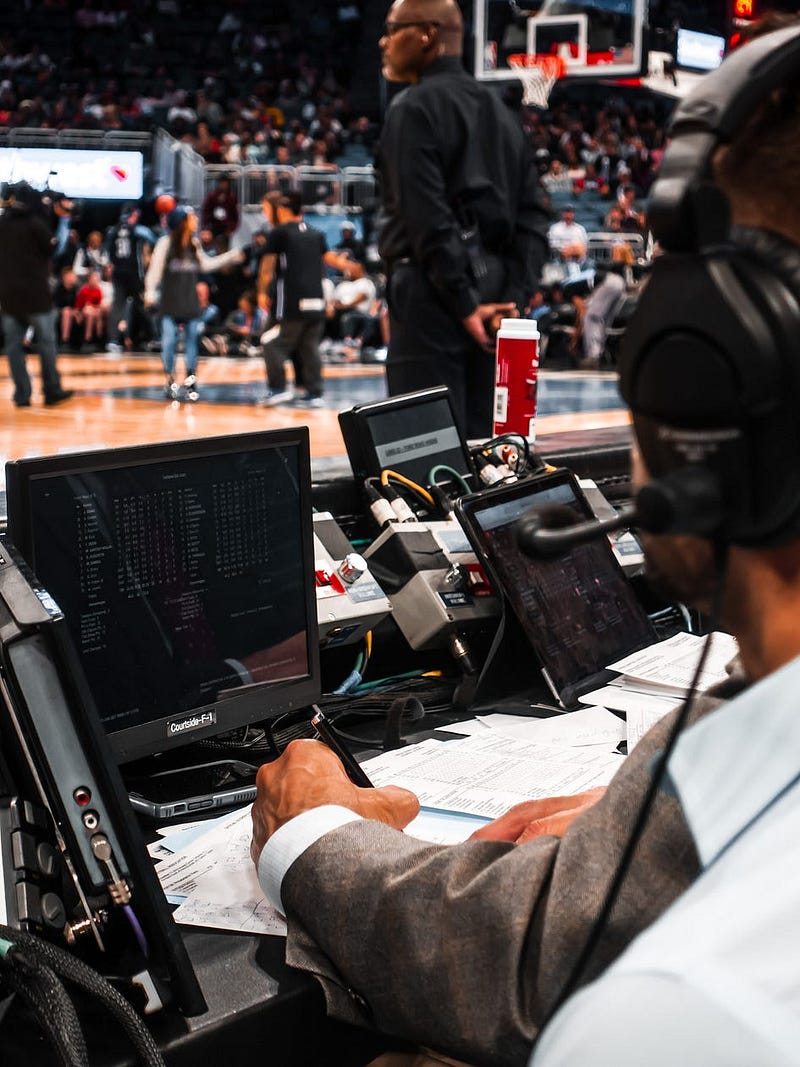
The audience chooses to stay at the game, regardless of the referee’s actions which have completely stopped all momentum between the players. In fact, because they choose to stay at the game, it allows the AI to be a key part of the game’s final outcome. I’m of course referring here to the application of instant replay and official reviews during a basketball game.
I can’t help but wonder why we have got to a point where a significant amount of the time, and thus value spent, on a basketball game takes place during the play review.
This basketball game scenario serves as an analogy to explain AI risk assessments. It also serves as an explanation to how much impact AI is having on society’s standards for entertainment and time. Time becomes irrelevant, as all motion of the games comes to a hard stop during the play review. What will this mean for competition in the race for AI in the future?
Read more about Future Concepts by following the publication Areas & Producers.


