
Geopolitics and Markets Review — 3rd April 2023
Sections:
1) OPEC+ Cuts Oil Production
2) Stock Market Liquidity
3) Binance Sued By CFTC
4) The Open Letter To Pause AI Development Above GPT-4
5) UK’s Trans-Pacific Trade Deal
6) De-Dollarisation
7) China and France Settle LNG Deal In Yuan
8) My Thoughts of the Week
9) My Current Reading
OPEC Oil Cuts
Yesterday, OPEC+ announced more cuts to oil production. Production will be cut by an extra 1.16 million barrels per day (bpd). Russia also announced it would extend its 500,000-bpd oil production cut until at least the end of 2023.
OPEC has pricing power over oil, so we would need a massive demand drop seen in a global recession to see prices drop too far. As these countries in OPEC benefit from higher oil prices, they will cut production to counter any price drops in oil. Should the US have refilled their SPR, rather than engaging in pricing battles with OPEC that they aren’t going to win by emptying their own? They are shooting themselves in the foot.
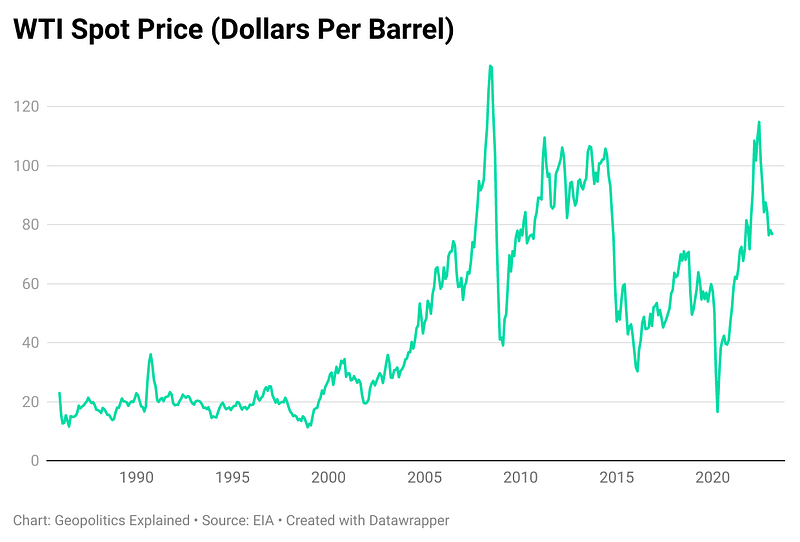
The Chinese SPR is very full, and the US SPR is the emptiest it’s been in over 40 years. As a strategic reserve, having less in it coincides with having fewer strategic options. Internal political games ensure the releases keep coming from the SPR as the Biden administration wants to remain in office, and low gasoline prices seem to be his strategy. The pricing power OPEC has over oil makes this a tough game to play.
As Powell also still wants to get inflation back to his 2% target, any price rises in oil are strongly correlated to inflation rises. In shattered relationships in a future multipolar world order, supply chain inflation will linger in the background and emerge in strong spikes.
In short, it’s OPEC pricing through production cuts vs U.S SPR releases, but if prices of oil rise too far, could demand destruction contribute to a U.S recession?
WTI and Brent are up 6.57% and 6.38% respectively at the time of writing. My alerts around the 50, 100-day moving averages were triggered this morning, but the price is still below the 200-day moving average which sits at around 89.53 on WTI.
Liquidity
Risk-on because the only important element in the financial markets is liquidity. The Federal Reserve balance sheet currently appears to be the only chart that is driving where capital is being parked in the financial markets.
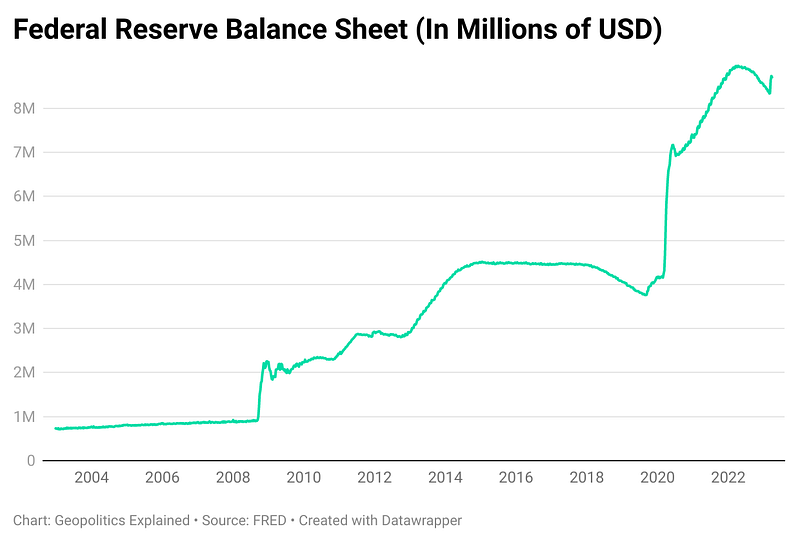
Quantitative tightening, the process of reducing the size of the Fed’s balance sheet through selling treasuries and other methods removes liquidity from the stock markets. In 2020, when stimulus checks were handed out, when interest rates were at 1000-year lows, money flowed into the stock markets riskiest assets with the hope of gaining a return that wasn’t seen in treasuries.
A return was seen, but the high levels of quantitative easing through stimulus and buying bonds saw valuation skyrocket to unsustainable and unrealistic levels.
This is why the tech sector was battered last year. It was full of unprofitable companies who lived off the rise of quantitative easing, SPAC booms, and excess liquidity.
We had a period of quantitative tightening reducing stock market liquidity since last June and performance last year was weak. Now that market participants think the hiking cycle is closer to the end and a pivot or pause in rates could occur, some optimism had returned to the markets in the early months of the year.
Then emerges something breaking. Caused by a rush of depositors out of Silicon Valley Bank, made worse by social media panic, the bank collapsed.
The Fed announced that all depositors would be guaranteed by the FDIC, and the Bank Term Funding Program was created to make additional funding available in bank-run events.
This is what happens in interest rate hiking cycles. Often, the lag effects are seen a year later, and poorly structured companies go bankrupt. This was the first inning of something breaking, and it was a bank.
The federal reserve usually reaches a point where something that is too big breaks, and then interest rates have to be cut. But Powell wants inflation back to his 2% target. If this is even possible as the dynamics of global trade are changing so much and the money printer is back out of its dark corner are the key questions to consider.
Key Questions:
1) Can inflation hit 2% before something major breaks and forces the Federal Reserve to start cutting interest rates?
2) If inflation isn’t under control and something major breaks, how long will this cycle of lower interest rates to stimulate growth and quantitative easing be used?
But currently, liquidity is driving the stock market. If or when further things break, will more expansion of the Fed’s balance sheet further advance stock prices, some of which are still at overvalued levels?
Someone, please point me in the direction of somewhere I can find out if QT is still happening in the background of all this, or if the new BTFP has signalled the end of it. I can’t find anything anywhere.
Binance Sued By CFTC
In the ongoing crackdown on crypto, the Commodity Futures Trading Commission (CFTC) announced on Monday it is suing Binance. $1.6B in withdrawals has since left the exchange and this was reported last Wednesday. We have recently seen the damage caused by bank-run-style events on cryptocurrency banks Signature and Silvergate, both of which shut down (or were seized by regulators).
The U.S. is on an attack against cryptocurrencies. Rather than blending it with its current financial system, adopting tokenisation and DeFi elements of crypto to improve trust and efficiency in the financial system, they have gone for the opposite approach.
Do not hold your cryptocurrency on exchanges. Understand how the technology works to move funds around. Explore different types of wallets, hot and cold storage, for example. Educate yourself and provide yourself with as many options as possible.
It reminds me of the 1934 ban on private holdings of Gold.
We are seeing things move very quickly in so many fields of technology. Sometimes, regulators can’t keep up with the innovation, and rash decisions are made to buy time. Another area of tech development that could change the future and is seeing regulators rush to control is AI.
As we see de-dollarisation in the news this week, could the attack on crypto also be an attempt to stop capital flows exiting to be stored in cryptocurrencies? The death of cryptocurrencies would mean more capital for the too-big-to-fail banks and more control.
Elon, Harari, Yang, Tegmark and Others Want AI Pause
The rush to develop AI run on more sophisticated language models has the potential to get out of control, as detailed in a letter proposed by many leaders in tech and AI. They want a 6-month pause on the training of AI systems that are more powerful than the most recent language model released, GPT-4.
The aim is to establish regulation in this 6-month period to stop AI from growing out of control. The safety of AI systems is vital, and understanding what is being created. AI systems can now pass some exams with ease.

Photo by julien Tromeur on Unsplash
AI can be used to advance our own work, through research, and deep questions to support our analysis. The emotion that is brought about by a beautiful piece of writing, or a song created by an artist with experiences, and feelings, cannot and will not be replicated by AI. AI don’t have feelings and emotions, and so true art will not be replaced by AI in my opinion, only enhanced.
We can enhance our art and even our lives through AI today. But an arms race to rashly develop AI that becomes more powerful and spread further out of our control needs to be addressed.
Trans-Pacific Trade Deal
The UK has a wonderful new trade deal as it joins the Comprehensive and Progressive Agreement for Trans-Pacific Partnership (CPTPP). The map says all there is to say about it.
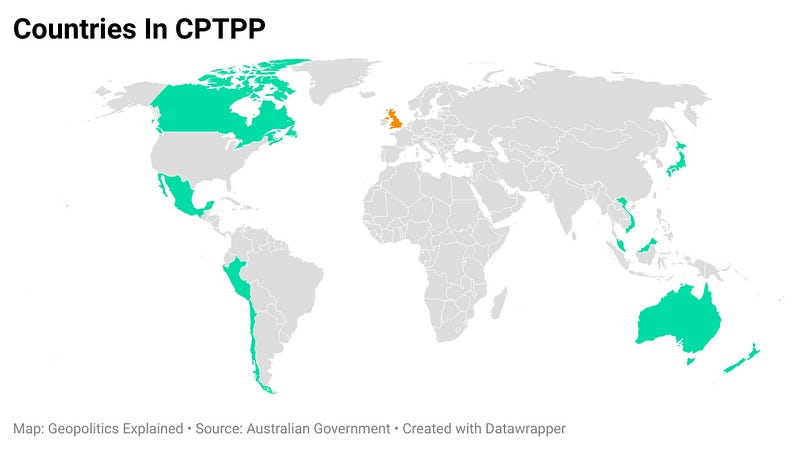
Connectivity between countries is changing. Navies will be used more to protect supply chains. If your supply chains are as far away as physically possible, you will have more work to do in defending these supply chains. This means more military spending.
Japan demonstrates how to be isolated and trade heavily to keep its economy functioning. However, the impact supply chain issues have as reflected through inflation damages these countries pricing power much greater than those highly connected countries with smaller supply chains.
China also applied to join the CPTPP back in September 2021, and Taiwan submitted theirs 6 days after.
Australia doesn’t support China joining the ground until China halts trade strikes against Australian exports. In January, the Chinese ambassador to Australia said he wants a solution to be found as quickly as possible. Still, no solution appears to have been found but discussion of a solution is emerging in the news recently.
Big Scary De-Dollarisation! Should We Be Scared?
When de-dollarisation gets mainstream media attention, I stop listening.
In the big cycle of empires, they have their rise and fall. The stages can be identified through a country’s financial situation, its political situation, and external geopolitical tensions. We are in a period that sounds like this.
The US has high levels of debt, its internal political tensions are the highest seen in decades, and geopolitical tensions are arising with the Russia-Ukraine conflict, tensions with China, and the creation of a multipolar world order.
However, the change needed to alter the entire financial system, specifically the world reserve currency, is massive. The decline of the reserve currency within the empire cycle is also one of the last pedestals to fall.
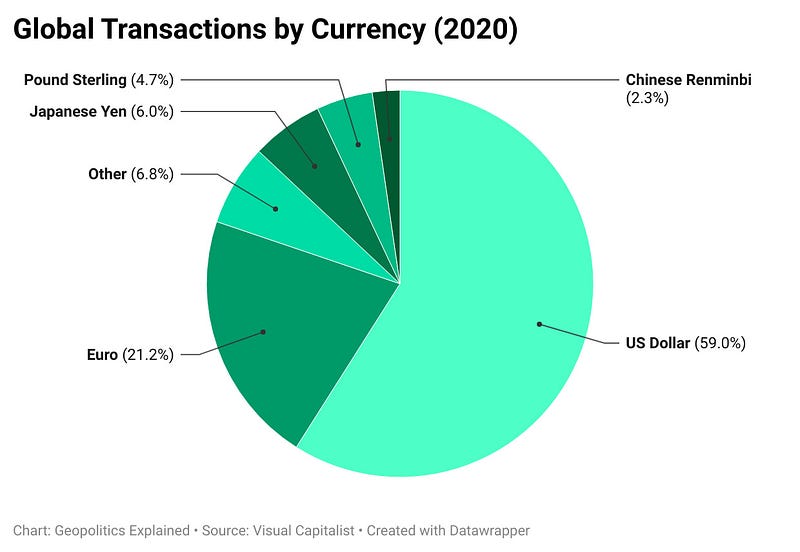
The mainstream media highlight the trend of de-dollarisation every few years and act as though it’s happening next week. The dollar is still used in over half of global transactions.
The signs are there that the US could be declining. Education is dropping, and as mentioned on Wealthion this week, it teaches people how to pass a test. And teachers are judged on the success of their students to pass a test. They are ultimately memory tests. When I was in high school, in languages, I had to write a piece and then recite it to my teacher. That didn’t test my Spanish, it tested my memory. I had no clue what I was saying half the time, I just knew how the words sounded and memorised them. Those with poorer memory or knowledge retention struggle with this, so why would they be motivated to try? The education system teaches no critical life skills. Nothing about sound financial activity, or how to explore and understand yourself and your interests through a future potential job. Education should open the young population up to so many opportunities and topics so that they can understand themselves and where they want to be in life.
Anyway, my rant is over! Education quality is dropping and that is one sign of a declining empire. But it’s often one of the first signs. The dollar losing its reserve currency status will be one of the last, often through revolution or war. The dollar is here to stay.
China and France LNG Yuan Deal
The first cross-border trade settled for LNG in yuan was completed between China and France.
France is a country that is a member of the Western alliance. But they are open to trading with countries in other currencies outside the dollar.
The opportunity for the dollar to be weaponised has emerged in recent years, as reserves held in dollar debt are charged higher interest rates in hiking cycles, and can be completely confiscated as was the case with Russian dollar-denominated reserves. This has made many countries aware of the fact that even if they are friendly with the US now, they can’t rely on that remaining, and don’t want to be victim to the same financial warfare.
China is coming out of COVID and could experience the same spending boom that was seen in the rest of the world after reopening. With this, they want to increase confidence in the Chinese market. Jack Ma, the Alibaba founder, returned to China for the first time since last year. The Chinese financial regulators cracked down on tech companies, especially public tech companies. The Ant Group IPO was shelved, and antitrust fines were issued. This further added to bearish sentiment in Chinese tech stocks.
China loves high growth in its economy. These tech giants can contribute to that, and altering investors’ attitudes to the Chinese markets will encourage investment in China.
More and more international trades being settled in yuan could bring confidence to the currency. However, the history of currency manipulation to keep exports cheap and hence more attractive leads to less trust in the Yuan. China holding a large amount of U.S. Treasuries also keeps export prices lower. But the connection between the U.S. and China is weakening. Holdings of treasuries have been dropping, and the Chinese spy balloon, and the banning of the export of materials to China related to semiconductors, are examples of rising tensions.
But China’s swap agreements are on the rise with other countries, and offshore deals denominated in yuan are rising also.
But if the yuan gets too strong, its exports become more expensive. It also has to manage if too much capital flows in too quickly. This could turn into a bubbly environment, or even cause inflation.
COVID spending and supply chain issues contributed to inflation in the West, China will want to avoid the same. As one of the key players in global commodity markets, they have the advantage that they are impacted less by supply chain disruptions. They are also building strong relationships with other countries it feels it can rely on, such as Qatar for LNG, Saudi Arabia for oil, and now other countries by settling trades in Yuan.
Thoughts of the Week
· My Habits — I don’t find the time to listen to entire episodes of Tim Ferriss’ podcast often, so I listen to his monthly recap episodes. One guest in January was James Clear, author of Atomic Habits. I bought the book last Christmas and it’s been sitting on my kindle waiting to be read. The things mentioned in the short snippet reviewing the episode made me want to read Atomic Habits very soon.
A framework detailed in the book involves considering how we can make our habits more obvious, attractive, easy, and satisfying. This is something I’m going to use to improve the habits in my life. For example, rather than meditating for 10 minutes, do 1 minute. And have a specified area where I go to meditate. Then after, have some reward for doing the habit. This is the example given in the podcast episode. I enjoy looking at the things I do in my life as a system of sorts. Systems need a framework that can be tweaked and improved upon. This is one such area I’m focused on currently.
Current Reading
· Mastery by Robert Greene — I read about strategies for the ideal apprenticeship this week. This book is worth reading, but I’ll provide some key points. Firstly value learning over money. Expand your horizons (skills). Trust the process. Seek out pain and resistance. Hopefully, I’ll finish Mastery this week and I can review the key points of the full book.
· Connectography by Parag Khanna — This book is very complicated, and I want to set aside time when I’m doing nothing so I can make notes will I read it. Hence why it is taking me so long, but a very interesting book, nonetheless. And I go away over the upcoming weekend, so this could be a good time to get through lots of the book.
Thanks for reading! If you want more like this then follow me on Twitter or Medium or subscribe on Substack for these posts directly to your email inbox. I write and research geopolitics and financial markets to organise my own thoughts and prepare myself for anything I can control. If any of this helps you to be more prepared and ease your mind, then that’s great. If you like what you read please share it with others. Have a good week.
Geopolitics Database: https://www.geopoliticsexplained.co.uk/geopoliticsdatabase-access
Geopolitics Explained Podcast: https://www.geopoliticsexplained.co.uk/geopol-podcast
or listen here:


