avatarGavin Lamb, PhD

Free AI web copilot to create summaries, insights and extended knowledge, download it at here

3453

Abstract

"><figcaption><a href="https://en.wikipedia.org/wiki/Moulin_Rouge">The Moulin Rouge,</a> Paris 1914 before the 1915 fire, in <a href="https://en.wikipedia.org/wiki/Autochrome_Lumi%C3%A8re">Autochrome Lumière</a> color. By Albert Kahn on <a href="https://commons.wikimedia.org/wiki/File:Paris_1914_Moulin_Rouge.jpg">Wikimedia Commons</a> (public domain).</figcaption></figure><div id="eb9f" class="link-block"> <a href="https://readmedium.com/30-beliefs-and-techniques-for-life-and-writing-from-jack-kerouac-938fcb1beb76"> <div> <div> <h2>30 Beliefs And Techniques For Life And Writing from Jack Kerouac</h2> <div><h3>#21 ‘Struggle to sketch the flow that already exists intact in mind’</h3></div> <div><p>medium.com</p></div> </div> <div> <div style="background-image: url(https://miro.readmedium.com/v2/resize:fit:320/1*d23HUw4ZMCWfvlBsEJUnKw.png)"></div> </div> </div> </a> </div><h1 id="6900">Colette on the joys (and pains) of writing by hand</h1><p id="79f0">As Robert Phelps writes, in the introduction to his edited collection of Colette’s work, one of her immense writing talents was to bring a vividness to the <a href="https://readmedium.com/solastalgia-the-word-invented-to-label-our-climate-homesickness-cb4c257a2d26">psychoterratic</a> (psyche + earth) space between the world and our perceptions of it:</p><blockquote id="7e61"><p>“Essentially Colette was a lyric poet, and her basic subject matter was not the world she described so reverently <b>but the drama of her personal relation to the world.</b> <b>Her injunction to those around her was always “Look!”</b> and her own capacity to behold was acute and untiring” (emphasis mine).</p></blockquote><p id="e026">When Colette turns her gaze onto the act of writing itself, her intense obsession with what writing is, and what it means to be a writer, is vividly detailed. In particular, as Maria Popova insightfully notes, Colette brings her powers of magnification to an increasingly threatened species of writing: that “creaturely joy of writing by hand.”</p><p id="cdc7">I almost always type on my laptop, but for some reason, reading Colette describe the joys and pains of handwriting makes me want to bust out a high-quality fountain pen and start scribbling furiously, writing down everything from a novel to a shopping list:</p><h2 id="9de4">1. On the meaning of writing</h2><blockquote id="e262"><p>“To write, to be able to write, what does it mean? It means spending long hours dreaming before a white page, scribbling unconsciously, letting your pen play around a blot of ink and nibble at a half-formed word, scratching it, making it bristle with darts, and adorning it with antennae and paws until it loses all resemblance to a legible word and turns into a fantastic insect or a fluttering creature half butterfly, half fairy.”</p></blockquote><h2 id="2e2b">2. On the obsession of writing</h2><blockquote id="e3a6"><p>“To write is to sit and stare, hypnotized, at the reflection of the window in the silver inkstand, to feel the divine fever mounting to one’s cheeks and forehead while the hand that writes grows blissfully numb upon the paper.”</p></blockquote><h2 id="5c9f">3. On the strange feeling after being overtaken by a bout of inspiration</h2><blockquote id="5c4e"><p>“[Writing] also means

Options

idle hours curled up in the hollow of the divan, and then the orgy of inspiration from which one emerges stupefied and aching all over, but already recompensed and laden with treasures that one unloads slowly on to the virgin page in the little round pool of light under the lamp.”</p></blockquote><h2 id="d6a0">4. On “the impatient god who guides” the hand struggling to write fast enough</h2><blockquote id="ade2"><p>“To write is to pour one’s innermost self passionately upon the tempting paper, at such frantic speed that sometimes one’s hand struggles and rebels, overdriven by the impatient god who guides it — and to find, next day, in place of the golden bough that boomed miraculously in that dazzling hour, a withered bramble and a stunted flower.”</p></blockquote><div id="3c0a" class="link-block"> <a href="https://readmedium.com/mary-oliver-on-writing-while-walking-in-the-woods-41eed733748a"> <div> <div> <h2>Mary Oliver on Writing While Walking In The Woods</h2> <div><h3>“Attention is the beginning of devotion”</h3></div> <div><p>medium.com</p></div> </div> <div> <div style="background-image: url(https://miro.readmedium.com/v2/resize:fit:320/1*ecwfH7-waGHYkju7NGAqLw.jpeg)"></div> </div> </div> </a> </div><h1 id="963b">Colette on the Landscape of Human Experience</h1><p id="70da">One more idea. As a writer, I’m always curious about how other writers write: what inspires them, how they handle the everyday challenges of putting words on paper, and how the personal experiences they live through shape the many possible worlds they pay attention to.</p><p id="a61a">But as an environmental writer, I’m also curious about how writers invoke the natural world to convey their lived experience of being a two-legged on planet Earth, whether through metaphor, memory, or careful scientific description.</p><p id="9e7e">In 1926, Colette <a href="https://archive.vanityfair.com/article/1926/1/the-landscape">published</a> a short story in Vanity Fair called “<i>The Landscape: Another Striking Proof That “Men Have Died Ere This, But Not for Love.”</i></p><p id="942f">It might be a dark comedy, or a tragedy, or a story of radical transformation through art. I’m not sure. But I thought the idea of the story was fascinating: a young man paints his inner psychological turmoil as a marshy, barren landscape. In the foreground,</p><blockquote id="ca52"><p>“a single, bare tree, bent beneath the gusting wind like river grass bowing in the current. The main branch, broken yet living, revealed the splintered white sapwood beneath the torn bark . . .”</p></blockquote><p id="7200">He thinks to stop at this dreary stage. But he can’t. Adding new detail after new detail, over the course of the day, his landscape is transformed, and so is he:</p><blockquote id="9c69"><p>“He put down his revolver and began painting a gray bird on the main branch of the tree, a songbird which, filled with its song, head raised toward the closed sky, was singing.”</p></blockquote><figure id="30e0"><img src="https://cdn-images-1.readmedium.com/v2/resize:fit:800/1*xJ__L0rRpdF6Pc6-ZKPusw.jpeg"><figcaption>Colette. By Henri Manuel on <a href="https://commons.wikimedia.org/wiki/File:Manuel_-_Colette_2.jpg">Wikimedia Commons</a> (Public Domain)</figcaption></figure></article></body>

Free And Wild Words: Colette on the Obsessive Joys of Writing By Hand

“There is a tired spirit deep inside of me that still continues its gourmet’s quest for a better word, and then for a better one still.”
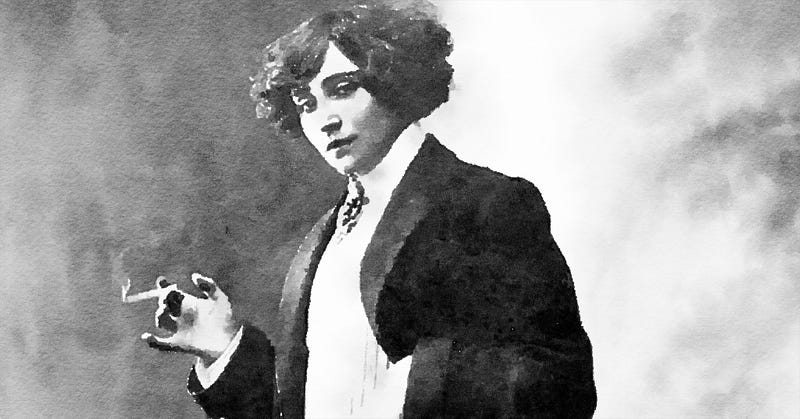
Colette (perhaps 1920s). By Henri Manuel on Wikimedia Commons (public domain).

Sidonie-Gabrielle Colette (1873–1954), or more famously known as Colette, was widely acclaimed during the 1920s to be France’s “greatest woman writer.

In 1948, she was nominated for the Nobel Prize in Literature, losing to T.S. Eliot. Colette is perhaps most well-known for her novella Gigi published in 1944.

But there’s another book I recently discovered, thanks to the research of the always illuminating Maria Popova, a now out-of-print 1975 edition of Earthly Paradise: An Autobiography of Colette Drawn from Her Lifetime Writings.
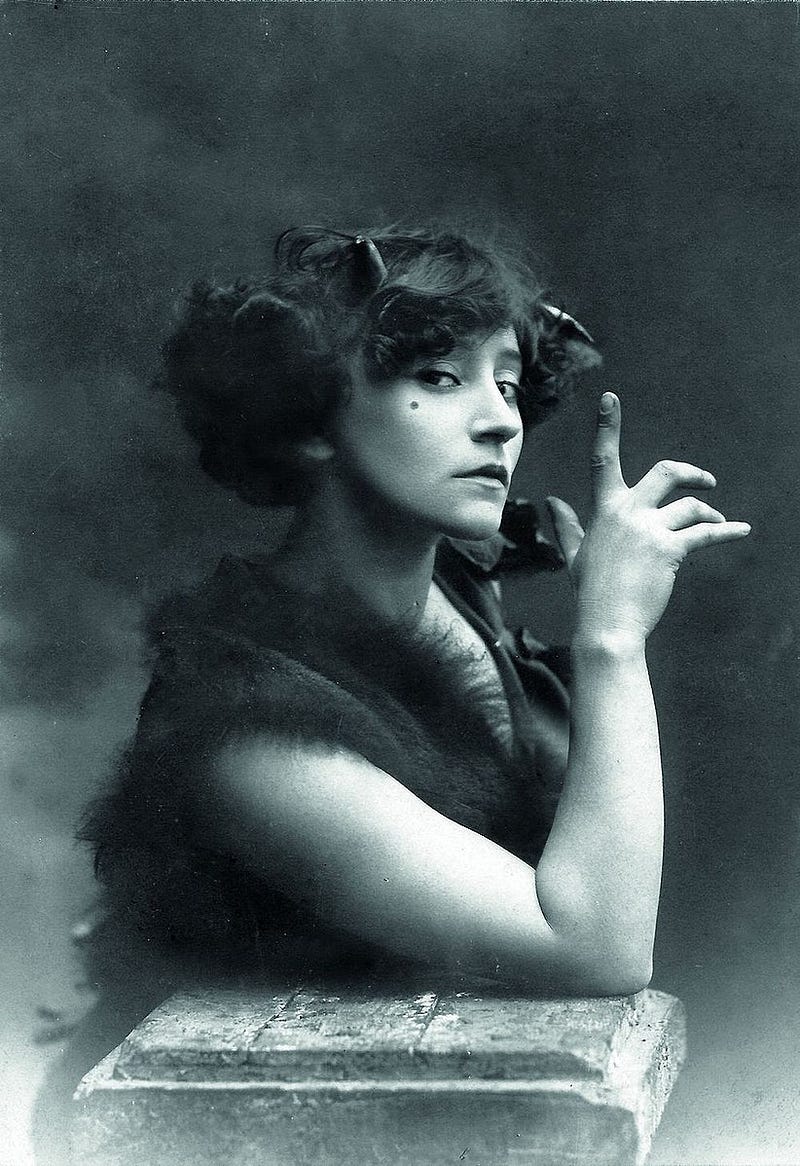
Photographie de Colette, 1910, author unknown on Wikimedia Commons (public domain)

Popova writes that, as “A queer woman amid the conservative and bigoted culture of the early twentieth century, [Colette] tirelessly championed women’s sexual liberation through her art.”

This is probably no more evident than in the Moulin Rouge incident of 1907, recounted in the book Women of the Left Bank: Paris, 1900–1940, by Sheri Benstock:

“On 3 January 1907, the Marquise de Belbeuf and Colette were very nearly arrested for enacting a scene of lesbian love in a pantomime skit at the Moulin Rouge. Entitled Reve d’Egypte, the mime portrayed the awakening of a mummy from her eternal sleep by the kiss of a former lover. The scene incited a near-riot in the theater, making it necessary to call in the police. Further performances of the play were banned…at the request of the marquise’s ex-husband; Colette’s estranged husband lost his position on the newspaper L’Echo de Paris; and the two women were forced to stop living openly together” (pp. 48–49).

Sheri Benstock goes on to argue in her account of the 1907 Moulin Rouge incident that this event was significant for two reasons.

First, “It illustrated the risks of any public announcement of lesbian commitment” in the bigoted and conservative culture of early 20th century Europe.

Second, “The Moulin Rouge scandal also exposed the risks of openly woman-oriented eroticism to working women…Almost overnight, these women lost the allegiance of the aristocracy and upper bourgeoisie that had formerly protected them.”
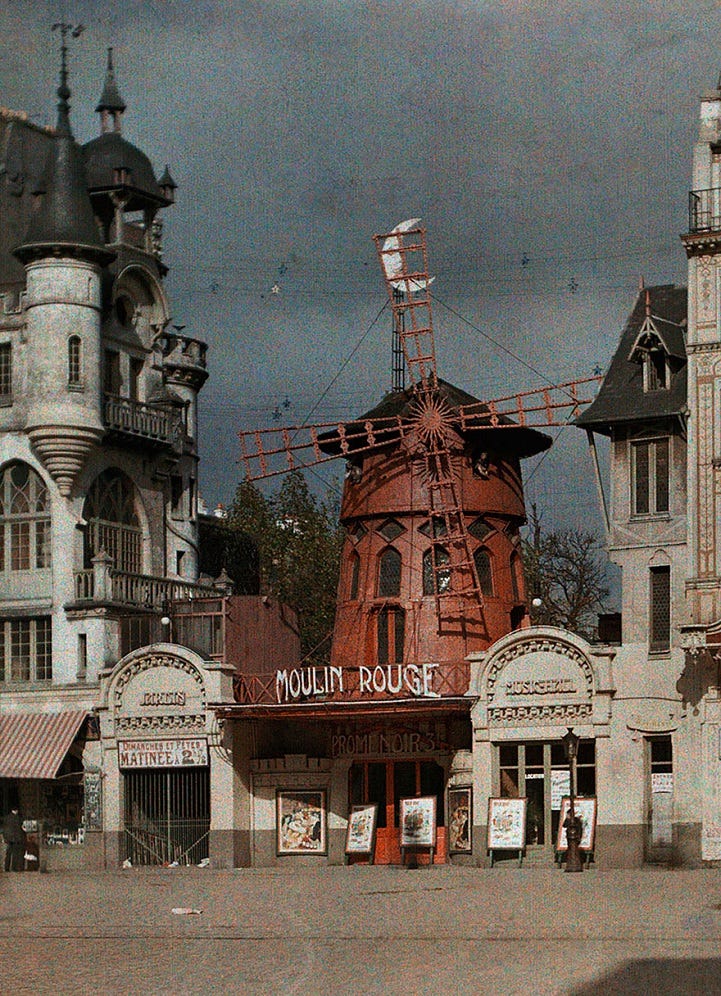
The Moulin Rouge, Paris 1914 before the 1915 fire, in Autochrome Lumière color. By Albert Kahn on Wikimedia Commons (public domain).

Colette on the joys (and pains) of writing by hand

As Robert Phelps writes, in the introduction to his edited collection of Colette’s work, one of her immense writing talents was to bring a vividness to the psychoterratic (psyche + earth) space between the world and our perceptions of it:

“Essentially Colette was a lyric poet, and her basic subject matter was not the world she described so reverently but the drama of her personal relation to the world. Her injunction to those around her was always “Look!” and her own capacity to behold was acute and untiring” (emphasis mine).

When Colette turns her gaze onto the act of writing itself, her intense obsession with what writing is, and what it means to be a writer, is vividly detailed. In particular, as Maria Popova insightfully notes, Colette brings her powers of magnification to an increasingly threatened species of writing: that “creaturely joy of writing by hand.”

I almost always type on my laptop, but for some reason, reading Colette describe the joys and pains of handwriting makes me want to bust out a high-quality fountain pen and start scribbling furiously, writing down everything from a novel to a shopping list:

1. On the meaning of writing

“To write, to be able to write, what does it mean? It means spending long hours dreaming before a white page, scribbling unconsciously, letting your pen play around a blot of ink and nibble at a half-formed word, scratching it, making it bristle with darts, and adorning it with antennae and paws until it loses all resemblance to a legible word and turns into a fantastic insect or a fluttering creature half butterfly, half fairy.”

2. On the obsession of writing

“To write is to sit and stare, hypnotized, at the reflection of the window in the silver inkstand, to feel the divine fever mounting to one’s cheeks and forehead while the hand that writes grows blissfully numb upon the paper.”

3. On the strange feeling after being overtaken by a bout of inspiration

“[Writing] also means idle hours curled up in the hollow of the divan, and then the orgy of inspiration from which one emerges stupefied and aching all over, but already recompensed and laden with treasures that one unloads slowly on to the virgin page in the little round pool of light under the lamp.”

4. On “the impatient god who guides” the hand struggling to write fast enough

“To write is to pour one’s innermost self passionately upon the tempting paper, at such frantic speed that sometimes one’s hand struggles and rebels, overdriven by the impatient god who guides it — and to find, next day, in place of the golden bough that boomed miraculously in that dazzling hour, a withered bramble and a stunted flower.”

Colette on the Landscape of Human Experience

One more idea. As a writer, I’m always curious about how other writers write: what inspires them, how they handle the everyday challenges of putting words on paper, and how the personal experiences they live through shape the many possible worlds they pay attention to.

But as an environmental writer, I’m also curious about how writers invoke the natural world to convey their lived experience of being a two-legged on planet Earth, whether through metaphor, memory, or careful scientific description.

In 1926, Colette published a short story in Vanity Fair called “The Landscape: Another Striking Proof That “Men Have Died Ere This, But Not for Love.”

It might be a dark comedy, or a tragedy, or a story of radical transformation through art. I’m not sure. But I thought the idea of the story was fascinating: a young man paints his inner psychological turmoil as a marshy, barren landscape. In the foreground,

“a single, bare tree, bent beneath the gusting wind like river grass bowing in the current. The main branch, broken yet living, revealed the splintered white sapwood beneath the torn bark . . .”

He thinks to stop at this dreary stage. But he can’t. Adding new detail after new detail, over the course of the day, his landscape is transformed, and so is he:

“He put down his revolver and began painting a gray bird on the main branch of the tree, a songbird which, filled with its song, head raised toward the closed sky, was singing.”
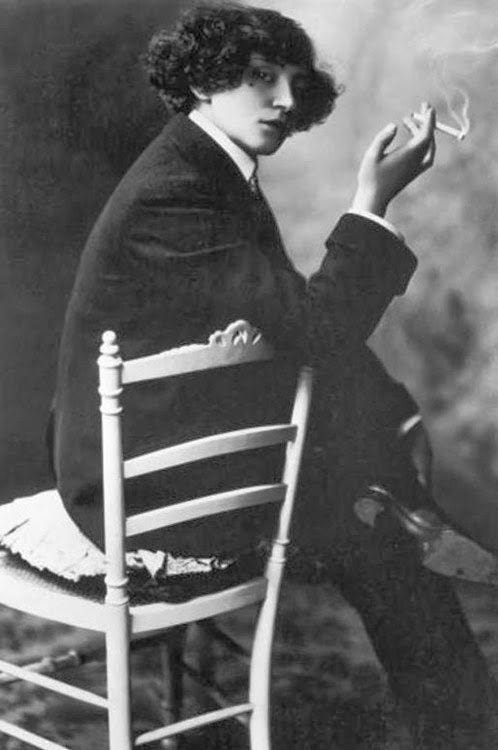
Colette. By Henri Manuel on Wikimedia Commons (Public Domain)
Writing
Books
LGBTQ
Fiction
Storytelling
Recommended from ReadMedium