Film Review — Poor Things
Darkly comic feminist emancipation fable? Allegorical apologia for OnlyFans? Either way, Emma Stone is extraordinary
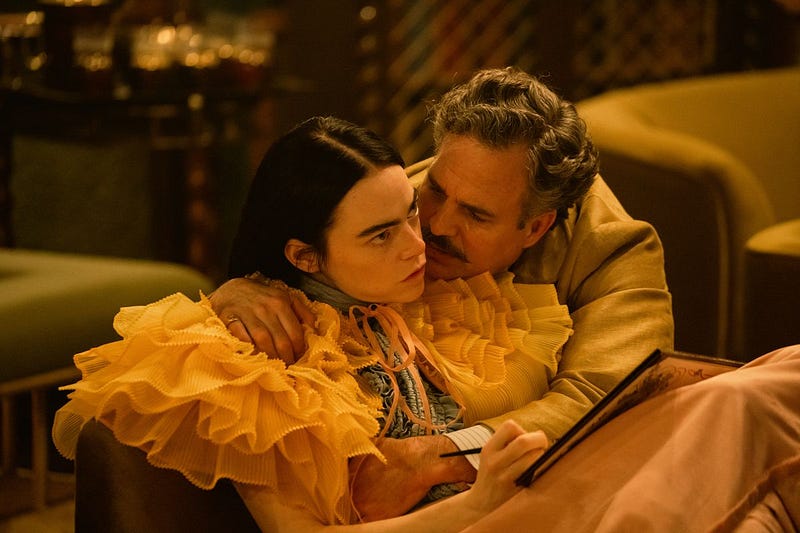
Emma Stone’s performance in Yorgos Lanthimos’s Poor Things is what critics euphemistically term “committed” or “fearless”. Most of the time, that’s code for lots of sex and nudity, and both are plentiful here. Nevertheless, Emma Stone gives a remarkably spirited turn in this satirical science fiction black comedy, adapted from the novel by Alisdair Gray with lashings of extra smut. It’s the kind of demonstrative lead role that could mean an Oscar win for Best Actress.
Essentially a variation on Frankenstein set in a steampunk late Victorian era, this begins with Dr Godwin Baxter (Willem Dafoe) fishing the body of a recently deceased pregnant woman (Stone) out of the river. She’d recently committed suicide for unknown reasons by throwing herself off a bridge. Godwin takes out her brain, replaces it with that of her unborn child, reanimates the corpse, and calls her Bella. When we first see her, she has the mind of a baby, meaning she wanders around breaking things and pees on the floor. But she learns quickly, indulging every sensual whim. Soon she begins a journey of uninhibited sexual discovery, as well as discovery of what the world is really like, good and bad, amid London, Lisbon, Alexandria, Marseille, and Paris.
Various men are drawn to Bella due to her shameless, darkly hilarious shenanigans. Some have purely paternal feelings; Dr Godwin, for instance, whom we learn was castrated and disfigured in his father’s experiments. Despite his father’s horrific behaviour, Dr Godwin seems to bear no ill will, as he states the mutilations were made in the interests of science.
Yet Dr Godwin in his own way seeks to control Bella (she calls him “God”, which can’t be good for his ego). So does Godwin’s kindly, decent, but still product-of-his-time assistant Max McCandles (Ramy Youssef). More blatantly, lawyer Duncan Wedderburn (Mark Ruffalo) starts out as your standard advantage-taking cad and bounder but evolves into a man with a deranged obsession. Other male characters also try to cage her, but I’ll say no more, for fear of spoilers. The point is, men don’t like it when Bella reads, gains intelligence, and becomes increasingly independent. Her behaviour also outrages so-called polite society.
So, a feminist emancipation fable? It rather depends on how you look it at. I can see arguments both for and against the idea. The argument for insists nudity is integral to Bella’s journey of discovery and path to freedom, including sexual freedom. It’s all performance art, and if we don’t get it, we’re simpleton philistine prudes. Probably sexist, misogynist prudes who have a problem with female liberation.
The argument against is more complicated and involves much handwringing over the fact that Lanthimos and his screenwriter Tony McNamara are men, and therefore the so-called “male gaze” is inherent in all the rumpy-pumpy depicted herein. I’m not sure I buy that, but there is a case to be made — especially in a later segment involving Bella working in a Parisian brothel — that the film suggests women should become desensitised to male exploitation and appropriate it for their own ends. A sex-work-is-work argument? An allegorical apologia for OnlyFans? If so, I daresay some will see this as positive. But if you’re of the opinion that selling one’s body isn’t a good idea, or that pornography is an internet scourge poisoning people’s minds, this apparent message is unlikely to sit easily with you.
Nor is the film likely to endear to those squeamish at the prospect of a baby’s brain in an adult body, which does raise a few uncomfortable hang-on-a-minute thoughts concerning potential paedophilic undercurrents. Of course, one can counter that argument with the notion that this is a commentary on patriarchal society condescending women by treating them as infants. However, regardless of the intent, I suspect an unpleasant aftertaste will linger for some viewers.
On a technical level, there is much to admire. Robbie Ryan’s eye-popping cinematography is a highlight, though for heaven’s sake, don’t play a drinking game where you have to take a shot every time a fish-eye lens is used. You’ll be under the table barely minutes in. Art direction, sets, costumes, and visual effects are all striking, and I was often reminded of films by Terry Gilliam. I’ll also add a grudging visual inspiration acknowledgement for Wes Anderson, who isn’t in my good books at present, following the insufferable one-two punch of The French Dispatch (2021) and Asteroid City (2023).
Other films referenced include The Wizard of Oz (1939), since the film goes into colour once Bella starts bonking her way around the world. Lanthimos also tips his hat to Bram Stoker’s Dracula (1992) and various other gothic gems, though this never feels like a horror film. It’s worth adding that the score by Jerskin Fendrix occasionally overdoes the intrusive screeching strings. I daresay that’s the point, but I found it vaguely annoying until the end credits, when I started to take on a new appreciation for the music.
All things considered, I found this a hard film to love. Yes, it’s ravishing and opulent. Yes, the acting is great (including the supporting cast). Yes, it’s got some amusing dark humour and satire amid the insistent prurience. But Poor Things still left me cold. Some will find it too weird and offbeat, though I certainly didn’t have a problem with it for that reason. However, I prefer Lanthimos’s earlier films; The Killing of a Sacred Deer (2017) in particular, which I consider a stunningly disturbing masterpiece.
To end on a positive, the various hybrid animals wandering around Dr Godwin’s home made me laugh in a toys-on-Sid’s-floor kind of way. There’s also no doubting Emma Stone’s extraordinary performance constitutes serious Oscar bait, and the most likely contender to snatch victory from Lily Gladstone for her turn in Killers of the Flower Moon (2023). Still, much as I admire Emma Stone, I prefered watching her in Easy A (2010), Crazy Stupid Love (2011), Birdman (2014), La La Land (2016), Cruella (2021), and almost any of her other films.
The Dillon Empire beyond Medium