Film Review — Killers of the Flower Moon
Both Scorsese’s great muses and Lily Gladstone deliver great performances in this lengthy but masterful adaptation of David Grann’s book
Is Martin Scorsese’s Killers of the Flower Moon as brilliant as critics have claimed? On the whole, I’d say yes, but eyebrows have been raised over the buttock-numbing running time. It’s worth taking into consideration that this is an expensive film, partly funded by the Apple streaming service. Perhaps that is why Scorsese has been given free rein the same way he was by Netflix for The Irishman in 2019. Streaming services are not bound by constraints of television timeslots or concerns about how many screenings can take place per day, so they tend to be relaxed about length.
Is this a good or bad thing for cinematic editorial discipline? There’s certainly a debate to be had around that question. Ridley Scott’s upcoming Napoleon will apparently play in a shorter cut in cinemas before a longer four-hour version turns up on streaming. However, unlike Scott, Scorsese is not one for alternative cuts of his films. There is only ever one version.
Since I’m concerned with cinema exhibition rather than streaming, I will say that at 206 minutes, Killers of the Flower Moon really ought to have an intermission. I’m a big believer in films being as long as they need to be, and in this case, I think the length is justified. However, such bladder-testing durations really ought to come with a comfort break. I’m not sure whether an intermission will exist in other territories, but here in the UK, it appears the film is running uninterrupted. (For my full thoughts on the intermission question, click here.)
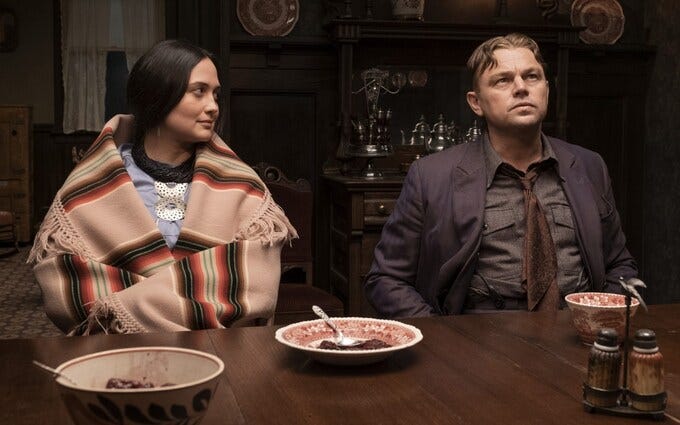
Based on a book by David Grann (which I confess I’ve not read), Killers of the Flower Moon is based on real events that took place during the 1920s in Osage Nation, Oklahoma. Black and white silent film reels illustrate the background history whereby the Native Americans discovered oil on their land, making them immensely rich. Subsequently, white opportunists attempt to insinuate their way into this wealth via manipulation, theft, and eventually murder. In the centre of this intrigue is not-too-bright Ernest Burkhart (Leonardo DiCaprio), returning from World War I (where he served as a cook) to live with his cattle baron uncle William King Hale (Robert De Niro), a man apparently beloved by the Osage community. However, Hale’s emphasis on his name being “King” gives a clear foreshadowing of what is to come.
Ernest takes a romantic interest in Native American Mollie (Lily Gladstone). She is aware of the dollar signs in his eyes, but is nonetheless attracted to him, not begrudging his desire to feel “settled”. Genuine love appears to flourish, despite Ernest’s motives. But over time, the weak-willed, already criminally inclined Ernest is drawn into a murderous conspiracy. Amid the mysterious illnesses, deaths, and violent killings in the Osage community, the government eventually decides to investigate. With the arrival of federal agent Tom White (Jesse Plemons), Ernest’s loyalties are put to the test.
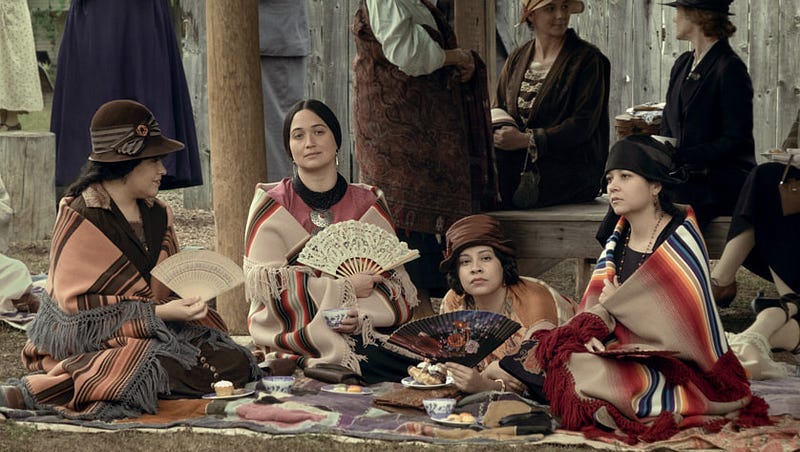
Extensive screenplay rewrites ensued when Scorsese and co-writer Eric Roth became concerned they were “making a movie all about the white guys”. Given how extraordinarily powerful the film feels when the perspective shifts to that of Mollie, I’m pleased they undertook those rewrites. For example, in a tellingly queasy scene, a grief-stricken Mollie in poor health navigates a railway station platform filled with white men staring at her, as she narrates in voiceover. Beyond this, the plight and concerns of the Osage are given prominent screen time, with the BOI investigation rightly pruned to the periphery. The story is much stronger and the sense of outrage far greater as a result.
That isn’t to say the film has been received without criticism from the Osage community. Christopher Cote, an Osage language consultant on the film, whilst generally approving Scorsese’s work, has gone on record with his mixed feelings, stating he wished the film had been told entirely from Mollie’s point of view rather than primarily that of Ernest. At the same time, he conceded it would probably take an Osage director to do that effectively. He goes on to say Scorsese did a good job overall in representing the Osage; making it a film for everyone, not just the Osage, and that the film asks challenging questions about being complacent about racism.
Certainly, complacency over murderous racist greed is the sin of many of the white characters in the film, whether directly implicated in the conspiracy or not. In this area, Scorsese is one of the best directors I know for tackling a theme of this kind without editorialising. With subtle precision, he lets the characters speak for themselves and leaves the audience to judge accordingly.
In that respect, De Niro’s performance as Hale is simply brilliant. He is entirely convincing as a self-deluded man whose conscience seems utterly desensitised to the moral gymnastics of being an apparent friend and ally of the Osage, despite what he reveals in his masonic lodge. His attitudes are further revealed when commenting on other matters of racial disharmony, such as the activities of the Ku Klux Klan. He expresses disapproval not because of the plight of Black people, but rather because he doesn’t want to be personally inconvenienced by the horrific race riots of Tulsa (which we glimpse in a newsreel) in his territory.
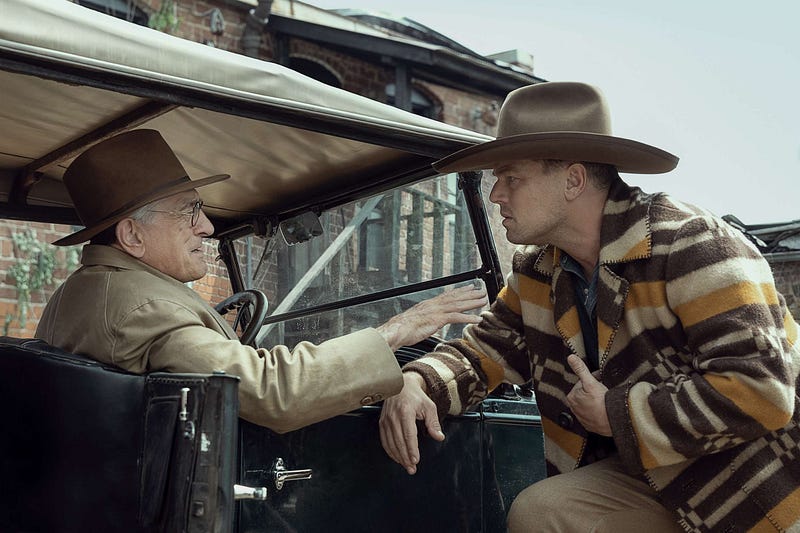
Scorsese’s other great muse, Leonardo DiCaprio, is on equally excellent form. Even his face looks a bit different for this performance, with his mouth seemingly fixed in a permanent downward position. Beyond the physicality, DiCaprio completely embodies his character as a man easily manipulated and intimidated, who struggles even in moments of apparent candour to face the full truth of his actions. It’s a remarkable turn and one that rates among DiCaprio’s finest.
Lily Gladstone also delivers a stand-out performance as a complex character of great inward strength and moral courage, who suffers physically (her character has diabetes, of which there seems to be an epidemic among the Osage). Her chemistry with DiCaprio is completely convincing, and her character is also imbued with a clear-eyed humour that greatly endears her to the viewer. Scorsese praised Gladstone’s performance as having “a fierceness and serenity at the same time. And it’s encased in this intelligence — the eyes say it all”.
Directorially, Scorsese’s work here is outstanding. His use of high vantage point epic vistas — depicting oil fields, cattle land, and tribal rituals — cries out for the big screen, so do see this in the cinema rather than on streaming. But he is no less assured in the smaller moments, with this feeling both epic and intimate. The film is never overly flamboyant, always allowing the drama to take centre stage.
Scorsese is well-served by the contributions of cinematographer Rodrigo Prieto, composer Robbie Robertson, and long-time collaborator Thelma Schoonmaker, on editorial duties. The supporting cast is strong too, including Tantoo Cardinal as Mollie’s mother, Cara Jade Myers, JaNae Collins, and Jillian Dion as Mollie’s sisters, William Belleau as Mollie’s (understandably) depressed first husband, as well as Brendan Fraser and John Lithgow, who turn up in minor roles. And of course, Jesse Plemons is on reliably good form.
Do I have any criticisms at all? Well, I must confess I wasn’t convinced by the whimsical epilogue, which for me veered into smug Wes Anderson territory. I felt it undermined the seriousness of the ending. Still, it’s a minor nit in a masterful piece of work that otherwise comes with my highest recommendation. Again, I’d urge seeing it in the cinema, but unless there’s an intermission, don’t buy drinks.
The Dillon Empire beyond Medium