Film Review — The French Dispatch
Wes Anderson’s latest will delight the faithful but test the patience of those unconverted to his particular brand of quirk.
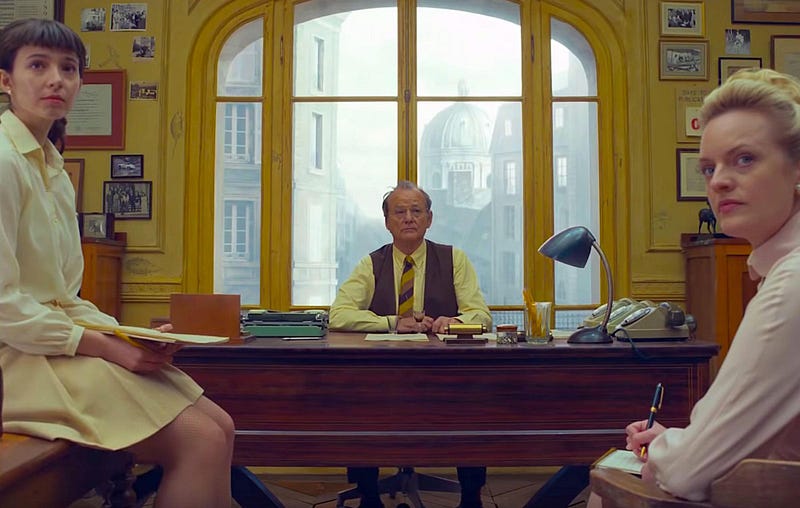
How much quirk can you endure from Wes Anderson until it all becomes just a tad insufferable? That’s the question at the heart of The French Dispatch, as far as I’m concerned. It is likely to appeal to hardcore Anderson disciples, but more general viewers may find themselves emerging with quirk exhaustion. For all its sublime artistry at a technical level, The French Dispatch is, dare I say, just a tiny bit exasperating.
Outwardly a love letter to the eponymous, now defunct literary supplement of a fictional Kansas newspaper, the film is in fact inspired by The New Yorker, its co-founder Harold Ross, and various journalists that have featured therein. The viewer is informed issues of The French Dispatch typically contained an obituary, a travel piece, and three features. The film is structured in the same way, with each of the journalist characters relating their various contributions which are visualised in a mixture of aspect ratios and directorial styles, leaping from colour to monochrome and back again, and even occasionally breaking into animation. There’s a decidedly Anderson-esque mixture of bravura camerawork, tableaux vivant, and static wide shots allowing the eye to travel all around the carefully designed frame.
Each of the stories is interspersed with comments from the editor Arthur Howitzer Jr (Bill Murray). Initially, he provides feedback on a travel column by Herbsaint Sazerac (Owen Wilson), concerned it may be too seedy for decent people. His advice to all his journalists, whom he greatly admires, is: “Try and make it sound like you wrote it that way on purpose”.
After that, we get into the meat of the film: The three features. In the first of these stories, imprisoned artist Moses Rosenthaler (Benecio Del Toro) finds a new muse in the form of prison guard Simone (Lea Seydoux), with whom he begins a sexual relationship. She poses nude for his modern art pieces, which attracts the attention of rich collector Julian Cadazio (Adrien Brody). Complicating matters further, the entire story is delivered as an art lecture, by JKL Beresen (Tilda Swinton).
The second story concerns Lucinda Krementz (Frances McDormand), who covers a story about a student uprising involving Zeffirelli (Timothee Chalamet) and Juliette (Lyna Khoudri). The third story involves author Roebuck Wright (Jeffrey Wright), who can recall every word he has ever written. Challenged on a TV programme into proving this, he recounts a kidnapping story that also involves haute cuisine and obscure metaphors about the loneliness of being a closet homosexual.
In this film, Anderson takes his auteur certificate and shoves it in your face, to the point that it becomes an almost infuriatingly arch distraction. As a result, for me, this falls short of top-tier Anderson. It is well-acted by a fine ensemble, and looks fabulous, but it lacks the bittersweet poignancy of Moonrise Kingdom, or the tragic, humane pathos of The Grand Budapest Hotel. Instead, The French Dispatch feels like much ado about nothing. All very well put together, but ultimately hollow. Yes, I get it, Wes. You like The New Yorker. So what?
This article was originally published at Simon Dillon Books. For more about me and my writing on Medium, please click here. For a list of my published novels and other works, please click here.