
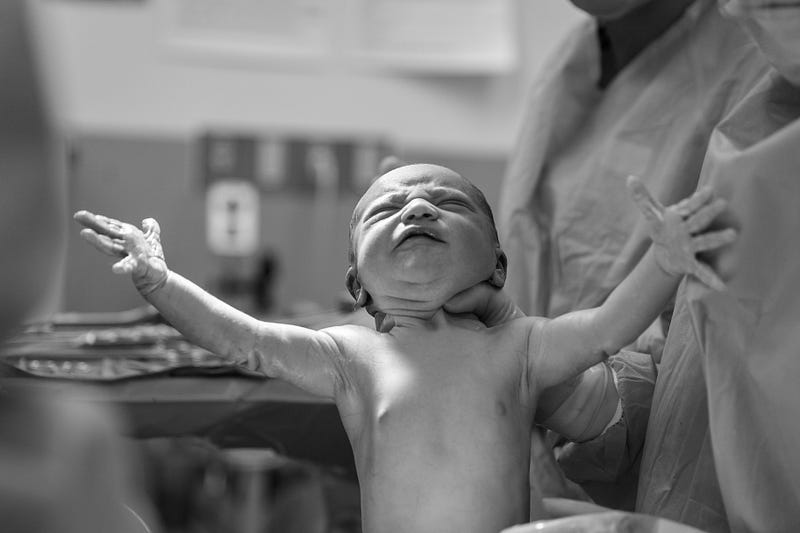
Fetal Microbiomes Are a Myth
New research shows that babies and prenatal fetuses don’t arrive with a pre-established microbiome.
At least not in their gut or anywhere else that we know of.
During the last several years, microbiome researchers have been debating whether or not bacteria were capable of establishing a microbiome in pre-natal human fetuses.
One side argued they did and the other argued they didn’t.
If they did, then how could this come about?
If they didn’t, what is preventing this from coming about?
The idea that newborn babies came packaged with a microbiome from their Mothers was not too crazy to assume, right?
Mom has a microbiome.
Dad has a microbiome.
Mom and Dad made the baby so the baby must have gotten a microbiome!
That sounds reasonable but scientists never assume something is true just because it sounds reasonable.
No matter how sensible it might seem to us lay people.
In order to be an actual “fact”, it has to be proven to be true in enough instances that all major doubt is removed and the finding is accepted as truth.
So let’s look at why one group of scientists thought they had established the truth of that.
And then we can look at how another group of scientists recently came together to question this “knowledge” and ultimately disprove it.
What it comes down to are the different ways in which the two sides approached the topic.
I’m particularly interested in how these lines of thought and research methods led to different conclusions.
Because that’s how science works. Test, retest, test, retest etc. And why, ultimately, most of us trust scientists and the data they publish.
What we already knew (or thought we did)
The original assumption for many years was that Mom’s intrauterine environment- the placenta, amniotic fluid and fetus- didn’t have any living microbes present.
It was generally thought that the mother’s and the developing fetus’ immune systems would prevent and destroy that kind of invasion.
But we already knew that certain viruses and bacteria can pass through the placenta and infect the baby while it is still developing in the uterus. Some of the more common ones include HIV, Group B Streptococcus, Listeria, Syphilis, Hepatitis B, and Rubella. In fact, this is common enough that these types of infections are called vertical transmissions.
These infections can lead to serious medical problems including sepsis, dysentery, pneumonia and meningitis to name a few.
This is why it is so important to monitor the mother’s health with prenatal screening tests during pregnancy. If an infection is detected and identified, intervention including vaccinations and antibiotic treatments can prevent newborns from being infected and keep both mothers and babies healthy.
Healthy moms = healthy babies!
So it was a bit of a surprise when independent studies from different labs published in 2019 and 2020, presented data that indicated the presence of microorganisms associated with unborn fetuses in both humans and mice.
How did they do this? Here’s what each of these studies did:
- “…used a combination of bacterial DNA sequencing, fluorescence in situ hybridization (FISH), and bacterial culture to determine the presence and viability of the fetal microbiota throughout gestation.” (Source reference # 1- Rak)
- “…profiled microbes across fetal organs using 16S rRNA gene sequencing and detected low but consistent microbial signal in fetal gut, skin, placenta, and lungs in the 2nd trimester of gestation…using SEM and RNA-ISH, we visualized discrete localization of bacteria-like structures and eubacterial-RNA within 14th weeks fetal gut lumen.” (Source reference # 2- Mish)
- “A population-based cohort of placental specimens collected under sterile conditions from 320 subjects with extensive clinical data was established for comparative 16S ribosomal DNA–based and whole-genome sequencing studies.” This study did not detect any microbes by 16S rRNA sequencing but further testing found bacterial metabolites in fetal intestinal samples. (Source reference # 3- Li)
- “Bacteria-like morphology was identified in pockets of human fetal meconium at mid-gestation by scanning electron microscopy (n = 4), and a sparse bacterial signal was detected by 16S rRNA sequencing…” (Source reference # 4- Kennedy)
You may notice that in 3 of these studies, they performed sequencing of a gene called the 16S rRNA gene. This gene is found in all bacteria, is responsible for making a very specific essential compound, and its sequence differs slightly in each bacterial species. So it lets them detect whether bacteria are present and if so, which ones they are.
So here we have 3 published studies claiming bacteria associated with the fetus both before and after birth.
Three different studies.
What could they all possibly have done incorrectly if the new study we’re featuring in this article is to be trusted?
A different lens
Sometimes when I’m looking at the world through my glasses, things start looking out of focus or blurry. Then I know it’s time to clean my lenses.
I think this is a good way of thinking about the new study that says there is no microbiome associated with the fetus or the newborn baby.
The 3 previous studies asserting that there was a microbiome in the fetus asked the same question; can we isolate or detect bacteria in samples taken directly from the fetus?
The new study took a completely different approach. Rather than using a sequencing lens to see if there were any microbes present, they used an immunology lens.
Immunology predicts the immune systems of both the mother and the developing infant should prevent any foreign organisms from growing in the womb or the newborn.
If that were the case, then a microbiome would only begin to show up once the baby was exposed to the outside world and began ingesting food that contained microorganisms.
If the human placenta and amniotic fluid were normally colonized by bacteria, this would “have serious implications for clinical medicine and pediatrics and would undermine established principles in immunology and reproductive biology.”
Jens Walter, professor of microbiology at University College Cork, Ireland and principal investigator at APC Microbiome Ireland, assembled a trans-disciplinary team of 46 experts to examine this question.
Their results were published in an article in Nature entitled “Questioning the Fetal Microbiome Illustrates Pit-falls of Low-biomass Microbial Studies”. Interestingly, the lead author of this report was also the lead author for study #4 referred to above. (and we’ll get into what Low-biomass studies are below)
They looked at it by examining many different possibilities:
- reproductive biology
- microbial ecology
- bioinformatics
- immunology
- clinical microbiology
- and gnotobiology — the study of germ-free plants and animals, as well as living things in which specific microorganisms, added by experimental methods, are known to be present.
What they found was that all the microorganisms previously reported were due to contamination of the samples as they were removed from the womb!
Our analysis indicates that the detected microbial signals are likely the result of contamination during the clinical procedures to obtain fetal samples or during DNA extraction and DNA sequencing.
Whoa!
So how did they do this and why should we trust their results?
How could this happen?
The one thing all scientists try rigorously to protect against in these kinds of experiments is faulty data due to contamination. All kinds of sterilization decontamination methods and negative controls are employed to prevent this.
Nonetheless, the team identified three specific areas of contamination; (i) clinical procedures, (ii) laboratory analysis and (iii) vaginal delivery.
How did they do this?
Checking methods
Okay, let’s start with some simple basics.
The fetus develops in this sac called the amnion and the amnion is made up of two independent layers of cells and filled with a fluid. That means any microbe that would enter the fetus would have to pass through those membranes and the fluid to enter and colonize it. On top of that, the amniotic fluid includes several compounds with anti-microbial properties that further prevent microbes from circumventing it.
So that leaves us with the placenta as the possible conduit for transmitting microbes to the fetus to establish a microbiome.
What is the likelihood of that?
Remember, we already noted above that certain microbes could infect the placenta and gain access to the fetus. But these were not friendly beasties!
And the microbiome, by definition, is non-pathogenic. Symbiotic. Friendly. Mutually beneficial.
In Kennedy’s words;
…the ability of specific pathogens to colonize and/or infect the placenta is distinct from the presence of an indigenous microbiota — that is, a prevalently stable, non-pathogenic, complex microbial community that is metabolically active.
So what about all that 16S rRNA sequencing that positively identified microbes?
Kennedy’s team looked very closely at how the samples in the previous papers were obtained and processed. Here’s what they found.
- the study by Mishra obtained second-trimester fetal tissue samples after a drug-induced pregnancy termination procedure that often causes the fetal membranes to rupture hours before vaginal delivery. This also extends the labour period and leads to infections and fever.
- Rackaityte and Li also used second-trimester terminations. In Li’s study, the delivery was completed by mechanical dilation. Rackaityte’s study failed to indicate whether the termination was drug-induced or via mechanical dilation. Both studies used samples obtained from core facilities. So they did not collect the samples directly from the patients.
- In all cases, the actual amount of sample present was very small, hence the “low biomass” assignation to the samples.
To take you through the minute details would be TMI. If you want that kind of info, do read the paper.
The bottom line is that when they looked at the composition of the purported fetal microbiomes and how and where the samples were obtained, they were able to show that the microbes identified were, in fact, contaminants that came from the sampling procedures.
They also did statistical analyses of all the data to further support these claims.
In Summary
Listen.
This article is not to bad-mouth the scientists’ work who previously claimed to have discovered a fetal microbiome.
Rather, it is to enforce the idea that science is a give-and-take venture and unless the data can be replicated, we need to question whether it is true or not. And that’s not always easy to determine.
Unconscious biases often slip in unbeknownst and the “lens” you look through can limit what you see.
That’s why in science we often say the data or results fit a “model” that we have come up with. And the model will often have to be adjusted as new data is obtained and old data retested.
Like when people thought the Earth was flat, and the sun revolved around the Earth.
A healthy skepticism. And lots of measuring. LOTs of measuring!
And that’s a very good thing.
There are many things that have been scientifically proven beyond a reasonable doubt; the existence of climate change, the disappearance of species, the ecological interplay of organisms required to sustain a healthy environment over millennia and so on...
To go back to Kennedy’s paper,
They warn us that
The pursuit of a fetal microbiome serves as a cautionary example of the challenges of sequence-based microbiome studies when biomass is low or absent, and emphasizes the need for a trans-disciplinary approach that goes beyond contamination controls by also incorporating biological, ecological and mechanistic concepts.
[Bolding is my addition]
The authors also provide methods and suggestions for how to avoid these pitfalls in future microbiome studies where low-biomass sampling is used.
I hope you enjoyed this venture into how science often works and moves forward, in fits and starts.
I did!
And I’d love to hear any comments you care to share.
Until next time,
Rich
Some other microbiome articles I published on Medium:
If you’d like to get Biology4Everyone updates, sign up here. They come out every few weeks. The newsletter also has short naturalist pieces, photographs and reading suggestions.
Sources:
- Viable bacterial colonization is highly limited in the human intestine in utero by E. Rackaityte et al., in Nature Medicine, (Feb 2020)
- Microbial exposure during early human development primes fetal immune cells by A. Mishra et al., in Cell, (Jun 2021)
- In utero human intestine harbors unique metabolome, including bacterial metabolites by Y. Li et al., in the Journal of Clinical Investigation, (Oct 2020)
- Fetal meconium does not have a detectable microbiota before birth by K. Kennedy et al., in Nature Microbiology, (May 2021)
- Fetal Microbiome Existence Refuted by Team of Experts in GEN, (Apr 2023)
- Questioning the Fetal Microbiome Illustrates Pit-falls of Low-biomass Microbial Studies by Katherine M. Kennedy et al., in Nature, (Jan 2023)


