avatarManasi Kudtarkar

Free AI web copilot to create summaries, insights and extended knowledge, download it at here

2992

Abstract

message">The moon is known to have a profound effect on human physiology and consciousness</a>. The cycles of the moon determine the nature of women’s bodies, and since we’re all born of our mothers’ wombs, our bodies and mind are governed by the moon, irrespective of our genders.</p><p id="ba9c">Ugadi falls on the first day of the waxing moon after the first new moon, post the spring <a href="https://en.wikipedia.org/wiki/Equinox">equinox</a>, in the month of <a href="https://readmedium.com/festivals-of-india-a-sneak-peek-f5e96f18b4cb">Chaitra</a> (refer to the table below). The tilt of our planet positions the northern hemisphere (and especially the equator) to receive the highest amount of the Sun’s energy during the 21-day period that starts from this day. This is the time when the earth’s batteries, per se, are re-charged.</p><p id="3e7e"><i>So, Ugadi or Gudi Padwa heralds a new beginning for our planet and for us. It is the time to renew, re-invent, re-energize, rejuvenate our body, mind, soul, as well as the intrinsic physical aspects of nature such as soil, water, and air.</i></p><p id="9b2c" type="7">Any life form — from plants to animals to humans — can fully flourish only if it is in sync with nature. — Sadhguru, A Mystic of India and founder of Isha Yoga.</p><p id="d103">If we look at the Gregorian calendar, Ugadi falls around late March, which is also the time temperatures in the northern hemisphere, and especially the Indian sub-continent, start soaring. In preparation of the heat waves that follow, it is customary to apply cooling oils such as castor oil on the body before showering, during this time.</p><figure id="c64d"><img src="https://cdn-images-1.readmedium.com/v2/resize:fit:800/1*lzDH_jnHrgD5Ka3PJ7HpzA.jpeg"><figcaption>A comparison of the Hindu calendar months and Gregorian months, Image by Author</figcaption></figure><h1 id="17b5">Gudi Padwa</h1><figure id="fc58"><img src="https://cdn-images-1.readmedium.com/v2/resize:fit:800/1*Z244pM_ztspi1cAjv1nnhw.jpeg"><figcaption>Source: Wikimedia Commons</figcaption></figure><p id="06b2">A ubiquitous sight on Gudi Padwa, in Maharashtra, is the Gudis hung outside every door. A Gudi means a Kalash (copper utensil used to hold water) hung upside-down on a wooden rod.</p><p id="9eaf">A Kalash is usually always kept upright, it is turned upside-down only on someone’s death when the water from the Kalash is sprinkled around the dead body, and the Kalash is placed upside-down behind the body, <i>as a symbol of the soul leaving the body. It indicates an end.</i></p><p id="4130">But on the day of Gudi Padwa, the Kalash is hung upside down for an entirely different reason. The upside-down position of the Kalash reminds people to purge their minds of all the baggage they carry from the previous year. <a href="https://www.youtube.com/watch?v=7ZrUBFl4tMI">It indicates that life will still go on, but in the new year, we must start afresh</a>. A cloth is tied to the bottom of the Kalash, al

Options

ong with a garland, and mango and neem leaves (neem or Indian lilac is a tree native to India).</p><p id="c220">The neem, though bitter, has immunity boosting, healing, and medicinal properties; the luscious mango fruit, on the other hand, is delightfully sweet (called the king of fruits in India). The mango and neem leaves (one sweet, the other bitter) indicate that life is replete with sweet and sour moments; we must take both in our stride and go on with our lives.</p><p id="0d17">The Gudi is worshipped on this day with an aarti (aarti is performed by placing a small lamp or ‘diya’ with a burning flame in a metal plate and rotating it clockwise in front of the object whose aarti is being done). A red dot is applied with kumkum (a powder made of turmeric and lime, used for religious markings in India). The Kalash is removed before sunset, and from the next day onwards, always kept upright until the next Gudi Padwa.</p><h1 id="0c8b">Chaitra Navaratri</h1><p id="9dbe">In the north of India, the first day of the new year commences the Chaitra Navratri (lit. nine days) festival. As the name suggests, it is a nine-day celebration of the Goddess Shakti (Divine Feminine) and her various forms.</p><p id="d811">All these traditions urge us to start the new year with a clean slate. <i>Forget the past and embrace the future with new gusto, new energy, and new hope!</i></p><p id="a170">If you like this article, you might also like these.</p><div id="2366" class="link-block"> <a href="https://readmedium.com/festivals-of-india-a-sneak-peek-f5e96f18b4cb"> <div> <div> <h2>Festivals of India — A Sneak Peek</h2> <div><h3>A brief history and an overview of the multitudes of festivals celebrated in India.</h3></div> <div><p>medium.com</p></div> </div> <div> <div style="background-image: url(https://miro.readmedium.com/v2/resize:fit:320/1*1HM_vyitKqDanwkjSJtmxQ.jpeg)"></div> </div> </div> </a> </div><div id="aee3" class="link-block"> <a href="https://readmedium.com/festivals-of-india-lets-bond-over-raksha-bandhan-4b8502391f12"> <div> <div> <h2>Festivals of India — Let’s bond over Raksha Bandhan</h2> <div><h3>A tribute to the bond of love between siblings.</h3></div> <div><p>medium.com</p></div> </div> <div> <div style="background-image: url(https://miro.readmedium.com/v2/resize:fit:320/1*XzZMko2vyFApELfJekm1MQ.jpeg)"></div> </div> </div> </a> </div><p id="5b39"><a href="https://exciting-teacher-6474.ck.page/912886dc82">Keep in touch, friends</a>.</p><p id="1b95"><b><i>Thoughts and Ideas is also now on substack! <a href="http://thoughtsandideas.substack.com/">thoughtsandideas.substack.com</a></i></b></p></article></body>

Festivals of India — Let’s Start With The New Year’s Day

Hint: It’s not on the 1st of January!

Photo by Annie Spratt on Unsplash

“Today is not the new year’s day! New year’s day is on the 1st of January, duh”, remarked my sister agitatedly. “Of course, today is new year’s day, and you’re the duh,” I retorted, a little miffed at her condescension.

“How much do you wanna bet?” she challenged me. “Ten bucks?” I asked hesitantly. Our pocket money during those innocent childhood days, though sufficient, was surely not meant to be splurged on whimsical bets. But I was confident of winning; I could gamble ten bucks, I thought. “Done,” she exclaimed as we both rushed to the only person who could settle the bet for us.

Grandma was busy preparing some special food whose aroma came wafting towards us as we entered the kitchen. “Grandma, please tell Riya that today is the first day of the new year,” I said as Riya rolled her eyes and muttered “Duh” and replied, “No, Grams, you, please tell her it’s not.” Grandma looked at both of us, amused, and replied, “Well, Riya, you are right!”. My jaw hit the floor, but before I could retort, Grams said, “But, Madhu is correct too.”

Now it was Riya’s turn to be shocked. Grandma went on, “the 1st of January is celebrated as new year’s day all over the world, including India, these days. But the ancients of India had bestowed this honor on what we call Ugadi or Gudi Padwa. It’s the first day of our Indian Hindu calendar, which is today. Why do you think I’m making your favorite sweets today?”. The sight and fragrance of those sweet delicacies made Riya and my mouth water, and we forgot all about our little bet.

Ugadi

The first day of the Indian Hindu calendar is famously known as Ugadi in the south of India, Gudi Padwa in Maharashtra (a state on the west coast of India, whose capital city is Mumbai). This day also marks the commencement of Chaitra Navaratri in north India.

The Indian Hindu calendar differs significantly from the Gregorian calendar in that it does more justice to the phases of the moon in relation to earth’s rotation around the Sun, unlike the Gregorian calendar, which is entirely partial to the latter. That’s why the Indian Hindu calendar is referred to as a lunisolar calendar.

The moon is known to have a profound effect on human physiology and consciousness. The cycles of the moon determine the nature of women’s bodies, and since we’re all born of our mothers’ wombs, our bodies and mind are governed by the moon, irrespective of our genders.

Ugadi falls on the first day of the waxing moon after the first new moon, post the spring equinox, in the month of Chaitra (refer to the table below). The tilt of our planet positions the northern hemisphere (and especially the equator) to receive the highest amount of the Sun’s energy during the 21-day period that starts from this day. This is the time when the earth’s batteries, per se, are re-charged.

So, Ugadi or Gudi Padwa heralds a new beginning for our planet and for us. It is the time to renew, re-invent, re-energize, rejuvenate our body, mind, soul, as well as the intrinsic physical aspects of nature such as soil, water, and air.

Any life form — from plants to animals to humans — can fully flourish only if it is in sync with nature. — Sadhguru, A Mystic of India and founder of Isha Yoga.

If we look at the Gregorian calendar, Ugadi falls around late March, which is also the time temperatures in the northern hemisphere, and especially the Indian sub-continent, start soaring. In preparation of the heat waves that follow, it is customary to apply cooling oils such as castor oil on the body before showering, during this time.
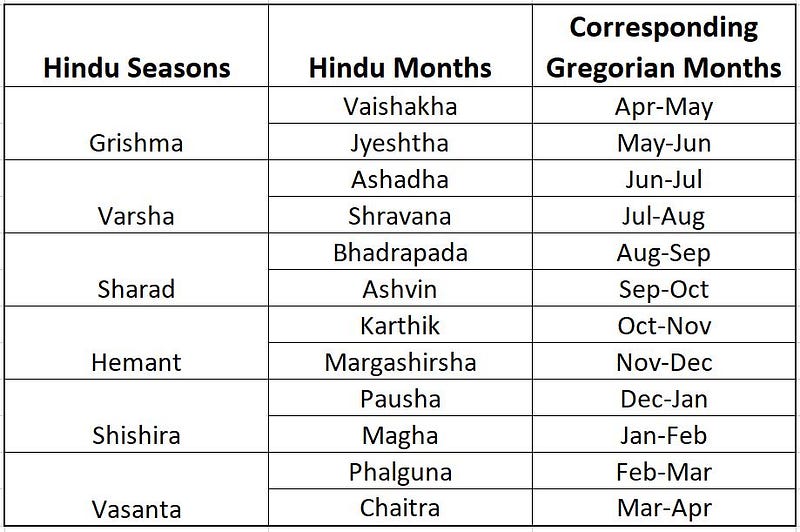
A comparison of the Hindu calendar months and Gregorian months, Image by Author

Gudi Padwa

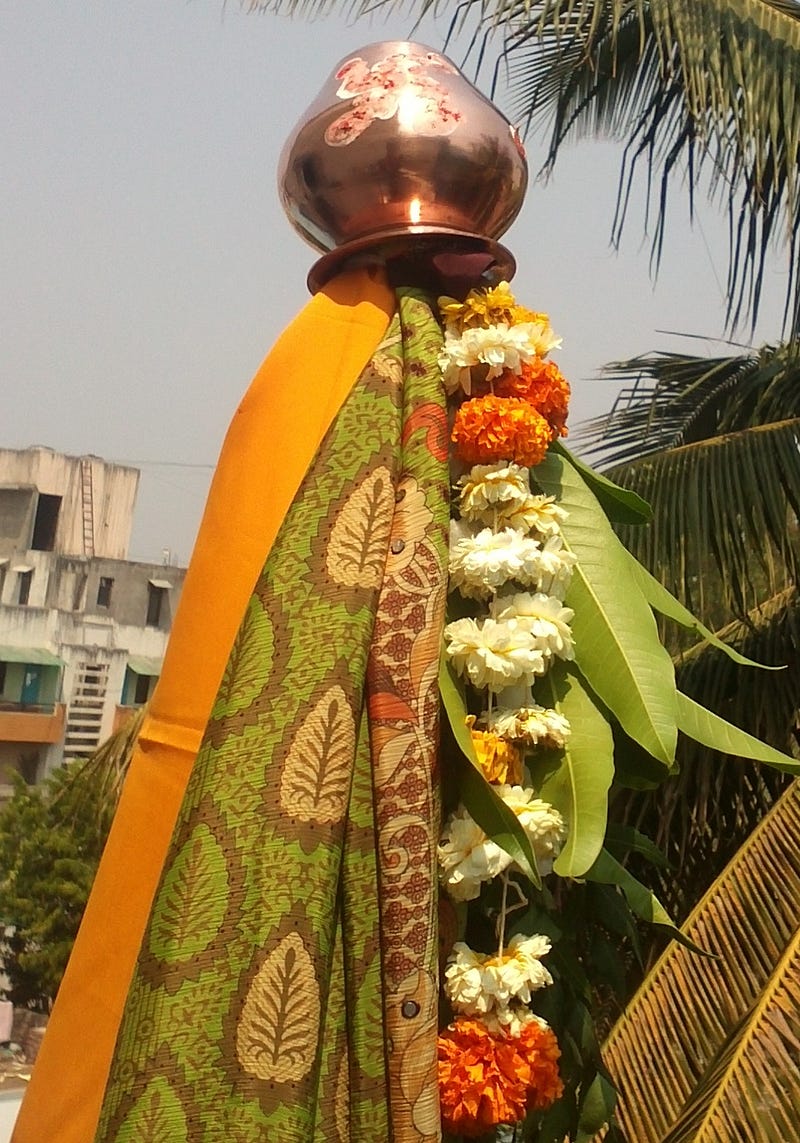
Source: Wikimedia Commons

A ubiquitous sight on Gudi Padwa, in Maharashtra, is the Gudis hung outside every door. A Gudi means a Kalash (copper utensil used to hold water) hung upside-down on a wooden rod.

A Kalash is usually always kept upright, it is turned upside-down only on someone’s death when the water from the Kalash is sprinkled around the dead body, and the Kalash is placed upside-down behind the body, as a symbol of the soul leaving the body. It indicates an end.

But on the day of Gudi Padwa, the Kalash is hung upside down for an entirely different reason. The upside-down position of the Kalash reminds people to purge their minds of all the baggage they carry from the previous year. It indicates that life will still go on, but in the new year, we must start afresh. A cloth is tied to the bottom of the Kalash, along with a garland, and mango and neem leaves (neem or Indian lilac is a tree native to India).

The neem, though bitter, has immunity boosting, healing, and medicinal properties; the luscious mango fruit, on the other hand, is delightfully sweet (called the king of fruits in India). The mango and neem leaves (one sweet, the other bitter) indicate that life is replete with sweet and sour moments; we must take both in our stride and go on with our lives.

The Gudi is worshipped on this day with an aarti (aarti is performed by placing a small lamp or ‘diya’ with a burning flame in a metal plate and rotating it clockwise in front of the object whose aarti is being done). A red dot is applied with kumkum (a powder made of turmeric and lime, used for religious markings in India). The Kalash is removed before sunset, and from the next day onwards, always kept upright until the next Gudi Padwa.

Chaitra Navaratri

In the north of India, the first day of the new year commences the Chaitra Navratri (lit. nine days) festival. As the name suggests, it is a nine-day celebration of the Goddess Shakti (Divine Feminine) and her various forms.

All these traditions urge us to start the new year with a clean slate. Forget the past and embrace the future with new gusto, new energy, and new hope!

If you like this article, you might also like these.

Keep in touch, friends.

Thoughts and Ideas is also now on substack! thoughtsandideas.substack.com

Culture
India
Ninjabyob
Traditions Around World
History
Recommended from ReadMedium