
Festivals of India — Let’s Bond over Raksha Bandhan
A tribute to the bond of love between siblings.
India is the quintessential land of festivals. The full moon day in the Indian month of Shravana is celebrated all over India and by countless Indians across the globe as Raksha Bandhan (‘Raksha’ means protection and ‘Bandhan’ means a bond, literally translating to a ‘bond of protection’). Let’s find out why.
Indra’s War
A sense of dread and apprehension filled Indra’s heart to the very brim. The intense battle between the Gods and the Asuras (demons) had perpetuated for more than a decade-twelve years to be precise. Alas, Indra lost the battle and his capital city of Amravati to the evil forces of the demons. Indra, the God of War himself. Indra, the God of Gods, of the heavens, of lightning and thunderstorms, of rivers and rain. Indra, the great!
Beset with misfortunes, he approached the one he could always turn to; his Guru (lit. spiritual teacher, translates to “dispeller of darkness” from gu, “darkness,” and ru, “that which dispels” from Sanskrit).
Indra pleaded with his Guru, Brihaspati, for counsel. Brihaspati advised performing a ritual of Raksha Vidhan (lit. statute of protection). On the day of Purnima in the month of Shravana, Brihaspati performed the said ritual chanting a powerful mantra (Sanskrit incantation, that has spiritual a significance and the power to effect changes in one’s consciousness or even the consciousness of the Universe in case of some ultra-potent mantras).
During the ritual, a Raksha potli (means bundle) was fortified with the powerful spell of the mantra. Sachi, Indra’s wife, tied that potli (like an amulet) around Indra’s wrist, and bid him adieu as he left for the battlefield, once again. This time around, Indra was more energized by the power of the amulet. Because it was no ordinary amulet; it was sacred, magical and the most powerful tool in Indra’s arsenal. It offered him complete protection from the attacks of the asuras (demons). He might have lost the battles, but the protection of amulet won him the war!
The sacred amulet became symbolic of protecting the wearer, and a tradition was born for all of posterity to celebrate. It is called Raksha Bandhan. Since it falls on the first full moon day (Purnima), Raksha Bandhan is, sometimes, also called as Rakhi Purnima.
A Divine Brother-Sister Bond
According to the epic lore of Mahabharata, Lord Krishna once accidentally cut his finger. Everyone present at the scene ran helter-skelter in search of a bandage to assuage the Lord’s pain. Everyone except Draupadi, who was standing nearby and saw her beloved brother’s bleeding finger. Without the slightest hesitation, she tore off a piece of her expensive saree (a traditional Indian outfit worn by women) and tied it around Krishna’s finger.
Though Krishna and Draupadi weren’t a real brother and sister duo, they considered each other as such and shared a strong bond of love. Krishna was so touched by her devotion and love that he gave her a promise that he would always protect her, whenever she would call to him in distress.
During one of the pivotal turning points of the epic Mahabharata, Draupadi found herself in dire straits after being lost in a game of dice by her husband Yudhishtira to his evil cousin Duryodhana. She was dishonourably dragged to the royal court by Duryodhana’s younger brother Dushasana. In one of the most deplorable incidents in this tale, which is not lacking in pathos, Dushasana started disrobing Draupadi. Finding herself in a hapless dilemma, Draupadi prayed fervently to Lord Krishna. Krishna heeded her desperate pleas and made her saree infinitely long. He defended her honor and saved the day. In honor of this divine brother-sister bond, countless siblings all over India celebrate Raksha Bandhan.
Do you know what friendship is… it is to be brother and sister; two souls which touch without mingling, two fingers on one hand. — Victor Hugo, French poet, novelist and dramatist.
How is Raksha Bandhan celebrated
As is the case with all Indian festivals, wearing new and festive clothes is a must. Girls and women dorn traditional wear such as sarees, salwar kameez, or ghagras. Men traditionally wear kurtas and pyjamas.
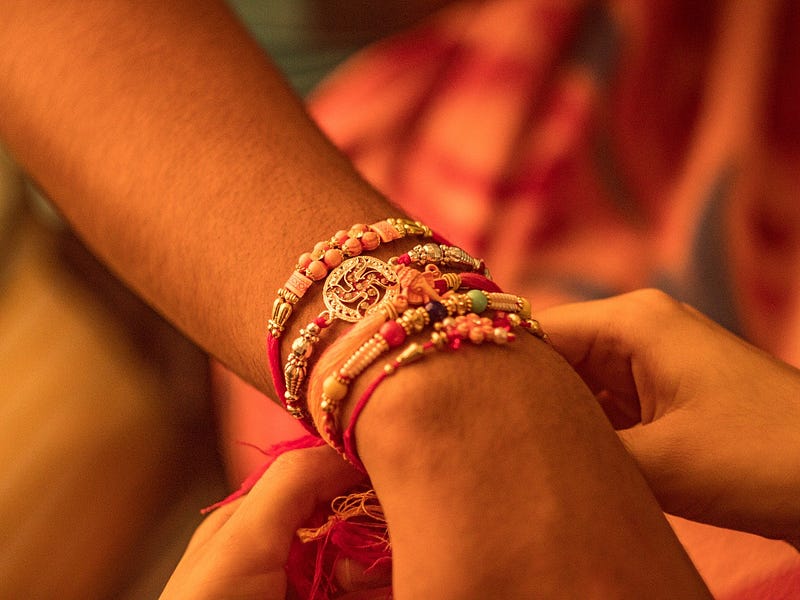
Sisters tie a Rakhi (a consecrated thread that preserves the bond of love between two people) on their brothers’ wrist. The colourful, ornamental bands that are sold under the name of rakhis, in the market today, are a far cry from the consecrated rakhis that create a cocoon of protection around the wearer. A thread is known to tie two things together and establish a connection and is one of the ideal objects for consecration because it can hold energies together. Consecration is done by the process of dipping it in turmeric and chanting incantations (mantras).
After tying a Rakhi, the sister applies a red dot (tilak) on the brother’s forehead and performs aarti (aarti is performed by placing a small lamp or ‘diya’ with a burning flame in a metal plate and rotating it clockwise in front of the one whose aarti is being done). The red dot is applied with kumkum (a powder made of turmeric and lime, used for religious markings in India). Then the sister treats the brother to his favourite dishes and sweets. The brother, in turn, expresses his love and affection by showering the sister with gifts. Thus, Raksha Bandhan is the biggest and grandest celebration of the bond between brothers and sisters.
Upakarma
This day is also celebrated as Upakarma in some parts of India. Upakarma means beginning, and it refers to the ceremonial beginning of education (learning of the Vedas — sacred, ancient Indian texts) of Brahmins. Brahmin men wear a new holy thread around their chest or change their old threads on this day, and offer libations of water to their ancestors and the saints of India, from whom they deemed to have originally learnt the Vedas which were then passed along from father to son, across generations.
When a young Brahmin boy wears this thread for the first time, he is believed to have been initiated in his learnings. That initiation is symbolic of the opening of his third eye (spiritual eye located between the two physical eyes, also considered as the eye of wisdom). The three layers of the thread symbolize the wearer’s three different responsibilities — to his ancestors, peers and posterity. It is also supposed to remind the wearer of his duties and to urge him to keep his body, mind and speech pure.
Narali Purnima
This day is also celebrated as Narali (coconut) Purnima in the state of Maharasthra, especially along the coastal regions. During the monsoon, the sea tends to become tempestuous because of the changes in nature combined with the plentiful monsoon rains. Fishing which is one of the most lucrative occupations in the coastal areas affording livelihood to many a fisherman is rendered unsafe during this time.
So, fishermen make a peace offering of coconuts to Varun Dev (the God of the mighty seas), so that He is appeased and protects the fishermen on their fishing ventures of the new season. People also plant trees to express their gratitude towards nature on this day. The festivities of Narali Purnima are thus an expression of man’s gratitude and supplication to nature’s forces to calm them down and ensure man’s perpetual safety.
Culinary Delights
Indian cuisine is replete with mouth-watering delicacies and sweets, some of which are specific to some fiestas. Raksha Bandhan doesn’t have any particular treats associated with it; however, in Maharashtra, Narali Purnima is synonymous with making Narali Bhaat (coconut rice with jaggery).
Modern-day Raksha Bandhan Celebrations
As years pass by, traditions tend to evolve to adapt to current happenings. And so it is that on this day, girls and women tie Rakhis to the policemen, armed forces personnel, and Indian soldiers, who risk their lives, guarding the ever turbulent borders of the great nation and keeping the populace of 1.3 billion safe. What an evocative way to honour their courage and sacrifice and make them feel honored and loved!
Nowadays, kids tie rakhis to their pets too, considering them as a part of their families, no different from their siblings.
On a lighter note, young girls who want to discourage unrequited love interests and let them down easy, tie rakhis on their admirer’s wrists turning their relationship into a platonic brother-sister bond. Many a young boy can be spotted bolting away from girls who are on the lookout for them. 😆
2020
This year Raksha Bandhan falls on the 3rd of August. So bring out your rakhis and get ready to share the love.
Here’s how you can learn about other popular Festivals of India.
If you’d like to read more about the Festivals of India, do give this a read.