
Faulty Trailer Hitches Have Dangerous Consequences
Hitch fails, trailer careens down ramp narrowly missing dozens.
The Annual Regatta
It was again time for the annual regatta. Sailors had come to south Texas from as far as Dallas and Houston. Ninety-four boats were registered. Upon arriving at the yacht club, sailors had to step their masts (raise the mast and secure it) and launch their boats. A few sailors arrived on Thursday or Friday and were able to tend to these matters in an unrushed manner, though most intended to launch their vessels Saturday morning before the first race of the day.
The club has been conducting this regatta since 1968. Over the years, the number of competitors has grown from a handful to nearly 100. This regatta is a circuit stop for many Texas fleets, including J/24, Catalina 22, and TOMA Championship (Extreme Freshwater Edition).
All boats from outside the club had to be trailered here by their owners. Some boats were as short as 14 or 15 feet. The longest boat brought in by a trailer was 26 feet.
Any trailer towed with a hitch set behind the rear axle of the tow vehicle can sway or fishtail while driving. The hitch acts as a pivot point in-between the centers of gravity of the two vehicles. Any trailer sway or side-to-side force will turn the vehicle and create an unexpected steering force. — Nationwide Insurance, 2019
Driving with Sailboat Behind
It is no easy feat to bring a sailboat 200 miles from Dallas or Houston. Trailers and boats are tricky combinations. The boat must be balanced correctly on the trailer. If the boat is too far forward, the tongue of the trailer is too heavy. This weight puts too much pressure on the rear tires of the tow vehicle and causes steering issues. If the trailer is too far back, the tongue is too light (tongue light), and the trailer fishtails. “Just the right amount of tongue weight (between 10–15% of GTW) will reflect a balanced line from the front of the truck to the back of the trailer with the coupler between the truck and trailer nearly level.” (Lee, 2019)
In addition to adequately balancing the boat on the trailer, the trailer must be correctly attached, at the hitch, to the towing vehicle. Most states have laws about hitching requirements.
Basic trailer hitch requirements include an appropriate receiver with a ball matched to the trailer. Safety chains connected at the trailer are required to be crisscrossed and secured to the towing vehicle.
A pin should be inserted into the latch on the ball housing, so the lock does not pop open when the trailer hits a bump. Adding the pin is particularly crucial if the trailer is tongue-light. In addition to hardware, most states require a working brake and turn-signal lights on the trailer. It’s a significant undertaking to transport a sailboat several hundred miles on the highway.
A Video Explains Hitching Requirements
Texas and Minnesota have similar requirements. In this video, Minnesota State Patrol Sgt. Steve Fischer explains hitching requirements.
Common Hitching Problems
I’ve spent a fair amount of time at Canyon Lake, located between Austin and San Antonio. I’ve seen more than a few boat trailers improperly connected to their vehicles. The most common errors are no or incorrectly attached safety chains. Another common problem is no pin securing the trailer hitch latch.
Saturday Morning Excitement
Saturday morning of the regatta was a busy time. Hundreds of sailors, friends, families, and club volunteers were busily preparing for a day of racing. Eighty-three boats had to be brought down so they could be on the water on their appointed start line by noon. Most of these boats were in the queue for backing down the ramp.
An experienced ramp team was on hand to orchestrate the movement of trucks, trailers, and boats. Traffic direction was a function with which this team was well acquainted. They have fifty years of experience.
”In the United States, maximum grade for Federally funded highways is . . . up to 6% . . .” — Wikipedia, 2019
Sailors not acquainted with the club ramp often find it challenging. The ramp grade is 19%. A 19% grade means the elevation of the ramp increases or decreases vertically 19 feet for every 100 horizontal feet driven. Let it suffice to say the ramp is quite steep. Proper towing and connection protocols by boat owners would be imperative. A forgotten link or unconnected safety chain could be a prelude to disaster.
By 9:45 am, most of the boats had successfully launched without mishap. It was now time for Sea Wolf to back down the ramp. The driver pulled onto the ramp staging area, ready to back at the signal of the traffic directors. As soon as a Toyota Sequoia completed launching its boat, Sea Wolf could begin.
Runaway Boat! Get out of the Way!
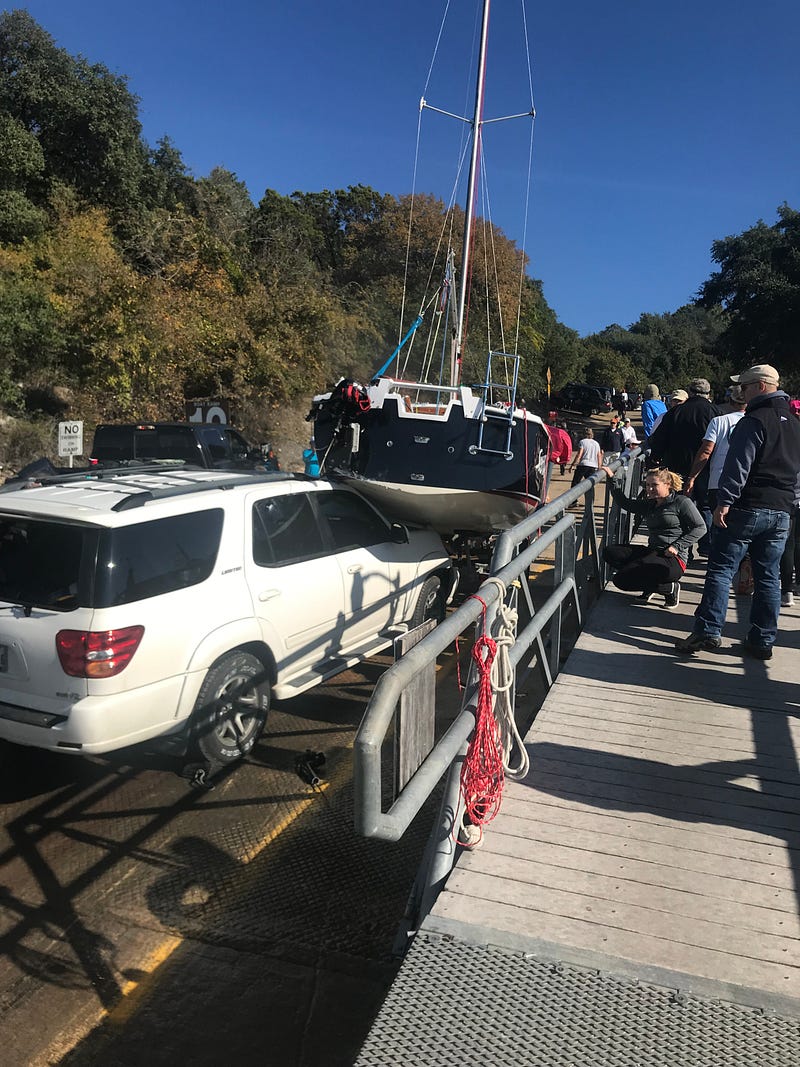
The preconditions of what happened next are in dispute and will be investigated by the Comal County Sheriff’s Department and insurance investigators. What was known and was observed was there was a loud bang as the trailer tongue hit the pavement, followed by shouts of “Runaway Trailer!” “Runaway Boat!” “Get out of the Way!”
From my vantage point on the walkway dock leading to the shore, I heard and saw the trailer and boat grinding the pavement down the hill toward a white Sequoia in the process of launching a J boat. It was scary. At first, I focused only on the rogue trailer. I recall noticing it was coming straight down the ramp, neither veering to one side or the other. I’m sure that image lasted less than a second, but it still captured my attention.
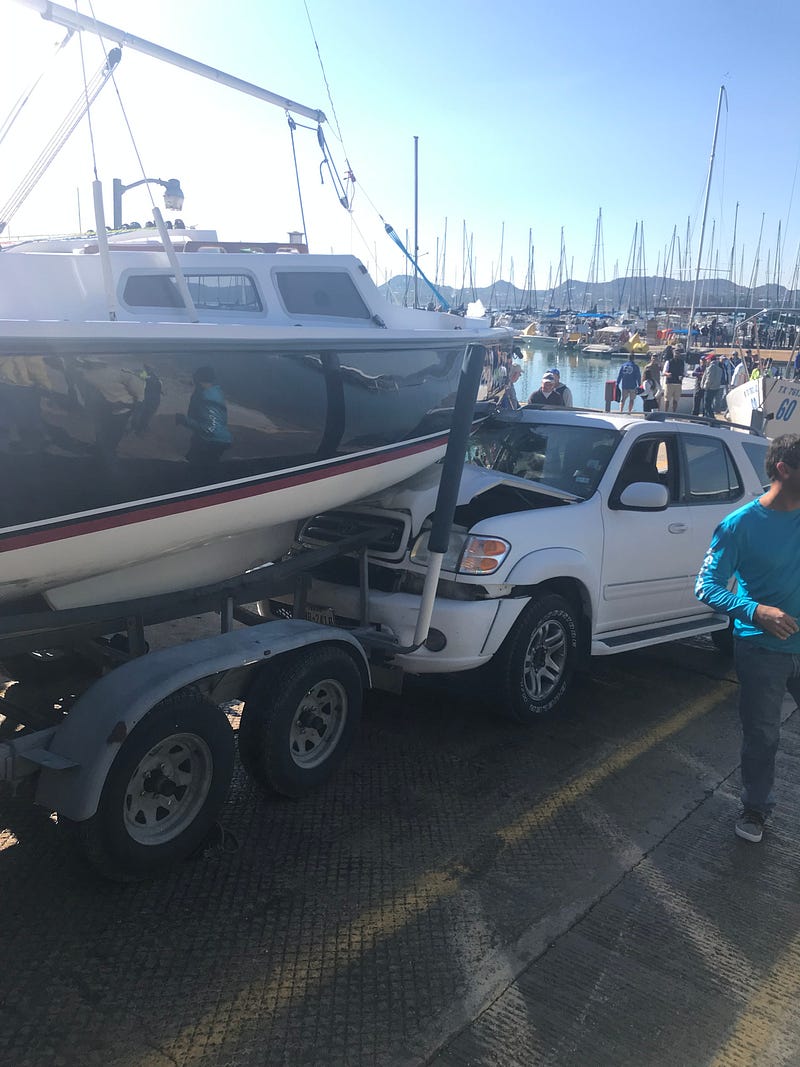
Then I realized there was a vehicle near the water’s edge. “Oh my, Sea Wolf is headed straight for the Toyota.” A moment later, Sea Wolf, on her trailer, crashed into the SUV, pushing it back 5 feet… 10 feet. “Will the car be pushed into the water?” I thought. Fortunately, the back wheels of the car stopped before the water’s edge.
There had been a driver in the Toyota. At the sound of people yelling, the driver bailed from the Sequoia. After the crash, he appeared unscathed to view the destruction of his beautiful new car. Fortunately, all pedestrians were able to avoid the avalanche of the boat and trailer. No one was injured.
Trailer Hitch Failures Are Common
This incident got me thinking about other trailer failures. This failure was not the first occurrence on a boat ramp of Canyon Lake. I’ve heard of others. This crash was just the first one I’ve personally observed. The usual cause of trailer disconnection rests on, or instead failing to rest on, safety chains. Safety chains are the key to retaining control of a trailer when a hitch fails.
Legendary Mishaps
Several stories of lake mishaps are nearly legendary. There’s the one about a trailer coming down from the top of the hill. When the trailer hit the speed bump at the top of the rise, it popped off the ball. The trailer followed its truck until the truck turned right. The trailer continued straight into the lighthouse on the lawn.
Then, there’s the story of the boat that launched itself. The boat rode its trailer ¾ of the way. When the trailer hit the pedestrian guard rail, the boat fell off and slid across the pavement on its side into the water. It righted itself and floated next to the dock awaiting its owner.
All these occurrences are fortunate in that no one was injured.
Sometimes Runaway Trailers Cause Deaths
While researching this article, I came across two items of note. Googling “runaway trailer crashes” produced dozens of advertisements for personal injury lawyers specializing in runaway trailers. I also came across nearly as many news media reports of injuries and deaths caused by runaway trailers. Some examples follow.
- UPDATE: Victim ID’ed, truck driver charged in fatal runaway trailer crash — The driver of the pickup truck was arrested and charged with involuntary manslaughter, improper towing/ failure to use safety chains, and reckless driving to endanger.” (WTN, 2019)
- Runaway trailers are persistent cause of crashes — “The truck driver, Bradley Demitras, hadn’t checked to make sure the chipper was securely hitched to his vehicle. He also failed to connect the safety chains, which are supposed to keep a trailer attached if the hookup fails. Demitras pleaded guilty to involuntary manslaughter and is serving 9 to 18 months in jail.” (Levin and Miller, 2007)
- Trailer Troubles: When Not Properly Secured, They Can Be Deadly on the Road [News article and Video] — “Kristi Cox’s husband, Jeremy, was driving down a Minnesota road in 2010 with their two children when a trailer came loose from a truck and careened into their car, killing Jeremy and his three-year-old daughter Isabel.” (Inside Edition, 2015)
In Summary
Required towing equipment is in Texas statutes, section 545.409 of the Transportation Code. Failure to properly secure a trailer per state statutes not only puts others at risk but may subject drivers to legal liability.
Citations:
Fischer, Steve, (July 1, 2010), Trailer Safety with Sgt. Steve Fischer of the MSP, Minnesota Department of Public Safety, Retrieved from https://www.youtube.com/watch?v=pnXGi16asOM
Lee, Ashley, (February 13, 2019), Proper Tongue Weight: Why It’s So Important To Get It Right, Weigh-Safe.com, Retrieved from https://www.weigh-safe.com/towing-safety/proper-tongue-weight/#:~:targetText=Too%20much%20tongue%20weight%20could,when%20you%20try%20to%20brake.
Levin, Myron, and Miller, Alan C., (Dec. 15, 2007), Runaway trailers are persistent cause of crashes, Tribune Newspapers, CHICAGO TRIBUNE. Retrieved from https://www.chicagotribune.com/news/ct-xpm-2007-12-15-0712141018-story.html
AutoGuide.com, (Nov. 19, 2015), How to Tow a Trailer, Retrieved from https://www.youtube.com/watch?v=wJFVMj-bVsY
Inside Edition, (Sept. 28, 2015), Trailer Troubles: When Not Properly Secured, They Can Be Deadly on the Road, Retrieved from https://www.insideedition.com/investigative/12122-trailer-troubles-when-not-properly-secured-they-can-be-deadly-on-the-road
Nationwide Insurance, (March 28, 2019), Trailer Towing Tips: How to Prevent Trailer Sway, Retrieved from https://blog.nationwide.com/rv-towing-tips-for-preventing-trailer-sway/
Regattanetwork.com, Wurstfest Regatta 2 Results (2019), retrieved from https://www.regattanetwork.com/clubmgmt/applet_regatta_results.php?regatta_id=19650&show_manufacturer=1&show_crew=1
Texas Transportation Code Section 545.509
Wikipedia — The Free Encyclopedia, Grade (Slope), Retrieved from https://en.wikipedia.org/wiki/Grade_(slope) on November 14, 2019
WTN, (Oct. 24, 2019), UPDATE: Victim ID’ed, truck driver charged in fatal runaway trailer crash, Retrieved from https://www.witn.com/content/news/Driver-killed-by-runaway-trailer-in-Jacksonville-563724141.html
© 2019 Randle B. Moore All Rights Reserved
Please click this [LINK] if you have enjoyed reading this story and would like to have my stories delivered to your email inbox when I publish.
Medium is a beautiful site for innovative and exciting stories. Paying $5 for a monthly subscription or $50 for an annual subscription entitles you to read all articles. Use this [LINK] to join. Your membership fee supports writers of Medium.
If you found this article useful, you may also find these other articles interesting.


