
Facebook’s New Remote Salary Policy is “Barbaric”
Why Facebook should pay remote employees more, not less

In a recent town hall meeting, Mark Zuckerberg shared Facebook’s lessons and strategy for transitioning to remote work in the coronavirus era. But although he spoke of creating a “thoughtful and responsible” work-from-home culture, the company’s new salary policy is hardly altruistic.
According to Zuckerberg, Facebook employees who move out of the Bay Area during the pandemic will face a cost-of-living salary adjustment. Those who don’t update their locations by January 1, 2021 risk “severe ramifications.”
But setting employees’ salaries based on where they live rather than their experience or output is illogical. According to David Heinemeier Hannson, Basecamp co-founder and co-author of the book Remote — Office Not Required, it’s also “barbaric.”
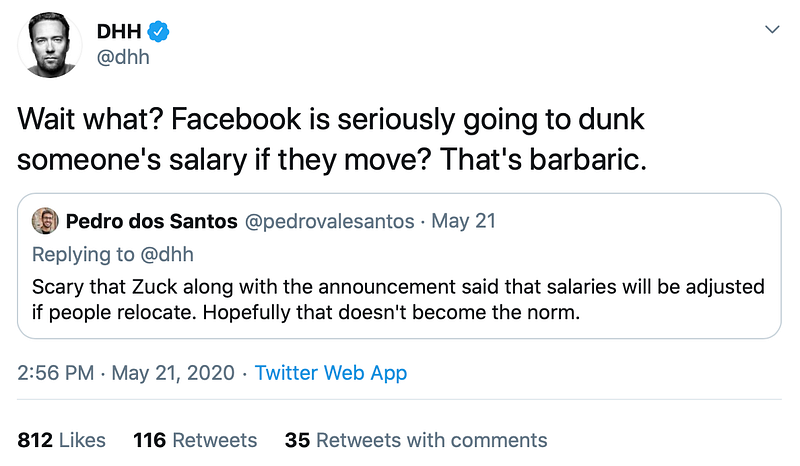
As a remote work consultant, I have strong opinions on why Facebook’s new policy is wrong. And I have two alternatives for what to do instead.
Facebook’s Remote Expansion and Hiring Plan
Although Facebook seems focused on cost-cutting, business has been good since the pandemic started. Workplace subscribers have nearly doubled, while Work Groups — launched six months ago — has twenty million daily active users. To meet the increased demand for remote collaboration tools and invent new ones, Facebook will begin an “aggressive” hiring push throughout the U.S. and Canada.
Where Facebook will recruit first:
Category 1: Remote engineers who live within a 4-hour drive from existing company offices.
Category 2: Facebook will hire near three new hubs in Atlanta, Dallas, and Denver.
Category 3: The third phase of the plan consists of seeking out talent in the more rural areas of North America.
So while Facebook invests in expanding its remote workforce and building new hubs, it will be reducing the salaries of existing employees. 95% of the company’s workforce is working remotely through 2020, but managers have discretion over which roles stay remote long-term.
Problems with Setting a Salary-Cutting Precedent
Like any company, Facebook has made plenty of business missteps in the past. After moving to open-office floor plans in 2012 — designed to enhance communication and collaboration — data showed it had the opposite effect. As it turns out, open-plan offices destroy productivity and employees hate them. Likewise, Facebook’s new salary policy will do more harm than good. The company just doesn’t know it yet.
In the age of remote work, companies with workplace flexibility will attract the best employees in the world and keep them. They’ll also save money — even if they pay employees at a premium. The best remote talent will go where they are treated best — not paid the least. Setting salaries based on location will undermine Facebook’s recruitment efforts, making the company less competitive long-term.
Before expanding its remote hiring, Facebook should ensure its current retainment strategy is sound.
Facebook’s policy brings up additional questions:
- What is the benefit of forcing employees to make a trade-off between their careers, income, and quality-of-life?
- Why is location more important than an employee’s experience, output, or contribution?
- Is it ethical for a company with market cap of $654 billion to dock employees’ paychecks? (Facebook has a higher annual profit-per-employee than any other tech company on the Fortune 500 —at $634,694.)
- Which regulation(s) require a company to lower salaries to comply with tax and reporting requirements, as Zuckerberg suggested?
- How would digital nomads without a homebase be treated at Facebook?
- What happens if an employee relocates to a more expensive location?
- What would the policy be for workers who move to the U.S. for college or on H1B1 visas, then return to their home countries?
- What if an employee temporarily relocates away from Silicon Valley for personal reasons, then moves back?
- What if employees maintain more than one residence?
- How would Facebook’s independent contractors be affected? Seven in ten U.S. freelancers want to move somewhere, too.
Solution #1: Offer Remote Relocation Incentives
Rather than cutting employees’ salaries if they move, Facebook could pay them more. That’s what Zapier does — a Silicon Valley company that began offering employees a $10,000 “de-location” incentive to move away from the Bay Area back in 2017. Said CEO, Wade Foster,
We’ve long embraced remote working. And think you should be able to work wherever you want and still work at a place that helps you achieve your career goals.
So if you’re living in the Bay Area but thinking about making a change that will improve your family’s standard of living, we’re eager to help. Zapier will provide up to $10,000 to help relocate you and your family to your new home outside the Bay Area.
While Zuckerberg seems unconvinced that remote work will decrease his company’s overhead, fully-distributed organizations know otherwise. Going remote reduces real estate, managerial, and other operating expenses— even when factoring in the cost of setting up home offices, subsidizing co-working memberships, and accounting for travel expenses.
Government and Private-Sector Grant Programs
Zapier isn’t the only company to experiment with remote work incentives. State and local governments across the U.S. began testing programs to attract remote workers in 2019. Each one offered some combination of cash compensation, tax credits, housing allowances, co-working memberships, and other forms of support.
Tulsa Remote’s remote work program includes housing support, a co-working allowance, and $10,000 in cash. Vermont’s Remote Worker Grant and Nebraska’s WorkNP program offer up to $5,000 in incentives to remote workers who relocate.
Meanwhile, a startup called MainStreet went viral in 2019 when it announced a $10,000 offer to help train workers in rural America and match them with remote tech jobs.
How will Facebook be able to attract the best talent if they de-incentivize prospective employees, while competitors do the opposite? The answer is anyone’s guess.
Solution #2: Set Objective Pay Parameters
Equal pay for equal work doesn’t have to be exclusively about gender equality — it can also apply to one’s geographic location. So, why not create consistent pay grades and categories, like Basecamp does?
Basecamp pays all its programmers according to the same scale and uses third-party data to get market salary rates. Even though Basecamp doesn’t have any staff in San Francisco, employees earn in the top 10% of Silicon Valley wages regardless. The company also has a uniform policy on annual raises.
Basecamp’s founders know that what you do is more important than where you log in from, and their employee retention is high because of it.
[At Basecamp,] everyone has the freedom to pick where they want to live, and there’s no penalty for relocating to a cheaper cost-of-living area. We encourage remote and have many employees who’ve lived all over while continuing to work for Basecamp. — DHH, Basecamp CTO
Another fully-distributed company, Help Scout, removed geography as a variable in its salary formula in 2018 based on employee feedback and logic. Wrote co-founder, Nick Francis,
Remote companies are decidedly, proudly indifferent to geography. We love to say you can work from anywhere — we have no borders, no “market,” and yet market rate remains a compensation factor. It doesn’t add up. Do we care about location or do we not?
The company’s decision to disregard location in its calculation was also about fairness:
All work has a fixed value to the business, irrespective of geography.
It’s math — we should all know what we can afford to pay an employee to produce a certain type of work.
Unsurprisingly, cost-of-living salary formulas are wildly unpopular among remote employees. The digital workforce wants flexibility. To attract the best talent, tech companies will need to set their pay policies accordingly.
Conclusion: Facebook’s Policy Will Prove Ineffective
Zuckerberg says that he wants to increase innovation, creativity, retention, and workforce diversity at Facebook, but his actions contradict his words. Rather than becoming a “north star” for other companies to follow, Facebook’s new remote work policy will have the opposite effect. It will demoralize current employees and weaken the company’s culture while diluting potential gains from a wider hiring pool.
Building a remote work foundation with salary cuts sets the wrong precedent. You don’t “serve the community and unlock innovation” by telling employees their worth is tied to a physical location — or worse, an IP location — especially in the era of location independence.
Looking for a remote job? Download my free guide.
(This article was updated on May 28 to include HelpScout’s salary policy.)


