
The Power of AI for Data Analytics: A Comprehensive Exploration

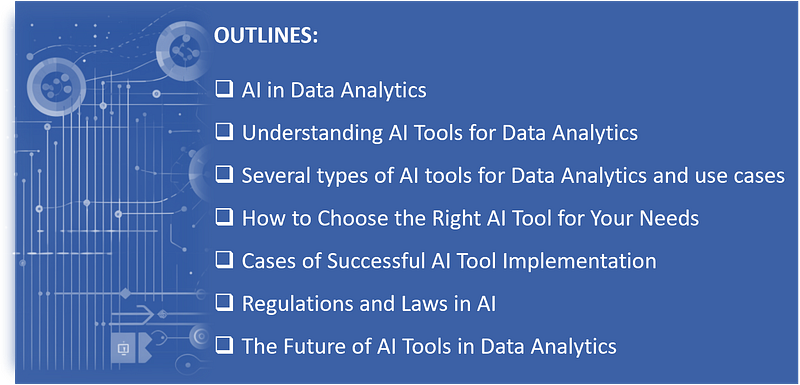
In the digital age, data has become the lifeblood of businesses. With the exponential growth of data, the need for effective data analytics tools has never been more critical. Artificial Intelligence (AI) has emerged as a game-changer in this realm, revolutionising the way we analyse and interpret data. Here provides a comprehensive guide to AI tools in data analytics, their benefits, and how to choose the right one for your needs.
The Rise of AI in Data Analytics
The advent of AI has transformed the landscape of data analytics. Traditional data analytics methods, while effective, often struggle to keep up with the sheer volume, velocity, and variety of Big Data. AI, with its ability to learn from data and make intelligent decisions, has proven to be a powerful solution to these challenges.
AI tools in data analytics can automate complex processes, identify patterns and trends in large datasets, and even predict future outcomes. For instance, AI-powered predictive analytics can help businesses forecast customer behaviour, market trends, and operational efficiency.
Moreover, AI brings a level of accuracy and speed that is unmatched by human analysts. It can process and analyse data in real-time, providing businesses with timely and actionable insights.
Understanding AI Tools for Data Analytics
AI tools for data analytics are software applications powered by AI technologies, such as machine learning, deep learning, and natural language processing. These tools can analyse large volumes of data, identify patterns, and generate insights without explicit programming.
There are several types of AI tools available for data analytics, each with its unique capabilities:
AI Data Preparation:
- Trifacta: Trifacta uses machine learning to automatically detect data schemas, data types, and anomalies. It suggests transformations to clean and structure your data. For example, if you’re working with sales data, Trifacta can automatically detect and correct inconsistent date formats or missing values.
- Paxata: Paxata allows users to clean, combine, and enrich data without coding. It uses machine learning to understand your data and suggest transformations. For instance, Paxata can help a data analyst combine multiple customer data sources, clean the data, and create a single view of each customer.
- Talend: Talend provides a suite of apps to collect, govern, transform, and share data. It uses machine learning for data matching, deduplication, and enrichment. For example, a company can use Talend to ensure their product data is consistent across all systems.
AI Data Visualisation:

- Tableau: Tableau uses AI to suggest visualisations based on the nature of your data. It also supports natural language queries. For example, a business user can ask “What were the sales last quarter?” and Tableau will generate an appropriate visualisation.
- Power BI: Power BI uses AI to provide quick insights, automated machine learning models, and cognitive services. For instance, a retailer can use Power BI to predict future sales based on historical data.
Built-in AI in Power BI. Find the Insight You Can’t See! — YouTube
- Qlik: Qlik uses AI to offer conversational analytics and automated insights. For example, a user can ask “What are the top-selling products?” and Qlik will generate a relevant visualisation.
AI Predictive Analytics:

- RapidMiner: RapidMiner uses AI to automate data prep, machine learning, and model deployment. For example, a bank can use RapidMiner to predict which customers are likely to default on a loan.
- Alteryx: Alteryx uses AI for predictive analytics, including regression analysis, time series, and model comparison. For instance, a marketer can use Alteryx to predict customer churn based on usage patterns.
- DataRobot: DataRobot automates the process of building machine learning models. For example, a healthcare provider can use DataRobot to predict patient readmissions.
AI Data Mining:

- Knime: Knime uses AI to automate data prep and exploration, model training, optimisation, and deployment. For instance, a researcher can use Knime to analyse genetic data and predict disease susceptibility.
- Orange: Orange uses AI for data visualisation, machine learning, and data mining. For example, a teacher can use Orange to demonstrate clustering algorithms to students.
- Weka: Weka provides a collection of machine learning algorithms for data mining tasks. For instance, a data scientist can use Weka to build a model that predicts customer behaviour based on past purchases.
Top AI Tools for Data Analytics
There are numerous AI/ML(Machine Learning) platforms available in the market for data analytics and machine learning. Here are some of the top ones:

- Amazon SageMaker: SageMaker is a fully managed service that provides developers and data scientists with the ability to build, train, and deploy machine learning models quickly.
- Google Cloud AI Platform: This platform provides a comprehensive set of AI tools for data analytics, including data preparation, machine learning, and predictive analytics.
- Microsoft Azure AI: Azure AI offers a range of AI tools for data analytics, including data visualisation, predictive analytics, and machine learning.
- DataRobot: This is an automated machine learning platform that assists in building and deploying accurate predictive models.
- IBM Watson: Known for its advanced AI capabilities, IBM Watson offers a suite of data analytics tools. It can analyse structured and unstructured data, generate predictive insights, and even understand natural language queries.
In-Depth Review of Select AI Tools
Let’s take a closer look at two of these tools: Amazon SageMaker and Microsoft Azure AI. These tools offer a range of functionalities and services that can greatly benefit various industries, including banking and the public sector.
- Amazon SageMaker
Amazon SageMaker is a comprehensive machine learning platform provided by Amazon Web Services (AWS). It simplifies the process of building, training, and deploying machine learning models at scale. SageMaker offers a rich set of tools and capabilities that enable developers and data scientists to accelerate their AI projects.
AI Function of Amazon SageMaker: Amazon SageMaker encompasses a wide range of AI functions.

Use cases:
Customer segmentation: SageMaker can help banks analyse customer behaviour and segment their customer base, allowing personalised marketing campaigns and tailored financial products based on individual preferences and needs.
Risk assessment: By training models on historical market data, SageMaker can assist banks in predicting and assessing credit risks, helping them make informed lending decisions and manage their portfolios more effectively.
Healthcare diagnostics: By utilising SageMaker’s image classification capabilities, medical professionals can develop models to assist in diagnosing diseases based on medical images, potentially improving the accuracy and efficiency of diagnostics.
Traffic management: Public transportation authorities can leverage SageMaker’s predictive modeling capabilities to forecast traffic patterns, optimise routes, and improve overall traffic management, leading to reduced congestion and enhanced efficiency.
Sentiment analysis: Public sector organisations can employ SageMaker’s natural language processing capabilities to analyse social media data, gauging public sentiment regarding specific policies, initiatives, or events, thereby aiding in decision-making and policy formulation.
- Microsoft Azure AI
Microsoft Azure AI is an integrated suite of AI services and tools offered by Microsoft. It provides a wide range of capabilities that facilitate the development and deployment of AI solutions across various domains. Azure AI empowers organisations to harness the power of artificial intelligence effectively.
AI Function of Microsoft Azure AI: Microsoft Azure AI comprises several powerful AI functions.

Use cases:
Customer service enhancement: Azure’s chatbot capabilities can be leveraged by banks to provide automated customer support, answering frequently asked questions, and handling routine inquiries, leading to improved customer experience and reduced operational costs.
Personalised financial advice: Azure’s cognitive services can be utilised to analyse customer financial data, providing personalised recommendations and financial planning advice based on individual goals and preferences, thereby enhancing customer engagement and satisfaction.
Smart city initiatives: Azure’s cognitive services and machine learning capabilities can help public sector organisations in implementing smart city initiatives. For example, by analysing sensor data, these services can optimise energy consumption, monitor air quality, and enhance overall urban planning.
Language translation and accessibility: Azure’s translation services can facilitate real-time language translation, aiding international diplomacy and cross-cultural communications. Additionally, Azure’s speech recognition capabilities can assist individuals with hearing impairments by transcribing audio content into text.
Document analysis and classification: Azure’s AI capabilities can automate document analysis and classification tasks for public sector organisations, reducing manual efforts and increasing efficiency. For instance, government agencies can utilise these capabilities to process and categorise large volumes of documents for archival purposes or compliance regulations.
How to Choose the Right AI Tool for Your Needs
Choosing the right AI tool for your data analytics needs depends on several factors:
- Your Data: The type and volume of data you’re dealing with will largely determine which AI tool is right for you. Some tools are better suited for structured data, while others excel at analysing unstructured data.
- Your Use Case: What do you want to achieve with data analytics? Whether it’s predictive analytics, data visualisation, or data mining, make sure the AI tool you choose aligns with your goals.
- Your Budget: AI tools come at various price points, from free open-source tools to premium enterprise-level software. Consider your budget and the return on investment the tool can provide.
- Your Technical Expertise: Some AI tools require a deep understanding of machine learning and data science, while others are designed for non-technical users. Choose a tool that matches your team’s technical expertise.
Cases of Successful AI Tool Implementation
Let’s look at some real-world examples of businesses that have successfully implemented AI tools in their data analytics processes:
- Netflix: The streaming giant uses AI to analyse viewing patterns and make personalised recommendations for each user. This has significantly improved user engagement and retention.
- American Express: The financial services company uses AI to analyse transactions and detect fraudulent activity. This has helped the company prevent millions of dollars in losses.
- Uber: The ride-hailing service uses AI to predict demand, optimise pricing, and improve route planning. This has helped Uber increase efficiency and provide better service to its customers.
Regulations and Laws in AI
As AI continues to evolve and become more integrated into our daily lives, it’s crucial to consider the legal and ethical implications. Regulations and laws are being developed worldwide to ensure the responsible use of AI. Here are a few examples:
- Data Privacy and Protection: This area includes laws like the General Data Protection Regulation (GDPR) in the European Union, and the California Consumer Privacy Act (CCPA) in the United States. These laws regulate how companies collect, store, and use data, including data used for AI purposes.
- AI Ethics: There is a growing emphasis on ethical considerations in AI. These include transparency (explaining how AI makes decisions), accountability (who is responsible when AI goes wrong), and fairness (avoiding bias in AI). Some countries like the UK have set up advisory bodies like the Centre for Data Ethics and Innovation to guide the ethical use of AI.
- Algorithmic Transparency: As AI systems become more sophisticated, it’s becoming increasingly important for users to understand how these systems make decisions. Regulations in this area could require companies to disclose how their algorithms work.
The Future of AI Tools in Data Analytics
As AI technology continues to evolve, we can expect to see even more powerful and sophisticated AI tools for data analytics. Future trends may include:
- Explainable AI: As AI decisions become increasingly impactful, there’s a growing demand for AI tools that can explain their decisions in a way that humans can understand.
- Real-Time Analytics: With the rise of IoT and real-time data streams, there’s a need for AI tools that can analyse data in real-time and provide instant insights.
- Privacy-Preserving Analytics: As data privacy regulations become stricter, we’ll likely see more AI tools that can analyse data without compromising privacy.
AI tools have revolutionised the field of data analytics, enabling businesses to gain deeper insights, make better decisions, and achieve competitive advantage. However, choosing the right AI tool requires careful consideration of your data, use case, budget, and technical expertise. As AI technology continues to evolve, we can look forward to even more powerful and sophisticated tools for data analytics.
If you found this article helpful, I’d appreciate it if you could show some love with a few claps at the bottom of the page. Don’t hesitate to leave your insights or feedback in the comments, and feel free to pass this along to your friends and follow me on Medium.
Some other articles from Jing Chen
- Customer Churn Prediction — A Step by Step Tutorial of Building XG Boost ML Model Part 1 — Exploratory Data Analysis (EDA)
- Time Series Forecasting — 6 steps to build a Stock Price Prediction LSTM Model: Give it a Try and See What You Can Get for the Next Day’s Stock Price
- Beyond the Spreadsheet toward Analytics Role Upskilling: A cheat sheet for people scared coding
- Mastering Financial Modelling 101: From Common Techniques to the Data Analytics Revolution
- Empowering Decision Making in Banking and Public Sector: The Role of Financial Modelling and Reporting Tools
- Building a Risk Management Model: A Journey of Transparency and Resilience
- Transforming Internal Audit: Unleashing the Power of Data Analytics in Banking and the Public Sector
Want to connect ?
- Follow me on Medium
- Connect me on LinkedIn