
Decision Making with Financial Modelling and Reporting Tools in Banking and Public sector

In today’s rapidly changing business environment, decision making in banking and the public sector requires effective support systems that leverage data, collaboration, and insightful analysis.
Drawing on my experience as a senior data analytics professional and financial controller, I have developed numerous financial models and reporting tools aimed at facilitating effective decision making. In this article, I will provide valuable insights and share my firsthand experience in the realm of decision support.
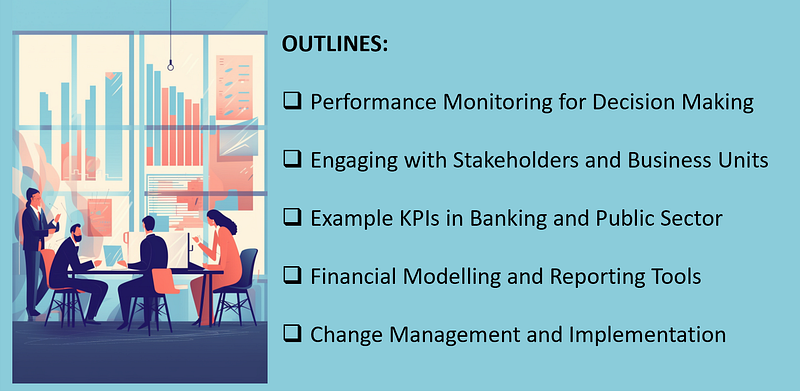
There are various strategies and tools can facilitate decision making, with a focus on performance monitoring, financial modelling, and change management. By collaborating with stakeholders, developing key performance indicators (KPIs), and implementing advanced analytics tools, organisations can make more informed decisions that align with their strategic objectives.
Performance Monitoring Supports Decision Making
Performance Monitoring is pivotal in decision-making within banking and the public sector. It offers in-depth insights into group performance through reporting and analytics, aligned with the organization’s strategic goals and an understanding of the competitive industry landscape. The objective is to challenge conventional practices, promoting continuous improvement, transformation, and digitization of processes and capabilities. The ultimate aim is to deliver outcomes efficiently, simply, factually, and insightfully, while leading a high-performing team.
Key responsibilities of performance monitoring support include:
• Cross-functional collaboration: Partnering with various teams such as group strategy, marketing, legal, compliance, risk, and tax to develop financial models, reporting tools, and processes that ensure optimal outcomes for the performance monitoring function.
• Regulatory compliance: Understanding and fulfilling regulatory reporting obligations and disclosures in line with all regulatory standards to maximize the efficiency of the performance monitoring support.
• Leveraging financial modeling, reporting, and analytics tools: to provide insights for senior stakeholders, enabling effective business decisions in pricing, resourcing, management, and product strategies to identify areas for improvement. For banking at the group level, this includes a focus on revenue, margin, expense, capital expenditure, and cash flow.
- Revenue: Performance monitoring can track the revenue generated from different banking services such as loans, mortgages, and fees for various services. For example, if a particular branch is underperforming in terms of loan disbursement, performance monitoring can identify this issue, leading to targeted strategies to improve loan sales.
- Margin: This refers to the difference between the interest income generated by banks and the amount of interest paid out to their lenders. Performance monitoring can help identify which products or services are yielding the highest margins. For instance, if credit card services are found to have high margins, the bank might decide to promote these services more aggressively.
- Expense: Performance monitoring can track various expenses, such as operational costs, employee salaries, and overheads. For example, if a bank notices a significant increase in operational costs in certain branches, it can investigate the cause and implement measures to reduce these expenses.
- Capital Expenditure: This involves major investments or expenses, such as purchasing a new building or investing in significant technology upgrades. Performance monitoring can help track these expenditures and assess whether they are yielding a good return on investment. For instance, if a bank invests in a new digital banking platform, performance monitoring can track the increase in digital transactions and customer satisfaction to evaluate the success of this investment.
- Cash Flow: Performance monitoring can track the inflow and outflow of cash, helping the bank maintain liquidity and meet its financial obligations. For example, if a bank sees a significant outflow of cash due to loan disbursements, it can adjust its strategies to ensure enough cash inflow through deposits or other means to maintain a healthy cash flow balance.
• Business planning: Using performance monitoring support to offer strategic insights, streamline processes, and drive digital transformation, thereby enhancing decision-making and operational efficiency. It also supports business planning by setting targets, formulating strategies, and providing data-driven insights to guide decision-making.
In essence, Performance Monitoring is a strategic tool that aids in decision-making by providing valuable insights, challenging existing processes, and leading to the continuous improvement and digital transformation of banking operations.
Engaging with Stakeholders and Business units to Develop KPIs
To effectively support decision making, it is essential to engage with various departments and stakeholders to develop Key Performance Indicators (KPIs) that align with organisational goals. By involving key stakeholders, including department heads, managers, and subject matter experts, in the development of KPIs, organisations can ensure that the metrics chosen are relevant, measurable, and aligned with business objectives. Collaborative discussions and brainstorming sessions enable the identification of key areas of focus and the establishment of a consensus on performance measurement.
To ensure effective decision making, KPIs must align with the organisation’s strategic objectives. In banking and public sector, departments such as finance, risk management, project management, human resources, and operations may have distinct KPIs that contribute to overall organisational success.
Example KPIs in banking:
Loan Portfolio Management: Loan portfolio management involves effectively managing a bank’s loan portfolio by assessing its performance and associated risks. Relevant KPIs can provide insights into the health and profitability of the loan portfolio. Examples of relevant KPIs may include:
- Loan Delinquency Rate: Measures the percentage of loans that are past due or in default, indicating the credit quality of the portfolio.
- Loan Loss Provision Ratio: Represents the amount set aside as provisions for potential loan losses as a percentage of the loan portfolio, indicating the adequacy of provisions for credit risk.
- Loan-to-Value Ratio: Compares the loan amount to the appraised value of the underlying collateral, helping assess the risk exposure of the portfolio.
Accurate Revenue Forecasting: Reliable revenue forecasting is essential for financial planning and resource allocation. Relevant KPIs can provide insights into revenue performance and market competitiveness.
- Revenue Growth Rate: Calculates the percentage increase in revenue over a specific period, indicating the growth trajectory of the organisation.
- Customer Churn Rate: Measures the percentage of customers who discontinue their relationship with the organisation, highlighting customer retention challenges.
- Sales Conversion Rate: Calculates the percentage of leads or prospects that convert into actual sales, assessing the effectiveness of sales efforts.
Creating a Productivity Reporting System: Enhancing operational efficiency requires monitoring and improving productivity. Relevant KPIs can help identify areas for improvement and measure workforce effectiveness.
- Output per Labor Hour: Measures the amount of output or work completed per labor hour, assessing productivity levels.
- Customer Support Response Time: Tracks the average time taken to respond to customer inquiries or issues, evaluating customer service efficiency.
- Employee Satisfaction Index: Assesses employee satisfaction and engagement levels, impacting productivity and overall organisational performance.
Developing a Financial Model for Liquidity Risk Assessment: Liquidity risk management is crucial for maintaining financial stability in the banking sector. Relevant KPIs can help monitor and mitigate liquidity risks effectively.
- Liquidity Coverage Ratio: Compares an organisation’s high-quality liquid assets to its net cash outflows during a specified stress period, ensuring adequate liquidity buffers.
- Net Stable Funding Ratio: Compares an organisation’s available stable funding to its required stable funding, assessing the long-term liquidity profile.
- Funding Gap Analysis: Analyses the difference between maturing liabilities and available funds, identifying potential liquidity gaps and funding needs.
Example KPIs in Public Sector:
Education sector: In the education sector, performing monitoring and establishing relevant KPIs is essential for ensuring the quality and effectiveness of educational institutions:
- Student Achievement:
- Graduation rates: Percentage of students who successfully complete their educational programs within the expected timeframe.
- Standardised test scores: Assessing student performance in core subjects to measure academic progress.
- Dropout rates: Percentage of students who leave school before completing their education.
2. Teaching Quality and Effectiveness:
- Teacher-student ratio: Evaluating the balance between the number of students and teachers to ensure adequate attention and support.
- Teacher performance evaluations: Assessing teacher effectiveness through observations, student feedback, and professional development participation.
- Professional qualifications: Ensuring that teachers possess the necessary qualifications and certifications for their subject areas.
Healthcare Sector: Monitoring performance and defining relevant Key Performance Indicators (KPIs) is crucial in the healthcare sector to ensure the delivery of quality care and optimise patient outcomes:
- Patient Satisfaction and Experience:
- Patient satisfaction surveys: Collecting feedback from patients to assess their satisfaction with the care received.
- Wait times: Measuring the time patients wait for appointments, procedures, or emergency care.
- Patient outcomes: Evaluating the health outcomes achieved by patients as a result of their healthcare interventions.
2. Quality of Care:
- Hospital readmission rates: Assessing the rate at which patients return to the hospital within a specified period after discharge.
- Mortality rates: Monitoring the number of deaths per patient population or specific medical conditions to assess the quality of care provided.
- Adherence to clinical guidelines: Ensuring that healthcare providers follow established best practices and protocols for various conditions.
Government Efficiency: Monitoring performance and establishing relevant Key Performance Indicators (KPIs) is vital for assessing and improving the efficiency of government operations. Here are examples of KPIs that can be used to monitor government efficiency:
- Service Delivery:
- Response time: Measuring the time taken to respond to citisen inquiries, requests, or complaints.
- Service accessibility: Evaluating the availability of government services through online platforms or physical locations.
- Service satisfaction: Assessing citisen satisfaction with the quality and timeliness of government services.
2. Process Efficiency:
- Time to process requests: Measuring the time taken to process applications, permits, or licenses.
- Workflow automation: Evaluating the extent to which digital tools and automation are utilised to streamline government processes.
- Staff productivity: Assessing the efficiency and effectiveness of government employees in delivering services and completing tasks.
Financial Modelling and Reporting Tools in Supporting Decision Making
Financial models and reporting tools are essential for monitoring performance and providing decision support. These tools enable organisations to consolidate and analyse data, track KPIs, identify trends and patterns and generate insightful reports.
- Financial models accurately forecast future performance.
- Reporting tools, such as dashboards and scorecards, visually present KPIs and performance trends for easy interpretation by decision-makers.
By integrating relevant KPIs into these models and reports, decision makers can gain a comprehensive understanding of their organisation’s financial health, risks, and opportunities.
To effectively support decision making, financial models and reporting tools must be tailored to stakeholders’ needs. Curating relevant data is a crucial aspect of this process. For example, when developing a financial model for a public sector infrastructure project, relevant data such as project costs, funding sources, and economic indicators need to be incorporated. By tailoring financial models and reporting tools, organisations ensure that stakeholders have access to the information necessary for effective decision making.
Examples of Financial Models and Reporting Tools
The banking and public sectors utilise a range of financial models and reporting tools to support decision making. These tools enable stakeholders to analyse data, generate reports, and make informed decisions. The implementation of such tools has demonstrated significant benefits, including improved risk management and enhanced strategic planning.
Examples of Financial Model in Banking:
- Risk Assessment Models: Banks use financial models to assess and quantify various types of risks, such as credit risk, market risk, and operational risk. These models help determine the probability of default, estimate potential losses, and evaluate the impact of risk on the bank’s overall financial health. Example: Credit scoring models that analyse borrower information, credit history, and financial ratios to predict the likelihood of loan defaults.
- Valuation Models: Financial institutions often use valuation models to determine the fair value of financial instruments, such as stocks, bonds, and derivatives. These models consider factors like market conditions, cash flows, and risk characteristics to estimate the value of these assets accurately. Example: Option pricing models, such as the Black-Scholes model, used to value options and calculate option prices based on underlying asset prices, volatility, interest rates, and time to expiration.
- Budgeting and Forecasting Models: Banks often use financial models for budgeting and forecasting purposes. These models help in projecting future revenue, expenses, and capital expenditures. They take into account various factors such as historical financial data, market trends, and macroeconomic indicators. Examples of budgeting and forecasting models used in banking include:
- Profit and Loss (P&L) Forecasting Models: These models help banks predict their future revenue and expenses, enabling them to make informed decisions about resource allocation and profitability.
- Cash Flow Forecasting Models: These models assist banks in estimating their future cash inflows and outflows, ensuring adequate liquidity management and cash flow planning.
Examples of Reporting Tool in Banking:
- Dashboards: Banks utilise interactive dashboards to provide real-time insights into key performance indicators (KPIs) and financial metrics. These dashboards consolidate data from various sources and present it in a visually appealing and user-friendly format. Example: A dashboard that displays metrics like loan portfolio quality, deposit growth, revenue generation, and risk exposures in an easily understandable visual format for senior management and executives.
- Management Reporting Systems: These systems generate comprehensive reports that provide insights into the bank’s financial performance, risk exposure, and operational efficiency. They help in monitoring key performance indicators (KPIs) and identifying areas for improvement.
- Regulatory Reporting Tools: Banks are required to comply with various regulatory reporting standards. Reporting tools streamline the process of generating and submitting regulatory reports, ensuring accuracy and timeliness in meeting regulatory requirements.
Examples of Financial Model in the Public Sector:
- Budgeting and Planning Models: Public sector entities use financial models to develop budgets, allocate resources, and forecast future expenditures. These models help in financial planning, decision making, and ensuring fiscal responsibility. Example: Budgeting models that consider revenue sources, expenditure categories, and policy priorities to create comprehensive budgets for government departments and agencies.
- Economic Impact Assessment Models: Public sector organisations often employ economic impact assessment models to evaluate the potential economic consequences of policy changes, infrastructure projects, or industry developments. These models estimate factors like job creation, GDP growth, and tax revenue impacts. Example: Input-output models that analyse the interdependencies of different sectors in the economy and assess the ripple effects of policy changes or investments on employment, income, and economic growth.
Examples of Reporting Tool in the Public Sector:
- Performance Dashboards: Public sector entities employ performance dashboards to track and communicate key performance indicators and progress towards strategic objectives. These dashboards help in evaluating the effectiveness of public programs and policies.
- Transparency and Accountability Reports: Public sector organisations often publish reports to enhance transparency and demonstrate accountability to taxpayers and stakeholders. These reports highlight financial performance, budget execution, and outcomes achieved. Example: Annual financial reports that disclose revenue sources, expenditure details, debt levels, and major financial transactions to ensure transparency in public finances and maintain public trust.
- Government Financial Management Information Systems (FMIS): FMIS tools are specifically designed for public sector organisations to support financial management processes. They enable budget monitoring, financial reporting, and accountability in the use of public funds.
Financial modelling and reporting tools are indispensable in facilitating effective decision making in banking and the public sector. Collaborative stakeholder engagement ensures that these tools align with organisational objectives. It’s important to note that the specific financial models and reporting tools used may vary across banking institutions and public sector organisations, depending on their unique requirements, regulations, and technology infrastructure.
Change Management and Implementation
Change management strategies and plans play a crucial role in the successful implementation of changes after the decision making process. Within the banking and public sector, often undergo significant transformations due to evolving regulatory requirements, technological advancements, and changing customer expectations.
Building Relationships with Key Stakeholders
Establishing strong relationships with key stakeholders is vital for gaining support and buy-in for change initiatives. Decision makers should invest time and effort in building trust, understanding stakeholders’ perspectives, and addressing their concerns. By involving stakeholders in the decision-making process, decision makers can foster a sense of ownership and alignment, leading to smoother implementation and greater success.
Building partnerships with regulatory bodies for compliance initiatives is an example of effective stakeholder engagement in decision making. By actively collaborating with regulatory bodies and seeking their input during policy formulation or system implementation, decision makers demonstrate their commitment to compliance. This collaboration helps ensure that decisions align with regulatory requirements, and it enhances the overall effectiveness of the organisation’s risk management practices.
To effectively support decision-making in banking and public sector, it is essential to develop robust change management strategies and plans. Here is an explanation of change management strategies and plans in the banking and public sector:
1. Identify Change Opportunities: The first step in change management is identifying areas where change is needed. This involves collaborating with key stakeholders from various departments to understand pain points, inefficiencies, and areas for improvement. By involving stakeholders early on, organisations can ensure that changes are aligned with business objectives and address critical issues.
2. Assess the Impact of Changes: Once change opportunities are identified, it is crucial to assess the potential impact of the proposed changes on decision-making processes. This includes evaluating the financial, operational, and regulatory implications of the changes. By conducting a comprehensive impact assessment, organisations can anticipate potential challenges and devise appropriate mitigation strategies.
3. Develop Change Management Strategies: Change management strategies outline the approach to implementing changes while minimising disruption and resistance. These strategies should address communication, training, stakeholder engagement, and organisational readiness. The strategies should be tailored to the specific needs and culture of the banking or public sector organisation.
4. Minimise Disruption: Change initiatives can disrupt existing processes, systems, and workflows. To minimise disruption, change management plans should include measures such as pilot testing, phased implementation, and change champions. These strategies help organisations test and refine changes in controlled environments, ensuring smooth transitions and reduced negative impact on decision-making activities.
5. Engage Stakeholders: Effective stakeholder engagement is crucial for gaining support and buy-in for changes. Organisations should identify key stakeholders, including employees, management, regulatory bodies, and customers, and develop tailored communication plans to ensure they are informed and involved throughout the change process. Regular updates, feedback mechanisms, and transparent communication channels are essential to address concerns, build trust, and maintain stakeholder engagement.
6. Provide Training and Support: Changes in decision-making processes often require employees to acquire new skills or adopt new tools and technologies. Change management plans should include comprehensive training programs to equip employees with the necessary knowledge and capabilities. Providing ongoing support, including mentoring and coaching, can further facilitate the successful adoption of changes and enhance decision-making effectiveness.
7. Monitor and Evaluate: Change management is an iterative process, and it is essential to monitor the progress and evaluate the effectiveness of implemented changes. Regular assessments help identify gaps, measure the impact on decision-making outcomes, and make adjustments if needed. Data-driven insights and feedback from stakeholders play a critical role in this monitoring and evaluation process.
Conclusion
Looking ahead, the future of decision-making support in the banking and public sector will continue to evolve. Advancements in technology, such as artificial intelligence and machine learning, will further enhance analytics tools, enabling more sophisticated data analysis and predictive modeling. Moreover, as organisations become increasingly data-driven, the role of decision makers will shift toward leveraging analytics insights to drive innovation and improve outcomes.
By embracing these trends and continuously striving for improvement, decision makers in the banking and public sector can navigate the complexities of their environments with confidence, making informed decisions that lead to positive outcomes for their organisations and the communities they serve.
If you found this article helpful, I’d appreciate it if you could show some love with a few claps at the bottom of the page. Don’t hesitate to leave your insights or feedback in the comments, and feel free to pass this along to your friends and follow me on Medium.
Some other articles from Jing Chen
- Customer Churn Prediction — A Step by Step Tutorial of Building XG Boost ML Model Part 1 — Exploratory Data Analysis (EDA)
- Time Series Forecasting — 6 steps to build a Stock Price Prediction LSTM Model: Give it a Try and See What You Can Get for the Next Day’s Stock Price
- Beyond the Spreadsheet toward Analytics Role Upskilling: A cheat sheet for people scared coding
- Mastering Financial Modelling 101: From Common Techniques to the Data Analytics Revolution
- The Power of AI for Data Analytics: A Comprehensive Exploration
- Building a Risk Management Model: A Journey of Transparency and Resilience
- Transforming Internal Audit: Unleashing the Power of Data Analytics in Banking and the Public Sector
Want to connect ?
- Follow me on Medium
- Connect me on LinkedIn


