

Expanding the House: The Path to True Representation
FREE LINK for Non-Members.
As the years go by, it increasingly feels like our voices aren’t being heard. Poll after poll indicates what the people want, yet these desires are often sidelined. It sometimes seems as if this neglect is intentional, setting up issues as ammunition for the next election cycle. Once in office, meaningful changes are rare. Gridlock in D.C. is the norm, while we wait for affordable healthcare, fair wages, child care, and guaranteed parental leave, to name just a few.
The crux of this discussion is to pinpoint the root cause so we can address some of the pressing issues before us. We can elect as many new faces as we want, but if the system is broken, we should anticipate the same outcomes. The focus has shifted so drastically that politicians now choose their voters, rather than voters choosing their representatives. Our democracy has been diluted to the point where lobbyists and political parties can easily exploit the bottlenecks this dilution creates. Most elections hinge on just a few states, and within those states, only a handful of voting districts truly matter. The rest of us watch and hope that those few vote in our favor.
In a previous article, “Democracy Diluted: The Declining Representation in America,” I discussed the how and why of this phenomenon. It all began with an act in 1929 that capped the number of Representatives. For nearly a century, the number of reps has remained static, even as the population has surged. Today, I aim to explore the possibility of increasing our representation and envision what that might look like.
Note to Readers: We writers don’t get paid unless Medium subscribers engage with the article — be it through 👏 claps, reading for at least 30 seconds, or leaving a comment. Your support helps us continue to create valuable content. Thank you so much! 👍

Nationalized Politics
Over the years, local political issues have increasingly been overshadowed by national narratives. This nationalization of politics has distanced representatives from the unique needs and concerns of their local constituents. Instead of focusing on local infrastructure, education, or community health, the discourse often revolves around broader national issues. While these national issues are undoubtedly important, the essence of representation is to ensure that local voices and concerns are also amplified in the national arena.
There’s a growing disparity in representation between urban and rural areas. As urban areas become more densely populated, the number of citizens each representative serves in these areas has surged. In contrast, rural areas, with their smaller populations, often have a more direct line to their representatives. This imbalance means that, in practice, a vote in a rural area can carry more weight than a vote in an urban center. This skewed representation challenges the very principles of equal representation upon which the nation was founded.
With these challenges in mind, it becomes evident that a solution is needed — one that not only addresses the representation disparity but also brings politics closer to the grassroots level. Expanding the House of Representatives offers a promising avenue to achieve this. Let’s explore what this expansion could look like and the potential benefits it could bring to our democracy.
The Rationale for Expansion
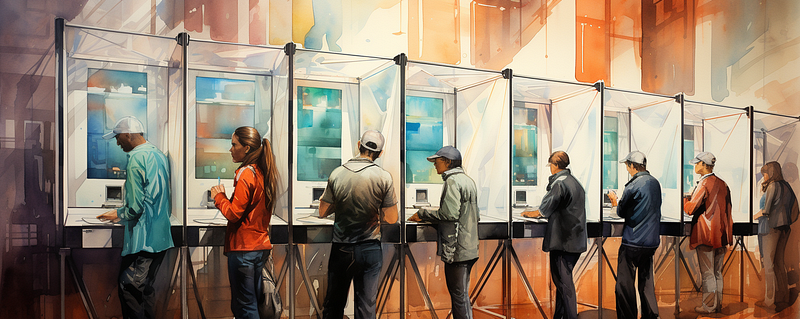
The foundation of a democracy lies in the principle that every citizen’s voice and vote should carry equal weight. With the cap on the number of representatives set nearly a century ago, this foundational principle has been eroded. As the U.S. population has grown exponentially, the number of citizens each representative serves has surged, leading to a dilution of individual voices in the national discourse.
This isn’t just a matter of numbers, it’s about the essence of representation. When a single representative is responsible for a vast number of constituents, it becomes challenging to truly understand and address the diverse needs and concerns of each individual. The result? A feeling of disconnect and disenfranchisement among the populace.
While urban/rural disparities are a notable consequence of this issue, the core problem is much broader. It’s about ensuring that every American feels heard and represented in the democratic process. Expanding the House of Representatives offers a tangible solution. By increasing the number of representatives, we can bridge the widening gap between representatives and their constituents, ensuring a more direct and meaningful connection. It’s a step towards rejuvenating our democracy and ensuring that every individual’s voice is valued as it should be.
Mathematical Projections
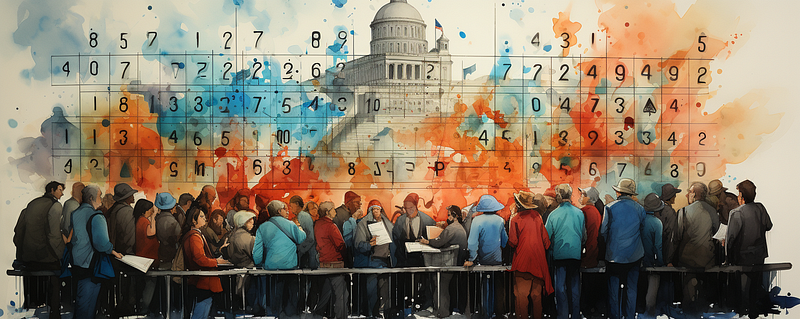
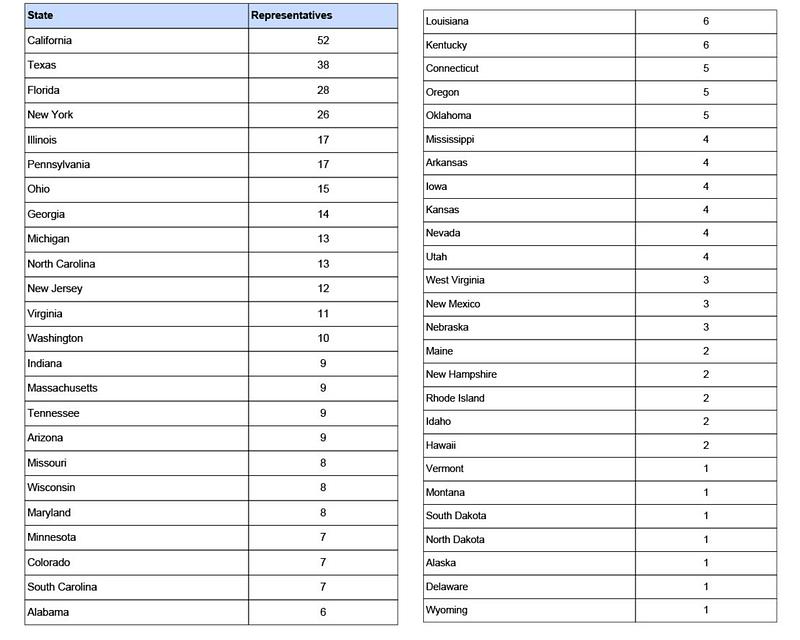
Current State of Representation: The United States, founded on the principles of democracy and representation, has seen a significant shift in the ratio of representatives to citizens over the years. As of now, each member of the House of Representatives speaks for an average of over 750,000 constituents. This vast number makes it challenging for representatives to maintain a close connection with their constituents and truly understand the diverse needs of their districts.
Proposed Representation with 1,000 House Members: The proposal to expand the House to 1,000 members is not just about numbers — it’s about enhancing the democratic essence of our nation. With this expansion, the average number of constituents per representative would decrease, allowing for a more direct and localized representation. This change would mean that representatives can focus more on the specific issues and concerns of their constituents, ensuring that every voice is heard.
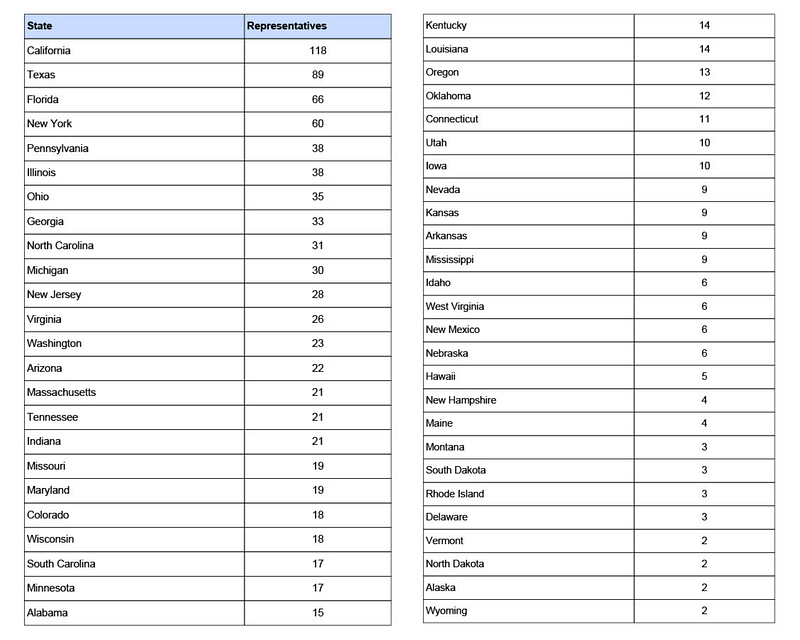
Future Distributions Every 10 Years: To ensure that our representation remains aligned with population growth and demographic shifts, a formula for future distributions is essential. This formula will serve as a guideline for adjusting the number of representatives every decade, ensuring that our democracy remains adaptive and responsive.
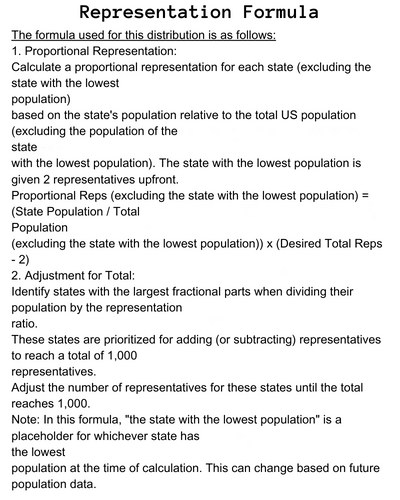
Regular adjustments based on this formula will ensure that our representation system remains current and reflective of the nation’s demographics. It’s a proactive approach to safeguarding the principles of democracy and ensuring that every citizen’s voice carries equal weight in the legislative process.
This is the equation used based on the current census that was conducted last.
Proportional Reps (excluding Wyoming)=(Total (excluding Wyoming)State Population)×(Desired Total Reps−2).
Since Wyoming had the lowest population, it sets the baseline for all other states. A full disclaimer: I’m not a mathematician, and there might be an even better way to ensure an even distribution of representatives, but this approach clearly offers less variance than the current system.

Implementation Strategies
The transformative idea of adding 565 new members to the House of Representatives is a bold step towards a more representative democracy. But with such a significant change come challenges and considerations that we must navigate.
The Capitol, a beacon of our democracy, wasn’t designed with a House of 1,000 in mind. Expanding or restructuring is inevitable, but it’s not just about the physical space. We need to ensure that the environment is conducive to debate, discussion, and decision-making for a much larger group. Beyond the physical infrastructure, we’re stepping into the digital age where modern solutions are essential. Secure voting systems, efficient communication platforms, and the right digital tools are essential. And with more representatives, we’re looking at more staff, more paperwork, and a heightened need for operational efficiency.
One significant advantage of smaller districts is that they’re harder to gerrymander. Drawing boundaries to favor one party becomes a more challenging task in compact districts. But this doesn’t mean we can be complacent. Oversight is crucial. We might need an accompanying bill that sets clear, stringent limits on gerrymandering to ensure that representation remains fair.
The task of onboarding 565 new representatives is massive and a structured transition is essential. We might even consider mentorship programs to help integrate the new members seamlessly. Change can be met with resistance. Some might feel their influence waning, while others could be skeptical of the motives. Building bipartisan support is going to be important. We also need to manage public perception, ensuring transparency and educating the public every step of the way.
New districts mean new election dynamics. We’ll need to adjust processes, redesign ballots, and revamp voter outreach strategies. And we can’t forget the budget. The financial implications of salaries, benefits, and operational costs for the new representatives and their staff will be significant and need thorough planning.
Every path to increase democracy will have its hurdles, but together it becomes easier.

America’s Constitution has stood the test of time. At its core is democracy. This once convenient idea has been fading for some time. America feels sick and needs some life breathed back into it. As we expand democracy for all, we revive the spirit of this nation, for democracy is its core. What would you do for democracy?
Thank you for reading all the way to the end! Your engagement is what makes this journey worthwhile for me, and I truly value your thoughts and opinions.
👉 Let’s Keep the Conversation Going:
- What was your biggest takeaway from this article?
- Is there a point you agree or disagree with? I’d love to hear your perspective.
- Do you have a personal experience that relates to the topic? Your stories make these discussions richer.
- Are there any questions or topics you’d like me to cover in future posts?
🙏 Your Voice Matters: By taking a moment to comment, you’re helping to elevate this conversation and make these discussions more dynamic and accessible to a broader audience.
So, let’s keep the dialogue alive and flowing! Your interaction is not just welcomed — it’s encouraged!
Thank you for being an integral part of this community. I’m eager to hear your thoughts!