
Excited about Emerging Technologies? Consider how you can reduce harmful outcomes & boost Tech for Good.
10 Ideas for Reducing the Unintended Consequences of Emerging Technologies

The appeal of ‘emerging technologies’ is undeniable. It seems like every week there’s a new gadget, app or platform released that sparks excitement about improving operations, services or products. Being an early-adopter can certainly create benefits for your organisation, but the dream of radical positive transformation quickly turns into a nightmare when there are harmful unintended consequences.
New technologies can help to future-proof organisations, but can we future-proof new technologies so they make organisations (and life) better and not worse? Can we reduce the harmful outcomes?
The first hurdle is that the risk of unintended consequences increases along with the ‘newness’ of a technology. By nature, emerging technologies — or EmTechs — haven’t been around for very long or haven’t been used for every specific purpose. The potential for a great outcome can be very high but they are essentially untested; the full spectrum of consequences is unknown.
To add to the challenge of using EmTechs, the consequences of implementation now spread further at a faster rate than ever before. A decision to use an EmTech can impact more people and systems in less time (e.g. environmental, economic, political, social systems). This rapid spread of impact is in no small part due to advances in digitisation and connectivity technologies. The luxury of time for experimentation and trial-and-error, or adopting a wait-and-see strategy is no longer viable. Instead, it’s imperative to ‘get it right the first time’.
How can we steer towards the best possible outcomes from using EmTechs and away from undesirable consequences? I’ve put together 10 ideas for decision-makers to ponder, tweak and build on as they consider integrating EmTechs into operations and products.
But first, what are ‘emerging technologies’?
EmTechs are technologies which rise from relative obscurity and offer us more efficient or completely new ways to get things done. They feature five attributes described by Rotolo, Hicks and Martin: (i) radical novelty, (ii) relatively fast growth, (iii) coherence, (iv) prominent impact, and (v) uncertainty and ambiguity.
EmTechs seem to appear overnight, however, the early development stage can be lengthy. It’s not until an ‘innovation trigger’ is pulled that interest, development and application skyrocket; often resulting in substantial disruption to traditional thinking and activities. Gartner’s Hype Cycle provides a neat description of the phases EmTechs commonly pass through.
There are simply too many EmTechs and applications to mention here, my Google search this morning for “list of emerging technologies 2020” yielded 289 million results. By way of introduction, I’ve created the figure below to summarise the areas today’s EmTechs generally fall into.
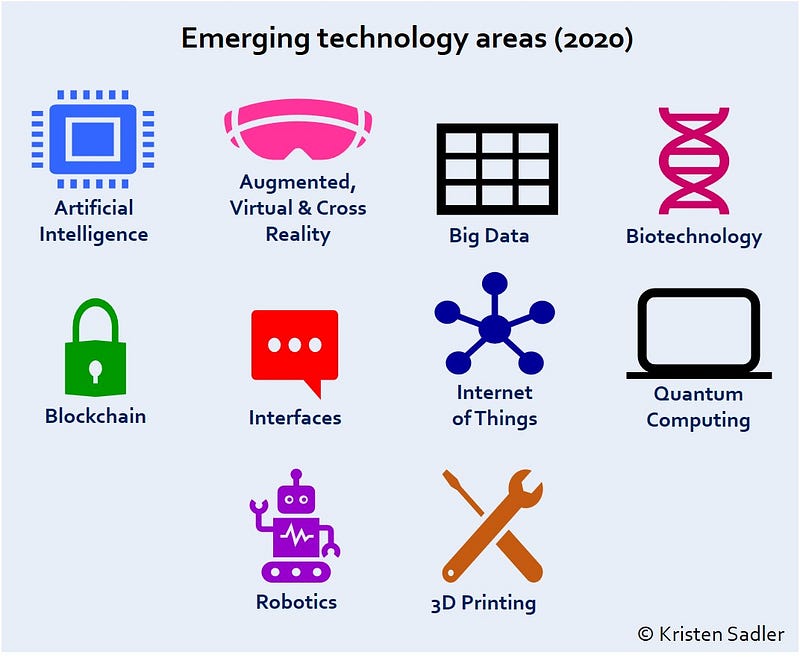
Artificial intelligence. AI is expected to exceed and augment human intellect, it includes machine learning and deep learning.
Augmented, virtual and cross reality. AR, VR and XR systems are becoming lighter and more mobile. They are proving useful for personnel training in simulated conditions.
Big data. An umbrella term for the huge amounts of info we are generating and utilising via Data Science. Data is becoming a new currency and there’s potential for personal ownership.
Biotechnology. Includes digital biology, genetic engineering and synthetic biology.
Blockchain. Electronic distributed ledger technology touted as providing an incorruptible transaction record.
Interfaces. Screens are the dominant interface today. There’s movement towards zero user interface with touch, gesture and voice control in development plus brain-computer interfaces.
Internet of Things. The combination of sensors and transmitters in objects that connect, collect, track and interact.
Quantum computing. Uses qubits which exist as 1 and 0 simultaneously to exponentially increase computing power. Google’s Sycamore recently completed a calculation in 200 seconds which would take supercomputers 10,000 years.
Robotics. Robots are automating a multitude of activities and replacing humans for dull, dirty or dangerous tasks.
3D printing. Development of software, printers and materials is revolutionising fabrication and advanced manufacturing for everything from pizza to rocket engines.
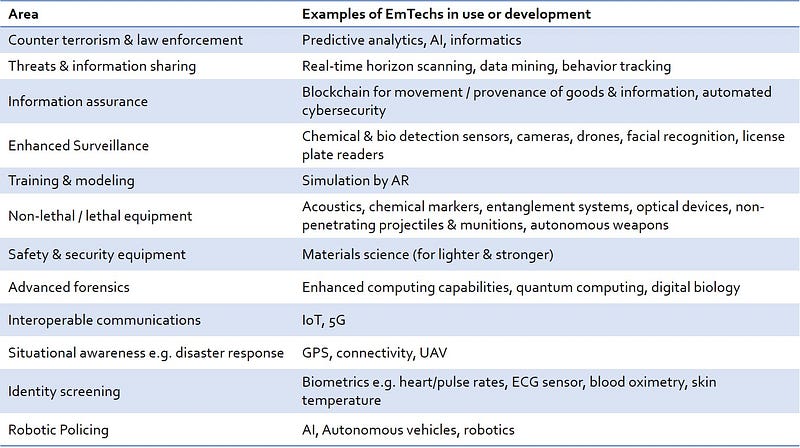
EmTechs are being applied across industries (e.g. MedTech, FoodTech, FinTech, EdTech) and developed for a range of functions (e.g. manufacturing, accounting, human resources, driving). Some of the most discussed uses are in the security industry where EmTechs such as biometric sensors, autonomous weapons and facial recognition are being explored. The table below outlines examples of EmTechs impacting the security industry (adapted from C. Brooks, Emerging Tech Impacting the Security Industry).
The rate of development, growth and impact of EmTechs are each often described as ‘exponential’. Indeed, if we look at the time taken for a personal digital entertainment product to reach 50 million users we see that computers took 14 years, the internet 7 years, Facebook 3 years and Pokemon Go just 19 days. The technologies themselves are being developed faster, there is a network effect, and convergence is occurring. For example, EmTechs from biotechnology, big data, robotics and 3D printing may converge to create tiny bots that can circulate inside our bodies to detect, report and treat disease.
What could possibly go wrong if I decide to use emerging technology in my business?
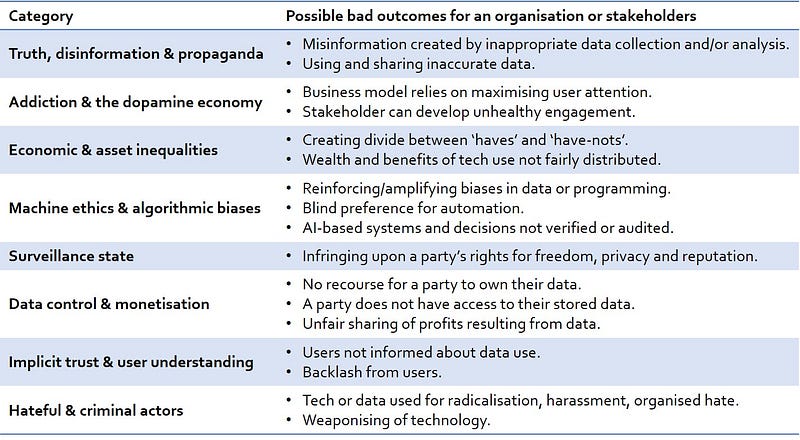
EmTechs disrupt traditional thinking and activities. They provide new solutions for old problems and can stimulate previously unimaginable positive change for organisations, communities and individuals. Sometimes, however, despite our good intentions there can be circumstances that result in a bad or harmful outcome. The types of harmful outcomes that could result from the use of EmTech are distributed within the 8 categories shown in the table below (adapted from the EthicalOS Toolkit).
To steer towards the best possible outcomes and away from undesirable consequences, here are 10 ideas for decision-makers to ponder, tweak and build on as they consider integrating EmTechs into operations and products.
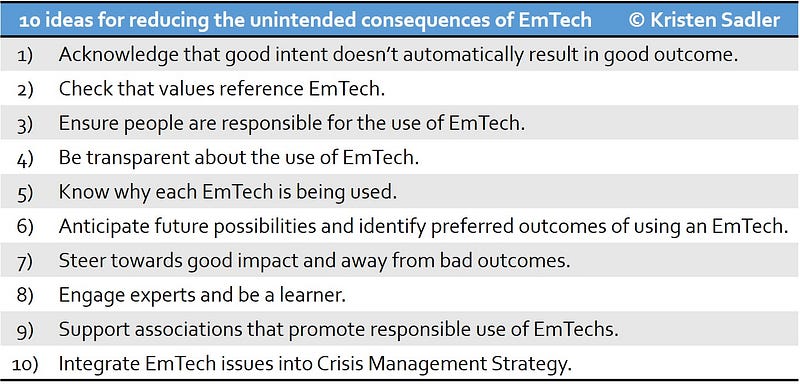
1) Acknowledge that good intent doesn’t automatically result in a good outcome.
At the outset, acknowledge that the potential for unintended consequences of technology (UCoT) exists. Only then can possible UCoT be envisioned, discussed and strategy implemented to steer away from unintended harm. To illustrate the potential consequences of utilising EmTech I created the ‘EmTech Intent and Outcome Model’ shown below.
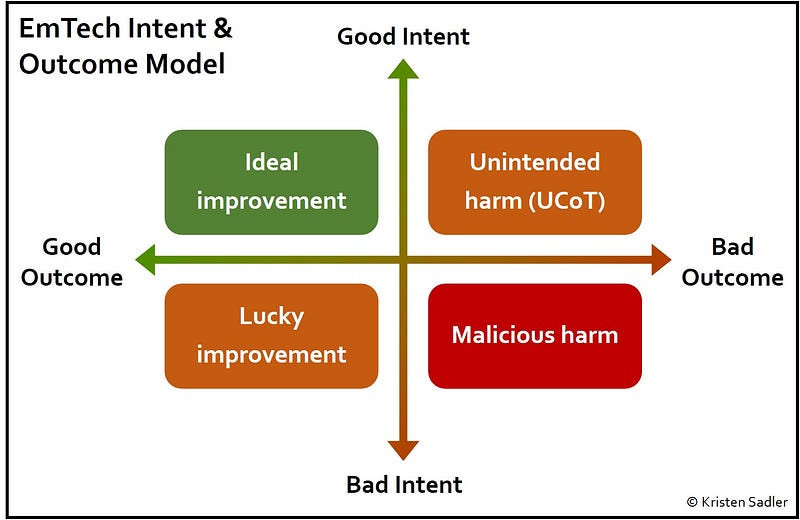
On the vertical axis is ‘intent’ which can range from good to bad. Most of us sit in the upper half; we have good intentions and aim for a better future for all as articulated by the UN Sustainable Development Goals and the Society 5.0 concept. Those with bad intent who wish to cause harm sit in the lower half. The horizontal axis represents ‘outcome’, also spanning from good (beneficial) to bad (harmful).
When there is good intent actualised as a good outcome, this is an ideal improvement. On the other hand, when there is good intent but a bad outcome for an individual or group then this result is unintended harm. For example, if a social media platform established with the ambition of strengthening communities and social interactions is in reality used for harassment and division. The occurrence of unintended harm isn’t a new issue however the impact is faster and more widespread in this digital and connected era.
2) Check that values reference EmTech.
Reference to personal and organisational values is a fundamental part of any decision-making process, and deciding on the use of EmTech is no exception.
Revisit your personal values to clarify what you stand for and who you aspire to be in this rapidly changing EmTech landscape. Assess how your personal values align with your organisation’s values with regard to EmTech. If there is significant difference, consider whether the difference(s) are manageable for maintaining and reaching both personal and professional goals.
If you’re in a position to do so, lead a revision of organisational values to ensure they reference EmTech use and consider establishing a Responsible Use of Technology policy that reflects the values. If you’re not in a position to initiate a review, propose it to the relevant team and volunteer to be involved.
3) Ensure people are responsible for the use of EmTech.
The decisions about which technologies are to be used must rest firmly with people.
The risk of UCoT increases when the responsibility for the use of Emtechs is unclear or outsourced. When a technology is available there should be discussion and decision about its use and clear responsibility for that process. Install a robust human ‘chain of command’ for EmTech use in your organisation. The people in the positions of responsibility must also understand the capabilities and limitations of the technology they are examining.
Secondly, outsourcing decision-making invites risk. External parties should be consulted and information collected from a variety of sources, however, the decision for your organisation should be made within your organisation to ensure alignment with values, strategy and goals and accountability.
How about asking an AI to make a decision about the use of EmTech in your business? Progress in AI and IA (intelligence augmentation, the blending of human and artificial intelligence) has been phenomenal. However, a system which can make contextual decisions about matters that significantly impact people is not yet available. For now, it may be true to say “a robot replaced ten human workers”, however, it’s more accurate to say “the CEO decided to automate tasks and sack ten employees”. Similarly, it may be true to say “a drone dropped a weapon that killed 20 people”, but it’s more accurate to say “the commander approved the use of an armed drone to kill 20 people”. Technology is enabling and assistive, and humans are still the decision-makers. It’s time though to initiate conversations about what decisions we want machines to make and how we want them to make decisions.
4) Be transparent about the use of EmTech.
Unintended consequences can eventuate when stakeholders are taken by surprise, whether it be employees shocked by the implementation of a technology to perform tasks, or customers hit with a new personal data privacy policy. Being transparent about your organisation’s approach to the use EmTech gives stakeholders the opportunity to make informed decisions about their involvement with your organisation. Communicate the values, policies and strategy related to EmTech in a timely and appropriate manner so others know what the organisation stands for and what to expect.
This is particularly vital for employees who must plan for changes to their tasks and jobs as a consequence of the increased use of EmTech. Leaders should be as open as possible about where the onus lies for employee upskilling and retraining (i.e. with the employer, employee or another party). A study by Joseph Fuller et al found that employers somewhat underestimate the importance of this area. Interestingly, the study also found that workers are more positive about the possibilities of technology than managers might think.
“The conventional wisdom [amongst employers], of course, is that workers fear that technology will make their jobs obsolete. But our survey revealed that to be a misconception. A majority of the workers felt that advances such as automation and artificial intelligence would have a positive impact on their future.” — Fuller et al.
Establishing a dialogue between managers and employees about EmTech will further both the communication of the organisation’s approach to EmTech and the management’s understanding of the real perspectives and concerns of employees. This can help to reduce uncertainty all round, so too can these tips on how to talk to your team when the future is uncertain.
5) Know why each EmTech is being used.
It can be tempting to adopt an EmTech as an experiment and “see what happens”, however, this can incur significant risk to stakeholders and the organisation. An alternative is to know in advance, and in as much detail as possible, what needs to be achieved using a specific EmTech.
EmTechs should be viewed as tools that can be used to help your organisation reach goals. The process can then follow either of two paths. On the first path, an existing goal is selected and then a search performed for EmTechs that can help reach that goal. For example, the goal may be to implement personalised online skills training for employees. Then a tool that can perform that task is sought — a program which assesses individual skill levels and then matches people with online courses. On the second path, you hear about an exciting new EmTech and then wish to explore if it can be applied in your business to reach a goal. But remember, just because you can doesn’t mean you should. In both cases, the EmTech tool must fuel measurable progress toward a goal and there must be metrics in place to assess its utility.
If there is no clear purpose or goal for using an EmTech then setting metrics is challenging, resources can be drained, and recognising the early signs of bad outcomes is harder which leads to a greater risk of UCoT.
6) Anticipate future possibilities and identify preferred outcomes of using an EmTech.
Before implementing an EmTech it’s worthwhile undertaking a Futures Thinking exercise to envision the possible outcomes. (Exercises can be performed to visualise outcomes for EmTech already in use too.) The purpose is to generate information that can be used during decision-making — what EmTech to use, or what not to use, or the right time to use it. When we know the possibilities, we reduce the chances of being caught by surprise, of being unprepared and of being overwhelmed.
The futures thinking exercise would typically involve collecting signals that hint at possible outcomes, unearthing trends and drivers that may influence outcomes, and creating a spectrum of scenarios that could arise. From that spectrum of possibilities — spanning from ideal to undesirable, and from highly likely to near impossible — the most probable and preferable can be identified.
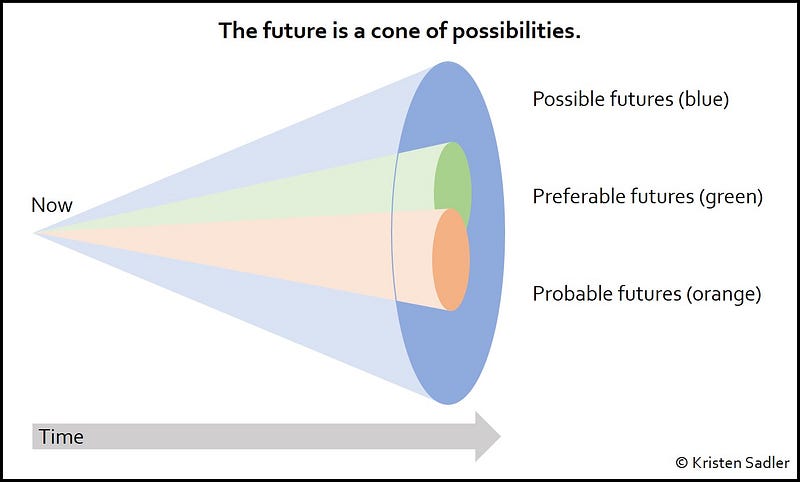
Imagine that an idea is floated to implement a technology that replaces all human-to-human interactions with human-machine interactions in your organisation. Before giving approval, you engage a small team to perform a futures thinking exercise and sketch out possible outcomes. They conclude that 95% of the envisioned outcomes will have a profoundly negative impact (on whatever parameters are set). On the basis of this information alone, a decision could be made about the use of the technology.
Thinking about the future is challenging though for (at least) four reasons. Firstly, no data exists for the future so we must rely on our creativity and imagination and reference to past experience. Secondly, we’re used to a local perspective and must stretch to think in a global sense, beyond self and immediate environment, because the impact of our decisions now reaches further in less time. Next, we’re also more comfortable with imagining events in the future happening at the same linear rate as in the past, whereas the rate of change is increasing exponentially. The fourth reason why thinking about the future is challenging is because of more ‘leapfrogging’ over concepts and implementation steps. In the latest news, Loon is now providing internet access to some users for the first time using stratospheric balloons, leapfrogging terrestrial and space-based technologies.
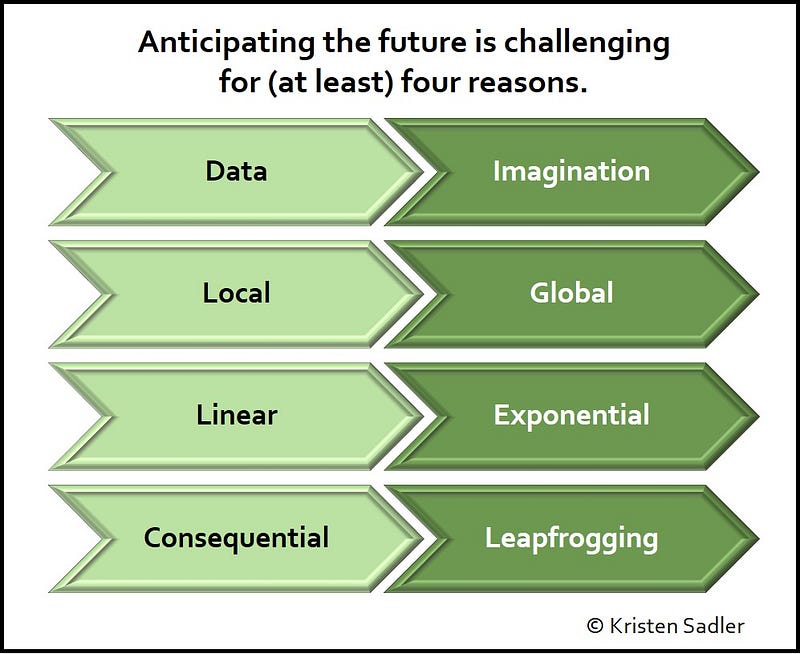
Fortunately, our futures thinking skills can be improved with practice and everyone can contribute with their unique experience and perspective. To start, one must be comfortable with ambiguity, be open-minded, observe the world beyond personal interests, and practice thinking in different timeframes.
Futures thinking exercises can also be utilized to scan the horizon for EmTechs. Detecting technologies in their earliest phases of development or application may help position an organization to avoid the shocks of the unknown, be prepared, an early adopter or even a leading disrupter.
7) Steer towards good impact and away from bad outcomes.
The imagining of possible, probable and preferable futures allows decisions, preparation and planning. It also allows for proactive steering towards preferred futures and away from undesirable paths. Just as values without strategy are rather inconsequential, so too are scenarios ineffective without action.
The possible scenarios which could occur from using an EmTech must be assessed and preferable paths determined (and those to be avoided) based on organisational factors such as values, mission or resources. The definitions of good and bad outcomes can vary so decision-makers should seek broad input and perspective. When the desired path has been identified then the team can proceed to develop strategy and actions to nudge towards the preferred outcome and avoid unwanted results. Indicators must be devised to track progress and monitoring put in place.
UCoT can appear out of nowhere if we don’t anticipate the bad along with the good, constantly monitor and iterate plans.
8) Engage experts and be a learner.
The Information Age and Fourth Industrial Revolution are combining to create a veritable data explosion and unprecedented opportunities to innovate faster with deeper and broader impact. Leadership teams are required to collate, comprehend and act on larger and more diverse information sets at an increasing rate. What’s more, we are also advancing our understanding of individual limitations and biases and the value of diversity and inclusion. Taking all these factors into account, there’s a risk to quality and sustainability if organisations disproportionately emphasise input from a single source or individual.
Whilst responsibility and accountability for decisions may lie with a relatively small leadership team, it’s imperative for that group to source accurate, relevant and timely information and critical thinking to assess EmTech use. Consider establishing an EmTech Advisory Group as an information source and think tank. Topics covered by the Advisory could include technical developments, possible applications, internal and external policy, regulation and ethics. The group could complement and contribute to futures thinking, strategic planning, and monitoring of EmTech implementation. The membership should be organisation-wide and deep, diverse and inclusive. The differing perspectives will aid in identifying the most appropriate EmTech for your organisation and the range of potential impacts on stakeholders.
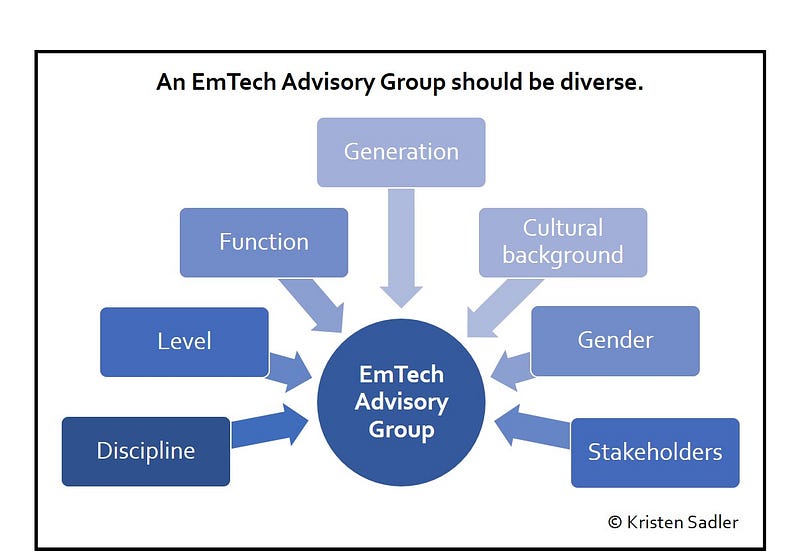
Access to expertise on the impact of technology on society is particularly crucial. If this expertise does not exist within your organisation then seek input from, or even a partnership with, professionals focusing on Tech in Society. There are a growing number of public and private centres with this expertise, some examples are shown below. Connecting with university professors directly is another option (e.g. pointers for finding professors for your expert network and ways to find out who’s doing what on campus).
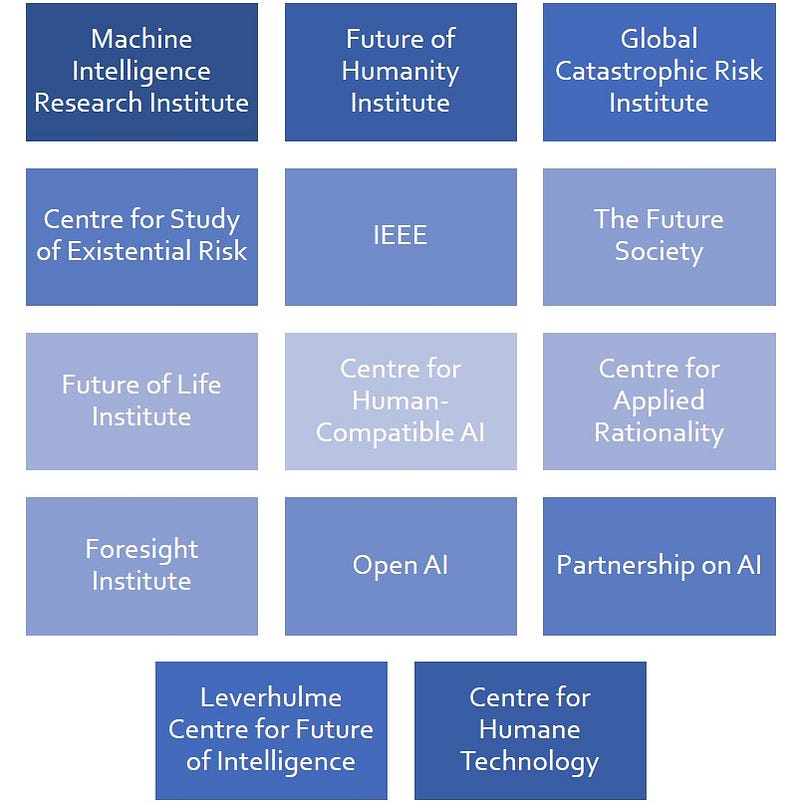
On a related note, there’s a need for more independent professionals who specialise in the application of EmTech in specific industries. Explore how your organisation can support training, curriculum development, accreditation and certification for Emtech professionals in your industry, perhaps in conjunction with a vocational training institute, university or industry association.
Having ‘tech experts’ on hand should be a part of any leader’s EmTech strategy. It may be beyond the capabilities of the CEO and executive team to comprehend the intimate details of a technology (how it works, what it does), in which case having access to people who do is imperative. Again, relying on one ‘tech expert’ can elevate the risk of UCoT, especially considering the points raised recently in Wired on there being “no such thing as a tech expert anymore”.
To boost your own knowledge about EmTechs and UCoT be an active learner. Collect information. Interact with people who have different backgrounds, experiences and perspectives. There’s a constant stream of EmTech information from the R&D community and media platforms (e.g. TechRepublic, Wikipedia, Scientific American), from consultancies (e.g. PwC, Deloitte), through online learning channels and conferences (e.g. EmTech by MIT Tech Review). The UCOT community is a network of individuals and groups focusing on unintended consequences of technology with a conference (here’s an article about the 2018 conference) and other activities.
9) Support associations that promote the responsible use of EmTechs.
Businesses don’t operate in a bubble and even if your organisation is a beacon of success in the adoption of EmTechs the actions of other parties can result in UCoT with widespread damage.
If one doesn’t already exist, lead the establishment of an association for the responsible use of EmTech in your industry, sector or region. It could encompass and interact with other organisations (for-profit, for-purpose), education and training institutes, industry associations, government agencies, legislators and regulators. The Partnership on AI exemplifies this concept. Organisations have come together to support best practices, enhance public understanding and create a platform for discussion and engagement about AI. The board has representatives from Microsoft, IBM, Google, Apple, Facebook, DeepMind and Amazon.
Be part of the conversation.
10) Integrate EmTech issues into Crisis Management Strategy.
Steering away from potential UCoT and towards ideal outcomes is an excellent strategy for managing matters within your control. But due diligence must also be applied to prepare for possible negative outcomes, even those with the slimmest probability. If your company purchased a fleet of autonomous vehicles that recorded a fatality rate of one per hundred million miles, should resources be allocated to prepare for that remote possibility? It’s an exercise in risk appetite.
Before a UCoT incident: Minimise surprise and prepare for UCoT by including the possible undesirable outcomes of EmTech use into the Crisis Management Strategy and table-top exercises. We can learn lessons from the immune system about thinking the unthinkable, planning for anything and not ignoring the small signals.
During a UCoT incident: When a UCoT crisis hits, as in any critical incident, action your values, work to limit harm, resolve acute situations and stabilise the situation.
After a UCoT incident: When the incident has been contained conduct an investigation to determine what happened and how to prevent repeat or similar occurrences. Use of an EmTech could lead to a UCoT for a range of reasons such as those outlined below.
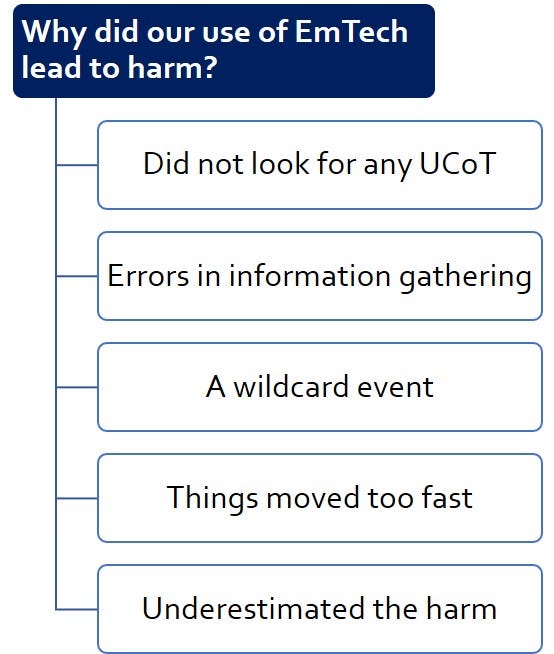
Did not look for any UCoT. No exercises were performed to identify and communicate possible negative outcomes and their early warning signs. It wasn’t a problem until it was.
Errors in information gathering. An attempt was made to foresee and avoid negative outcomes, but the information and/or process was flawed. This particular event was not prepared for, or the appropriate expertise was lacking, or there was a need for more creativity and expansive mindsets.
A wildcard event. Something unimaginable occurred which could not be detected in advance due to its novelty and/or complexity. Some argue that this is not a valid reason, that all possibilities can be foreseen in some form.
Things moved too fast. The incident was considered possible and even probable, yet events moved faster than expected. Plans didn’t account for the accelerating pace of impact and the subsequent requisite ramping up of response.
Underestimated the harm. The extent of the harm that could be caused by a UCoT was underestimated. Perhaps a decision was made to implement an EmTech without fully understanding the potential impact on all stakeholders, or overestimating the capacity to manage such an incident.
May the odds be ever in your favour
Today’s collection of emerging technologies has the potential to create a better future for all within a short period of time — if applied with good intent and if good outcomes are realised. However, they also pose dangers or even existential risk in the hands of bad actors, or in the hands of good actors who inadvertently trigger unintended harmful outcomes (UCoT).
Swaying the odds in favour of good over bad outcomes requires a systematic embedded permanent on-going commitment by organisations, individuals and industries alike. The use of each new emerging technology and the spectrum of possible outcomes must be rigorously examined before application in order to minimise the chance of unintended consequences. To create awareness about UCoT and add to the discussion, here I presented ten ideas for reducing the risk of UCoT and summarise them in the below table.
What tech are you most excited about using? What are the pros and cons? How will you increase the likelihood of a great outcome and reduce the chance of UCoT?
Kristen Sadler PhD is an independent advisor, speaker and author. She uses futures thinking and strategic foresight to explore possible, probable and preferable futures and how to take action today to shape tomorrow.


