
PhD graduates bring critical thinking to the CEO’s expert network
To navigate the challenges of the data-rich Information Age, the CEO and executive team require access to increasingly sophisticated critical thinking skills. University professors and Post-Ac members are professional critical thinkers and offer enormous value to the CEO’s expert network.

The sheer volume and variety of data available to today’s executive team is mind-boggling and continues to grow. It’s estimated that 463 exabytes of data will be created daily by 2025, that’s 463 billion gigabytes per day. This Information Age data explosion is creating new opportunities for leadership teams to innovate and have a faster, deeper and broader impact.
Having access to more data is a key enabler, but to have real value the data must be converted into useful information that the executive team can confidently utilise during strategic decision-making. That is, the disparate unstructured sets of data points and signals must be logically translated and organised into contextual comprehensive materials. In fact, a recent study suggests sophisticated information processing was key for societal development as far back as the Neolithic period.
As the amount of data grows, so does the need for critical thinking
Increases in the amount and range of data don’t automatically result in increases in quality information, though, because not all data is credible and relevant. As the data volume increases, so too does the need for critical thinking to identify and evaluate appropriate data sets for a specific purpose. Poor quality data and/or analysis is a recipe for producing incorrect and unsuitable information which can in turn waste time and resources, stifle progress and even create harmful outcomes.
Similarly, the decisions about how and what information is used during strategic planning also rely on critical thinking. Selecting material to be included in discussions or prioritising one piece of information over another, requires high-level reasoning and reflection. In today’s Exponential Era — a time of accelerated change — the margins of error for strategic planning are rapidly shrinking. The consequences of decisions occur faster and reach further, errors are amplified quicker and unintended negative outcomes can spread like uncontrolled wildfire with rapid deleterious effects on stakeholders and the organisation itself.
Therefore, whilst blessed with an abundance of data and potential for unprecedented impact, the CEO and executive team are challenged with ensuring that: appropriate data is collected from a multi-modal environment; translation of data into information is rational and logical; and that strategic planning is informed by fit-for-purpose materials, processes and thinking.
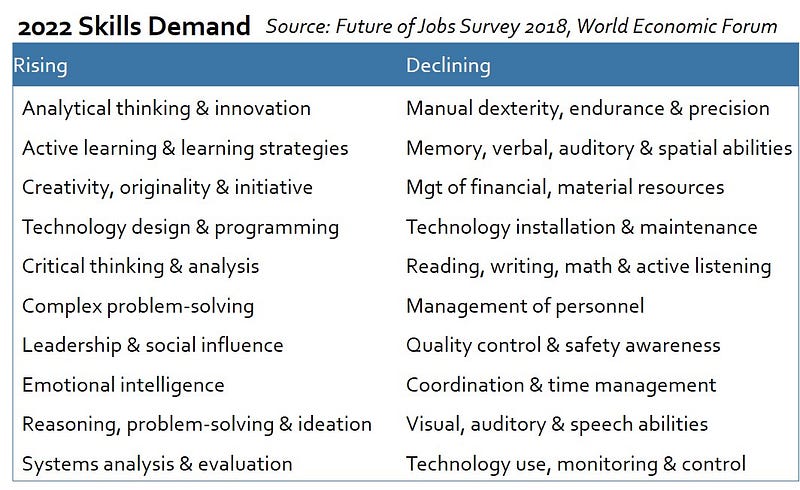
This rising demand for critical thinking and related skillsets is reflected in the WEF 2018 Future of Jobs Report.
Critical thinking is rational, open-minded and informed by evidence
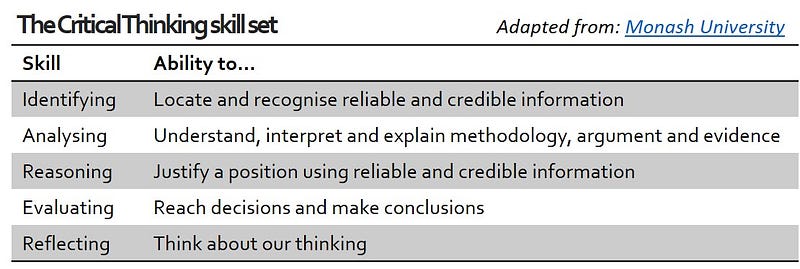
The definitions of ‘critical thinking’ are many and varied, and exploration of the discipline could well take a lifetime. For the purposes of this conversation, critical thinking is defined as ‘disciplined thinking that is clear, rational, open-minded, and informed by evidence’. The skills which critical thinkers use are divided into the five categories of identifying, analysing, reasoning, evaluating and reflecting, and the associated abilities are summarised in the table below. For those interested in further details, the Foundation for Critical Thinking is an excellent resource.
Embedding the skills internally and in the expert network
With the demand for critical thinking rising, it is timely to assess and (if need be) develop the individual and collective skills of the executive team. The skills can be enhanced with training and practice, and a higher level of competency reached by members with time and capacity for the task. Alternatively, new people with better critical thinking skills can be recruited; adding to or replacing existing executive members. Either way, when there is more individual and collective critical thinking, existing methods and timelines will be disrupted. However, the resulting processes and decisions will be more reliable and robust.
The executive team must also include professional critical thinkers in their expert network. Creating an expert network allows access to thinking and perspectives which aren’t available internally. The network can range from an informal group of mentors, advisors and service providers to a formal advisory board. Whatever the structure, an independent expert critical thinker should be engaged as a ‘sounding board’ or discussion partner for ideation and intellectual processes, and/or provide insight on data collection, information management and strategic planning.
Do professional critical thinkers exist?
The questions which then arise are: do professional critical thinkers exist and are their skills transferable to our specific circumstances? It so happens that there are people trained in critical thinking who apply their skills virtually every day of their professional lives: university professors.
Professors are perhaps best known for their world-leading content knowledge and achievements in a chosen field of research. What’s often forgotten is that each professor has spent years practising, teaching and mastering their unique critical thinking skills. Whilst the spectrum of specialisations is indeed vast across the professoriate, the principles and methods of empirical research are grounded in critical thinking, as illustrated below.
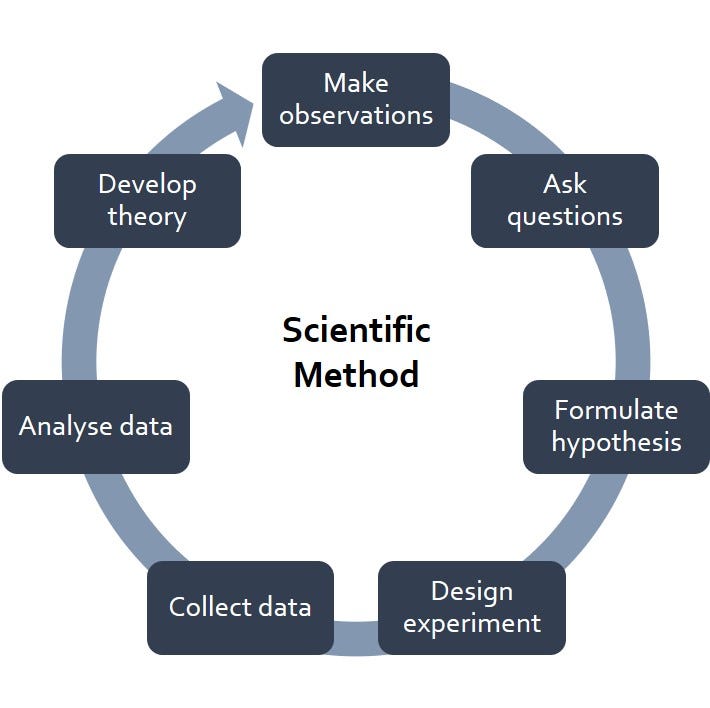
During the course of a single experiment, a professor observes a problem or phenomenon, then hypothesizes, determines the modes for data collection, analyses data, draws conclusions and critiques knowledge as new information comes to light. They use a similar process when planning research projects that span months and years. The professor also applies critical thinking to the work of peers when evaluating journal submissions, grant applications and published work. If indeed “we are what we repeatedly do”, then professors are arguably professional critical thinkers.
Of course, there are expert critical thinkers outside the professoriate — some with formal training through PhD programmes, and others who hone their skills with self-directed learning. The post-academic (Post-Ac or Alt-Ac) community is another rich source of expert critical thinkers. Typically PhD graduates with varying postdoctoral experience, Post-Ac members choose careers beyond the professorial track and are valued across the public and private spheres for their transferable critical thinking skills. They demonstrate that these skills can be applied in different contexts and my own experience serves as a prime example. After completing a PhD in biomedical research then two research fellowships and an Assistant Professor appointment, I chose a non-professorial path. I utilise critical thinking to support executive-level activities in a variety of sectors — I’m not restricted to the bioscience ecosystem.
Being a technical subject matter expert is not essential for effective critical thinking, however, gaining an understanding of the content and issues at hand is vital for making valuable contributions. Just as other experts apply their professional skills (e.g. in risk management, people and culture, or legal), so too can the critical thinker innovate the application of their specialised skill set.
Professors bring more than their critical thinking skills.
Professors and PhD graduates bring additional competencies to the expert network.
Technical expertise. Perhaps the most obvious extra value is technical expertise. An organisation may gain dual benefit by engaging someone with both technical know-how and critical thinking skills. For example, a company developing online games could engage a sociologist specialising in the impact of gaming on society who can also advise on data analysis methods for strategic planning. A technical expert from academia can offer insight into emerging R&D and contribute to horizon-scanning using their knowledge of global research and prominent work in the field.
A different perspective. A career-professor typically works in sectors and organisations which are different from those of a career-CEO. Hence the professor has experience in different work environments and organisational cultures. They can offer an alternative view and approach to commercial sector issues based on their diverse experience, knowledge set and mode of thinking. Opportunity can spring from difference.
Board experience. Governance and advisory boards are embedded in the university research organisational structure. They are routine components of the research framework, particularly for multifaceted programmes which encompass several project streams and/or stakeholders. Thus, professors conducting research are familiar with the principles and roles of governance and advisory boards through reporting or membership.
Professional competencies. Professors can bring a range of professional competencies due to their experience in research, teaching and service to the professional community. Career academics are often proficient and practised in collaboration, resilience, intellectual humility, intercultural competency and lifelong learning.
Appreciation of project management. When a professor leads a research project, they are ultimately responsible for all decisions on strategy, implementation, people and culture, resources, milestones, budget and reporting. They can, therefore, appreciate the details and limitations inherent in time and resource management.
Complexity doesn’t have to be complicated
As data volumes grow and rate of change accelerates, the generation and use of information are becoming more complex. But managing data and strategy don’t need to become more complicated. Embedding critical thinking within the executive team and having access to professional critical thinkers within the expert network will provide valuable additions to the leadership’s intellectual resources. The team who invests in intellectual resources will be well-positioned to: understand what’s happening and why; anticipate probable and preferable futures; make informed decisions; and develop strategies to prepare for and/or shape what’s to come.
If the university environment and Post-Ac community is a little unfamiliar, I’ve put together another article with 11 pointers for finding professional critical thinkers for your expert network.
Kristen Sadler, PhD is an independent advisor, speaker and author. She uses futures thinking and strategic foresight to explore possible, probable and preferable futures and how to take action today to shape tomorrow.